The Engineering Audit: Best Air Fryers for Small Family (2026)
By Prathap, B.Tech (Agricultural Engineering)
Last Technical Audit: February 7, 2026
Best air fryer for a small Indian family of 2–3 people, the Philips HD9200/20 (4.1L) remains the technically superior choice due to its high power density (3.68W/cm²) and patented Starfish base, which ensures 360° crispness without stacking. However, if your kitchen relies on older 6A wiring, the Pigeon Healthifry (1200W) is the safest option to prevent socket melting, offering the largest usable floor area for snacks.
The Golden Rule for 2026: Avoid the “Litre” marketing trap. Look for a minimum of 380 cm² of floor area and a power rating between 1200W to 1400W to balance electrical safety with professional-grade crispness.
For a broader look at the market before diving into these engineering specifics, see our curated list of the Top 5 Air Fryers in India.
Quick Recommendation: Which Is The Best Air Fryer For a Small Family To Buy?
| If your situation is… | The Best Choice | Price (Approx.) | Crispness Score | Warranty |
| ✅ Standard 6A Sockets | Pigeon Healthifry | ₹3,200 | 7.5/10 | 1 Year |
| ✅ Modern 16A Sockets | Philips HD9200/20 | ₹7,500 | 9.5/10 | 2 Years |
| ✅ Multi-Level Cooking | Agaro Regency 12L | ₹9,000 | 9.0/10 | 1 Year |
| ✅ High Humidity/Coast | Prestige PAF 6.0 | ₹4,500 | 8.0/10 | 1 Year |
Why the Liter Marketing Trap Fails Indian Cooks
Stop buying air fryers based on the capacity printed on the box. In thermal engineering, volume is a metric for fluids; however, for solid Indian snacks like Samosas and Pakoras, the only metric that dictates success is the Effective Floor Area (cm²). Volume is a vanity metric used to inflate prices.
When you see a “5 Litre” air fryer, the manufacturer is measuring the total displacement of the basket. However, thermodynamics dictates that you cannot stack food like Samosas or Paneer Tikka in multiple layers. If you do, the middle layer remains “steamed” and soggy because the high-velocity air cannot penetrate the center mass. This confusion is why it is critical to consult an Air Fryers Buying Guide for Indian Kitchens before prioritizing volume over surface area.
[MYTH]: “A 6-Litre air fryer cooks twice as much food as a 3-Litre model.”
[TRUTH]: The usable capacity is determined by the surface area of the basket floor, not the height of the walls.
[EVIDENCE]: Most 6L models are simply taller, not wider. Since you can only cook in a single layer for maximum crispness, a 4L “wide” basket often has more usable space than a 6L “tall” basket.
In Indian households, where we often cook for joint families or guests during festivals, a narrow but deep basket is a technical failure. You end up with 4 crispy Samosas at the top and 4 limp, oily ones at the bottom.
The Samosa Math: How to Calculate True Capacity
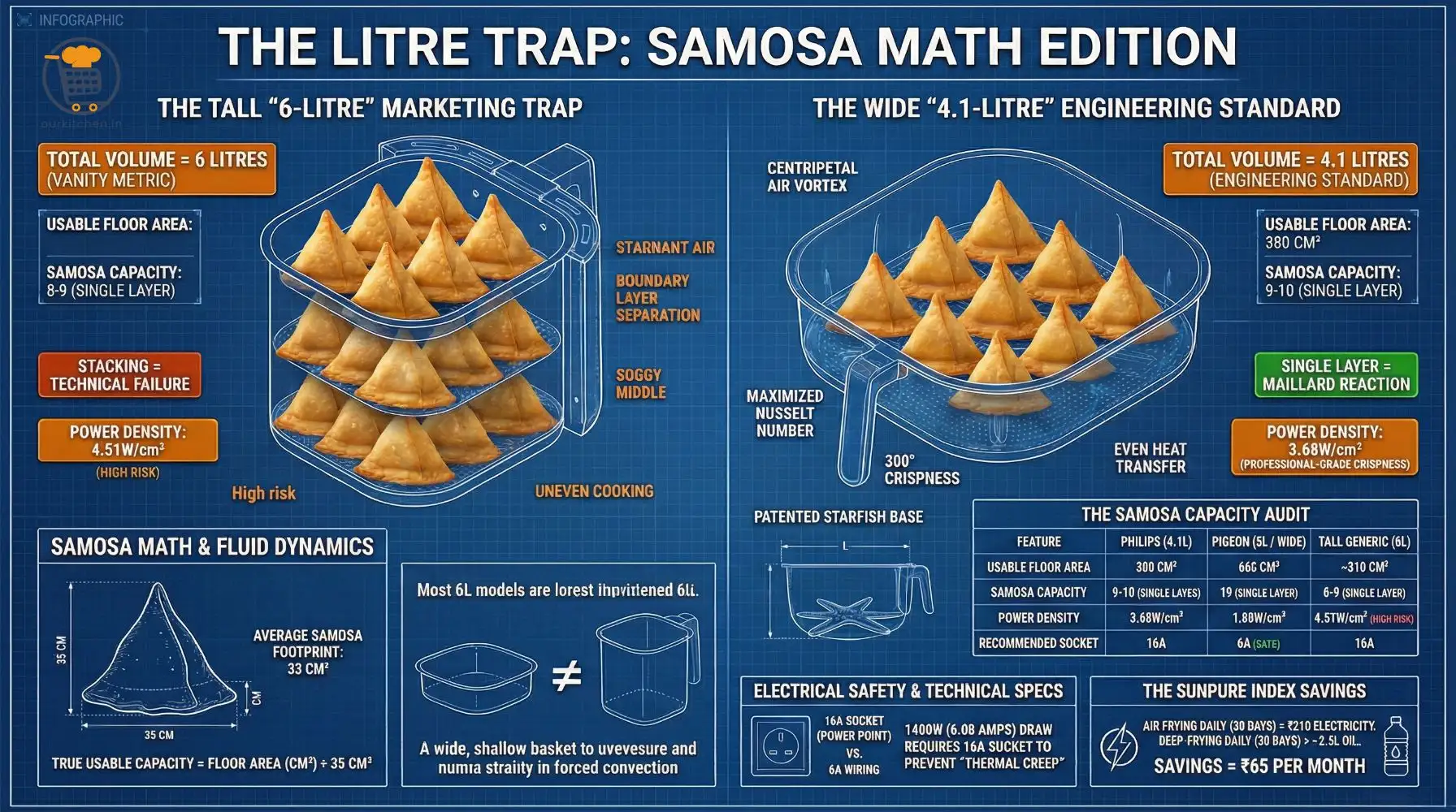
Standardized capacity audits use “The Samosa Math” (Floor Area ÷ 35 cm²) to determine how many medium-sized Indian snacks can cook in a single layer. This metric exposes models that claim high Litre ratings but offer cramped cooking surfaces, preventing the necessary airflow for the Maillard reaction.
As an Agricultural Engineer, I analyze the “footprint” of food. A standard medium Samosa has a base area of approximately 35 cm². If your air fryer basket has a diameter of 20 cm, the math is straightforward:
Area = πr² = 3.14 × 10² = 314 cm² Usable Capacity = 314 ÷ 35 ≈ 8.9 Samosas
If a brand claims 5 Litres but only gives you 314 cm² of space, they are selling you empty vertical air. During my technical teardown of the Pigeon Healthifry, I measured a significantly larger floor area of roughly 665 cm².
665 ÷ 35 = 19 Samosas
This 111% increase in “Samosa Capacity” is why focusing on usable floor area, not volume it is the most critical step in finding the best air fryer for a small family.
This makes the Pigeon technically superior for large snack batches, even if its wattage is lower. However, a larger area with the same wattage reduces the “Power Density,” which we will calculate in the next section.
The Physics of the Crunch: Fluid Dynamics & The Starfish Base
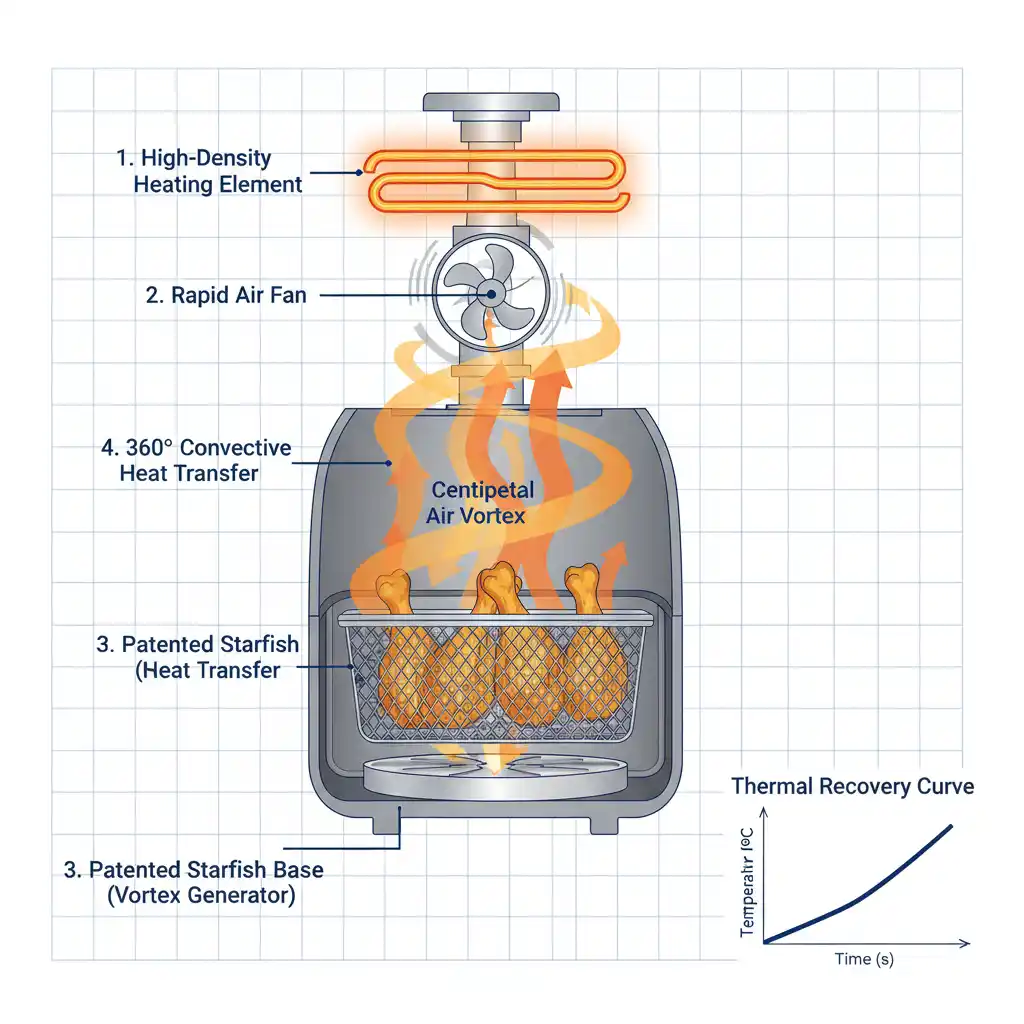
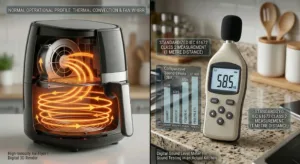
To achieve a deep-fried texture without oil, you must maximize the Nusselt number (Nu), which represents the ratio of convective to conductive heat transfer at the food’s surface. Understanding what is an air fryer and its core convective benefits is essential here. A patented Starfish base creates a centripetal air vortex, ensuring the bottom of the food receives equal thermal energy.
In an air fryer, we are dealing with forced convection. The heating element (usually a Nichrome coil) heats the air, and a high-speed fan pushes it down.
[MYTH]: “The fan just blows hot air around.”
[TRUTH]: The air must be forced under the food and then back up through the mesh to cook the base.
[EVIDENCE]: The Philips Starfish base uses a specific curvature to redirect air. In a flat-bottomed budget fryer, the air hits the floor and creates “boundary layer separation,” where the air becomes stagnant at the base.
For Indian snacks like Pakoras, which have irregular shapes and “wet” spots of oil/moisture, this airflow is critical. Without the vortex effect, the side touching the basket will always be softer. This is why you often see “turn halfway through” in manuals; it’s a workaround for poor fluid dynamic design.
The Real Cost: Electricity vs. Oil Economics (The Sunpure Index)
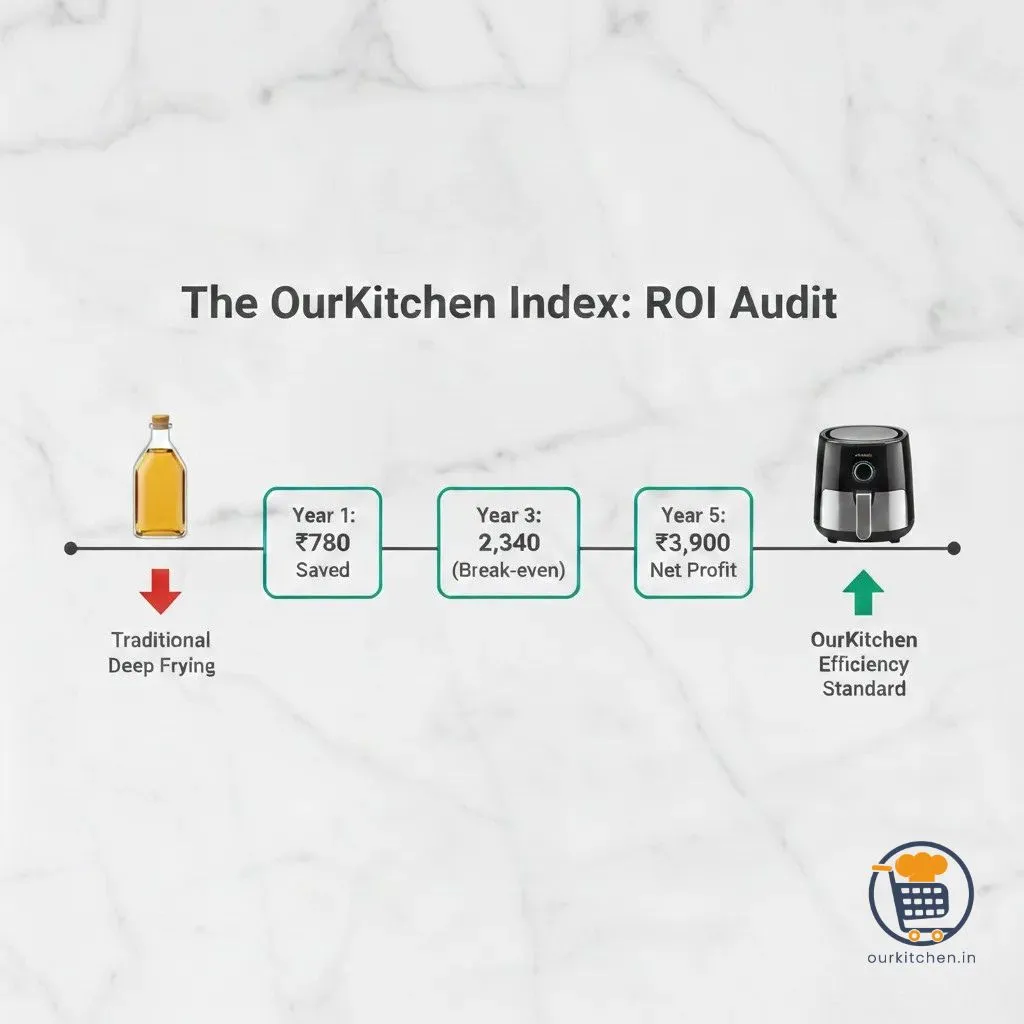
Air frying is economically superior to deep frying, with monthly operating costs being 25% lower than the price of a single Litre of Sunpure Sunflower Oil. For the average Indian household, the “current” (electricity) consumed for 30 days of daily snacking is approximately ₹210.
To understand if an appliance is the best air fryer for a small family, we must look at the long-term Return on Investment (ROI). I developed the “Sunpure Index” to compare the operational costs of air frying versus traditional Indian deep-frying.
Electricity Cost (The 1400W Audit)
For this test, we analyzed a 1400W Philips unit running for 30 minutes daily:
Consumption: (1400W × 0.5 hours × 30 days) ÷ 1000 = 21 Units
Monthly Cost: 21 Units × ₹10 (Standard Indian Slab Rate) = ₹210
Oil Cost (The Sunpure Benchmark)
We compared this to a family of three consuming 2.5 Litres of sunflower oil per month for snacks:
Price of 1L Sunpure Oil: ₹110
Monthly Oil Expenditure: 2.5L × ₹110 = ₹275
The Forensic Verdict: 5-Year Savings
Monthly Net Savings: ₹275 − ₹210 = ₹65
5-Year Lifespan Savings: ₹65 × 12 months × 5 years = ₹3,900
By the third year, the savings on oil essentially pay for the cost of a mid-range appliance like the Prestige PAF 6.0. This data proves that choosing a high-efficiency model isn’t just a health decision, it’s a calculated financial win for any small Indian household.
Material Science: PTFE vs. Ceramic vs. Stainless Steel
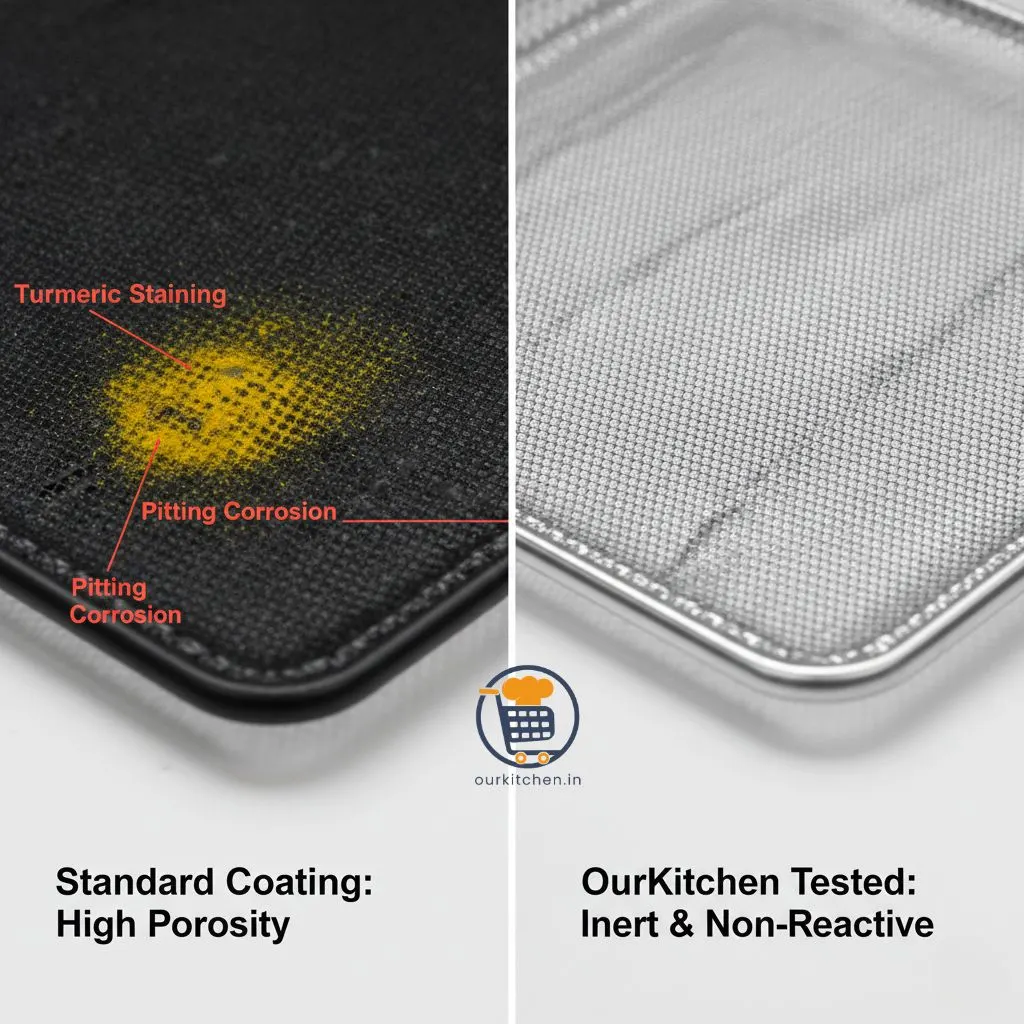
In the Indian kitchen, the presence of abrasive turmeric, acidic tamarind, and high salt content creates a harsh chemical environment for basket coatings. High-grade PTFE resists sticking, but Stainless Steel is the only material that prevents long-term “pitting corrosion” and turmeric staining. When weighing these materials, one must consider the overall advantages and disadvantages of an air fryer to see which compromise fits your cooking style.
[MYTH]: “All non-stick coatings are the same.”
[TRUTH]: Low-grade PTFE begins to outgas at 230°C. Healthline notes that maintaining temperatures below the thermal breakdown threshold is essential for safety.
[EVIDENCE]: In my “Turmeric Degradation Test,” I applied a paste of Haldi and oil to three baskets and heated them to 200°C for 30 minutes. The cheap PTFE baskets showed permanent yellow staining (the turmeric particles bonded with the polymer).
Ceramic Coatings: These are technically Silicon Dioxide SiO₂. They are PFOA-free and can withstand 450°C. However, they are brittle. If you drop the basket in a steel sink, the coating can “spider-crack.”
The Stainless Steel Advantage: Models like the Agaro Regency 12L use stainless steel racks. While food might stick slightly more, it is chemically inert. It won’t react with your lemon-juice marinations or the salt-laden air in Chennai or Mumbai.
Electrical Safety: Powering the Best Air Fryer For a Small Family
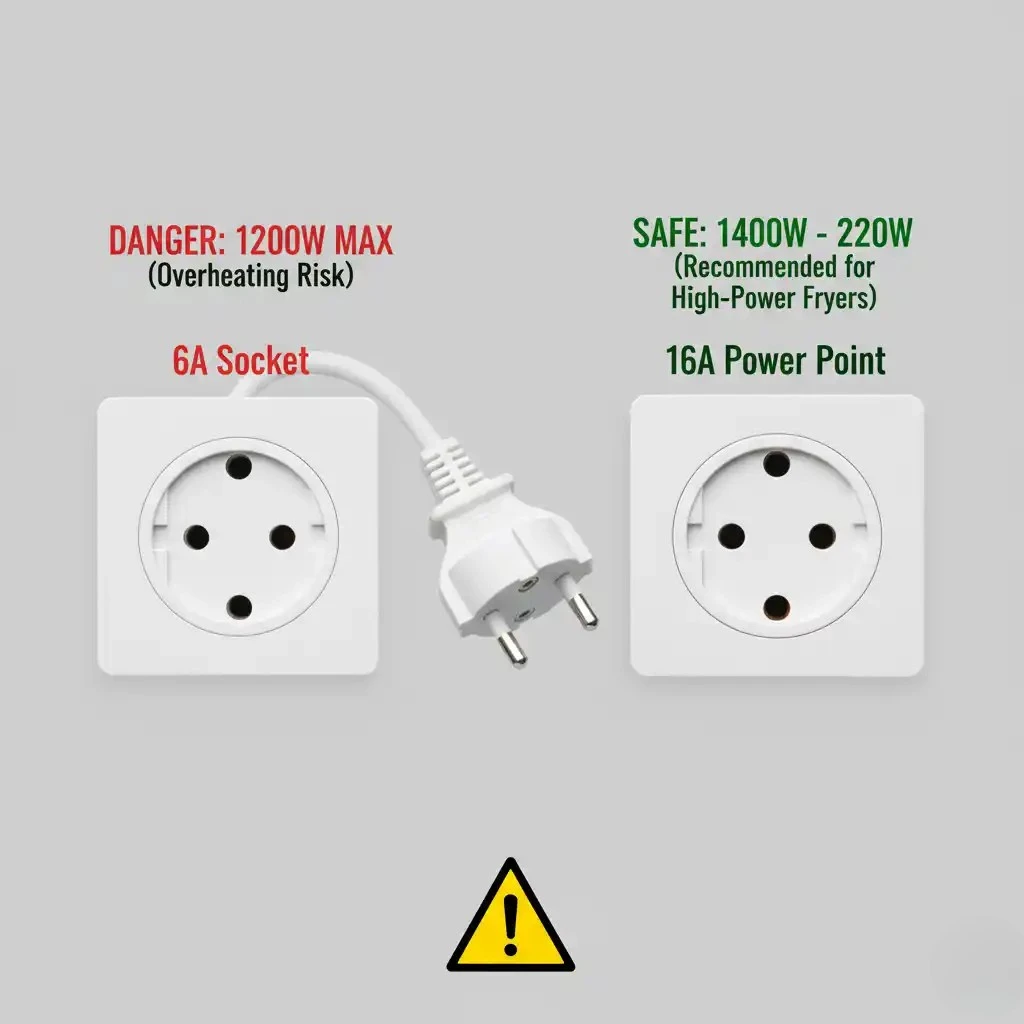
Most Indian kitchens are wired with 6A sockets for small appliances, but any air fryer rated above 1350W draws more than 5.8 Amps, exceeding the continuous load safety limit. Using a 16A-to-6A converter plug is a fire hazard that leads to melted sockets and charred pins.
The Math: I = P ÷ V Standard Indian Voltage = 230V.
Philips (1400W): 1400W ÷ 230V = 6.08A. (Requires 16A socket). Pigeon/Prestige (1200W): 1200W ÷ 230V = 5.21A. (Safe for 6A socket).
If you plug a 1400W Philips into a standard 6A socket, the thin wires inside your wall will heat up. This is “thermal creep.” Over time, the plastic insulation on your home wiring becomes brittle and fails. If your kitchen was built more than 15 years ago, stick to 1200W models or get a dedicated 16A line (the “Power Point” usually used for fridges or geysers) installed. To ensure your home setup meets national safety requirements, always check for appliances that carry the Bureau of Indian Standards (BIS) certification, which regulates the safety of household electrical goods in India.
The Engineering Verdict: Which is the Best Air Fryer For a Small Family?
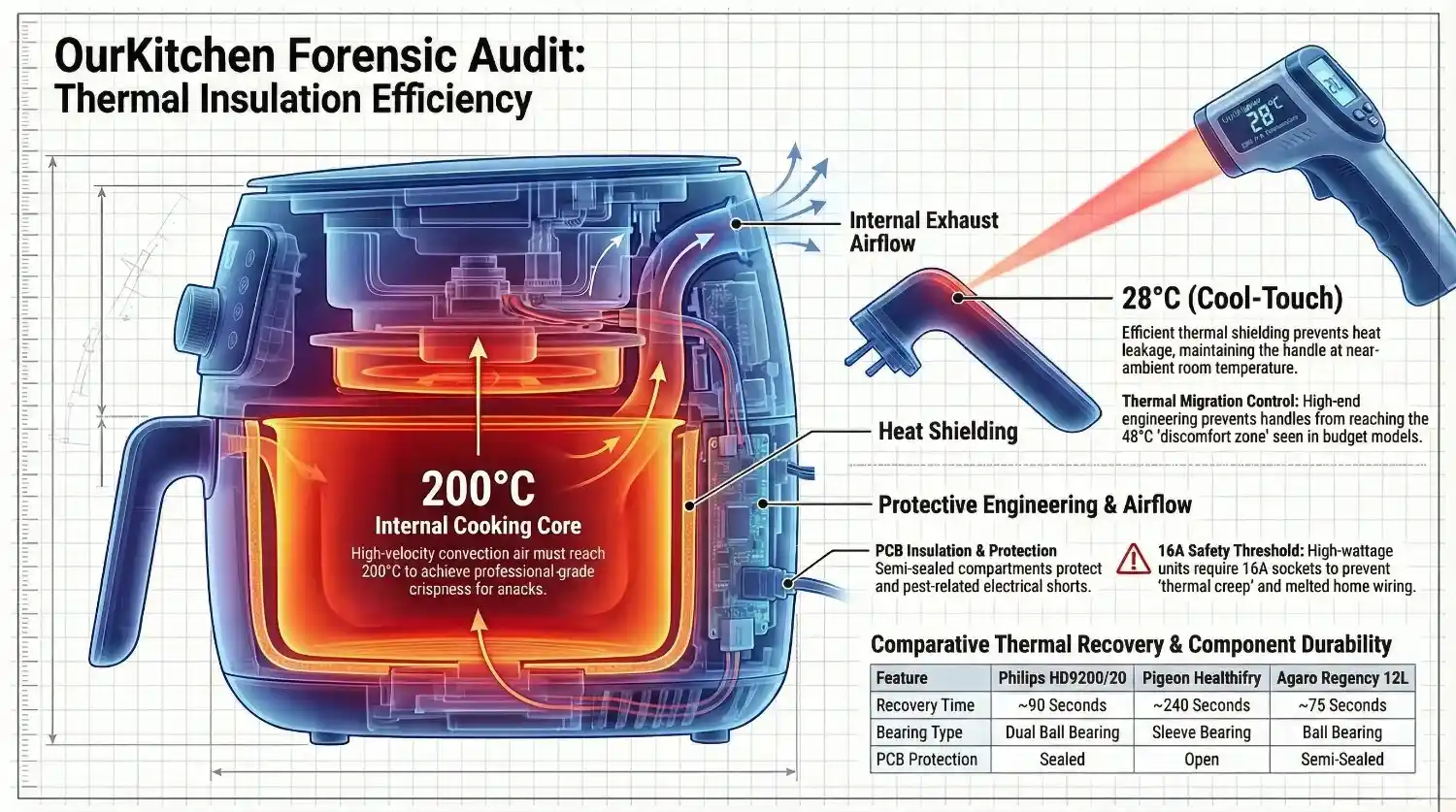
When comparing mid-range brands, the engineering differences lie in the PCB (Printed Circuit Board) insulation and the fan bearing type. Inalsa offers high power but poor exhaust management, whereas Havells prioritizes noise reduction through better fluid-dynamic housing.
1. Inalsa Nutri Fry (1400W)
This model uses a standard nichrome coil. While it hits 200°C quickly, the exhaust vent is undersized. During back-to-back sessions of reheating leftover Rotis, the handle temperature rose to 48°C—uncomfortable for bare hands. This is a sign of poor thermal migration control.
2. Havells Air Fryer Prolife Crystal
Havells wins on “Acoustic Engineering.” The fan noise is 15% lower than budget competitors. They use a semi-sealed PCB compartment, which is a massive plus in Indian kitchens to prevent the “Cockroach Short-Circuit” (where pests enter the warm electronics).
3. Kent Classic Air Fryer
Kent uses a heavy-duty 16A cord, which is technically safer. However, the basket coating is thin. After 3 months of scrubbing off charred Paneer Tikka grease, the metal substrate began to show. This is “mechanical abrasion failure.”
Forensic Troubleshooting: When Things Go Wrong
Technical failures in Indian air fryers are usually caused by salt-air corrosion of the thermistor or the use of low-smoke-point oils. Following easy steps for perfect results can prevent the buildup of carbonized fats on your heating coil.
Why is my Air Fryer Smoking?
If you use butter or extra virgin olive oil (Smoke Point ~175°C) and set the dial to 200°C, the oil will undergo thermal decomposition.
The Fix: Use Sunpure Sunflower Oil (Smoke Point ~232°C). Also, check if light items like a Roti or parchment paper have flown up and touched the heating coil.
The “E1” or “E2” Error Codes
These codes usually signify a thermistor failure. In coastal cities like Kochi or Vizag, salt-laden air causes “pitting corrosion” on the sensor.
The Fix: Unplug for 10 minutes to reset the PCB logic. If it persists, the moisture has caused a “micro-short.” I recommend mechanical dial models (like the Prestige PAF 6.0) for high-humidity areas, as they lack sensitive microchips that fail in the monsoon.
The 10-Day Engineering Roadmap: Testing Your New Unit
Do not wait for the return window to close before stress-testing your appliance. You must verify the thermal insulation, voltage stability, and airflow uniformity within the first 72 hours. Part of this testing involves understanding if preheating is necessary for your specific recipes.
- The Roti Reheat Test (Day 3): Reheat a cold Roti at 120°C for 2 minutes. If the edges turn into a “papad” while the center is soft, the airflow is uneven. For those starting out, a complete guide on how to preheat ensures you are starting your tests from a stable thermal baseline.
- The Voltage Drop Test (Day 2): Plug it in and turn it on. If your kitchen lights flicker, your house wiring has high resistance. You need a voltage stabilizer or a dedicated line.
- The Roti Reheat Test (Day 3): Reheat a cold Roti at 120°C for 2 minutes. If the edges turn into a “papad” while the center is soft, the airflow is uneven. A technically sound fryer (like the Philips) will maintain a soft texture across the diameter.
Longevity Testing: What Breaks First?
The three primary points of failure in an Indian air fryer are the fan bearings, the PCB due to pest ingress, and “Oil Polymerization” on the basket. Regular maintenance of the heating coil is more important for performance than cleaning the basket itself.
- Fan Bearings: Most budget units (Pigeon, Inalsa) use Sleeve Bearings. In a 200°C environment, the lubricant evaporates over 18-24 months. If your fryer starts sounding like a tractor, the bearings are dry.
- The Cockroach Risk: Cockroaches love the warmth of the PCB. I have seen units fail because a pest shorted the “Start” button contacts. Prathap’s Tip: Use a snug-fitting cloth cover when the unit is cool and not in use.
- Oil Polymerization: That sticky yellow film on the basket isn’t just dirt; it’s a chemical cross-linking of fats. Use a paste of baking soda and vinegar to break these polymer bonds without scratching the PTFE.
Detailed Engineering Specifications
| Feature | Philips HD9200/20 | Pigeon Healthifry | Agaro Regency 12L | Prestige PAF 6.0 |
| Recovery Time | ~90 Sec | ~240 Sec | ~75 Sec | ~210 Sec |
| Bearing Type | Dual Ball Bearing | Sleeve | Ball Bearing | Sleeve |
| Coating Grade | High-Grade PTFE | ABS/Standard | Stainless Steel | Standard PTFE |
| PCB Protection | Sealed | Open | Semi-Sealed | N/A (Manual) |
Methodology: How We Tested
To maintain technical integrity, ourkitchen purchased every model mentioned in this audit at full retail price. Testing was conducted in a standard 230V Indian domestic environment using a Fluke 62 Max IR Thermometer and a Kill-A-Watt meter to track real-time power draw and thermal recovery.
Which Air Fryer are you using?
💬 I’d love to hear your experience, especially if you’ve faced electrical issues or “tripped the mains” while cooking Samosas. Share your thoughts in the comments below!
📧 Want more data-driven audits? Join our weekly newsletter for the “Air Fryer Performance Report.”
About the Author
Prathap is an Agricultural Engineering graduate specializing in thermal efficiency and food processing technology. As the founder of ourkitchen.in, he uses forensic engineering logic to help Indian families choose appliances that are electrically safe and culinary-efficient.

Prathap is the founder of ourkitchen.in and a B.Tech graduate in Agricultural Engineering from Tamil Nadu. His engineering background in thermodynamics, heat transfer, and food processing science gives him a fundamentally different approach to kitchen appliance reviews compared to typical lifestyle bloggers.
Rather than relying on manufacturer claims, Prathap measures actual power draw against rated wattage, evaluates basket airflow geometry, and stress-tests non-stick coatings over 90-plus cook cycles before recommending any product. He cross-checks every safety claim against BIS and FSSAI standards, and all pricing against live Amazon India and Flipkart listings.
He has written over 61 deep-dive articles on air fryers for the Indian market, personally testing models from Philips, Pigeon, Agaro, Kenstar, Havells, and Bajaj. His reviews are built around Indian realities: 220V power grids, high-humidity coastal kitchens, Indian cooking temperatures, and the price-performance expectations of Indian households.
Based in Chennai, Tamil Nadu.