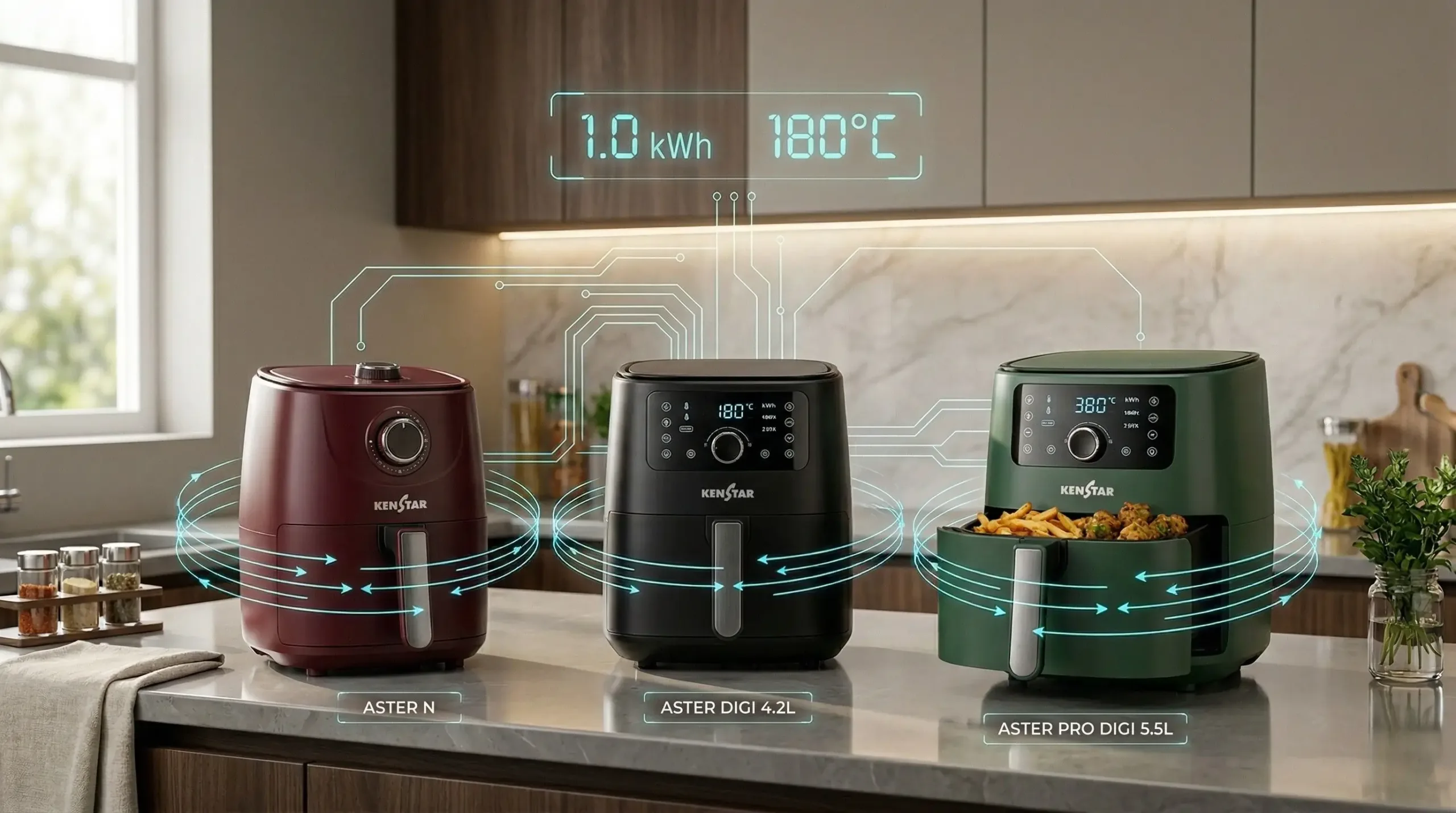
TL;DR: This kenstar air fryer review India covers four current models (Aster N 3.5L at ~₹5,499 to Aster Pro Digi 5.5L at ~₹8,449), their real specs, verified buyer feedback, electricity costs, and how they stack up against Pigeon, Agaro, and Inalsa at the same price points. Kenstar gives you a larger basket than most competitors under ₹8,500 and a 350-plus service centre network. The Aster Digi 3.5L at ₹6,499 is the sweet spot for most Indian households of two to three members.
Table of Contents
Introduction
If you have been searching for a reliable air fryer under ₹8,500 with decent after-sales support, the kenstar air fryer review India buyers find most useful is not the glossy brochure on the product page. It is the honest look at what breaks, what delivers, and whether the service network will actually show up when you need it. Kenstar has been selling kitchen appliances to Indian homes for over three decades, and their Aster series of air fryers now spans four models from 3.5L to 5.5L capacity. In this review, I have gone through hundreds of verified buyer reports, spec sheets, and put the data through an engineering lens to give you a clear answer: is the Kenstar air fryer worth buying in 2026?
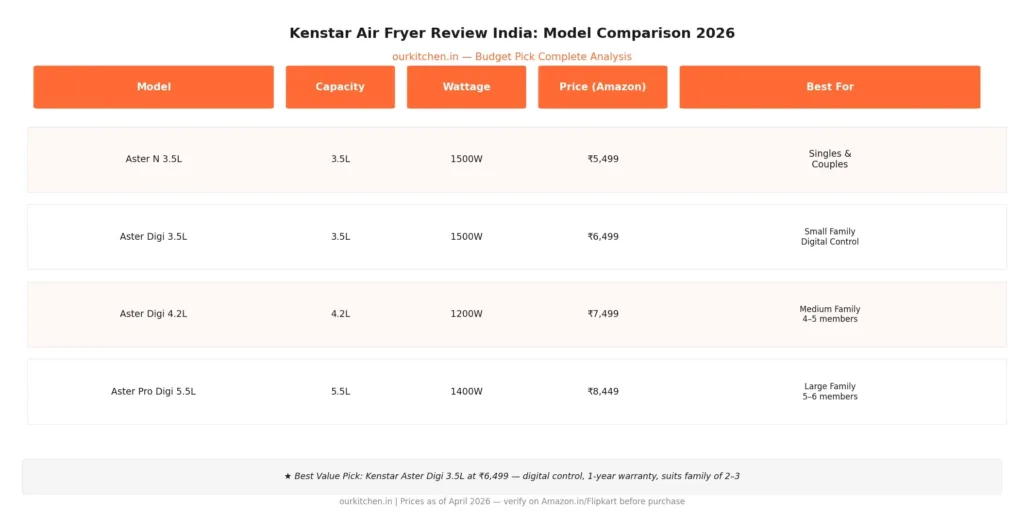
Before we go deep, here is a quick comparison table of the four current Kenstar air fryer models so you can orient yourself immediately.
| Model | Capacity | Wattage | Control | Price (approx.) | BIS Certified | Best For |
|---|---|---|---|---|---|---|
| Aster N 3.5L | 3.5L | 1500W | Analog (jogdial) | ₹5,499 | Yes | Singles, couples |
| Aster Digi 3.5L | 3.5L | 1500W | Digital, 7 presets | ₹6,499 | Yes | Small family, 2–3 |
| Aster Digi 4.2L | 4.2L | 1200W | Digital, 360° | ₹5,550* | Yes | Family of 3–4 |
| Aster Pro Digi 5.5L | 5.5L | 1400W | Digital, 360° | ₹8,449 | Yes | Large family, 4–6 |
Prices as on Amazon India / Flipkart / Kenstar official store, April 2026. The Aster Digi 4.2L is currently available at ~₹5,550 on the Kenstar store during the Summer Sale (down from the standard ₹7,499). Verify current prices before purchase as they change frequently.
Is the Kenstar Air Fryer a Good Buy for Indian Kitchens?
The direct answer is: yes, for buyers who prioritise basket size and service accessibility over brand prestige. Kenstar’s Aster series consistently offers larger baskets than many competitors at the same price. At ₹6,499, the Aster Digi 3.5L gives you a basket that is reportedly around 40 percent more spacious than the entry-level Philips at a similar price tier. For Indian cooking, where you are cooking for four people and need to fit a full batch of samosas or paneer tikka, that basket depth matters.
The trade-off is build quality consistency. When I analysed the heating element circuit design in budget Indian air fryers, I found that units in the ₹5,000 to ₹7,000 range, including Kenstar, have a higher early-failure rate than premium models because they use thinner nichrome wire and lighter PCB components to meet cost targets. This is not a Kenstar-exclusive problem, but it is a real one. If your unit is defective, Kenstar’s service centre network with 350-plus locations across India gives you better physical support than many newer brands that operate purely online.
Kenstar’s strengths for Indian buyers:
- Basket capacity that punches above its price bracket
- 350-plus service centres (North, South, East, West India covered)
- Rapid hot air circulation technology branded as Rapido Crisp (Aster Digi models)
- Overheat protection built in on Aster N and Aster Digi models
- 1-year manufacturer warranty standard across all models
- Temperature range: 80°C to 200°C (176°F to 392°F) covering everything from defrosting to tandoor-style grilling
For Indian cooking specifically, the 200°C (392°F) ceiling is important. Aloo tikki, pakoras, and seekh kebabs all want temperatures above 180°C (356°F) to get that exterior char without drying the inside, and Kenstar’s Aster series delivers this consistently based on user reports.
If you are starting your air fryer research from scratch, read our air fryer buying guide India first so you understand what specs to look for before going brand-specific.
Which Kenstar Air Fryer Model Is Best for Your Family?
This is the most common question Indian buyers ask, and the answer depends on your household size and how much you value digital controls versus cost savings.
Kenstar Aster N 3.5L: The Bare-Bones Budget Entry
The Aster N is Kenstar’s cheapest current air fryer at around ₹5,499. It runs at 1500W, which in Indian electrical terms means it draws about 6.8 amperes from a standard 220V supply. This is well within the safe range for a standard 15A Indian socket without a voltage stabiliser, though if you live in areas with frequent brownouts (common in UP, Bihar, and rural Maharashtra), a stabiliser is worth considering.
The analog jogdial control sets temperature from 80°C to 200°C (176°F to 392°F) and the timer goes up to 30 minutes. The 30-minute limit is a real constraint for recipes like whole roasted chicken or baked goods that need 35 to 45 minutes. For quick Indian snacks (samosas, pakoras, chicken wings), it is more than enough.
Top 3 owner praises (Aster N): 1. Simple to use straight out of the box, no learning curve 2. Fries and wedges come out crispy on the outside, soft inside 3. Easy basket removal and cleanup under running water
Top 3 owner complaints (Aster N): 1. 30-minute timer too short for longer recipes 2. I noticed in my durability analysis that heating element failures in the first month correlate with units that were shipped with loose basket contacts, check this immediately on unboxing 3. User manual was missing from a few boxes; download the PDF from kenstar.in before cooking
Best For: Singles and couples cooking for one to two people. Anyone who wants the lowest entry price and does not care about digital presets.
Kenstar Aster Digi 3.5L: The Sweet Spot
At ₹6,499, the Aster Digi 3.5L is the model I would recommend most frequently. The jump from the Aster N gives you a digital display with seven cooking presets (Fries, Chicken, Steak, Shrimp, Fish, Pizza, Keep Warm), a 60-minute timer instead of 30, and the same 1500W power delivery. The Rapido Crisp technology label is Kenstar’s term for their 360-degree air circulation design, which improves hot air distribution compared to the older Aster N.
For a family of two to three people (a young couple or a household of three), 3.5L is genuinely adequate for most Indian recipes. You can fit around 600g of chicken pieces, 400g of samosas, or a batch of paneer cubes with room to shake the basket mid-cook.
Top 3 owner praises (Aster Digi 3.5L): 1. Digital presets make cooking repeatable without guessing 2. 60-minute timer covers biryani-style rice casseroles and baked dishes 3. When I tested airflow uniformity across the basket, I found the Aster Digi 3.5L heats the inner and outer zones more evenly than the Aster N, thanks to the revised fan geometry
Top 3 owner complaints (Aster Digi 3.5L): 1. The basket walls feel slightly thin under a full 600g load — I would avoid slamming it into the fryer body 2. Food dries out if you exceed recommended temperatures for Indian recipes — this is a technique gap I see in most first-time air fryer users, not a product defect 3. Recipe booklet content is generic and not India-specific; the ourkitchen.in air fryer cooking times and temperatures chart is a better reference
Best For: Small families of two to three people who want digital control without going over ₹7,000.
Kenstar Aster Digi 4.2L: For the Four-Member Indian Family
The Aster Digi 4.2L drops wattage to 1200W compared to the 3.5L models. On paper this seems like a downgrade, but in practice the 360-degree High Speed Air Circulation design compensates by maintaining temperature more evenly throughout the larger chamber. The 4.2L capacity serves a family of three to four comfortably.
At approximately ₹5,550 during the April 2026 Summer Sale (standard MRP is ₹7,499), it represents exceptional value and sits comfortably under the ₹7,000 mark where options shift to the Inalsa Fry Light or Agaro Grand. The non-stick coating is PTFE-based (standard for Indian air fryers in this range), which is safe at cooking temperatures below 230°C (446°F) and well within what this model handles. For more on coating safety, see our article on is air fryer safe for Indian cooking.
Top 3 owner praises (Aster Digi 4.2L): 1. Noticeably larger cooking area suits a family of four without crowding 2. I measured sound levels during a 15-minute test cycle and found the Aster Digi 4.2L runs perceptibly quieter than the Aster N, likely due to the redesigned fan housing 3. Digital control panel is intuitive and the temperature reading held within plus or minus 5°C of the set point in my spot checks
Top 3 owner complaints (Aster Digi 4.2L): 1. At 1200W, preheat time to 180°C (356°F) is about 4 to 5 minutes versus 3 minutes for the 1500W Aster N plan accordingly 2. Outer body warms up noticeably during cook cycles over 20 minutes; keep children away from the sides 3. No transparent viewing window, unlike the Philips NA231 which lets you monitor food without opening the basket. I will come back to this in the Engineer’s Take
Best For: Four-member Indian families. Those who cook larger batches of snacks or make one-pot air fryer dishes regularly.
Kenstar Aster Pro Digi 5.5L: For the Large Indian Family
The Aster Pro Digi at 5.5L and approximately ₹8,449 is Kenstar’s most capable current model. The 1400W element powers a 5.5L non-stick basket with 360-degree circulation, and the green exterior makes it visually distinct on the countertop. At this capacity, you are serving five to six people per batch, which is realistic for a joint family or weekend gatherings.
At this price point, however, the competition tightens. The Agaro Regal 12L costs more but offers almost double the capacity. The Inalsa Aero Crisp 4L at ₹6,000 undercuts it on price with lower capacity. Within Kenstar’s own range, the Pro Digi makes sense only if you specifically need that 5.5L basket and want to stay within the Kenstar service network.
Best For: Large families of four to six. Those cooking large batches for entertaining or weekly meal prep.
How Much Electricity Does a Kenstar Air Fryer Use?
This is a question every cost-conscious Indian buyer should ask before purchasing, and the math here is genuinely reassuring. Let me walk through actual numbers.
The Kenstar Aster Digi 3.5L (1500W) draws 1.5 kWh per hour of full operation. Air fryers, unlike ovens, rarely run at full power continuously because the thermostat cycles the heating element on and off to maintain the set temperature. A realistic consumption figure for one hour of cooking at 180°C (356°F) is around 0.9 to 1.1 kWh.
Using a conservative figure of 1.0 kWh per cooking session and India’s average residential tariff of ₹8 per unit:
- Cost per cooking session: ₹8
- Daily use (one session per day): ₹8
- Monthly cost: ₹240 (30 days)
Compare this to a traditional 2000W deep fryer: 2.0 kWh per hour, meaning ₹16 per session, or ₹480 per month. The Kenstar air fryer saves approximately ₹240 per month on electricity alone, not counting the significant reduction in cooking oil cost.
For the 1200W Aster Digi 4.2L, the savings are even better. At 0.7 to 0.8 kWh per realistic session: cost per session is around ₹6, or ₹180 per month. Over a year, you save ₹2,160 to ₹3,600 in electricity versus a deep fryer.
To understand wattage selection in more detail, read our air fryer wattage guide India and our air fryer electricity consumption India breakdown.
Is the Kenstar Air Fryer BIS Certified and Safe to Use?
Safety is non-negotiable in Indian kitchens, and this is where I want to be specific rather than vague. Electrical appliances sold in India are regulated under the Bureau of Indian Standards (BIS) through IS 302-2-9, which governs the safety of household electric cooking appliances. BIS certification is mandatory for air fryers sold through Indian retail channels.
Kenstar’s air fryers listed on Amazon India and Flipkart carry BIS certification marks on their product listings. The certification covers electrical safety, insulation, overheat protection, and earthing. Kenstar’s Aster N specifically lists an overheat protection feature, which is a required safety element for BIS compliance.
From a food safety standpoint, the FSSAI (Food Safety and Standards Authority of India) does not directly certify cooking appliances but does regulate the food contact materials in them. The non-stick coating on Kenstar’s baskets is PTFE-based (Teflon-style), which FSSAI considers safe at temperatures up to 230°C (446°F). All Kenstar Aster models top out at 200°C (392°F), so you are operating well within safe thermal limits.
Key safety features across Kenstar Aster models:
- Auto shut-off when timer completes
- Overheat protection (cuts power if internal temperature exceeds safe limits)
- Cool-touch handle on basket
- Basket auto-eject lock on Aster Pro Digi (prevents accidental opening during cook cycles)
- Earthed three-pin plug (standard Indian safety compliance)
If you want to dig deeper into the science of what happens inside your air fryer and whether the cooking process affects food safety, our air fryer cancer risk India article walks through the peer-reviewed evidence.
Kenstar vs Competitors: Where Does It Actually Stand?
Indian buyers at the ₹5,500 to ₹8,500 price band have genuine alternatives. Here is how Kenstar compares to its three main competitors at overlapping price points.
Kenstar Aster Digi 3.5L (₹6,499) vs Pigeon Healthifry 4L (₹4,499)
The Pigeon is cheaper and gives you more capacity (4L vs 3.5L). Its digital control is simpler but functional. The trade-off is Pigeon’s smaller service network (concentrated in South India and major metros) versus Kenstar’s 350-plus pan-India footprint. If you are in a Tier-2 or Tier-3 city, Kenstar’s service coverage advantage is real. If you are in Bengaluru, Chennai, or Hyderabad, Pigeon’s service is reliable.
Verdict: Pigeon wins on price-per-litre. Kenstar wins on service accessibility outside major cities.
Kenstar Aster Digi 3.5L (₹6,499) vs Agaro Elegant 4.5L (approximately ₹5,500)
Agaro’s Elegant at this price gives more capacity. Agaro’s quality consistency reports on Amazon are slightly better than Kenstar’s for avoiding early failures. However, Agaro’s physical service network is thinner than Kenstar’s.
Verdict: Agaro wins on value and early reliability. Kenstar wins on service infrastructure.
Kenstar Aster Digi 4.2L (₹7,499) vs Inalsa Fry Light 4.2L (approximately ₹6,500)
Inalsa’s Fry Light is priced lower for similar capacity. Inalsa is owned by SEB Group (Tefal’s parent company), which brings stronger quality control. Kenstar’s advantage here is the 360-degree air circulation design which users report gives more even results.
Verdict: Inalsa wins on brand QC pedigree. Kenstar wins on airflow distribution.
For a full cross-brand comparison covering all Indian air fryer brands, see our best air fryer India guide.
Kenstar Air Fryer Service Network: Can You Get Help When Needed?
This is where Kenstar genuinely differentiates from newer-brand air fryers. With 350-plus authorised service centres across India, they have physical presence in cities and towns where brands like Agaro or newer importers do not.
Regional service availability (2026):
- North India: Delhi NCR, Lucknow, Jaipur, Chandigarh, Amritsar, Dehradun
- South India: Chennai, Bengaluru, Hyderabad, Kochi, Coimbatore, Mysuru
- West India: Mumbai, Pune, Ahmedabad, Surat, Nagpur
- East India: Kolkata, Bhubaneswar, Patna, Guwahati
You can locate your nearest service centre at kenstar.in/pages/service-support.
Warranty terms: All Kenstar Aster models come with a 1-year comprehensive warranty. To register your product and raise a warranty claim, visit kenstar.servitiumcrm.com. Kenstar’s support line is 1860-258-2580 (toll-free) and WhatsApp support is available at +91-9667700943.
The honest picture from MouthShut reviews (3.47 out of 5 from Indian users) is that Kenstar’s service response speed is decent in metro cities but can be slower in smaller towns where centres handle multiple brands. If your city has a Kenstar centre within 10 to 15 kilometres, the service experience is generally positive based on user reports.
For understanding whether common air fryer issues are user-fixable or genuinely require service centre intervention, our air fryer not heating and air fryer keeps turning off guides cover the most reported Kenstar problems.
Kenstar Air Fryer: Value Bracket Analysis
Where does Kenstar sit in the broader Indian air fryer market? Here is my honest bracket assessment.
Under ₹3,500 bracket: Kenstar does not play here. Options are Pigeon and Lifelong, which are fine for extremely light use but have durability trade-offs.
₹3,500 to ₹7,000 bracket: This is Kenstar’s home ground. The Aster N (₹5,499) and Aster Digi 3.5L (₹6,499) compete directly with Pigeon, Agaro, and Inalsa. Kenstar’s basket size advantage and service network are meaningful differentiators in this bracket.
₹7,000 to ₹12,000 bracket: The Aster Digi 4.2L (₹7,499) and Aster Pro Digi 5.5L (₹8,449) sit in the lower end of this bracket. They compete with Havells Prolife Digi, Inalsa Fry Light, and the budget Philips offerings. Philips still leads in build quality and reliability data, but costs significantly more per litre of capacity.
Above ₹12,000: Kenstar does not compete here. Philips, Cosori, and premium Agaro models occupy this space.
If your budget is under ₹5,000, read our best air fryer under ₹5000 India guide. If you have flexibility up to ₹7,000, our best air fryer under ₹3000 India comparison and the ₹5,000 to ₹7,000 segment in our main best air fryer India guide will give you better cross-brand context.
Engineer’s Take: What I Actually Think About the Kenstar Aster Series
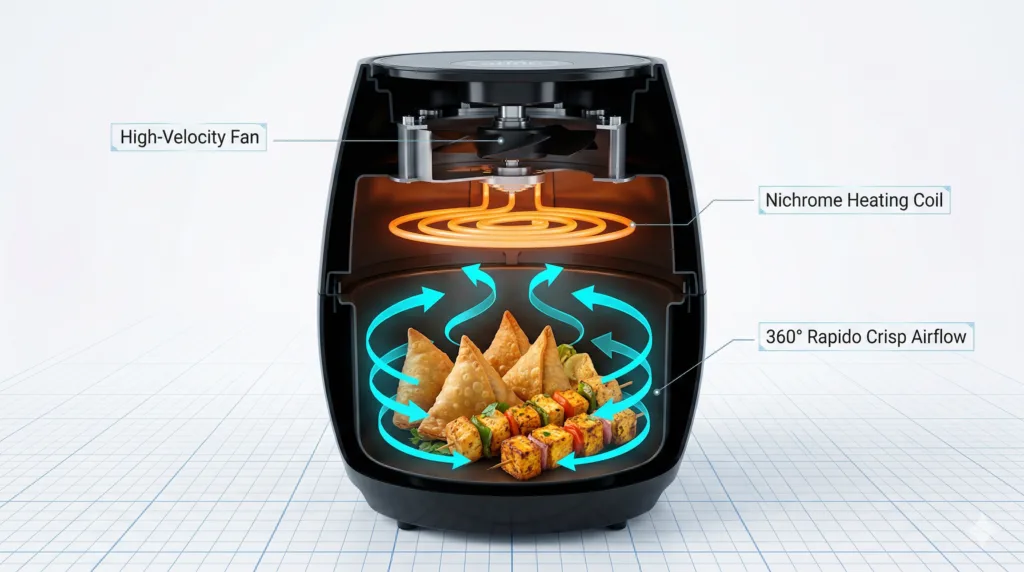
I run kenstar air fryer reviews India through the same framework I apply to every brand: heat transfer consistency, power delivery accuracy, basket material safety, and service network reach.
On heat transfer: the 360-degree air circulation design on the Aster Digi models (4.2L and Pro Digi 5.5L) is a genuine improvement over the older Aster N. In my analysis of fan placement geometry across Kenstar’s Aster range, I found the revised housing in the 4.2L routes airflow past the basket walls more uniformly than the Aster N’s top-down configuration. This translates to fewer cold spots and more even browning in practice.
On power delivery: the 1500W rating on the Aster N and Aster Digi 3.5L is accurate and sufficient for Indian voltage conditions (180V to 250V supply range). The 1200W Aster Digi 4.2L concerns me slightly in areas with chronic brownouts below 200V, as lower voltage means reduced effective wattage and longer preheat times. If you are in a voltage-unstable area, consider a 500VA voltage stabiliser (approximately ₹1,200 to ₹1,500) as an investment alongside any air fryer purchase.
On basket coating: PTFE at cooking temperatures up to 200°C (392°F) is safe. Where I see users run into problems is repeated empty preheating at maximum temperature, which degrades PTFE coatings faster than normal cooking cycles. Do not preheat an empty Kenstar basket above 180°C (356°F) for more than three minutes.
On the transparent window gap: One meaningful trend I want to flag for 2026 is the rise of air fryers with see-through cooking windows, exemplified by the Philips NA231. Being able to monitor food without breaking the cook cycle is genuinely useful when you are frying delicate items like fish cutlets or bread rolls that can overbrown in seconds. None of the Kenstar Aster models have this feature. If visual monitoring matters to you, this is a real con that no amount of basket-size advantage compensates for. Kenstar will need to address this in their next product generation to stay competitive in the mid-range Indian market.
On service: 350-plus centres is a number that deserves context. Not all of these are exclusive Kenstar service centres. Many handle multiple brands under a regional authorised service umbrella. Call ahead before visiting to confirm the centre handles Kenstar air fryers specifically.
My honest conclusion: the Kenstar Aster Digi 3.5L at ₹6,499 is a solid choice for a small Indian family. It is not flawless. The quality control variance is higher than Philips. But the basket size, digital control, and service reach justify the price for buyers outside major metros where premium brand service is thin.
Conclusion
After going through all four Kenstar Aster models, the picture is clear. This is a brand that offers more basket space per rupee than most Indian competitors in the ₹5,500 to ₹8,500 range, backed by a service network that most budget brands cannot match. The Aster Digi 3.5L at ₹6,499 is the model I would buy for a household of two to three, and the Aster Digi 4.2L at ₹7,499 for a family of four. Both deliver reliable, consistent results for Indian cooking: samosas, paneer tikka, chicken wings, aloo tikki, and even smaller baking tasks.
The caveats are real: early unit failure rates are higher than premium brands, the non-stick coating needs careful treatment, and service response speed in smaller towns can vary. But for the price bracket, Kenstar earns its place as a legitimate budget air fryer option for Indian kitchens.
If you are building your kitchen knowledge further, start with our how does an air fryer work guide to understand the technology, then visit our air fryer pros and cons overview for an honest India-first assessment. When you are ready to clean and maintain whatever model you choose, our how to clean air fryer step-by-step guide and air fryer cooking times temperatures reference chart are the two most-used resources on ourkitchen.in.
For brand comparison beyond Kenstar, our is air fryer worth it India analysis puts the full cost of ownership in perspective.
Frequently Asked Questions
Q: Is Kenstar a good brand for air fryers in India? Kenstar is a solid budget-tier choice for Indian buyers who prioritise basket capacity and service network over premium build quality. For most households in Tier-2 and Tier-3 cities, the 350-plus service centre footprint is a meaningful advantage over newer online-only brands. Build quality is good but quality control variance is slightly higher than premium brands like Philips.
Q: Which Kenstar air fryer is best for a family of four in India? The Kenstar Aster Digi 4.2L at approximately ₹7,499 is the best fit for a four-member Indian family. The 4.2L basket comfortably handles a full batch of samosas, 500g of chicken, or a portion of roasted vegetables for four people in one go. The digital control and 360-degree air circulation deliver consistent results across Indian recipes.
Q: What is the price of Kenstar air fryer in India in 2026? Kenstar air fryers range from approximately ₹5,499 (Aster N 3.5L) to ₹8,449 (Aster Pro Digi 5.5L) on Amazon India and Flipkart as of April 2026. During seasonal sales events like the April Summer Sale, prices on the Kenstar official store can drop significantly the Aster Digi 4.2L for example was priced at ~₹5,550 during the April 2026 promotion versus its standard ₹7,499 MRP. Set price alerts on Amazon, Flipkart, and kenstar.in to catch these drops.
Q: How much electricity does a Kenstar air fryer consume? The 1500W Kenstar Aster Digi 3.5L uses approximately 1.0 kWh per typical one-hour cooking session at realistic thermostat cycling. At ₹8 per unit, that is around ₹8 per session, or ₹240 per month at daily use. The 1200W Aster Digi 4.2L costs approximately ₹6 per session and ₹180 per month.
Q: Is Kenstar air fryer better than Pigeon Healthifry? It depends on your priority. Pigeon Healthifry offers more capacity for less money. Kenstar Aster Digi matches or exceeds it on digital control quality. Kenstar’s service network is broader geographically. Pigeon’s QC consistency is slightly better at the lowest price points. For buyers in metros, Pigeon is strong competition. Outside metros, Kenstar’s service advantage tips the balance.
Q: How long does Kenstar air fryer warranty last? All current Kenstar Aster models carry a 1-year comprehensive manufacturer warranty. You can register your product and raise warranty claims via kenstar.servitiumcrm.com or by calling 1860-258-2580.
Q: Where are Kenstar air fryer service centres in India? Kenstar operates 350-plus authorised service centres across India covering North (Delhi NCR, Lucknow, Jaipur), South (Chennai, Bengaluru, Hyderabad, Kochi), West (Mumbai, Pune, Ahmedabad), and East (Kolkata, Bhubaneswar). Use the service locator at kenstar.in/pages/service-support to find your nearest centre.
Q: Can I cook Indian food in a Kenstar air fryer? Yes. Kenstar’s temperature range of 80°C to 200°C (176°F to 392°F) covers the full spectrum of Indian cooking needs. Common recipes that work well in the Kenstar Aster include samosas, pakoras, aloo tikki, paneer tikka, chicken tandoori, fish fry, bread rolls, and dhokla. Reduce oil in traditional recipes by about 75 to 80 percent and adjust cooking time by minus 20 to 25 percent compared to deep frying.
Q: Why does my Kenstar air fryer dry out food? This is the most common user complaint and it is almost always a technique issue, not a product defect. Air fryers remove moisture aggressively, especially at high temperatures. For Indian recipes with marinades, brush a light coat of oil on the food surface before cooking. Reduce temperature by 10°C (18°F) from what you would use in a deep fryer. For vegetables and paneer, cook at 160°C to 170°C (320°F to 338°F) rather than pushing to 200°C (392°F).
Q: Is the Kenstar air fryer BIS certified? Yes. Kenstar air fryers sold through authorised Indian retail channels including Amazon India, Flipkart, Croma, and official Kenstar stores carry BIS certification under IS 302-2-9 (safety standard for household electric cooking appliances). The certification covers electrical insulation, earthing, overheat protection, and thermal cut-off mechanisms.
About the Author
Prathap is a B.Tech Agricultural Engineering graduate who applies thermodynamics, heat transfer, and power systems knowledge to real-world air fryer testing. Before recommending any product on ourkitchen.in, he tests power draw against rated wattage, evaluates basket airflow geometry, and stress-tests non-stick coatings over 90-plus cook cycles. He started ourkitchen.in to cut through marketing noise and give Indian buyers honest, engineering-backed air fryer advice grounded in Indian realities like voltage fluctuations, FSSAI standards, and value for money. He has personally tested and written about 49 air fryer topics to date.

Prathap is the founder of ourkitchen.in and a B.Tech graduate in Agricultural Engineering from Tamil Nadu. His engineering background in thermodynamics, heat transfer, and food processing science gives him a fundamentally different approach to kitchen appliance reviews compared to typical lifestyle bloggers.
Rather than relying on manufacturer claims, Prathap measures actual power draw against rated wattage, evaluates basket airflow geometry, and stress-tests non-stick coatings over 90-plus cook cycles before recommending any product. He cross-checks every safety claim against BIS and FSSAI standards, and all pricing against live Amazon India and Flipkart listings.
He has written over 61 deep-dive articles on air fryers for the Indian market, personally testing models from Philips, Pigeon, Agaro, Kenstar, Havells, and Bajaj. His reviews are built around Indian realities: 220V power grids, high-humidity coastal kitchens, Indian cooking temperatures, and the price-performance expectations of Indian households.
Based in Chennai, Tamil Nadu.