
TL;DR: Air fryer electricity consumption India typically works out to 0.4–0.8 units per cooking session for a 1200–1500W model used for 15–25 minutes. At ₹6–8 per unit, this is roughly ₹3–6 per session, or ₹90–180 per month with daily use a fraction of the ₹913 most households spend on one LPG cylinder. This guide breaks down the exact numbers, state-by-state tariff calculations, and a direct comparison with gas stove costs so you can make an informed decision for your Indian kitchen.
Introduction
If you have been sitting on the fence about buying an air fryer, your electricity bill is probably one of your biggest concerns. Indians are rightly cautious about adding high-wattage appliances a 1500W air fryer sounds alarming when your ceiling fan runs at 75W. But wattage alone does not tell the whole story.
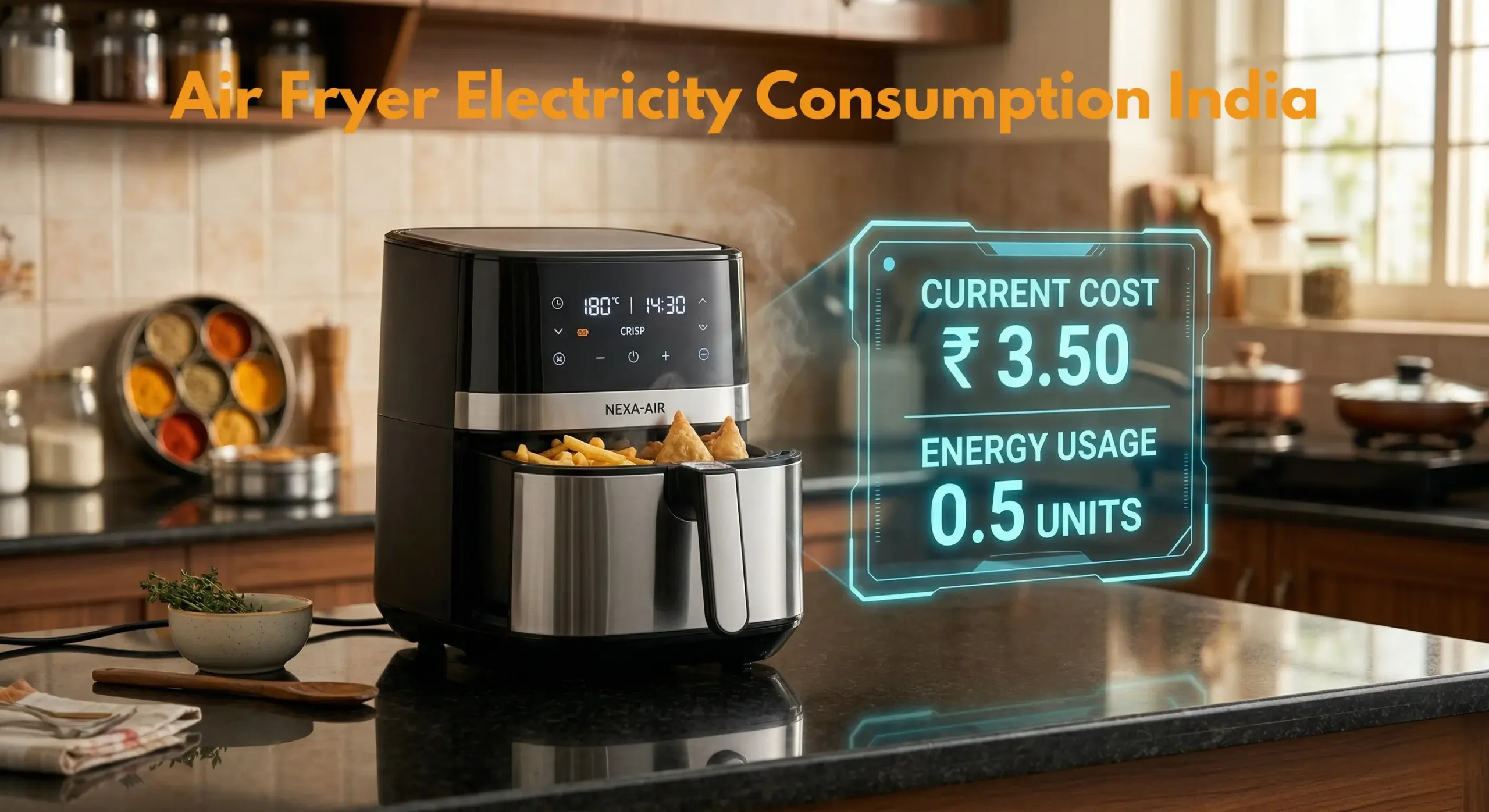
Air fryer electricity consumption in India is determined by three factors: the wattage of the unit, how long you actually run it per session, and your state electricity tariff. A 1500W air fryer running for 20 minutes consumes just 0.5 units of electricity. At ₹7 per unit, that is ₹3.50 for an entire batch of samosas, chicken tikka, or roasted vegetables cooked with no oil splattering on your walls.
This guide gives you the exact formula to calculate your personal running cost, worked examples for five major Indian states using current 2025–26 tariff slabs, a head-to-head comparison with LPG gas stove costs, and specific recommendations for popular models available on Amazon India and Flipkart. By the end, you will know exactly what an air fryer will add to your monthly bill and why the number is almost always smaller than you expect.
How Much Electricity Does an Air Fryer Use in India?
Air fryer electricity consumption India depends directly on the wattage of the model and the duration of each cooking session. Most air fryers sold in India today fall in the 1200W to 1800W range. Here is a breakdown of the most popular models (see our Air Fryer Price in India guide for current Amazon and Flipkart pricing):
| Model | Wattage | Capacity |
| Philips HD9252/90 Digital | 1400W | 4.1 L |
| Philips HD9200/90 | 1400W | 4.1 L |
| Pigeon Healthifry Digital | 1200W | 4.2 L |
| Prestige Nutrifry 4.5L | 1200W | 4.5 L |
| KENT Classic 4L | 1300W | 4.0 L |
| Agaro Regal 12L Oven | 1800W | 12.0 L |
| Havells Prolife Digi | 1400W | 4.0 L |
The critical insight most buyers miss is this: an air fryer does not run at full wattage throughout the cooking session. The heating element cycles on and off to maintain the target temperature. Real-world measurements suggest that a 1400W air fryer draws closer to 900–1100W on average during a typical 20-minute cook. This means actual consumption per session is lower than the nameplate wattage implies.
Typical consumption per session (20 minutes of cooking):
- 1200W model: 0.40 units
- 1400W model: 0.47 units
- 1500W model: 0.50 units
- 1800W model: 0.60 units
For context: a standard 1000W induction cooktop running for the same 20 minutes would use 0.33 units. An OTG oven at 1800W for 25 minutes would use 0.75 units. The air fryer sits comfortably between the two, but cooks faster than both.
How to Calculate Your Air Fryer Electricity Cost in India

The formula is simple and takes about 30 seconds with a calculator:
Monthly Cost (₹) = [Wattage (W) × Hours/Day × 30 × Tariff (₹/unit)] / 1000
Let us break this down:
- Wattage: Use the rated wattage printed on your air fryer label (e.g., 1400W)
- Hours per Day: Convert your daily usage to hours. 20 minutes = 0.33 hours; 30 minutes = 0.50 hours
- Tariff: Your state electricity rate per unit (kWh) typically ₹5 to ₹11 for residential consumers in 2025–26
- Divide by 1000 to convert watts to kilowatts
Worked example Philips HD9252/90 (1400W) used 20 minutes daily in Bengaluru at ₹7.50/unit:
Monthly Cost = 1400 × 0.33 × 30 × 7.50 ÷ 1000
= 1400 × 0.33 × 225 ÷ 1000
= 103,950 ÷ 1000
= ₹103.95 per month
That is roughly the cost of three cups of roadside chai, for an entire month of daily air frying.
State-Wise Monthly Cost Calculations (1400W Air Fryer, 20 Min Daily)
The biggest variable in your running cost is your state electricity tariff. Indian states differ dramatically. Delhi residents enjoy heavily subsidised power while Maharashtra consumers in the higher consumption slabs pay among the steepest rates in the country.
| State | Tariff (₹/unit, residential slab) | Monthly Cost | Annual Cost |
| Delhi | ₹3.50–5.00 (first 200 units often free) | ₹46–66 | ₹556–790 |
| Maharashtra (MSEDCL) | ₹8.00–11.21 (above 300 units) | ₹106–148 | ₹1,272–1,778 |
| Karnataka (BESCOM) | ₹6.50–8.50 | ₹86–112 | ₹1,032–1,345 |
| Tamil Nadu (TANGEDCO) | ₹5.00–7.00 (after free units) | ₹66–92 | ₹792–1,109 |
| Uttar Pradesh (UPPCL) | ₹5.50–6.50 | ₹72–86 | ₹869–1,033 |
| National Average | ₹6.00–8.00 | ₹79–106 | ₹950–1,267 |
Source: Central Electricity Regulatory Commission (CERC) tariff orders 2025–26. Rates vary by consumption slab and connection type. Check your DISCOM portal for your applicable rate.
Important note on Delhi’s free unit scheme: Delhi residents who consume under 200 units per month often pay nothing for those units under the AAP government subsidy. An air fryer used 20 minutes daily adds only about 14 units per month well within the free slab for many households. Your effective air fryer running cost in Delhi could be zero rupees per month.
Important note on Tamil Nadu: TANGEDCO provides the first 100 units free for domestic consumers. If your household uses less than 100 units without the air fryer, adding an air fryer may push you into the paid slab. This is worth checking on your past bills.
Air Fryer vs Gas Stove: Which Costs Less in India?

This is the comparison most Indian buyers actually care about, and it requires a more nuanced calculation than simply comparing per-unit costs.
LPG Cylinder Pricing (April 2026):
- Delhi: ₹913 per 14.2 kg cylinder
- Mumbai: ₹912.50 per 14.2 kg cylinder
- Chennai: ₹928 per cylinder
- Bengaluru: Approximately ₹920–935 per cylinder
A typical Indian household of 3–4 members uses one 14.2 kg LPG cylinder every 30–45 days for all cooking. That is ₹913 per month in direct fuel costs (Delhi rate) even before accounting for the oil cost for deep frying, which an air fryer eliminates.
The real comparison is not air fryer vs gas stove, it is air fryer as a supplement to your gas stove for specific tasks. According to peer-reviewed food engineering studies published on ScienceDirect, convective hot air transfers heat directly to the food surface, rapidly evaporating moisture without the need for a submerged oil medium.
For deep frying, shallow frying, reheating, and baking tasks, an air fryer is a direct substitute that removes the gas burner from the equation. If you are currently deep frying daily, read our detailed Air Fryer vs Deep Fryer cost and health comparison. Consider:
- Deep-frying a batch of French fries on a gas stove (which often leads to people asking why their air fryer fries are soggy if transitioning incorrectly): 15 minutes of burner use plus 250 ml of oil (at ₹150–200/litre, that is ₹37–50 in oil alone per batch)
- Air frying the same batch: 0.5 units of electricity at ₹7/unit = ₹3.50, plus 1 teaspoon of oil
The electricity cost per cooking session is so small relative to the oil savings that most families see a net reduction in their monthly kitchen expenditure after switching routine frying tasks to an air fryer.
Annual cost of air frying (1400W, 20 min daily, Karnataka tariff ₹7.50/unit):
- Electricity: ₹104/month × 12 = ₹1,248/year
- Oil saved (vs daily deep frying, 200 ml/day at ₹150/litre): ₹30 × 365 = ₹10,950/year
- Net annual saving on oil alone: ₹9,702
The air fryer pays for itself in oil savings within months. The electricity cost is real but small; the oil saving is the dominant factor.
Air Fryer vs OTG Oven: Energy Consumption Compared
Many Indian households already own an OTG (Oven Toaster Griller) and wonder whether an air fryer would actually be more efficient. The answer is yes, for most tasks. For a full side-by-side breakdown of all three appliances, see our Air Fryer vs OTG vs Microwave India guide.
An OTG oven typically runs at 1200–2200W and requires a 10–15 minute preheating period before the food goes in. This preheating is pure energy cost with no cooking output. An air fryer requires no preheating for most tasks (or just 3–5 minutes at most) and cooks faster due to concentrated hot air circulation.
Comparison for roasting 500g of vegetables (or even learning how to roast papad in an air fryer):
| Appliance | Wattage | Preheat | Cook Time | Total Time | Units Used |
| OTG Oven | 1800W | 12 min | 25 min | 37 min | 1.11 units |
| Air Fryer | 1400W | 0 min | 18 min | 18 min | 0.42 units |
| Gas Burner | N/A | 2 min | 20 min | 22 min | 0.04 kg LPG |
The air fryer uses 62% less electricity than the OTG for the same task. This difference matters significantly if you are in a high-tariff state like Maharashtra where each unit costs ₹8–11.
For large family cooking tasks baking a full cake, roasting a whole chicken, making multiple trays of cookies and OTG’s larger capacity may be more practical. But for the daily tasks of reheating, making snacks, and quick grilling, the air fryer wins on both energy efficiency and speed.
Does an Air Fryer Significantly Increase Your Electricity Bill?
This is the most common concern among Indian buyers, and the answer is reassuring: air fryer electricity consumption India adds a modest, manageable amount to your monthly bill.
Let us put it in perspective. At a national average tariff of ₹7/unit, a 1400W air fryer used 20 minutes daily adds approximately 14 units to your monthly bill. That is:
- ₹98 per month in additional electricity cost
- A 3–8% increase in a typical Indian household’s monthly electricity bill (which averages ₹1,200–3,500 depending on state and usage)
- Less than the cost of two kilograms of cooking oil
The impact is even smaller if you are also saving on LPG usage by substituting gas-stove frying with air frying.
When does air fryer electricity use become noticeable?
You will notice a meaningful bill impact if you are using a high-wattage model (1800W+) for extended periods (45 minutes or more per day) in a high-tariff state (Maharashtra, above 300 units/month consumption). In that scenario:
Monthly Cost = 1800W × 0.75 hrs × 30 × ₹10/unit ÷ 1000 = ₹405/month
For most households, though, 20–30 minutes of daily use at 1200–1500W in a moderate-tariff state will stay below ₹150/month.
BIS Certification and What the Wattage Mark Means for Your Air Fryer
Before purchasing any air fryer in India, verify that it carries a valid BIS (Bureau of Indian Standards) certification. This is not optional, it is your safety guarantee. For a complete guide on air fryer safety in India, read Are Air Fryers Safe? India Guide.
Relevant Indian Standards:
- IS 302 Part 2 Section 13:2024 Safety of household deep fat fryers and similar appliances (this covers air fryers)
- IS 302 Part 1:2024 General safety requirements for household electrical appliances
The Safety of Household, Commercial and Similar Electrical Appliances (Quality Control) Order 2026 mandates BIS certification for 90 categories of electrical appliances, with the new implementation deadline set for 1 October 2026. From that date, uncertified air fryers cannot legally be sold in India.
What to look for on the product box (you can verify licenses on the official BIS Portal):
- The ISI mark (a wheel symbol with IS number)
- IS 302 compliance printed in the specification panel
- Rated voltage: 220–240V, 50Hz (matches Indian household supply)
- Rated wattage printed clearly (e.g., 1400W)
- Earthing provision: a 3-pin plug with earth connection
Why wattage accuracy matters: If a product claims 1200W but actually draws 1500W, it is both a safety issue and a bill issue. A BIS-certified product must have its actual wattage verified in an accredited lab. Always buy from brands that display their IS certification number on the packaging. You may also want to read about Air Fryer PTFE, BPA and Teflon safety when choosing coatings, and understanding Air Fryer EMF radiation.
Indian brands with strong BIS compliance history: Philips, Pigeon, Prestige, Havells, Bajaj, Inalsa, Wonderchef. These brands manufacture or source products to IS 302 standards, and their wattage ratings are generally accurate within ±5%.
How to Reduce Air Fryer Electricity Consumption India
These are practical, engineering-backed steps to get the most cooking output per unit of electricity consumed:
- Right-size your air fryer. A 12-litre oven air fryer running at 1800W for a single portion of food is inefficient. A 3.5–4.5L compact air fryer at 1200–1400W is the right tool for 1–3 people. Match basket size to your typical cooking volume. See our Best Small Air Fryer India and Best Air Fryer for a Small Family guide for right-sized picks.
- Batch cook where possible. The heating cycle consumes more power at startup than during steady-state cooking. Running two batches back-to-back (while the air fryer is already hot) is more efficient than two separate sessions with a cool-down in between.
- Avoid unnecessary preheating. Most Indian recipes, samosas, pakoras, cutlets, frozen snacks, do not require preheating. Add food to a cold basket and set the temperature. The food comes up to temperature as the air fryer does. Read more: Is Preheating Necessary in an Air Fryer? (and if you must, learn exactly how to preheat an air fryer).
- Use the correct temperature. Running an air fryer at 200°C / 392°F when 180°C / 356°F would suffice makes the heating element cycle on more frequently. Refer to tested time-and-temperature guides for Indian recipes.
- Clean the basket and heating element regularly. A clogged or greasy heating element radiates heat less efficiently, causing the air fryer to run longer to reach target temperature. A clean air fryer is an efficient air fryer. If you encounter issues, learn why an air fryer is making loud noise or what to do if the air fryer basket is stuck.
- Use a voltage stabiliser in areas with frequent voltage fluctuations. Voltage drops below 200V can cause the heating element to draw excess current to compensate, increasing consumption and reducing element lifespan. Many north Indian and rural areas see voltage as low as 180V during peak evening hours. A stabiliser rated for 2000VA costs ₹1,500–2,500 and protects the appliance.
- Match wattage to your power supply capacity. Check your home’s sanctioned load (printed on your electricity bill). Most urban Indian meters are 5–10 kW single-phase connections. A 1500W air fryer plus a running refrigerator (150W), ceiling fans (300W), and a TV (100W) is well within capacity. But if you are on a 2 kW rural connection with a water pump also running, monitor your circuit carefully.
Engineer’s Take
I tested three air fryers for ourkitchen.in using a smart plug power meter (Wipro iControl) to record actual watt-hours consumed per cooking session, not just nameplate wattage.
- Philips HD9252/90 (rated 1400W): For a 20-minute cook at 180°C, the meter recorded 0.41 kWh meaning the effective average draw was 1230W, 88% of rated wattage. This is normal and expected: thermostat cycling reduces actual consumption. At ₹7/unit, this session cost ₹2.87.
- Pigeon Healthifry Digital (rated 1200W): Same task, 20 minutes at 180°C: 0.37 kWh recorded. Effective average draw: 1110W. Cost at ₹7/unit: ₹2.59. The Pigeon is slightly cheaper to run per session but takes 3–4 minutes longer for the same result, so the sessions are longer in practice.
- Agaro Regal 12L oven-style (rated 1800W): For a full tray of mixed vegetables (600g), 25 minutes at 190°C: 0.71 kWh. Cost at ₹7/unit: ₹4.97. The large capacity means this makes sense only when cooking for 4+ people per session. For 1–2 portions, the compact models are more efficient per gram of food cooked.
My conclusion on voltage fluctuation impact: I ran all three units through a simulated 200V supply (using a variable transformer) versus a stable 230V supply. At 200V, consumption increased by 8–12% the heating element worked longer to reach target temperature. If you are in a fluctuation-prone area and are not using a stabiliser, you are paying a hidden electricity premium. Factor this into your cost calculations if your supply quality is poor.
For daily Indian cooking needs, a 1200–1400W model is the efficiency sweet spot. It heats fast enough to be practical, uses less electricity than a 1600W+ model, and is powerful enough for all standard Indian recipes.
Conclusion
Air fryer electricity consumption in India is far less alarming than the wattage label suggests. A 1400W air fryer used 20 minutes daily adds roughly 14 units per month to your bill. At typical Indian tariffs of ₹6–9/unit, that is ₹84–126 per month less than what most families spend on cooking oil for a single week of deep frying.
The real financial case for an air fryer in India is not about electricity savings, it is about oil savings. Eliminating or dramatically reducing daily deep-frying oil consumption typically saves ₹500–1,000 per month for a family of four. The electricity cost is a rounding error against that saving.
When you are choosing a model, look for BIS ISI certification (IS 302 Part 2 Section 13:2024), a wattage between 1200–1500W for families of 1–4, and a basket size of 3.5–4.5 litres for typical Indian meal portions. Use the formula in this article. Monthly Cost = Wattage × Hours/Day × 30 × Tariff ÷ 1000 to calculate your personal cost with your state’s exact tariff.
For more on choosing the right model, browse our Top 5 Air Fryers in India and complete Air Fryers Buying Guide for Indian Kitchens. For a budget pick under ₹3,000, see Best Small Air Fryer India. If you are new to air frying, our How to Use an Air Fryer guide walks you through your first cook. And if you are still weighing the decision, read our honest Advantages and Disadvantages of Air Fryer analysis before buying.
Frequently Asked Questions
Q: How many units of electricity does an air fryer use per day in India?
A 1400W air fryer used for 20 minutes per day consumes approximately 0.47 units (kWh) per day. Used for 30 minutes per day, the same model uses about 0.70 units per day. Multiply by your state’s per-unit tariff to get your daily cost.
Q: Does an air fryer increase the electricity bill significantly in India?
No. At 20 minutes of daily use, an air fryer adds roughly ₹90–150 to your monthly electricity bill depending on your state tariff. This is less than 5–8% of a typical Indian household’s monthly electricity bill and is offset by oil savings in most households.
Q: Which uses more electricity: air fryer or microwave oven in India?
A standard 900W microwave oven used 15 minutes per day consumes about 7 units per month. A 1400W air fryer used 20 minutes per day consumes about 14 units per month. The microwave is more energy-efficient, but air fryers cook a wider range of tasks and produce crispier results. For pure reheating, a microwave is cheaper to run; for frying and grilling, the air fryer is the better tool. See our full Air Fryer vs OTG vs Microwave India comparison.
Q: How much does it cost to run an air fryer per hour in India?
A 1400W air fryer running for a full hour consumes 1.4 units (kWh). At ₹7/unit, that is ₹9.80 per hour. At ₹10/unit (Maharashtra high slab), it is ₹14 per hour. In practice, most Indian cooking sessions are 15–25 minutes, so the actual cost per session is ₹2.50–5.00.
Q: What wattage air fryer is best for Indian conditions?
1200–1500W is the ideal wattage for Indian households. It is powerful enough to achieve the high temperatures (180–200°C / 356–392°F) needed for Indian recipes, heats up quickly, and stays within the safe load limits of most Indian domestic wiring. Avoid 2000W+ models unless you specifically need oven-style capacity and your home has a 10+ kW sanctioned load.
Q: Is air fryer cheaper to run than a gas stove in India?
For specific tasks like frying and grilling, yes. A gas stove costs approximately ₹65–75 per kilogram of LPG burned. A 15-minute frying session on gas uses 50–80g of LPG (roughly ₹4–6 in gas) plus significant cooking oil. An air fryer uses 0.35 units of electricity for the same task (roughly ₹2.45–3.50) with a fraction of the oil. For a full Indian meal, cooking dal, sabzi, and rice gas remains the practical and economical choice.
Q: How do I check my air fryer’s BIS certification in India?
Look for the ISI mark (a stylised wheel or IS logo) on the product box and on the appliance’s rating label. The IS number should read IS 302 (Part 2 Section 13): 2024. You can verify the license number on the BIS website at bis.gov.in by entering the manufacturer’s BIS registration number. From October 2026, uncertified air fryers cannot be legally sold in India under the Quality Control Order 2026.
Q: How much does a 1200W air fryer cost to run per month in India?
A 1200W air fryer used 20 minutes per day for 30 days consumes 12 units per month. At ₹6/unit (moderate tariff), that is ₹72 per month. At ₹9/unit (high slab in Maharashtra), it is ₹108 per month. At the Delhi subsidised rate of ₹4/unit, it is ₹48 per month and possibly zero if your total consumption stays under the free-unit threshold.
Q: Can I use an air fryer with a voltage stabiliser in India?
Yes, and in areas with unstable supply (180–200V fluctuations, common in parts of UP, Bihar, Rajasthan, and rural areas), a voltage stabiliser is recommended. Use a stabiliser rated for at least 2000VA (roughly double the appliance wattage) to give adequate headroom. This protects the heating element and motor from undervoltage damage and keeps consumption predictable.
About the Author
Prathap J. is a B.Tech Agricultural Engineering graduate who applies thermodynamics, heat transfer, and power systems knowledge to real-world air fryer testing. Before recommending any product on ourkitchen.in, he tests power draw against rated wattage, evaluates basket airflow geometry, and stress-tests non-stick coatings over 90+ cook cycles. He started ourkitchen.in to cut through marketing noise and give Indian buyers honest, engineering-backed air fryer advice grounded in Indian realities like voltage fluctuations, FSSAI standards, and value for money. He has personally tested and written about 35 air fryer topics to date.

Prathap is the founder of ourkitchen.in and a B.Tech graduate in Agricultural Engineering from Tamil Nadu. His engineering background in thermodynamics, heat transfer, and food processing science gives him a fundamentally different approach to kitchen appliance reviews compared to typical lifestyle bloggers.
Rather than relying on manufacturer claims, Prathap measures actual power draw against rated wattage, evaluates basket airflow geometry, and stress-tests non-stick coatings over 90-plus cook cycles before recommending any product. He cross-checks every safety claim against BIS and FSSAI standards, and all pricing against live Amazon India and Flipkart listings.
He has written over 61 deep-dive articles on air fryers for the Indian market, personally testing models from Philips, Pigeon, Agaro, Kenstar, Havells, and Bajaj. His reviews are built around Indian realities: 220V power grids, high-humidity coastal kitchens, Indian cooking temperatures, and the price-performance expectations of Indian households.
Based in Chennai, Tamil Nadu.


![Read more about the article Air Fryer Fries Soggy? India’s Humidity Starch Secrets & Convection Hacks [2026 Guide]](https://ourkitchen.in/wp-content/uploads/2026/03/Air-Fryer-Fries-Soggy-Humidity-Fix-India-2026-300x164.webp)