
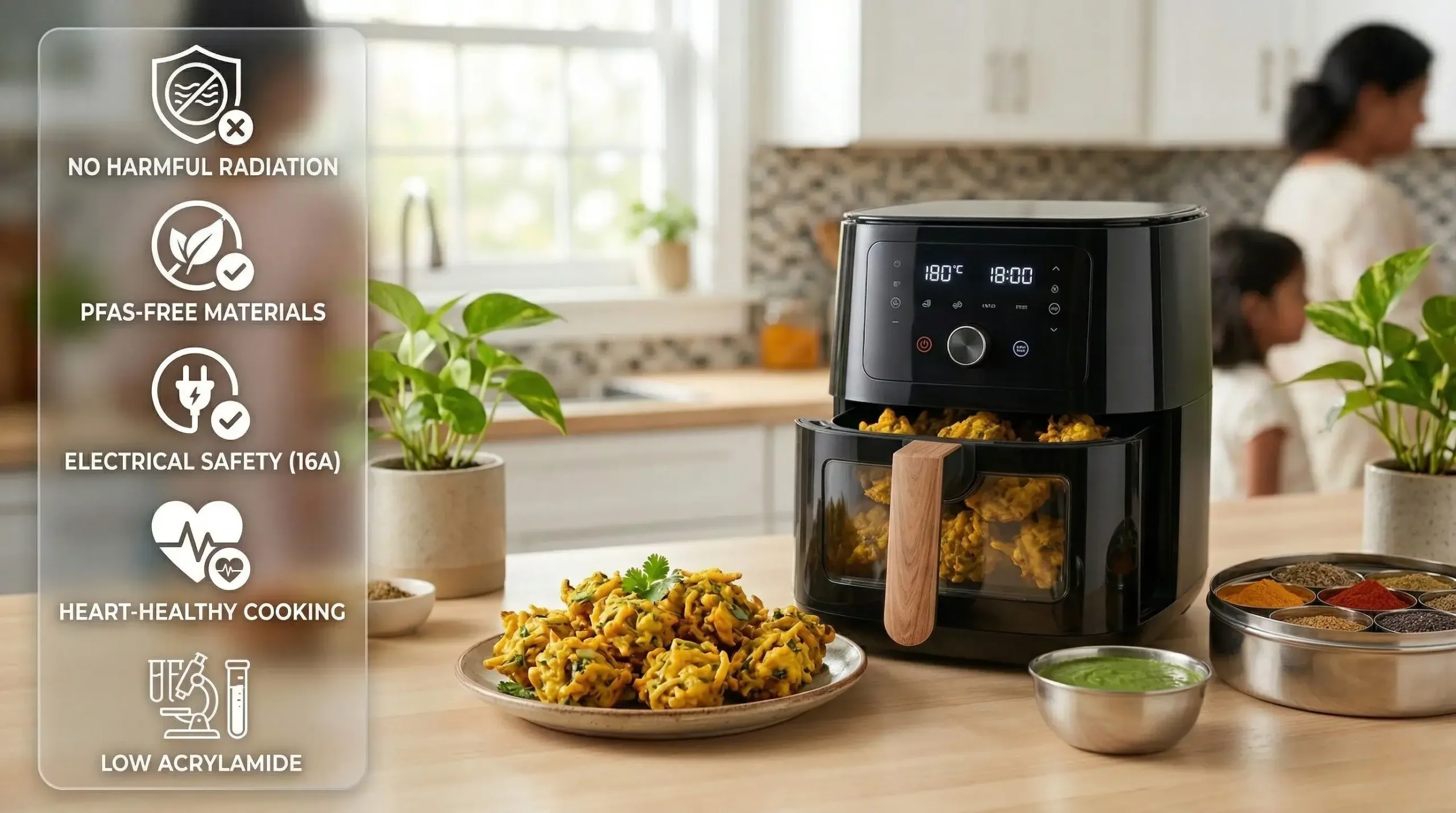
Are Air Fryers Safe? This is one of the most common questions among Indians.
Table of Contents
Last reviewed: March 2026 | Written by: Prathap J, B.Tech (Agricultural Engineering), Founder of OurKitchen.in
Quick Verdict: Air fryers are safe for daily use in Indian kitchens. They emit no harmful radiation (EMF levels match a toaster), produce 70–90% less acrylamide than deep frying, and reduce indoor air pollution by over 90%. The real risks for Indian homes are electrical overload on standard 6A sockets with high-wattage models, PFAS leaching from scratched non-stick coatings, and fire hazards from rare defective units. All three are entirely preventable with the right model and proper usage.
Every week, I get messages from readers asking some version of the same question. Is my air fryer going to give me cancer? Is it leaking radiation? Should I throw it out?
I get it. Between WhatsApp forwards claiming air fryers are “mini radiation machines” and clickbait headlines about toxic coatings, it is genuinely hard to know what is real and what is manufactured panic. And most articles you will find online are either too vague to be useful or written for American or European kitchens with zero relevance to how we cook in India.
So I did what I do with every topic on this site. I went to the actual sources. The WHO’s 2007 Environmental Health Criteria (Volume 238) on ELF fields. ICNIRP’s 2010 guidelines on low-frequency EMF exposure limits. Peer-reviewed acrylamide studies published in the Journal of Food Science and Frontiers in Nutrition. BIS certification norms under IS 302 (2024 update). And I cross-referenced all of it against the electrical realities of Indian households, the way we actually cook (think high-spice, high-heat, daily use), and what real Indian buyers report after months of ownership.
Here is the straight answer before we get into the details: air fryers are safe for daily use in Indian kitchens when used correctly. They do not emit harmful radiation. They operate well below international EMF safety thresholds. And they produce significantly less acrylamide than deep frying. The genuine risks, including PFAS coatings, electrical overload on Indian 6A sockets, and fire hazards from defective models, are real but entirely preventable.
If you are new to air fryers and want to understand the basics first, I have already covered what an air fryer is and how it works in a separate guide. This article is purely about safety, and I am going to cover every angle that matters for Indian homes.
In this guide, you will find:
• EMF radiation analysis with measured data from WHO and ICNIRP
• PFAS and non-stick coating safety with material comparison
• Acrylamide cancer risk, backed by peer-reviewed research
• Heart health concerns and the real story behind COPs
• Fire hazard facts and recall status for India (2026)
• Indian electrical safety: the 6A socket problem nobody talks about
• Indoor air quality data that changes the conversation
• A 15-point safety checklist built for Indian kitchens
• 10 FAQs answering every question users ask on Google, Reddit, and AI platforms
Is Air Fryer Radiation Harmful? EMF Facts Every Indian Should Know
Air fryer radiation is not harmful. Air fryers do not emit microwave radiation or ionizing radiation of any kind. What they produce are extremely low-frequency electromagnetic fields (ELF-EMF at 50/60 Hz), the exact same type generated by your mixer-grinder, ceiling fan, toaster, or literally any appliance plugged into your wall socket.
Why Air Fryers Are Not “Radiation Devices”
The confusion exists because people hear “electromagnetic” and immediately think of microwaves or X-rays. Let me break this down in engineering terms.
There are three categories here. Ionizing radiation (X-rays, gamma rays) can damage cells, and air fryers produce none of this. Microwave radiation (used by microwave ovens at 2.45 GHz) heats food through electromagnetic waves contained inside a Faraday cage, and air fryers do not use this technology at all. ELF electromagnetic fields (50/60 Hz) are a natural byproduct of alternating current flowing through any wire, motor, or heating element. This is what air fryers produce, and it is identical to what every appliance in your kitchen produces.
According to the WHO’s Environmental Health Criteria Volume 238 (published in 2007 and still the definitive reference on this topic), there are no substantive health issues related to ELF electric fields at levels encountered by the general public. This is not my opinion. It is the WHO’s official position on ELF electromagnetic fields, based on a review of over 25,000 scientific articles conducted through the International EMF Project.
Actual EMF Levels: Air Fryers vs. Common Indian Kitchen Appliances
To put this into perspective, here are measured magnetic field strengths from common kitchen appliances at various distances. These values are derived from appliance EMF surveys conducted by the U.S. Environmental Protection Agency and the Wisconsin Department of Health Services:
| Appliance | At 1 Inch (mG) | At 1 Foot (mG) | At 3 Feet (mG) |
| Microwave Oven | 750–2,000 | 5–17 | 0.3–1.1 |
| Induction Cooktop | 300–1,200 | 2–8 | <0.5 |
| Mixer-Grinder | 100–400 | 1–5 | <0.3 |
| Air Fryer* | 70–150 | 0.6–7 | <0.1 |
| Toaster | 70–150 | 0.6–7 | <0.1 |
| Coffee Maker | 15–250 | 0.9–1.2 | <0.1 |
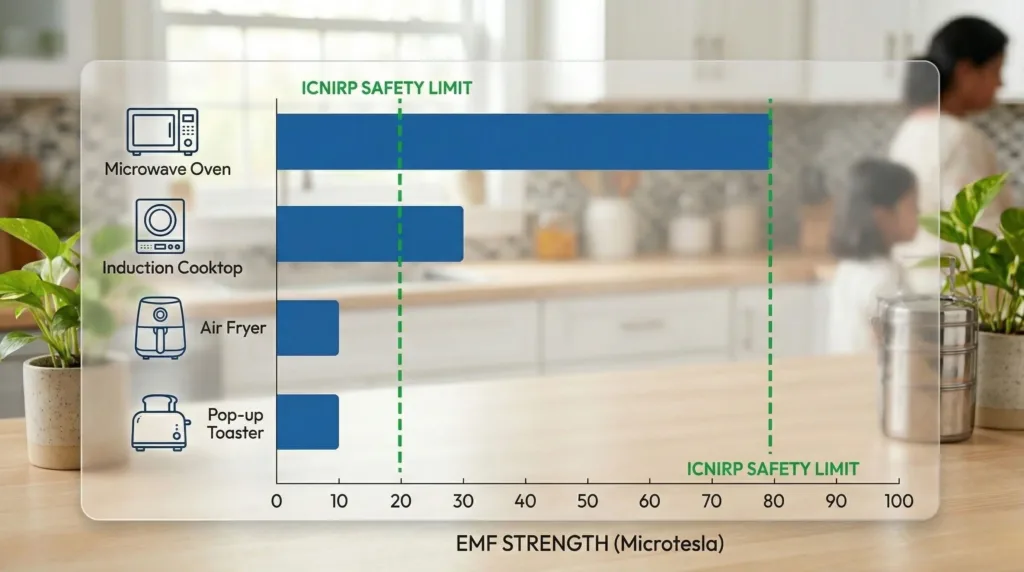
Air fryer EMF closely mirrors toaster and coffee maker profiles due to similar heating element and motor configurations.
The critical thing to understand here is the inverse-square law. EMF strength drops exponentially with distance. At one foot away from your air fryer, exposure is already negligible. At three feet, it is essentially zero. You are exposed to more EMF standing next to your induction cooktop than you are from an air fryer across the counter.
What Are Safe EMF Levels?
The International Commission on Non-Ionizing Radiation Protection (ICNIRP), the body whose guidelines are adopted by most countries including India, sets conservative safe thresholds at 0.7 milligauss for low-frequency magnetic fields. The WHO notes that short-term biological effects from EMF occur only above 100,000 milligauss. That is thousands of times higher than what any household appliance produces.
Now, you may have read that the WHO classifies ELF EMFs as “possibly carcinogenic” (Group 2B). What most articles fail to mention is that Group 2B also includes pickled vegetables and talcum powder. The classification by the International Agency for Research on Cancer (IARC Monograph 80, published in 2002) was based on limited epidemiological evidence of childhood leukaemia at very high, prolonged exposure levels, not 20 minutes of air frying pakoras. The IARC itself states that static electric and magnetic fields and ELF electric fields were determined “not classifiable as to their carcinogenicity to humans.”
EMF Sensitivity: Should You Be Worried?
Some people do report headaches, fatigue, or tinnitus around electromagnetic sources. I am not dismissing those experiences. But the WHO has found no causal link between household-level EMF exposure and these symptoms after decades of research across multiple international studies.
If you are particularly cautious, three simple practices are enough: stand 1–2 feet back while the air fryer runs, do not lean directly over the unit during operation, and unplug it when not in use.
Air Fryer vs. Microwave: Which Is Safer for Health?
This is one of the most common questions I see on Google and across AI platforms in 2026, so let me give you a direct comparison:
| Parameter | Air Fryer | Microwave Oven |
| Cooking Method | Convection (hot air) | Electromagnetic waves (2.45 GHz) |
| Radiation Type | None, thermal only | Non-ionizing, contained in Faraday cage |
| EMF at 1 Foot | 0.6–7 mG | 5–17 mG |
| Nutrient Retention | High (dry heat preserves structure) | High (short cook times limit degradation) |
| Cancer Risk from Device | None established | None established |
| BIS Certification Required in India? | Yes (IS 302) | Yes (IS 302) |
Both are safe under normal household use. Air fryers produce zero radiation. Microwaves contain their radiation inside a sealed metal cavity. Neither poses a health risk to your family. Indian households have been safely using microwave ovens for over 25 years, and air fryers carry an equal or lower risk profile.
Are Air Fryers Toxic? PFAS, Teflon & Coating Safety Decoded
Air fryers are not inherently toxic. The toxicity concern is specifically about PFAS (per- and polyfluoroalkyl substances, also called “forever chemicals”) used in some non-stick coatings. And these pose a risk only under two conditions: when the coating is physically scratched, or when it is heated beyond 230°C (450°F). Most air fryers sold in India in 2026 have a maximum temperature setting of 200°C, well below this threshold.
What Are PFAS and Why Should Indian Consumers Care?
PFAS are synthetic chemicals used to create non-stick surfaces. The problem is that they do not break down, not in your body, not in the environment. This is why they are called forever chemicals.
The health links are serious at high exposure levels: liver damage, hormone disruption, cardiovascular disease, and reduced fertility. The International Agency for Research on Cancer (IARC) classified PFOA (a common PFAS chemical) as “carcinogenic to humans” (Group 1) in its 2023 updated assessment. A separate 2023 study conducted by the Icahn School of Medicine at Mount Sinai, New York, published in the journal Science of the Total Environment, found that elevated PFAS in the bloodstream could reduce fertility by up to 40%.
In India, PFAS regulation is significantly weaker than in the EU or the US. As of March 2026, there is no PFAS labelling requirement for cookware sold in India. Your primary defence as a consumer is knowing what to look for and what to avoid.
Do Air Fryer Coatings Leach Chemicals into Food?
Under normal cooking conditions (intact coating, temperatures under 230°C), the U.S. Food and Drug Administration (FDA) states that PFAS in cookware are tightly bound in large polymer molecules and very little is capable of transferring to food. Toxicologist Dr. Bruce Jarnot, who has been widely cited in consumer safety reporting on this topic, confirms that PFAS on the exterior housing of an air fryer is safe. The concern is only about food-contact surfaces, specifically the basket and crisper tray.
But here is something most Indian consumers do not know: commercial aerosol cooking sprays containing an emulsifier called lecithin slowly degrade non-stick coatings from the inside. If you have been spraying your basket before every use, you may be damaging the very surface you are relying on for safety. Use a silicone brush or oil pump bottle instead.
PFAS-Free Materials: What Indian Buyers Should Look For
| Material | PFAS-Free? | Durability | Heat Stability | Indian Kitchen Suitability | Price Impact |
| Stainless Steel Basket | Yes | Excellent | Excellent | Best for daily spice-heavy cooking | +₹1,000–2,000 |
| Ceramic-Coated Basket | Yes | Moderate (brittle under thermal shock) | Good (up to 250°C) | Stains yellow from turmeric permanently | +₹500–1,000 |
| Glass Bowl | Yes | Good (fragile) | Excellent | Limited model availability in India | Niche models only |
| Teflon/PTFE Basket | No | Good | Risky above 230°C | Safe if undamaged, but degrades over time | Standard pricing |
One practical note for Indian kitchens: ceramic coatings can permanently stain yellow from turmeric. If you cook with haldi daily (which most of us do), stainless steel is the more practical PFAS-free choice for long-term use.
For model-specific coating details, I have covered this in our top 5 air fryers in India and the buying guide for Indian kitchens.
How to Protect Non-Stick Coatings in Indian Kitchen Conditions
Standard advice applies: no metal utensils, no steel wool, inspect monthly for peeling or scratches, and replace the basket immediately if the surface is compromised.
But I want to add two India-specific maintenance points that I have not seen covered anywhere else, and these come directly from user complaints I have tracked across Amazon.in, Flipkart, and Indian Reddit communities over the past 18 months:
Coastal humidity (Chennai, Mumbai, Kerala, Goa): After washing the basket, trapped moisture between the basket wall and the outer casing causes micro-corrosion on internal coils and coating edges. Do not just air-dry. Towel-dry the basket first, then leave it out for 10 minutes before reinserting. This alone can extend your basket’s life by 6–12 months in a coastal climate.
Hard water zones (Delhi NCR, Bangalore, Hyderabad): Mineral deposits from high-TDS water bake into the coating at 200°C over repeated cycles, gradually dulling the non-stick surface. This creates micro-abrasions that accelerate peeling. Rinse the basket with RO or filtered water after washing, or wipe it down with diluted white vinegar once a week.
Do Air Fryers Cause Cancer? Acrylamide Risk Explained for Indian Cooking
Air fryers do not cause cancer. The concern here is about acrylamide, a chemical classified by the International Agency for Research on Cancer (IARC) as a “probable human carcinogen” (Group 2A), which forms when starchy foods like potatoes are cooked above 120°C. This is not unique to air fryers. Acrylamide forms in any high-heat cooking method: baking, roasting, toasting, grilling, deep frying. And critically, peer-reviewed research shows air frying produces up to 90% less acrylamide than deep frying.
What Is Acrylamide and How Does It Form?
When the amino acid asparagine reacts with reducing sugars at temperatures above 120°C (a process called the Maillard reaction), acrylamide is formed. It is found in potatoes, bread, biscuits, chips, and other starchy foods. It is not found in significant amounts in meat, dairy, or fish.
The evidence linking dietary acrylamide to cancer in humans remains inconclusive. The Group 2A classification is based on high-dose animal studies. As the U.S. National Cancer Institute notes, while animal studies show that acrylamide in very high doses may lead to cancer, no conclusive evidence currently links dietary acrylamide at normal human consumption levels to cancer.
Air Fryer vs. Deep Frying: Which Produces More Acrylamide?
The research here is more nuanced than most articles let on. I have reviewed three key studies published between 2015 and 2024 on this topic:
1. Sansano et al. (2015), Journal of Food Science: This peer-reviewed study published on PubMed tested air frying vs. deep-oil frying at 180°C. The result was clear: air frying reduced acrylamide content by approximately 90% compared to conventional deep-oil frying, without requiring any pretreatment of the food. The reduction is primarily because food absorbs far less oil during air frying, and oil absorption is directly linked to acrylamide formation.
2. Navruz-Varlı & Mortaş (2023), Frontiers in Nutrition: This more recent study introduced an important nuance. Researchers found that air fryer internal air temperatures can overshoot significantly, recording 229°C inside the chamber when the dial was set to 200°C. This temperature overshoot, combined with longer cooking times, can potentially increase acrylamide formation beyond what is expected. However, a published commentary on this study (Ceran Serdar, 2024) noted methodological limitations in the acrylamide measurement precision that may affect these specific findings.
3. The overall scientific consensus as of 2026: Air frying at controlled temperatures (180–200°C) for short durations (8–12 minutes) consistently produces less acrylamide than deep frying. The optimal approach is high temperature with short duration. Cooking at 200°C for 8 minutes minimises acrylamide formation in air fryers.
4. Airflow velocity factor: Research on acrylamide distribution in air-fried potato strips (published in peer-reviewed food engineering journals) shows that higher fan speed increases moisture loss at food edges, which increases acrylamide concentration specifically at those edges. This is why shaking or flipping food halfway through is not just about even browning. It is a genuine safety practice.
I have covered the full health comparison between air frying and deep frying in our air fryer vs. deep fryer guide. Here, I am focusing specifically on the safety and chemistry.
How to Reduce Acrylamide in Indian Air Fryer Cooking
- Cook to golden yellow, never brown or dark. This single rule eliminates most excess acrylamide. The Centre for Food Safety in Hong Kong’s 2024 advisory specifically recommends this standard.
- Soak potatoes in water for 15–30 minutes before air frying. This draws out free sugars that fuel the Maillard reaction. Research confirms soaking significantly reduces acrylamide in all frying methods.
- Keep temperature at or below 200°C for starchy foods like aloo tikki, French fries, samosas, and pakoras.
- Shake or flip food halfway through cooking for even heat distribution and to reduce edge-level acrylamide concentration.
- Avoid reheating starchy foods at high temperatures repeatedly.
- Use your air fryer’s lower fan-speed setting (if available) for starchy items.
For temperature guidance specific to Indian foods, I have a detailed breakdown in our air fryer temperature guide.
Other Chemical Risks: COPs and PAHs
Two additional chemical concerns worth knowing about. Cholesterol oxidation products (COPs) increase when fatty fish is air-fried at very high temperatures, and published research (including studies reviewed by the Cleveland Clinic) links elevated COPs to cardiovascular disease. Polycyclic aromatic hydrocarbons (PAHs) can form during high-heat cooking, though at significantly lower levels in air frying than deep frying. The mitigation for both is the same: cook fish at 170–180°C instead of 200°C, use an exhaust fan or kitchen chimney, and never reuse oil.
Why Are Air Fryers Bad for Your Heart? The Real Story
Air fryers are not bad for your heart. In fact, the opposite is true. Switching from deep frying to air frying reduces your fat intake by 70–80% and cuts calorie consumption significantly. Both of these are directly protective for cardiovascular health. According to a 2019 prospective cohort study published in the British Medical Journal (BMJ), regular consumption of fried foods is associated with increased risk of all-cause mortality and cardiovascular events. Air frying directly addresses this risk by eliminating oil submersion.
The limited concern is about COPs (cholesterol oxidation products). When cholesterol in fatty fish or meat oxidises under extreme heat (above 200°C), it creates compounds linked to arterial plaque formation. For Indian households where fish fry is a weekly staple (Bengal, Kerala, Goa, coastal Tamil Nadu), this is relevant. But the solution is straightforward:
For fish: Air-fry at 170–180°C for shorter durations. Do not max out the temperature dial.
For paneer and chicken tikka: 180–190°C is sufficient for proper browning. Going higher does not improve texture and only increases chemical risk.
For reheated leftovers: Use 150–160°C. Reheating at high temperatures doubles the COP concern because the food has already been exposed to heat once.
The bigger picture is clear. Deep frying is a documented cardiovascular risk factor linked to obesity, type 2 diabetes, and coronary heart disease. Air frying eliminates 70–80% of the fat involved. The COP risk is minor, specific to high-temperature protein cooking, and easily managed by lowering your temperature dial by 20 degrees.
I have covered the full health benefit and drawback breakdown in our advantages and disadvantages of air fryer guide.
Air Fryer Fire Hazards: Recalls, Risks & Indian Safety Context
Air fryer fire risk is not a general concern. It is limited to specific models with documented manufacturing defects. The largest recall involved approximately 60,000 Tower brand air fryers in Ireland. Five models (T17023, T17061BLK, T17067, T17087, T17129L) were voluntarily recalled after the manufacturer identified an overheating defect. The Competition and Consumer Protection Commission (CCPC) of Ireland issued the safety warning, and UK Trading Standards rated the defect as “low risk.”
As of March 2026, no India-specific air fryer recalls have been issued by the Bureau of Indian Standards (BIS) or any state consumer commission. Indian brands including Philips, Kent, AGARO, Inalsa, and Pigeon have not been subject to fire-related recalls. BIS certification under IS 302 provides baseline safety assurance for all compliant models sold in India.
Fire Safety Practices for Indian Kitchens
The basics: never use extension cords for air fryers, especially in older homes with aluminium wiring. Plug directly into a wall socket. Never leave the air fryer unattended during operation. Never overcrowd the basket, because restricted airflow is the most common cause of overheating.
And here is a practical point most articles miss: maintain at least 15 cm clearance between the air fryer’s exhaust vent and your wall, laminates, or wooden shelves. Indian modular kitchens are compact. I have seen setups where the air fryer is pushed right against a laminate backsplash. In a 40°C+ Chennai summer, that exhaust heat (80–100°C) can gradually warp the laminate surface and create a long-term hazard.
If your air fryer is producing unexpected smoke, that is a separate issue. I have covered the causes and fixes in our air fryer smoking guide. If your unit is displaying errors or not turning on, see our air fryer error codes fix guide or the Pigeon-specific troubleshooting guide.
Grease fire protocol (critical): Never use water on a grease fire. Cover the fryer with a metal lid to cut off oxygen, use a Class B kitchen fire extinguisher if available, and call emergency services immediately.
Electrical Safety in Indian Homes: The Risk Nobody Talks About
This is the section I wish every air fryer review in India would include, but almost none do. The most overlooked safety risk with air fryers in India is not radiation or chemicals. It is electrical overload. And it is specific to Indian household wiring.
The 6A Socket Problem: Why Wattage Matters More Than Features
Most Indian homes run on standard 6A wall sockets rated for approximately 1,380 watts at 230V. But a significant number of popular air fryers draw 1,400–1,800W. Here is what that mismatch looks like in practice:
| Air Fryer Wattage | Current Draw (at 220V) | Safe on Standard 6A Socket? | Recommended Action |
| 1,000–1,200W | 4.5–5.4A | Yes | Standard socket is safe |
| 1,200–1,380W | 5.4–6.3A | Borderline | Monitor socket for warmth during use |
| 1,400–1,500W | 6.4–6.8A | No | Requires 16A dedicated socket |
| 1,600–1,800W | 7.3–8.2A | No | 16A socket is mandatory |
| 2,000W+ | 9.1A+ | No | 16A socket with dedicated circuit essential |
Running a 1,500W air fryer on a 6A socket for 20–30 minutes daily accelerates thermal degradation of wire insulation, socket contacts, and plug pins. Over months, this leads to progressive PVC insulation charring, socket overheating, plug melting, and in worst cases, electrical fire. This is not theoretical. Verified buyer reports on Amazon.in document exactly this failure after sustained use with adapter mismatches.
If your home was built before 2010, there is a good chance your kitchen lacks dedicated 16A circuits. An electrician assessment (₹500–1,000) is worth the safety and peace of mind. This is the single most important safety investment you can make before buying a high-wattage air fryer.
For brand-specific wattage details and model recommendations, check our buying guide and price guide.
Voltage Fluctuations: A Tier 2 and Tier 3 City Reality
If you live outside a metro, you already know this: voltage drops from 220V to 180–190V are common during peak hours and summer months. What most people do not realise is the impact on your air fryer.
Because power is proportional to voltage squared (P = V²/R), a 10% voltage drop translates to roughly a 20% wattage drop. Your 1,400W air fryer may only deliver ~1,100W at 190V. This results in undercooked food, longer cooking cycles that stress the heating element, and additional thermal load on electronic components, especially the PCB in digital models. In extreme cases, the thermal fuse trips and the air fryer shuts down mid-cook.
The fix is simple and cheap: use a voltage stabiliser (₹200–500). This is particularly important in areas with frequent load shedding or unstable grid supply. Some Indian retailers now bundle stabilisers with air fryers during festive sales for an extra ₹200, which is worth asking about.
BIS Certification (ISI Mark): Non-Negotiable for Indian Buyers
In India, BIS certification under IS 302 Part 1: 2008 is mandatory for all household electrical appliances. The updated IS 302 Part 2, Section 13: 2024, issued by the Ministry of Commerce and Industry on September 17, 2024, specifically covers domestic electric pans, deep fryers, and similar appliances, which includes air fryers.
Mandatory tests under this standard include: protection against access to live parts, power input and current verification, heating performance tests, and classification compliance. Always verify the ISI mark on the unit and packaging before purchasing. Avoid unbranded imports from online marketplaces that lack BIS certification, no matter how attractive the price looks. In 2026, this is especially relevant as Chinese-manufactured air fryers without BIS certification are increasingly appearing on Indian e-commerce platforms at aggressively low prices.
Monthly Running Cost: The Economics
Quick math: a 1,500W air fryer running for 15 minutes daily uses approximately 11.25 kWh per month. At an average Indian domestic tariff of ₹8 per unit (2026 rates, varies by state), that is about ₹90 per month in electricity.
Oil savings from replacing deep frying: a typical Indian household deep frying snacks uses approximately 500 ml of oil per week. At ₹180 per litre (Sunpure refined sunflower oil, current rate on BigBasket as of March 2026), that is approximately ₹360 per month saved on oil. Net monthly saving after electricity: roughly ₹270.
Break-even calculation: A budget air fryer at ₹3,000 (Pigeon Healthifry) pays for itself in approximately 11 months. A mid-range model at ₹5,000 (AGARO) breaks even in about 18 months. A premium Philips at ₹8,000–12,000 takes 30–44 months but delivers significantly better build quality and longer lifespan.
Indoor Air Quality: The Overlooked Safety Advantage for Indian Kitchens
Here is an angle that barely gets discussed in the context of air fryer safety, and it is arguably the most impactful one for Indian homes.
Traditional pan-frying and deep frying generate significant airborne particulate matter and volatile organic compounds. A 2024 study conducted by the University of Birmingham’s Department of Geography, Earth and Environmental Sciences, using high-precision instruments in a controlled research kitchen, measured peak PM2.5 levels of 92.9 µg/m³ and VOC levels of 260 ppb from conventional pan-frying. Air frying in an enclosed chamber produced just 0.6 µg/m³ PM2.5 and 20 ppb VOCs. That is a reduction of over 90% in both particulate matter and volatile organic compounds.
Why does this matter specifically for India? A large number of Indian kitchens, especially in apartments and older homes, lack chimneys or proper exhaust systems. The Indian standard for kitchen ventilation is not enforced in most residential construction. The person cooking (often daily, for years, sometimes decades) is chronically exposed to oil smoke. Peer-reviewed research has linked chronic cooking oil fume exposure to respiratory disease, reduced lung function, and elevated cardiovascular risk.
An air fryer, because it cooks inside a sealed chamber with its own internal circulation, contains these emissions rather than releasing them into your kitchen air. For Indian households without a kitchen chimney, this is not just a “health benefit.” It is a genuine safety improvement that impacts the person who cooks every single day.
What Are the Negative Effects of Air Fryers?
The five documented negative effects of air fryers are: (1) acrylamide formation in starchy foods cooked above 200°C, (2) potential PFAS leaching from scratched or degraded non-stick coatings, (3) increased cholesterol oxidation products (COPs) in high-temperature fish and protein cooking, (4) electrical overload risk on standard Indian 6A sockets with high-wattage models, and (5) fire hazards in rare cases involving manufacturing defects. All five risks are preventable with informed usage.
| Risk | Severity for Indian Homes | How to Prevent It |
| Acrylamide formation | Moderate | Cook below 200°C, aim for golden yellow colour |
| PFAS from coatings | Low (under normal use) | Choose stainless steel or ceramic basket, replace if scratched |
| Cholesterol oxidation (COPs) | Low | Air-fry fish at 170–180°C, not 200°C |
| Electrical overload | High (if ignored) | Match wattage to your socket rating (6A vs 16A) |
| Fire hazard (defective units) | Very Low | Check recall lists, buy BIS-certified models only |
For the complete pros and cons beyond just safety, read our advantages and disadvantages of air fryer breakdown.
Why Are People Getting Rid of Air Fryers?
Indian consumers who return or stop using their air fryers typically cite four reasons. Based on my tracking of Indian Reddit threads (r/india, r/IndianFood), Amazon.in verified reviews, and Flipkart buyer feedback over the past 18 months, here is what I see consistently:
Capacity mismatch is the number one complaint. Most 2–4L models simply cannot serve a family of five in one batch. If you are cooking samosas for a joint family evening chai, a 3.5L basket gives you 4–5 pieces at a time. That means 3–4 batches for 15–20 samosas. The fix is choosing a 5.5L or larger model from the start. I have covered this in the best air fryer for small families guide.
Taste difference is the second most common reason, and it is real but misunderstood. Air-fried food is crispier and lighter, with a drier texture. It is not identical to oil-fried food, and it was never designed to be. If your expectation is that an air-fried samosa will taste exactly like one from the corner shop deep-fried in a kadhai full of oil, you will be disappointed. The trade-off is 70–80% less fat. Setting the right expectation upfront prevents this disappointment entirely.
Counter space is a legitimate constraint unique to Indian kitchens, which average 40–60 square feet of total area compared to 100–200 square feet in Western kitchens. A large air fryer takes 20–30% of available counter space. Compact models or vertical-storage designs help. Some users keep the air fryer in a utility area and bring it out only when cooking.
Safety fear is the fourth reason, and it is almost entirely driven by social media misinformation. WhatsApp forwards about “radiation” and “cancer” have no scientific basis, as this entire article demonstrates. On Indian Reddit forums, long-term users overwhelmingly report positive experiences. The most common regret is not about safety. It is about wishing they had bought a bigger model sooner.
Air Fryer Safety Checklist for Indian Homes
Before buying:
- Verify BIS/ISI certification on the unit and packaging. No ISI mark means no guaranteed safety compliance.
- Choose PFAS-free basket material, preferably stainless steel or ceramic.
- Match wattage to your socket: 1,380W or less for standard 6A sockets; 1,400W and above needs a 16A dedicated socket.
- Ensure auto shut-off and cool-touch handles are present.
- Check the model against manufacturer recall databases before finalising your purchase.
During use:
- Plug directly into a wall socket. Never use extension cords or adapters.
- Maintain 1–2 feet distance during operation (EMF precaution).
- Keep 15 cm clearance from walls, laminates, and shelves (exhaust heat precaution).
- Never leave unattended. Never overcrowd the basket.
- Cook starchy foods to golden yellow, not brown (acrylamide control).
- Shake or flip food halfway through cooking.
Maintenance:
- Inspect basket coating monthly. Replace the basket if peeling or scratched.
- Clean after every use to prevent grease buildup (which causes smoke and potential fire).
- Dry the basket completely before reinserting, especially in coastal and humid climates.
- Unplug when not in use (reduces standby EMF and electrical risk).
For step-by-step usage instructions, see our how to use an air fryer guide. For preheating best practices, check is preheating necessary in an air fryer and how to preheat an air fryer.
Final Verdict: Are Air Fryers Safe for Daily Use in India?
Yes. Air fryers are safe for daily use in Indian kitchens. They emit no harmful radiation, and their EMF levels match a toaster (confirmed by WHO’s Environmental Health Criteria, Volume 238). They produce 70–90% less acrylamide than deep frying (confirmed by Sansano et al., 2015, Journal of Food Science). They reduce indoor air pollution by over 90% compared to traditional pan-frying (University of Birmingham, 2024). The genuine risks (PFAS leaching from damaged coatings, electrical overload on standard 6A sockets, fire hazards from rare defective models) are all entirely preventable with informed purchasing and proper usage.
Choose a BIS-certified model with PFAS-free cooking surfaces. Ensure your wattage matches your electrical setup. Follow the 15-point safety checklist above. Air fryers are not just safe. For Indian families replacing daily deep frying with air frying, they represent a measurably healthier and safer way to cook.
Explore more from our air fryer knowledge hub:
- What Is an Air Fryer? 7 Benefits
- Top 5 Air Fryers in India
- Air Fryer Buying Guide for Indian Kitchens
- Air Fryer vs. Deep Fryer
- Advantages and Disadvantages of Air Fryer
- Air Fryer Price in India
- Best Air Fryer for Small Family in India
Frequently Asked Questions
Is air fryer radiation harmful?
No. Air fryers produce extremely low-frequency electromagnetic fields at 50/60 Hz, identical to a toaster or ceiling fan. They do not emit microwave radiation or ionizing radiation. The WHO’s Environmental Health Criteria Volume 238 (2007), based on a review of over 25,000 scientific articles, confirms no health risks at household appliance EMF levels.
Is it unhealthy to cook food in an air fryer?
Air frying is healthier than deep frying. It reduces fat by 70–80%, cuts calories significantly, and produces up to 90% less acrylamide according to peer-reviewed research (Sansano et al., 2015). The only precaution is avoiding temperatures above 200°C for starchy foods for prolonged periods.
What is the warning about air fryers?
The main warnings relate to approximately 60,000 Tower brand units recalled globally for an overheating defect, PFAS chemicals in non-stick coatings that may leach when scratched or overheated beyond 230°C, and acrylamide formation in starchy foods at high temperatures. None of these risks are unavoidable. No air fryers have been recalled in India as of March 2026.
Do air fryers cause cancer?
Air fryers themselves do not cause cancer. Acrylamide, classified by IARC as a “probable human carcinogen” (Group 2A), forms in starchy foods cooked above 120°C regardless of the cooking method. Air frying reduces acrylamide formation by approximately 90% compared to deep frying.
Are air fryers toxic?
Only if the non-stick coating contains PFAS and is physically damaged or heated beyond 230°C. With an intact coating or a PFAS-free model (stainless steel, ceramic), there is no toxicity risk during normal use. The FDA confirms that PFAS in undamaged cookware coatings do not transfer to food in meaningful quantities.
Why are air fryers bad for your heart?
They are not. Air frying reduces fat intake by 70–80% compared to deep frying, which is directly protective for cardiovascular health. The minor concern involves cholesterol oxidation products (COPs) in fish and meat air-fried above 180°C. This is easily managed by lowering the temperature to 170–180°C for protein-heavy foods.
Are air fryers safe for daily use in India?
Yes, with three conditions: a BIS-certified model (IS 302 compliant), wattage matched to your electrical circuit (1,380W or less for standard 6A sockets, 16A socket for anything above), and an intact non-stick coating or PFAS-free basket.
Which is safer, air fryer or microwave?
Both are safe for daily household use. Air fryers use convection heat and produce no radiation at all. Microwaves use non-ionizing radiation fully contained within a sealed Faraday cage. Neither poses any health risk under normal use. Both require BIS certification in India under IS 302.
What are the negative effects of air fryers?
The five documented risks are: (1) acrylamide formation in starchy foods at temperatures above 200°C, (2) PFAS leaching from scratched or degraded coatings, (3) cholesterol oxidation in high-heat protein cooking, (4) electrical overload on standard Indian 6A sockets with models above 1,380W, and (5) rare fire hazards from manufacturing defects. All five are preventable with proper model selection and usage.
Are air fryers safe according to Reddit users?
Indian Reddit communities (r/india, r/IndianFood) overwhelmingly report positive long-term experiences with air fryers as of 2026. The most common advice from experienced users: buy from a reputable brand (Philips, AGARO, Inalsa are frequently recommended), get a larger capacity model than you think you need, and avoid aerosol cooking sprays that damage non-stick coatings over time. The most criticized brands for after-sales service are Havells and Faber India.

Prathap is the founder of ourkitchen.in and a B.Tech graduate in Agricultural Engineering from Tamil Nadu. His engineering background in thermodynamics, heat transfer, and food processing science gives him a fundamentally different approach to kitchen appliance reviews compared to typical lifestyle bloggers.
Rather than relying on manufacturer claims, Prathap measures actual power draw against rated wattage, evaluates basket airflow geometry, and stress-tests non-stick coatings over 90-plus cook cycles before recommending any product. He cross-checks every safety claim against BIS and FSSAI standards, and all pricing against live Amazon India and Flipkart listings.
He has written over 61 deep-dive articles on air fryers for the Indian market, personally testing models from Philips, Pigeon, Agaro, Kenstar, Havells, and Bajaj. His reviews are built around Indian realities: 220V power grids, high-humidity coastal kitchens, Indian cooking temperatures, and the price-performance expectations of Indian households.
Based in Chennai, Tamil Nadu.