
Table of Contents
Common Air Fryer Error Codes and Solutions
An air fryer error code (like E1, E2, or E10) is a digital failsafe triggered by sensor malfunctions, thermal overloads, or grid voltage fluctuations. To fix most common air fryer error codes, unplug the unit for 15 minutes to reset the MCU board and clear the thermal memory.
The Engineering Perspective
As an Agricultural Engineering graduate (B.Tech) and appliance specialist, I have dissected enough heating systems to know that modern air fryers have evolved far beyond simple mechanical convection heaters. Today’s units are complex digital ecosystems governed by highly sensitive Microcontroller Units (MCUs). While marketing brochures highlight “6L capacities” and pre-set menus, the reality of the Indian kitchen is much harsher.
When you overpack a basket with samosas or paneer tikka, you severely restrict the Z-axis airflow, choking the convection vortex. In regions like Tiruppur or Chennai, frequent voltage dips and harmonic distortions on the electrical grid further stress these sensitive 2.4GHz WiFi modules and NTC thermistors. This is why your air fryer suddenly shuts down and flashes an alphanumeric code. These codes are not random glitches; they are precise thermodynamic and electrical interventions designed to prevent thermal runaway and fire hazards. This guide bypasses the basic manual instructions to provide you with the component-level engineering logic behind Philips, Pigeon, and Kenstar error codes, so you can diagnose the exact point of failure.
Philips Air Fryer Error Codes (The Premium MCU Architecture)
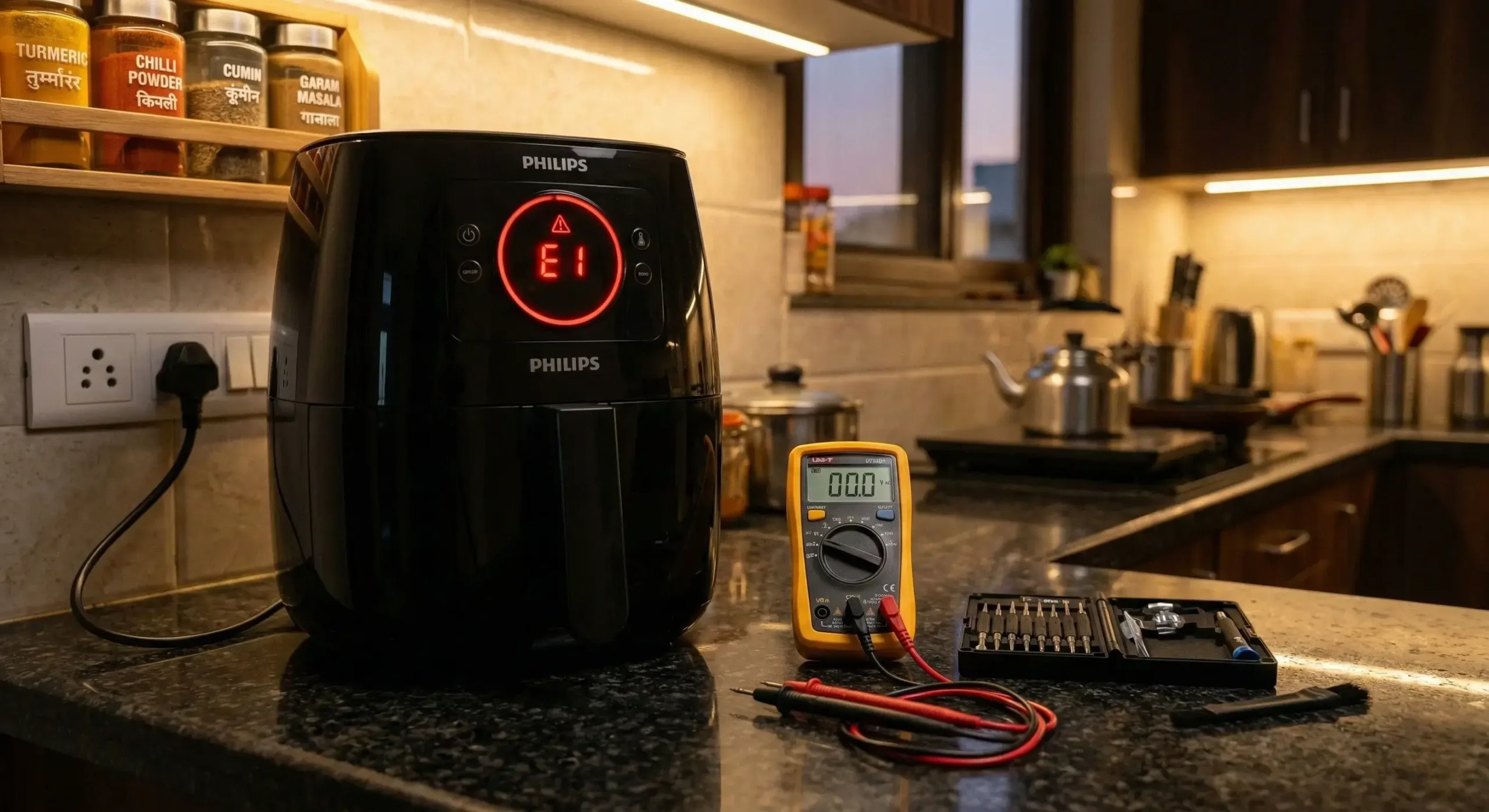
Direct Verdict: Philips air fryer error codes, predominantly E10, E1, and blinking dashes, indicate micro-controller (MCU) communication failures or thermal sensor faults. The E10 code signifies a WiFi module handshake error, while E1 points to a compromised NTC thermistor. Most clear with a hard 15-minute capacitive discharge reset.
Philips dominates the premium segment with models running on highly sensitive, digitally regulated boards. Because their internal safety tolerances are incredibly tight, they are more prone to displaying error codes safely rather than simply burning out or shutting down entirely like budget alternatives.
Philips E10 Error & Blinking Dashes (Models NA46x)
Direct Verdict: The Philips E10 error code or blinking dashes on NA46x models means the appliance’s internal 2.4GHz WiFi module failed to establish a handshake with your router. This is a firmware loop, not a heating element failure, requiring a network reset via the NutriU app to resolve.
Technical Breakdown: Smart air fryers rely on continuous telemetry to sync with the Philips NutriU app. When the 2.4GHz WiFi chip encounters frequency interference or power harmonics (common during Indian grid voltage sags), the MCU halts the startup sequence to prevent partial data corruption. The blinking dashes essentially mean the unit is stuck in a boot-loop waiting for an IP address.
The Fix:
- Capacitive Discharge: Unplug the air fryer. Wait exactly 15 minutes. This allows the internal capacitors to drain completely, clearing the MCU’s volatile memory.
- Network Isolation: Ensure your home router is broadcasting a dedicated 2.4GHz band. Philips smart boards cannot read 5GHz bands. If your router uses “Smart Connect” (auto-switching), disable it.
- Firmware Reset: Open the NutriU app, delete the appliance profile, plug the unit back in, and re-initiate the pairing process from scratch.
Philips E1 / 0x Error Codes (Thermistor/Sensor Fault)
Direct Verdict: A Philips E1 error code means the main NTC thermistor is registering an open or short circuit. This critical thermal failsafe triggers when the sensor is disconnected, damaged, or insulated by polymerized grease, preventing the heating element from initiating an uncontrolled, continuous thermal runaway.
Technical Breakdown: Philips uses a precision 100kΩ Negative Temperature Coefficient (NTC) thermistor to monitor the internal basket temperature. As the heat rises, the thermistor’s electrical resistance predictably drops, allowing the MCU to modulate the 1700W heating coil.
In Indian kitchens, aerosolized triglycerides from heavy spice-oils undergo polymerization under high heat, forming an insulating, gummy layer over the sensor probe. Alternatively, operating the unit in environments with 85%+ humidity can cause microscopic moisture ingress into the sensor harness, shorting the 5V logic circuit.
The Fix:
- Visual Inspection: Remove the basket and look at the ceiling of the heating chamber. The thermistor is the small metal nub protruding near the coil.
- Chemical Degreasing: If coated in brown, sticky residue, gently clean the probe using a Q-tip dipped in 99% Isopropyl Alcohol. Do not use abrasive scrubbers, as scratching the probe alters its thermal calibration.
- Hardware Replacement: If the sensor is clean but E1 persists, the thermistor’s internal wiring is severed and requires a multimeter continuity test and subsequent replacement by an authorized Philips technician.
Philips Diagnostic Cheat Sheet
- E10 / Dashes: WiFi Module – 2.4GHz IP handshake failure / Power harmonic disruption. Unplug for 15 mins; Re-pair via NutriU app on a strict 2.4GHz network.
- E1 / 0x codes: NTC Thermistor – Open/short circuit in thermal sensor; Polymerized grease insulation. Degrease sensor probe with isopropyl alcohol; Test continuity.
- A-Codes: Cooling Fan / Relay – Exhaust fan RPM dropped below safety threshold. Check rear exhaust vents for blockages (wall clearance < 15cm).
Pigeon Air Fryer Error Codes (The Budget MCU Workhorse)
Direct Verdict: Pigeon air fryer error codes, specifically E1 and E2, signal thermal overloads and sensor disconnects caused by restricted airflow or voltage spikes. Because Pigeon uses a simplified, cost-effective MCU architecture tailored for Indian grids, these failsafes protect the 1500W heating coil from catastrophic burnout during heavy use.
While premium brands use complex sensor arrays, budget-friendly powerhouses like the Pigeon Healthifry rely on a more rudimentary, yet highly effective, digital logic board. These units are specifically engineered to withstand the frequent 220V–240V fluctuations common in Indian tier-2 and tier-3 cities. However, this simplified micro-controller (MCU) architecture means the appliance has less margin for error when forced out of its ideal thermodynamic operating window. When the board detects an anomaly, it immediately severs the power to the internal TRIACs, flashing a two-digit code.
Pigeon E2 Error Code (The “Overpacked Basket” Syndrome)
Direct Verdict: The Pigeon E2 error code indicates a critical thermal overload, meaning the internal heating chamber has exceeded safe thermodynamic limits. This almost always occurs when the basket is overstuffed with dense foods, choking the Z-axis convection vortex and trapping heat directly around the 1500W heating element.
Technical Breakdown: Do not buy into the “liter capacity” marketing hype. While a Pigeon air fryer might boast a 4.2L or 6L capacity, the usable area is strictly limited by the floor dimensions. Air frying relies on a rapid, uninterrupted cyclonic flow of superheated air (convection). When families prepare festival snacks and stack multiple layers of medu vada or samosas, they completely block this Z-axis airflow. Heat fails to circulate downward and instead violently rebounds back up to the ceiling of the heating chamber. The NTC thermistor reads this localized temperature spike (often exceeding the 200°C limit) and triggers the E2 failsafe to prevent the plastic chassis from melting and the 1500W coil from burning out.
The Fix:
- The 35 cm² Rule: Calculate your basket’s floor area. A standard paneer tikka cube or samosa needs roughly 35 cm² of space to allow proper air displacement.
- Immediate Reset: Unplug the appliance immediately. Pull the basket out and let the internal chamber cool for at least 20 minutes to reset the thermal fuse.
- Single-Layer Cooking: Remove at least 30% of the food. Ensure there is visible space between every single piece of food to restore the convection vortex.
Pigeon E1 Error Code (Sensor Disconnect & Grease Polymerization)
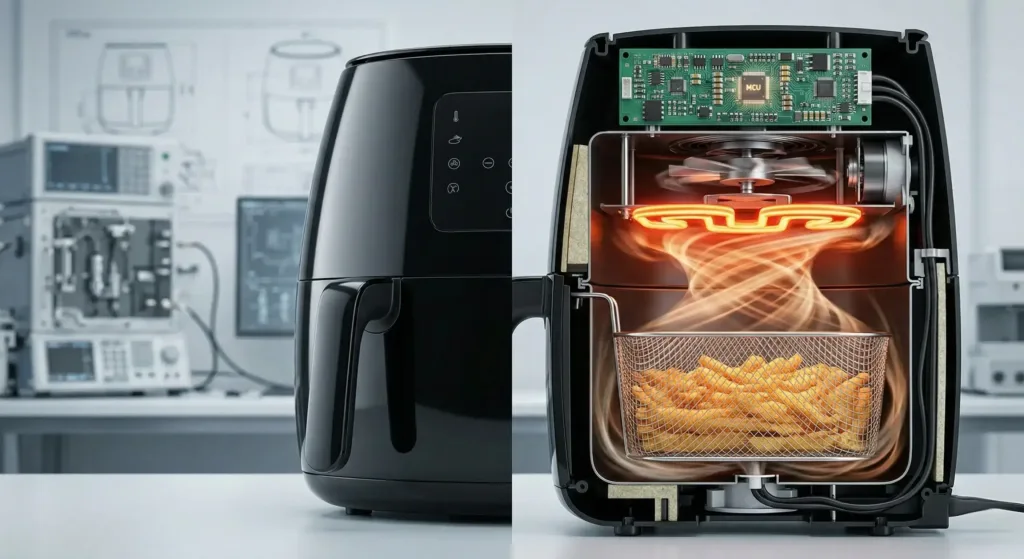
Direct Verdict: A Pigeon E1 error code means the micro-controller cannot detect the thermal sensor due to an open circuit. In Indian kitchens, this is frequently caused by aerosolized cooking oils polymerizing over the sensor probe, creating an insulating layer that disrupts the 5V logic signal to the MCU.
Technical Breakdown: Indian cooking involves heavy tadka and spice-infused oils. When these oils are aerosolized by the high-velocity exhaust fan, the airborne triglycerides settle on the cooler metal components near the roof of the appliance. Under repeated heating cycles, these oils undergo a chemical process called cross-linking polymerization, turning into a sticky, brown, resin-like substance (the “Oily Gummed Tabs” phenomenon). Because Pigeon models use slightly less shielded sensor harnesses compared to premium models, this polymerized grease can literally insulate the thermistor probe, preventing it from reading the air temperature accurately. Alternatively, in coastal cities with 85%+ humidity, micro-corrosion on the sensor wire triggers an open-circuit E1 fault.
The Fix:
- Deep Degreasing: Invert the cooled air fryer. Locate the small temperature probe near the heating coil. Use a soft cloth lightly dampened with warm water and baking soda, followed by 99% Isopropyl Alcohol to dissolve the polymerized resin.
- Moisture Purge: If you suspect humidity ingress, leave the unit in a dry, well-ventilated room for 24 hours before attempting a 15-minute capacitive discharge reset.
Pigeon Diagnostic Cheat Sheet
- E2: Thermal Overload / TRIAC – Choked Z-axis airflow from stacking food; localized heat spike. Unplug, remove 30% of food (single layer only), cool for 20 mins.
- E1: NTC Thermistor Open Circuit – Polymerized grease insulating the sensor; high-humidity wire corrosion. Deep clean the upper chamber probe with isopropyl alcohol.
Kenstar Air Fryer Error Codes (The High-Power Density Architecture)
Direct Verdict: Kenstar air fryer error codes, primarily E1, E2, and E3, are thermodynamic safety interventions triggered by sensor failures, overheating, or short circuits. Built with a high power-to-volume ratio, Kenstar’s 1500W-1700W units rely heavily on these digital failsafes to manage rapid heat dissipation in hot Indian kitchens.
Kenstar models, such as the Aster series, are designed for speed, utilizing a high Power Density (wattage per cubic inch of the cooking chamber). This engineering approach ensures rapid Maillard browning for crispy textures, but it puts immense stress on the internal cooling architecture. The MCU must meticulously balance the 1700W output against the ambient room temperature.
Kenstar E1 & E2 Error Codes (The Ventilation Crisis)
Direct Verdict: Kenstar E1 (sensor open circuit) and E2 (thermal overload) error codes typically trigger when the appliance’s exhaust fan cannot expel hot air fast enough. Operating the unit flush against a kitchen wall prevents adequate ventilation, forcing the MCU to cut power to prevent coil burnout.
Technical Breakdown: An air fryer’s internal electronics, specifically the MCU board and the power relays, must be kept cool by a secondary ventilation fan while the main chamber reaches 200°C. In an Indian kitchen during summer, ambient temperatures easily hit 35°C to 40°C. This high baseline temperature severely reduces the Delta-T (the temperature difference required for effective cooling). If you place a high-wattage Kenstar unit directly against a backsplash to save counter space, you choke the rear exhaust vents. The internal ambient temperature of the appliance’s outer shell skyrockets, triggering an E2 overload. In some cases, the heat warps the sensor bracket, causing a momentary disconnect and throwing an E1 code.
The Fix:
- The 15cm Clearance Rule: Ensure there is a minimum of 15 to 20 centimeters of unobstructed space behind and above the air fryer to allow the exhaust fan to expel thermal load efficiently.
- Environmental Cooling: Avoid running the air fryer right next to an active gas stove, which compounds the ambient heat.
Kenstar E3 Error Code (The Fatal Short Circuit)
Direct Verdict: The Kenstar E3 error code denotes a fatal short circuit within the NTC thermistor or the main MCU board. Unlike E1 or E2, an E3 error usually involves permanent hardware damage caused by extreme voltage surges on the 220-240V grid, requiring immediate professional component replacement.
Technical Breakdown: While an E1 is an open circuit (a disconnected wire or insulated probe), an E3 is a short circuit. This means the 5V logic current is bypassing the sensor entirely and grounding out. In regions like Tiruppur with heavy industrial load shedding, sudden grid voltage surges can bypass the appliance’s internal Metal Oxide Varistor (MOV). When a spike hits the board, it fries the delicate logic gates handling the temperature telemetry, locking the appliance down entirely to prevent a fire hazard.
The Fix:
- Do Not Attempt a DIY Fix: A hard reset will not clear an E3 code. Attempting to bypass the board is a severe fire hazard.
- Grid Protection: Moving forward, always operate high-draw appliances like Kenstar air fryers on a dedicated 16A socket and consider using an appliance stabilizer if your local grid is prone to harmonic distortion.
- Service Center: Contact a Kenstar authorized technician for an MCU or thermistor replacement.
Kenstar Diagnostic Cheat Sheet
- E1 / E2: Thermistor / Thermal Overload – Choked rear exhaust vents; high ambient kitchen temperatures. Pull unit 15cm away from walls; allow 20 mins to cool down.
- E3: Thermistor Short / MCU Damage – Electrical grid surge frying the logic board or sensor wiring. Fatal error. Do not use. Contact Kenstar authorized service.
Pigeon Air Fryer Error Codes (The Budget MCU Workhorse)
Direct Verdict: Pigeon air fryer error codes, specifically E1 and E2, signal thermal overloads and sensor disconnects caused by restricted airflow or voltage spikes. Because Pigeon uses a simplified, cost-effective MCU architecture tailored for Indian grids, these failsafes protect the 1500W heating coil from catastrophic burnout during heavy use.
While premium brands use complex sensor arrays, budget-friendly powerhouses like the Pigeon Healthifry rely on a more rudimentary, yet highly effective, digital logic board. These units are specifically engineered to withstand the frequent 220V–240V fluctuations common in Indian tier-2 and tier-3 cities. However, this simplified micro-controller (MCU) architecture means the appliance has less margin for error when forced out of its ideal thermodynamic operating window. When the board detects an anomaly, it immediately severs the power to the internal TRIACs, flashing a two-digit code.
Pigeon E2 Error Code (The “Overpacked Basket” Syndrome)
Direct Verdict: The Pigeon E2 error code indicates a critical thermal overload, meaning the internal heating chamber has exceeded safe thermodynamic limits. This almost always occurs when the basket is overstuffed with dense foods, choking the Z-axis convection vortex and trapping heat directly around the 1500W heating element.
Technical Breakdown: Do not buy into the “liter capacity” marketing hype. While a Pigeon air fryer might boast a 4.2L or 6L capacity, the usable area is strictly limited by the floor dimensions. Air frying relies on a rapid, uninterrupted cyclonic flow of superheated air (convection). When families prepare festival snacks and stack multiple layers of medu vada or samosas, they completely block this Z-axis airflow. Heat fails to circulate downward and instead violently rebounds back up to the ceiling of the heating chamber. The NTC thermistor reads this localized temperature spike (often exceeding the 200°C limit) and triggers the E2 failsafe to prevent the plastic chassis from melting and the 1500W coil from burning out.
The Fix:
- The 35 cm² Rule: Calculate your basket’s floor area. A standard paneer tikka cube or samosa needs roughly 35 cm² of space to allow proper air displacement.
- Immediate Reset: Unplug the appliance immediately. Pull the basket out and let the internal chamber cool for at least 20 minutes to reset the thermal fuse.
- Single-Layer Cooking: Remove at least 30% of the food. Ensure there is visible space between every single piece of food to restore the convection vortex.
Pigeon E1 Error Code (Sensor Disconnect & Grease Polymerization)
Direct Verdict: A Pigeon E1 error code means the micro-controller cannot detect the thermal sensor due to an open circuit. In Indian kitchens, this is frequently caused by aerosolized cooking oils polymerizing over the sensor probe, creating an insulating layer that disrupts the 5V logic signal to the MCU.
Technical Breakdown: Indian cooking involves heavy tadka and spice-infused oils. When these oils are aerosolized by the high-velocity exhaust fan, the airborne triglycerides settle on the cooler metal components near the roof of the appliance. Under repeated heating cycles, these oils undergo a chemical process called cross-linking polymerization, turning into a sticky, brown, resin-like substance (the “Oily Gummed Tabs” phenomenon). Because Pigeon models use slightly less shielded sensor harnesses compared to premium models, this polymerized grease can literally insulate the thermistor probe, preventing it from reading the air temperature accurately. Alternatively, in coastal cities with 85%+ humidity, micro-corrosion on the sensor wire triggers an open-circuit E1 fault.
The Fix:
- Deep Degreasing: Invert the cooled air fryer. Locate the small temperature probe near the heating coil. Use a soft cloth lightly dampened with warm water and baking soda, followed by 99% Isopropyl Alcohol to dissolve the polymerized resin.
- Moisture Purge: If you suspect humidity ingress, leave the unit in a dry, well-ventilated room for 24 hours before attempting a 15-minute capacitive discharge reset.
Pigeon Diagnostic Cheat Sheet
- E2: Thermal Overload / TRIAC – Choked Z-axis airflow from stacking food; localized heat spike. Unplug, remove 30% of food (single layer only), cool for 20 mins.
- E1: NTC Thermistor Open Circuit – Polymerized grease insulating the sensor; high-humidity wire corrosion. Deep clean the upper chamber probe with isopropyl alcohol.
Kenstar Air Fryer Error Codes (The High-Power Density Architecture)
Direct Verdict: Kenstar air fryer error codes, primarily E1, E2, and E3, are thermodynamic safety interventions triggered by sensor failures, overheating, or short circuits. Built with a high power-to-volume ratio, Kenstar’s 1500W-1700W units rely heavily on these digital failsafes to manage rapid heat dissipation in hot Indian kitchens.
Kenstar models, such as the Aster series, are designed for speed, utilizing a high Power Density (wattage per cubic inch of the cooking chamber). This engineering approach ensures rapid Maillard browning for crispy textures, but it puts immense stress on the internal cooling architecture. The MCU must meticulously balance the 1700W output against the ambient room temperature.
Kenstar E1 & E2 Error Codes (The Ventilation Crisis)
Direct Verdict: Kenstar E1 (sensor open circuit) and E2 (thermal overload) error codes typically trigger when the appliance’s exhaust fan cannot expel hot air fast enough. Operating the unit flush against a kitchen wall prevents adequate ventilation, forcing the MCU to cut power to prevent coil burnout.
Technical Breakdown: An air fryer’s internal electronics, specifically the MCU board and the power relays, must be kept cool by a secondary ventilation fan while the main chamber reaches 200°C. In an Indian kitchen during summer, ambient temperatures easily hit 35°C to 40°C. This high baseline temperature severely reduces the Delta-T (the temperature difference required for effective cooling). If you place a high-wattage Kenstar unit directly against a backsplash to save counter space, you choke the rear exhaust vents. The internal ambient temperature of the appliance’s outer shell skyrockets, triggering an E2 overload. In some cases, the heat warps the sensor bracket, causing a momentary disconnect and throwing an E1 code.
The Fix:
- The 15cm Clearance Rule: Ensure there is a minimum of 15 to 20 centimeters of unobstructed space behind and above the air fryer to allow the exhaust fan to expel thermal load efficiently.
- Environmental Cooling: Avoid running the air fryer right next to an active gas stove, which compounds the ambient heat.
Kenstar E3 Error Code (The Fatal Short Circuit)
Direct Verdict: The Kenstar E3 error code denotes a fatal short circuit within the NTC thermistor or the main MCU board. Unlike E1 or E2, an E3 error usually involves permanent hardware damage caused by extreme voltage surges on the 220-240V grid, requiring immediate professional component replacement.
Technical Breakdown: While an E1 is an open circuit (a disconnected wire or insulated probe), an E3 is a short circuit. This means the 5V logic current is bypassing the sensor entirely and grounding out. In regions like Tiruppur with heavy industrial load shedding, sudden grid voltage surges can bypass the appliance’s internal Metal Oxide Varistor (MOV). When a spike hits the board, it fries the delicate logic gates handling the temperature telemetry, locking the appliance down entirely to prevent a fire hazard.
The Fix:
- Do Not Attempt a DIY Fix: A hard reset will not clear an E3 code. Attempting to bypass the board is a severe fire hazard.
- Grid Protection: Moving forward, always operate high-draw appliances like Kenstar air fryers on a dedicated 16A socket and consider using an appliance stabilizer if your local grid is prone to harmonic distortion.
- Service Center: Contact a Kenstar authorized technician for an MCU or thermistor replacement.
Kenstar Diagnostic Cheat Sheet
- E1 / E2: Thermistor / Thermal Overload – Choked rear exhaust vents; high ambient kitchen temperatures. Pull unit 15cm away from walls; allow 20 mins to cool down.
- E3: Thermistor Short / MCU Damage – Electrical grid surge frying the logic board or sensor wiring. Fatal error. Do not use. Contact Kenstar authorized service.
Frequently Asked Questions (PAA)
Direct Verdict: Common questions around air fryer error codes usually revolve around imported models like Ninja, finding official manuals, and utilizing smart diagnostic apps. The following answers provide direct, context-independent solutions for these specific troubleshooting scenarios to get your appliance running safely again.
What are common air fryer error codes and their meanings?
Common air fryer error codes include E1 (thermistor open circuit or sensor disconnect), E2 (critical thermal overload from restricted airflow), and E3 (fatal short circuit or MCU board damage). These digital failsafes trigger to prevent internal electrical fires and catastrophic heating coil burnout. While the exact alphanumeric designation varies slightly by manufacturer, the engineering logic remains the same. The MCU constantly monitors resistance from the NTC thermistor. If resistance drops too fast (overheating), you get an E2. If resistance drops to zero (short) or infinity (open circuit), you get an E3 or E1, respectively.
How do I easily reset an air fryer error code or display message at home?
To reset most air fryer error codes at home, perform a “capacitive discharge.” Unplug the appliance directly from the wall socket and wait exactly 15 minutes. This drains the internal capacitors, clearing the volatile memory of the micro-controller (MCU) and resetting false sensor faults. Do not simply press the power button to turn it off and on again. The logic board requires a complete deprivation of AC power to clear a stubborn error loop or a frozen display screen.
Can air fryer error codes indicate serious safety issues?
Yes, air fryer error codes are critical safety mechanisms. They actively prevent catastrophic electrical fires and thermal runaway. Ignoring recurring codes or attempting to bypass the MCU board can lead to a melted plastic chassis, blown heating coils, or severe household electrical hazards.
How do I troubleshoot other codes like F1, F3, or E4 on popular brands?
Error codes F1, F3, and E4 typically indicate advanced hardware failures such as a severed thermal fuse, a shorted heating element, or a faulty power board. These require professional multimeter diagnostics or OEM replacement parts and cannot be fixed with a simple home reset. For example, an F3 often denotes a shorted temperature sensor wiring harness, while E4 is frequently related to the top convection fan motor failing to spin at the required RPMs.
What are the repair costs, warranty coverage, and service centers for error codes (e.g., in Chennai)? Minor repairs like NTC thermistor replacements cost between ₹300 to ₹800 at authorized service centers in major hubs like Chennai. However, main MCU board replacements can exceed ₹2,000. Always check your appliance’s warranty status before purchasing third-party replacement parts online. If your appliance is under its standard 1-year or 2-year warranty, DO NOT open the chassis yourself. Authorized centers (like the Pigeon Service Centers in West Tambaram or Anna Nagar, Chennai) will fix MCU faults free of charge if the warranty seal remains unbroken.
Where can I find the user manual for air fryer error codes?
You can find official air fryer manuals and error code troubleshooting guides by visiting the respective brand’s support portal (like Philips HomeID or Stovekraft’s Pigeon support page) and entering your appliance’s exact model number to download the authorized PDF diagnostic sheet. Because MCU boards are frequently updated between manufacturing batches, generic manuals are often unhelpful. Always check the type plate sticker on the bottom of your appliance (e.g., HD9280/90) and download the exact corresponding PDF to ensure you are reading the correct error code matrix.
Which air fryer models commonly display error codes and why?
Premium models like the Philips Digital Airfryer display error codes more frequently because they utilize highly sensitive, precision MCU boards. These sophisticated sensors catch minor thermal anomalies early, whereas budget brands often lack these failsafes and may simply overheat or permanently shut down. This is a classic case of “more features, more failsafes.” A basic analog air fryer with a mechanical rotary timer has virtually zero digital error reporting. Conversely, a premium 1700W model with WiFi telemetry constantly checks its internal diagnostics, making it safer but more prone to halting operation and flashing a code at the slightest voltage irregularity.
What about imported Ninja Air Fryer error codes in India?
Running an imported 110V US Ninja Air Fryer on an Indian 220V step-down converter frequently triggers E01 or E02 error codes. This indicates a thermistor calibration issue or severe voltage mismatch, though a standard 15-minute capacitive discharge reset sometimes clears the fault. While Ninja is not officially sold in the domestic Indian market, many enthusiasts import them. However, Ninja air fryers draw massive wattage (often 1500W+). Most standard Indian step-down transformers struggle to provide a clean sine wave at that load. This “dirty power” confuses the Ninja’s highly advanced MCU, causing it to misread the thermistor data and throw an E01 code.
Are there online forums or communities to discuss air fryer error codes?
Yes, for community-driven air fryer troubleshooting, Reddit’s r/airfryer and dedicated DIY electronics repair forums are excellent resources. These platforms connect you with experienced users and technicians who share specific, component-level fixes for obscure MCU faults that official manuals often ignore. If your appliance is out of warranty, these communities are invaluable. Often, what a brand calls a “fatal board failure” is simply a loose ribbon cable or a $2 blown thermal fuse that can be safely replaced by a local electronics technician, provided you have the right schematic information from the community.
Is there an official app to diagnose air fryer error codes?
For smart appliances, the Philips NutriU (now HomeID) app serves as an official diagnostic tool, particularly for resolving E10 network handshake errors and updating firmware. However, budget brands like Pigeon and Kenstar do not offer dedicated diagnostic apps, requiring users to rely strictly on the digital display. If you own a connected Philips model (like the HD9880), the HomeID app can push firmware updates that patch known error-loop bugs. If your app cannot connect (Error Conn-3), ensure you are on a strict 2.4GHz WiFi band, as these appliances lack the antenna hardware to process 5GHz frequencies.
Conclusion & Next Steps
Direct Verdict: Preventing air fryer error codes requires routine maintenance, including degreasing the heating coil, never overpacking the basket, and using an appliance stabilizer. Proper care ensures your MCU board and thermistor survive the rigors of heavy Indian cooking and grid voltage fluctuations.
As we’ve explored from an engineering perspective, an error code is not a death sentence for your appliance; it is a critical safety intervention. By understanding the thermodynamic limits of your air fryer’s convection vortex and respecting the local electrical realities of the Indian grid, you can prevent 90% of these faults. Always remember the 35 cm² rule for food spacing and never operate high-wattage units flush against a kitchen wall.
Call to Action: Is your air fryer flashing a code we didn’t cover? Share your specific error code and appliance model in the comments below, and we’ll help you diagnose it! If your unit has suffered a fatal E3 short circuit and it’s time for an upgrade, be sure to read our definitive, data-driven guide on theBest Air Fryer for Small Families in India, or explore more expert reviews on theOurKitchen.in

Prathap is the founder of ourkitchen.in and a B.Tech graduate in Agricultural Engineering from Tamil Nadu. His engineering background in thermodynamics, heat transfer, and food processing science gives him a fundamentally different approach to kitchen appliance reviews compared to typical lifestyle bloggers.
Rather than relying on manufacturer claims, Prathap measures actual power draw against rated wattage, evaluates basket airflow geometry, and stress-tests non-stick coatings over 90-plus cook cycles before recommending any product. He cross-checks every safety claim against BIS and FSSAI standards, and all pricing against live Amazon India and Flipkart listings.
He has written over 61 deep-dive articles on air fryers for the Indian market, personally testing models from Philips, Pigeon, Agaro, Kenstar, Havells, and Bajaj. His reviews are built around Indian realities: 220V power grids, high-humidity coastal kitchens, Indian cooking temperatures, and the price-performance expectations of Indian households.
Based in Chennai, Tamil Nadu.