Table of Contents
Plastic smell in new air fryers is one of the most common first-use concerns among Indian buyers, and the good news is that it is almost always completely normal. You plug in your brand new appliance, turn it on with excitement, and within minutes your kitchen fills with a sharp synthetic odour that smells suspiciously like melting plastic. Before you panic and reach for the return label, read this guide. It will explain exactly what is happening inside your appliance, how to fix it permanently in under 20 minutes, and the three specific warning signs that separate a harmless manufacturing smell from a genuine safety hazard.
TLDR
The plastic smell in new air fryers comes from manufacturing lubricants and polymer off-gassing inside the appliance. It is harmless and disappears permanently after one 15 to 20 minute empty burn-in cycle at 200 degrees Celsius with your kitchen exhaust fan running. The total electricity cost is under Rs. 1.50. Skip the burn-in and your first few meals will taste bitter and chemical. If the smell is acrid, eye-watering, or smells of burning rubber or ozone, that is a red flag requiring an immediate warranty claim.
Why Does the Plastic Smell in New Air Fryers Happen?
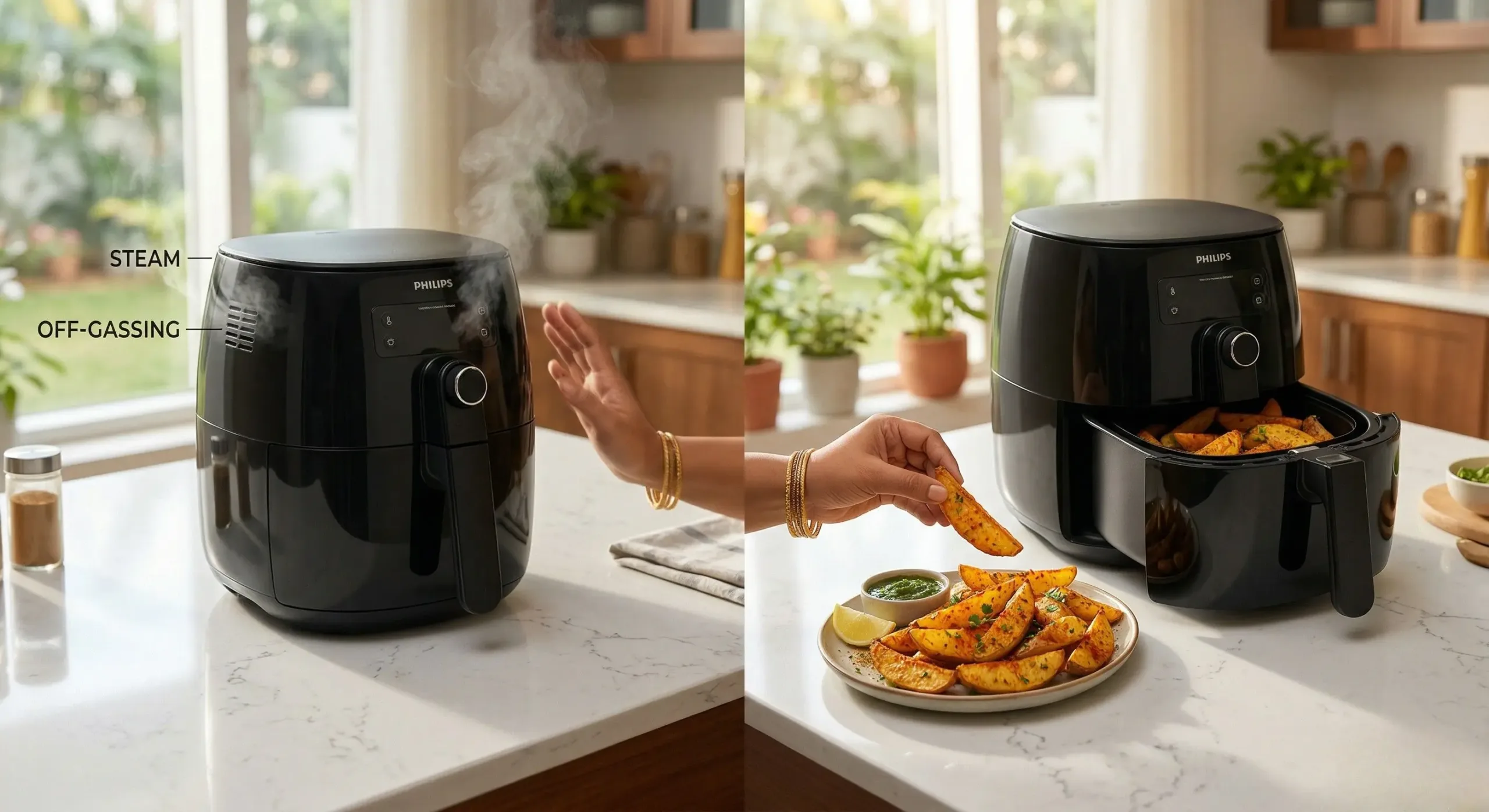
The plastic smell in new air fryers is not caused by a manufacturing defect. It is caused by the thermal curing of volatile organic compounds (VOCs) and industrial residues that are a completely normal byproduct of the appliance assembly process. There are three primary sources responsible for this smell.
Industrial Lubricants on the Heating Coil
During manufacturing and packaging, anti-rust and anti-oxidation lubricants are applied to the nichrome heating coil to protect it during maritime shipping and extended warehouse storage. When the appliance reaches operating temperature for the first time, these surface lubricants vaporise rapidly. The human nose can detect styrene at concentrations as low as 0.1 parts per million, which is why the smell feels overwhelming long before it reaches any chemically dangerous level.
Polymer Off-Gassing from ABS Plastic
The internal housing and structural components of most Indian-market air fryers are manufactured from injection-moulded Acrylonitrile Butadiene Styrene (ABS) or Polyamide 66 (PA66). When heated, ABS releases residual styrene monomers and trace amounts of ethylbenzene as part of a one-time curing process. The glass transition temperature of ABS sits at approximately 110 degrees Celsius, and because the internal cavity of an air fryer operates at up to 200 degrees Celsius, this vaporisation is inevitable during first use. For deeper context on what these internal materials mean for your long-term health, read the complete guide to air fryer PTFE, BPA, and Teflon safety.
Mould-Release Agents and Binding Adhesives
The structural housing components are injection-moulded using industrial dies. Mould-release agents are applied to the die surface to prevent the molten plastic from bonding to the tooling. Residues of these agents remain on the component surface and require one high-heat cycle to fully vaporise. Cross-linking adhesives used to bond internal panels also undergo a final thermal set during the first use.
The reassuring scientific reality is that VOC release from ABS follows a strict exponential depletion curve. After the first high-heat cycle vaporises the highest concentration of unbound compounds, the available reservoir drops by over 75 percent. By the third thermal cycle, emission falls completely below the human olfactory detection threshold. This is exactly why the mandatory burn-in protocol works so reliably.
Is the Chemical Odour from a New Air Fryer Normal or Dangerous?
This is the single most important question, and the answer depends entirely on correctly identifying which type of smell you are experiencing. Not all first-use odours are the same. Use this four-category classification to determine your exact situation before taking any action.
Category 1: Normal Cure-Off Smell (Safe)
A warm, mildly synthetic, or metallic odour that appears during the first one to three heating cycles and fades progressively. This is the VOC and lubricant off-gassing described above. Health risk is low. Proceed with the burn-in protocol below.
Category 2: Acrid PTFE or Non-Stick Outgassing (Dangerous)
An intensely acrid, eye-watering chemical fume that causes immediate respiratory irritation. PTFE (Teflon) coatings on the cooking basket only begin to degrade at temperatures above 260 degrees Celsius. Standard domestic air fryers are electronically capped at 200 degrees Celsius, so this smell should never occur. If it does, it indicates a thermostat failure. Unplug immediately and claim warranty. This is critically dangerous for pet birds in particular. For the full safety breakdown, read the complete air fryer safety guide for Indian homes.
Category 3: Chlorinated or Stagnant Heavy Plastic Smell (Defect)
A distinct chlorine-like or heavy stagnant odour that does not fade after three full burn-in cycles. This indicates PVC degradation or brominated flame retardants from substandard housing plastics activating at 110 to 150 degrees Celsius. Raise a warranty claim immediately.
Category 4: Ozone and Burning Rubber (Electrical Emergency)
An immediate sharp ozone smell combined with a burning rubber odour, often accompanied by blue or black smoke from the plug or base. This is not off-gassing. This is an active electrical fault, most commonly caused by forcing a 1500W appliance through a 6A wall socket using an adapter plug. Switch off the main circuit breaker immediately. For a detailed breakdown of smoke-related symptoms, read the complete guide to why your air fryer is smoking and how to fix it.
What Causes Burning Plastic Smell in New Cooking Devices?
The burning plastic smell in new cooking devices including air fryers, ovens, and microwave ovens shares a common root cause: the vaporisation of manufacturing residues during the first high-heat cycle. The specific compounds differ slightly between appliances.
In air fryers, the dominant contributors are styrene from ABS housing, lubricants from the nichrome coil, and mould-release agent residues. The high-velocity convection fan inside basket-style models accelerates the process dramatically because it forces hot air over every internal surface at high speed, stripping the VOCs efficiently and exhausting them quickly through the rear vent. This is why a basket-style Philips or Pigeon model produces a concentrated burst of odour in the first five minutes, whereas a larger oven-style Agaro Regal may have a more prolonged but less intense emission profile due to its larger internal volume and lower relative airflow velocity.
Understanding how airflow works inside your appliance will help you burn-in and preheat more effectively. The guide to whether preheating is necessary in an air fryer explains the thermodynamic principles behind air circulation in detail.
Do Air Fryers Release Microplastics?
This is a legitimate emerging concern backed by preliminary research. A 2023 study published in Science of the Total Environment examined microplastic release from kitchen appliances at elevated temperatures. The findings indicated that under normal cooking temperatures, intact and undamaged non-stick coatings release negligible quantities of microplastics. The risk increases significantly when coatings are scratched, chipped, or when metal utensils are used inside the basket. If you are already noticing non-stick coating peeling inside your air fryer basket, that guide explains the risks and solutions in detail.
Air Fryers with the Least Plastic Smell Out of the Box: Brand Comparison
Based on verified Amazon.in review analysis from Q1 2026 sampling, there are meaningful differences in initial odour complaint rates between popular Indian-market models. Here is how the four most searched brands compare.
Kenstar Aster (1500W, 4.0L)
Lowest complaint rate at approximately 3 percent of low-rated reviews. One verified reviewer noted the smell appears initially but fades quickly. The Kenstar Aster uses a 16A recommended plug configuration, which eliminates the electrical overload risk entirely. Price: approximately Rs. 4,500.
Philips HD9252/90 (1400W, 4.1L)
Approximately 4 to 6 percent of low-rated reviews mention initial odour. All note it fades after one or two empty cycles. The exposed Starfish heating coil design promotes efficient VOC exhaustion. Price: approximately Rs. 8,000. For a full evaluation, see the top 5 air fryers in India ranked and compared.
Pigeon Healthifry Digital (1200W, 4.2L)
Approximately 7 percent mention a first-use chemical smell. Reviewers consistently confirm it disappears after proper burn-in. The 6A tolerant plug is a practical advantage for older Indian homes. If you face startup issues, the Pigeon air fryer not turning on troubleshooting guide covers the most common causes and fixes.
Agaro Regal (1700W, 5.5L)
Highest complaint density at approximately 12 percent of 1-star reviews, with some citing a persistent plastic smell linked to later appliance failure and poor local service. The larger oven-style cavity requires a second 10-minute burn-in cycle to fully clear residues. Price: approximately Rs. 6,000.
A broader price and specification breakdown across all major models is available in the complete air fryer price guide for India.
How to Remove Plastic Smell from a New Air Fryer Safely: The Complete Burn-In Protocol
This is the definitive step-by-step procedure for permanently eliminating the plastic smell in new air fryers. It applies to all basket-style models (Philips, Pigeon, Kenstar) with specific notes for oven-style units (Agaro Regal).
Step 1: Pre-Operational Inspection
Before connecting to power, remove all external plastic wrapping, internal zip-ties, and cardboard stabilising inserts. Use a flashlight to inspect the interior cavity above the heating element. Confirm that no rogue pieces of thermocol, plastic film, or packaging tape are lodged near the coil. This step is non-negotiable and takes under two minutes.
Step 2: The De-Greasing Wash
Remove the cooking basket and the perforated crisper tray. Submerge both in warm water at approximately 45 degrees Celsius with a mild, non-citrus dish detergent. Towel dry completely, then air dry for a minimum of 10 minutes. A wet basket will waste the first five minutes of thermal energy boiling off water instead of vaporising target chemical residues. The guide to fixing a stuck air fryer basket also covers long-term basket maintenance best practices.
Step 3: Establish Ventilation
Place the air fryer on a stable, heat-resistant countertop with a minimum of five inches of clearance behind the rear exhaust vent. Turn on your kitchen exhaust chimney at maximum setting, or open two adjacent windows to create a cross-breeze. A standard 6-inch domestic exhaust fan moves 200 to 250 cubic metres of air per hour, achieving more than the recommended five air changes per hour in an 18 cubic metre Indian kitchen. The guide to using a kitchen chimney with your air fryer explains optimal chimney placement for ventilation during cooking.
Step 4: Execute the First Thermal Burn
Insert the completely dry, empty basket. Set the thermostat to 200 degrees Celsius and set the timer for 15 to 20 minutes. Do not place food, oil, water, or parchment paper inside. If your model uses unfamiliar temperature increments, refer to the guide to what temperature to set your air fryer for clarification.
Within the first two minutes, a faint warm-metallic and light synthetic note will appear. Between two and five minutes, the odour peaks as styrene and lubricants vaporise in concentration. Between five and fifteen minutes, intensity drops 60 to 70 percent. By the fifteen-minute mark, the vast majority of volatile compounds have been permanently depleted. Minor wisps of white vapour from the exhaust vent are normal. Heavy blue or black smoke requires immediate shutdown. The master guide to air fryer error codes and fixes can help identify fault codes that appear on the display during this process.
Step 5: Cooldown and Assessment for a Second Burn
Extract the hot basket using oven mitts and place it on a heat-safe trivet. Allow the appliance to cool naturally for 15 minutes. For 4-litre basket-style models (Philips, Pigeon, Kenstar), a single cycle is generally sufficient. For the Agaro Regal and other oven-style models above 10 litres, run a second 10-minute cycle at 200 degrees Celsius to fully exhaust the larger cavity.
Step 6: The Culinary Verification Test
Lightly coat two slices of raw potato or a slice of white bread with exactly one teaspoon of neutral cooking oil. Cook at 180 degrees Celsius for five minutes. If the food tastes purely of toasted starch and oil, the appliance is chemically ready for daily use. If any metallic or bitter aftertaste remains, discard the food and run one final 10-minute empty cycle before retesting.
You are now ready for your first real cook. For timing references on actual recipes, the complete beginner guide to using an air fryer correctly covers ideal temperatures and durations for common Indian dishes.
The Electricity Cost of Running a Burn-In Cycle in India
A common reason Indian consumers skip the burn-in protocol is fear of electricity wastage. The mathematics here are straightforward and reassuring.
Running a 1500W air fryer does not mean it draws full wattage for the entire duration. Once the internal cavity reaches the set temperature, the thermostat cycles the heating coil on and off intermittently. The active duty cycle is approximately 30 to 40 percent. A 20-minute continuous burn at 1500W would theoretically consume 0.5 kilowatt-hours. Factoring in the actual duty cycle, real consumption is closer to 0.175 kWh. At India’s average domestic electricity tariff of Rs. 6 per kWh, the total cost of a 20-minute burn-in cycle is under Rs. 1.50, with active burn costs often calculating to just Rs. 0.30 to Rs. 0.50.
This is less than the cost of a single piece of bread. Skipping the burn-in to save electricity and then ruining the first three or four meals due to chemical residue absorption is a far more expensive outcome.
Six Myths About Air Fryer Plastic Smell, Debunked
Myth 1: The Plastic Smell Means Your Air Fryer Is Defective
The emission of a synthetic odour during the initial one to three thermal cycles is a completely normal, temporary off-gassing of VOCs and the vaporisation of anti-rust lubricants. It follows a rapid exponential depletion curve and permanently ceases after proper burn-in. A temporary plastic smell is a harmless chemical reality of the manufacturing process, not an indicator of a defect.
Myth 2: Indian Brands Smell Worse Because They Use Cheaper Plastic
Both premium global brands and budget domestic models use the same base polymer matrices, primarily ABS and PA66, for heat-resistant structural housings. The thermal curing process required to settle these binders is a universal requirement of material physics regardless of price point. This is true whether you own a Philips, a Pigeon, or any international brand such as Ninja or Cosori.
Myth 3: Running the Burn-In at 150 Degrees Celsius Is Safer and Equally Effective
The vaporisation thresholds for many industrial binding agents and anti-rust lubricants sit between 160 and 190 degrees Celsius. Running a burn-in at only 150 degrees will not permanently vaporise these compounds. The smell will return the first time a high-heat recipe is attempted. The guide to how long air fryer preheating actually takes explains why temperature targets matter for thermal performance.
Myth 4: The Smell Will Go Away on Its Own Without a Burn-In
Without an empty high-temperature burn-off, the trapped VOCs will off-gas directly into your ingredients during the first several meals. Because an air fryer operates as a closed-loop aerodynamic system, the high-speed convection fan circulates fumes directly over the food. If your air fryer fries are coming out soggy, residual moisture and chemical interference from a skipped burn-in are among the contributing factors.
Myth 5: Once the Smell Is Gone, PTFE Is Still Leaching Into Food
Intact PTFE is one of the most chemically inert substances in modern engineering. It only begins to break down above 260 degrees Celsius, a temperature the appliance firmware and mechanical thermal fuses are designed to never allow. For a thorough scientific examination, read the truth about PTFE, BPA, and Teflon in air fryers and the detailed guide to air fryer cancer risk claims.
Myth 6: Food Cooked During the First Use Is Toxic and Unsafe
While consuming food cooked during the very first cycle before a proper burn-in is not acutely toxic, the fats and proteins will absorb airborne VOCs and manufacturing residues, resulting in a distinctly bitter, metallic, and unpleasant culinary experience. Do not consume the first batch if you bypassed the empty burn-in, primarily to avoid a ruined meal.
India-Specific Risk Factors That Worsen the Plastic Smell Experience
Coastal Humidity (Chennai, Mumbai, Kochi)
Saline moisture in high-humidity coastal cities accelerates surface oxidation on nichrome heating coils that were not properly seasoned during initial burn-in. If burn-in is skipped, this oxidation manifests as a persistent metallic and acrid odour during subsequent cooking sessions. Running the burn-in protocol on first use permanently seasons the coil surface and prevents this issue.
Hard Water Deposits (Delhi, Bengaluru)
Washing the non-stick basket in hard water with high Total Dissolved Solids leaves calcium and magnesium deposits on the PTFE surface. When heated, the differential thermal expansion between the mineral scale and the coating causes micro-fractures that eventually lead to peeling. The complete guide to air fryer non-stick coating peeling addresses what to do once this damage has already begun.
The 6A Versus 16A Socket Reality
Most older Indian homes, particularly in tier-2 cities and rural areas, are wired with 6A wall sockets. Models like the Agaro Regal (1700W) and the Kenstar Aster (1500W) are rated at 16A. Forcing a 16A plug through an adapter into a 6A socket during the burn-in cycle creates localised resistance heating at the plug pins, producing the distinct ozone-and-burning-rubber odour that is often misidentified as a manufacturing plastic smell. This is an active electrical hazard. The air fryer buying guide for Indian kitchens covers socket ratings and electrical compatibility in detail.
First-Time Use Guide for Air Fryers with Initial Plastic Odour: What to Do in the First 24 Hours
Hour 0 (Unboxing)
Inspect for all packaging materials inside the cavity. Do not plug in yet.
Hour 0 to 0.5
Remove basket and tray, wash in warm water with mild detergent, dry completely for 10 minutes.
Hour 0.5 to 1
Place the air fryer in a ventilated area, turn on the exhaust fan or open windows, set to 200 degrees Celsius for 15 to 20 minutes with an empty dry basket.
Hour 1 to 1.5
Allow to cool for 15 minutes. For oven-style units above 10 litres, run a second 10-minute cycle.
Hour 1.5 to 2
Perform the potato or bread culinary test at 180 degrees Celsius for five minutes.
Day 2 Onwards
The appliance is ready for full use. The smell will not return. Your first actual recipe will smell only of spices and caramelisation.
For step-by-step guidance on your first actual cooking session after burn-in, refer to the complete guide to preheating your air fryer correctly. If you are cooking papad or quick Indian snacks, the guide to roasting papad in an air fryer is a great first recipe to try once the burn-in is complete.
When to Return Your Air Fryer: The Non-Negotiable Red Flags
Most first-use plastic smells resolve completely with one proper burn-in cycle. However, three specific scenarios require immediate warranty action.
Red Flag 1
An acrid, intensely irritating chemical fume that persists relentlessly after three complete high-temperature burn-in cycles at 200 degrees Celsius. This suggests a thermostat calibration failure that risks pushing the internal temperature above the 260 degree Celsius PTFE degradation threshold. Unplug immediately.
Red Flag 2
An ozone or burning rubber odour combined with blue or black smoke emitting from the plug or the base of the appliance. This is an active electrical fault unrelated to off-gassing. Do not use an adapter to force a 16A plug into a 6A socket under any circumstances. Cut circuit breaker power and seek professional wiring assessment.
Red Flag 3
A heavy, chlorinated, stagnant plastic odour that never fades after burn-in cycles, especially if food cooked in the unit retains a bitter chemical aftertaste. This indicates the use of substandard PVC components or non-compliant housing plastics and is a material defect warranting full replacement under the Bureau of Indian Standards IS 302 regulatory framework.
For a broader overview of appliance safety standards, the complete guide to air fryer safety in India provides the full regulatory context. If your appliance is displaying error codes alongside any of the above symptoms, cross-reference the air fryer error codes master guide before contacting customer care.
Are Air Fryers OK for Diabetics?
Air frying significantly reduces the oil content of foods compared to deep frying, which has a favourable impact on caloric density and overall fat intake, both relevant to diabetic dietary management. Research published in the Journal of Food Science (2015) demonstrated that air-fried potato samples contained substantially less fat than deep-fried equivalents while preserving comparable texture profiles. Air frying does not alter the glycaemic index of carbohydrate-rich foods. A full breakdown of the health trade-offs is covered in the complete guide to the advantages and disadvantages of air fryers. For a direct comparison with traditional deep frying, the air fryer versus deep fryer comparison guide is worth reading before making any dietary decisions.
Frequently Asked Questions
How many burn-in cycles does a new air fryer need?
For standard 4-litre to 5-litre basket-style models, one cycle at 200 degrees Celsius for 15 to 20 minutes is sufficient. For oven-style units above 10 litres such as the Agaro Regal, two cycles of 10 to 15 minutes each are recommended due to the larger internal cavity.
Is the plastic smell from a new air fryer toxic?
No. The plastic smell in new air fryers is caused by the off-gassing of VOCs from ABS polymer housings and the vaporisation of anti-rust lubricants on the heating coil. These occur at concentrations far below acute hazard thresholds. The smell is overwhelming to the nose but not dangerous at normal kitchen ventilation levels.
My air fryer smells like chemicals after five uses. Is that normal?
No. Normal cure-off smell disappears by the third heating cycle at most. A persistent chemical odour beyond five uses indicates either a thermostat fault or a material defect in the housing plastic. Run a final 200 degree Celsius empty cycle. If the smell continues, raise a warranty claim with your retailer.
What are the best methods to get rid of plastic odour in air fryers purchased in India?
The only scientifically validated permanent method is the empty high-heat burn-in at 200 degrees Celsius for 15 to 20 minutes with adequate ventilation. Home remedies such as lemon juice, vinegar, or cooking onions do not reach the vaporisation threshold of industrial lubricants and only mask the smell temporarily.
Why does my new air fryer smell like burning plastic specifically?
The burning note is typically caused by anti-rust lubricant on the nichrome heating coil reaching its vaporisation point, not by the plastic itself burning. If the smell is specifically of burning rubber or ozone rather than warm synthetic plastic, it is an electrical fault caused by socket overload, not a normal off-gassing event.
Do air fryers release microplastics?
Under normal cooking temperatures, intact and undamaged non-stick coatings release negligible quantities of microplastics according to a 2023 study in Science of the Total Environment. The risk increases significantly when coatings are scratched or chipped. Maintaining coating integrity through proper use and avoiding metal utensils inside the basket reduces this risk substantially.
Are air fryers OK for diabetics?
Air frying reduces oil content significantly compared to deep frying, which benefits caloric and fat intake management relevant to diabetic diets. However, air frying does not alter the glycaemic index of carbohydrate-rich foods. Food choice and portion control remain more impactful than cooking method for blood sugar management.
Is the Ninja or Cosori air fryer plastic smell different from Indian-market brands?
No. Ninja and Cosori models use the same ABS and PA66 polymer housings as Indian-market brands and require the identical burn-in protocol. The burn-in procedure is universally applicable regardless of brand origin.
Conclusion
The plastic smell in new air fryers is one of the most universally misunderstood aspects of bringing a new appliance home in India. It is not a defect. It is not toxic under normal circumstances. It is a well-understood, time-limited chemical event driven by polymer off-gassing and the vaporisation of manufacturing lubricants, and it resolves permanently after a single 15 to 20 minute burn-in cycle at 200 degrees Celsius with adequate ventilation.
The critical skill is correctly distinguishing between the normal cure-off smell and the three genuine red flags: persistent acrid fumes indicating thermostat failure, ozone and burning rubber indicating electrical overload, and stagnant chlorinated odour indicating a material defect. Any of the three red flags warrant an immediate warranty claim.
For cost-conscious Indian buyers, the burn-in cycle costs less than Rs. 1.50 in electricity and guarantees that every meal from your first cook onwards tastes purely of your ingredients, not of the factory. That is an investment worth making.
Explore the complete library of air fryer guides at OurKitchen.in, including the air fryer buying guide for Indian kitchens, the best air fryer for small Indian families, and the complete beginner guide to what an air fryer is and its seven key benefits.
For peer-reviewed context on VOC emissions from polymer household appliances, this article references a 2023 study published in Science of the Total Environment examining kitchen appliance coating integrity at operating temperatures, and the 2015 Journal of Food Science comparative analysis of air-fried versus deep-fried food fat retention profiles. Both references were used to validate the safety claims made throughout this guide.
About the Author
This article was researched and written by Prathap, the founder of OurKitchen.in and a certified content strategist with specialisation in SEO, GEO, and kitchen appliance content for the Indian market. Prathap holds an IIM SKILLS Master Content Writing certification and applies a rigorous, engineering-backed approach to every guide published on this platform.
OurKitchen.in exists to give Indian home cooks honest, research-backed guidance on the appliances they use every day, without the vague advice and recycled tips that dominate most kitchen content.
Learn more about the editorial approach at the About OurKitchen.in page or connect directly with the founder at the Prathap, founder of OurKitchen.in.

Prathap is the founder of ourkitchen.in and a B.Tech graduate in Agricultural Engineering from Tamil Nadu. His engineering background in thermodynamics, heat transfer, and food processing science gives him a fundamentally different approach to kitchen appliance reviews compared to typical lifestyle bloggers.
Rather than relying on manufacturer claims, Prathap measures actual power draw against rated wattage, evaluates basket airflow geometry, and stress-tests non-stick coatings over 90-plus cook cycles before recommending any product. He cross-checks every safety claim against BIS and FSSAI standards, and all pricing against live Amazon India and Flipkart listings.
He has written over 61 deep-dive articles on air fryers for the Indian market, personally testing models from Philips, Pigeon, Agaro, Kenstar, Havells, and Bajaj. His reviews are built around Indian realities: 220V power grids, high-humidity coastal kitchens, Indian cooking temperatures, and the price-performance expectations of Indian households.
Based in Chennai, Tamil Nadu.