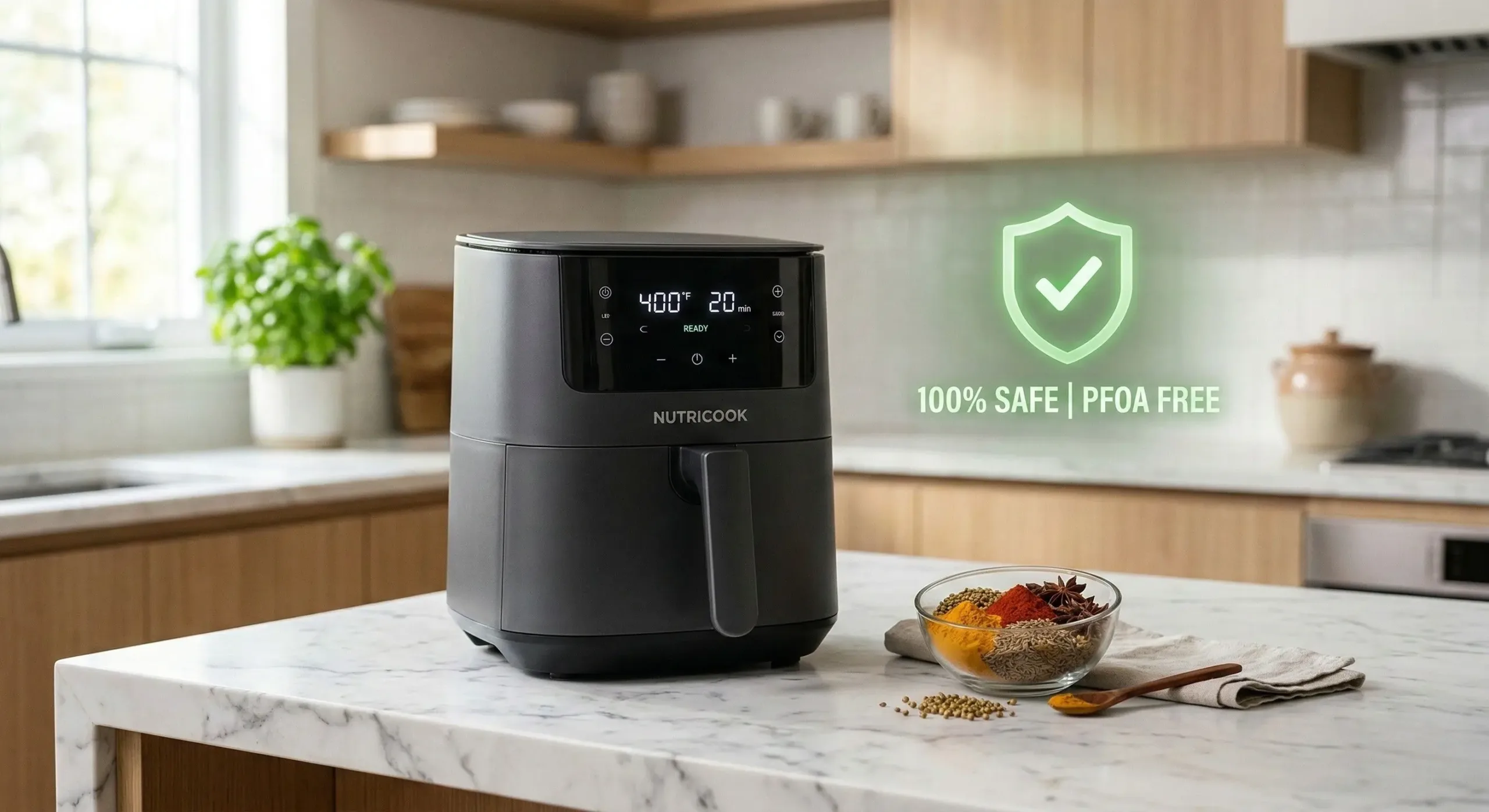
Quick Answer: Air fryers are not toxic under normal use. All reputable brands sold in India are PFOA-free since 2014. PTFE coatings are chemically inert below 260°C and every consumer air fryer is hard-capped at 200°C. Real risk only arises from mechanically damaged coatings or BPA off-gassing from uncertified budget-grade plastic housings.
Table of Contents
In March 2026, OLX Chennai listings showed Pigeon air fryer units selling at a 50% discount. The owners were not selling because the appliances had stopped working. They were selling because the coating had started to peel. That behavioural data point tells you everything about the state of air fryer toxic anxiety in India. The fear is real. The question is whether it is calibrated correctly.
Every air fryer contains two distinct chemical systems worth examining: the basket coating and the plastic housing surrounding the cooking chamber. Each carries a different risk profile, a different failure mechanism, and a different solution. The answer depends on what coating your appliance has, whether that coating is intact, and whether the manufacturer used certified materials throughout. This article examines both systems using thermal thresholds, regulatory timelines, and the specific environmental conditions of Indian kitchens to separate verified chemical risk from alarmist misinformation.
What Makes an Air Fryer Toxic and What Does Not
An air fryer is not a single chemical system. It is two distinct material systems operating simultaneously, and conflating them is the primary source of consumer confusion on this topic.
System 1: The Basket Coating. This is the non-stick layer applied to the interior of the cooking basket. It is either PTFE (Polytetrafluoroethylene, the compound in Teflon) or ceramic. The risk here is thermal and mechanical, not chemical under normal operating conditions. When intact and used below the manufacturer’s maximum temperature, neither coating releases anything measurable into food. If you are new to this category of appliance, our guide on what is an air fryer and its benefits provides a foundational overview of how the technology works.
System 2: The Thermoplastic Housing. This is the plastic outer shell and internal structural components that sit adjacent to the 200°C metal cooking chamber. In premium models, these plastics are certified BPA-free. In budget and unbranded models, this certification is frequently absent. Sustained heat cycling against uncertified polycarbonate is a genuine chemical risk that receives almost no attention in consumer literature. For health, convenience, and cost trade-offs beyond coating chemistry, our analysis of the advantages and disadvantages of air fryers covers the full picture.
The calibration question for both systems is identical: not whether these chemical compounds exist inside the appliance, but whether they are released at the temperatures and physical conditions of normal Indian cooking. For a comprehensive safety assessment covering electrical, material, and operational dimensions, our detailed are air fryers safe guide for Indian kitchens covers the full picture beyond coating chemistry alone.
| Chemical System | Material | Risk Condition | Risk Level: Normal Use |
|---|---|---|---|
| Basket Coating (PTFE) | Polytetrafluoroethylene | Temperature above 260°C or mechanical damage | Low if intact and below operating maximum |
| Basket Coating (Ceramic) | Sol-gel silica compound | Chipping under metal utensils; brittle fracture risk distinct from PTFE chemical degradation | Low to Medium: more brittle and more prone to chipping than PTFE under heavy Indian use |
| Plastic Housing (BPA) | Polycarbonate plastic | Sustained heat cycling in uncertified budget models | Medium in models without BPA-free documentation |
The sections that follow examine each of these systems in detail, starting with the one generating the most fear and ending with the one generating the least attention.
The PTFE Truth: What Teflon Actually Does Inside Your Air Fryer
PTFE toxicity is the most searched, most misunderstood, and most poorly explained topic in the entire air fryer category. Most consumer articles either dismiss the concern entirely or amplify it without supplying the thermal threshold data that makes the answer meaningful. Neither approach is useful.
PTFE at Normal Operating Temperatures: The Chemistry
PTFE, or Polytetrafluoroethylene, is the compound coating the baskets of most mid-range to premium air fryers sold in India. At room temperature and at standard cooking temperatures, PTFE is one of the most chemically inert substances used in any consumer product. It is so biologically unreactive that surgeons use it in medical implants. Vascular grafts, surgical sutures, and joint replacement components all rely on PTFE specifically because the human body cannot absorb, metabolise, or break it down.
That is the calibration anchor for this entire discussion. A compound trusted inside a living human body for years at a time is the same compound coating your air fryer basket.
PTFE belongs to the broader PFAS family, Per- and polyfluoroalkyl substances, widely referred to as “forever chemicals” because their carbon-fluorine molecular bonds are extraordinarily resistant to environmental breakdown. This classification is important to state clearly rather than sidestep. However, membership in the PFAS family does not automatically mean a compound is bioavailable or harmful at room temperature or standard cooking temperatures. The relevant question is always: at what temperature does the compound become unstable?
For PTFE, that threshold is precise and well-documented. PTFE begins to degrade above 260°C (500°F). Below this temperature, the carbon-fluorine bonds remain intact and nothing volatile enters the cooking environment. Above this threshold, the bonds fracture and release fluoropolymer fumes. These fumes are acutely toxic to pet birds, causing the condition known as Teflon toxicosis. In humans, they can induce polymer fume fever: a severe flu-like syndrome characterised by chills, body aches, and respiratory distress.
Engineering Fact: Every consumer air fryer sold in India operates at a hard-capped maximum of 200°C (400°F). The PTFE degradation threshold is 260°C (500°F). This creates a deliberate engineering safety margin of 60°C between normal operation and the danger point. Under intended operating conditions, an intact PTFE coating does not degrade, does not release fumes, and does not present a measurable health risk.
Pro Tip: Keep your cooking temperatures between 160°C and 200°C for all standard Indian snacks. Samosas and pakoras crisp perfectly at 180°C. Paneer tikka works well at 200°C. Staying consistently within this range preserves coating integrity over years of daily use. Our guide on what temperature to preheat your air fryer maps the correct operating range for different Indian foods.
PTFE vs PFOA: The Distinction That Resolves Most of the Fear
This is the single most important factual distinction in this entire article. The vast majority of air fryer toxicity anxiety, in Indian buyer forums, on Reddit, and across social media, conflates two chemically distinct compounds. Understanding the difference between them resolves most of the fear immediately.
PTFE is the coating itself. It is the Polytetrafluoroethylene layer applied to the basket surface. As established above, it is inert under normal cooking conditions and only becomes dangerous above 260°C.
PFOA, Perfluorooctanoic acid, also known as C8, is an entirely different compound. PFOA was not the coating. It was the manufacturing surfactant used during the production process to help disperse PTFE molecules evenly across the basket surface before bonding. PFOA was the genuinely toxic element in the system. It is a persistent environmental contaminant, a documented probable carcinogen, and a compound that does not break down in human tissue or in the natural environment.
The United States EPA and global regulatory bodies recognised the severity of these impacts and acted. Through the PFOA Stewardship Programme, they mandated and completed a full global phase-out of PFOA production between 2013 and 2014. This was a regulatory requirement, not a voluntary brand initiative.
The direct consequence for Indian consumers: Every reputable brand now manufactures without PFOA. This is a baseline regulatory compliance requirement, not a premium feature. Philips, Agaro, Prestige, Pigeon, Havells, and Bajaj all meet this standard.
To verify this for any model you are considering: open the Amazon India or Flipkart listing, scroll to “Special Features” or “Material”, and confirm the “PFOA-free” label is present. Our air fryer buying guide for Indian kitchens walks through how to evaluate material certifications alongside the technical specifications that determine long-term suitability.
The persistent conflation of PTFE with PFOA in consumer media, treating them as interchangeable, is the primary driver of disproportionate air fryer toxicity fear. They are not the same compound. The dangerous one has been banned from manufacturing for over a decade. The one remaining in your basket is inert below 260°C, and your appliance never reaches 260°C.
When an Air Fryer Coating Does Become Dangerous: The Real Risk Scenario
The previous section established that PTFE is safe when intact and used below its degradation threshold. That qualifier, when intact, carries the entire weight of the toxicity argument.
The danger is not chemistry. It is not the compound itself. It is mechanical damage to coating integrity. Once the PTFE layer is scratched, peeled, or structurally compromised, three simultaneous consequences follow.
First, the underlying metal substrate is exposed. Typically mild steel or aluminium, it sits open to the acidic and alkaline compounds in Indian spice marinades: tamarind, tomato, lemon, and vinegar-based preparations that accelerate oxidative corrosion. Second, the structural stability of the remaining coating is permanently lost. The boundary between intact and damaged PTFE is never clean, and failure accelerates rapidly once it begins. Third, the chemical adhesives used during manufacturing to bond the PTFE layer to the metal substrate can interact directly with food at cooking temperatures.
If you can see visible flaking, pitting, or peeling on your basket surface, the appliance is no longer safe for food preparation. This is not a precautionary statement. It is the point at which the coating’s protective chemical barrier has physically failed. A detailed stage-by-stage assessment of what coating failure looks like at each point of progression, and the exact threshold at which the basket must be replaced, is covered in our guide on air fryer non-stick coating peeling.
The 5 Indian Kitchen Habits That Destroy Non-Stick Coatings Fastest
Amazon India reviews, Reddit threads, and OLX resale listings all confirm the following five damage vectors operating in Indian households:
- Green abrasive scouring pads: The single most common cause of micro-scratches on air fryer baskets in India. The standard green-and-yellow nylon scrub pad found in virtually every Indian kitchen sink is designed for steel vessels and hard ceramic surfaces. On a PTFE coating, a single wash with even moderate pressure creates microscopic surface abrasions invisible to the naked eye. Each subsequent wash deepens them. Within weeks, the coating’s structural integrity is compromised at a microscopic level before any visible damage appears.
- Hard water TDS scaling: Municipal water in Delhi, Bengaluru, Hyderabad, Pune, and Ahmedabad carries high Total Dissolved Solids, primarily calcium carbonate and magnesium compounds. When a washed basket is left to air dry on the counter, the water evaporates and leaves microscopic jagged calcium carbonate scale deposits on the coating surface. When the basket is reinserted into the appliance, this invisible scale acts as fine-grit sandpaper. This abrasion mechanism repeats at every single wash cycle in high-TDS zones.
- Coastal salt-air humidity: The failure mechanism here operates differently from TDS scaling. Once any micro-scratch exposes the underlying metal substrate, the combination of salt-laden coastal air and ambient humidity initiates galvanic corrosion at the exposure point. The electrochemical reaction between the exposed metal and the salt-humid environment oxidises the substrate rapidly, undercutting the surrounding intact PTFE layer from below. This is why budget models with thin coating layers fail disproportionately in Chennai, Mumbai, and Kochi.
- Metal spatulas and steel tongs: A deeply ingrained habit carried directly from kadhai and tawa cooking. In traditional Indian cookware, steel ladles and iron spatulas are standard. An air fryer basket is not built for them. One contact between a steel tong and the basket surface creates a micro-scratch. That micro-scratch is the initiating event in a failure cascade that ends with a peeling basket and a replaced appliance. The damage from one use is not immediately visible, which is precisely what makes this habit so destructive.
- Overcrowding the basket: Packing the basket to capacity creates localised thermal stress at every food-contact edge. Where adjacent pieces of food press against the basket wall, airflow is blocked and heat accumulates. These localised hot spots push the coating surface temperature above the ambient 200°C cooking temperature at contact points. If you have noticed that overcrowding produces uneven, soggy results, our guide on why air fryer fries turn soggy explains the airflow physics behind it. The thermal stress on the coating is the direct parallel consequence of the same overcrowding behaviour.
If you have recently encountered difficulty reinserting or removing the basket after washing, a common early symptom of warped or scale-damaged basket edges, our troubleshooting guide on air fryer basket stuck covers the safe extraction and assessment procedure without risking further damage to the chassis or coating.
BPA and the Plastic Housing: The Toxic Risk Nobody in India Is Talking About
Every consumer article on air fryer toxicity is written about the basket. The basket gets the chemistry discussion, the coating comparison, and the safety warnings. The plastic housing surrounding the cooking chamber receives almost no analytical attention, and this is precisely the gap that makes it a more insidious risk than the coating it surrounds.
To understand why the housing matters, consider the thermal geometry of an air fryer in operation. The metal cooking chamber is running at 200°C. The plastic outer shell is not separated from this chamber by significant insulation in most consumer models. It sits directly adjacent to it, separated by an air gap and whatever thermal bridging the manufacturer has engineered into the chassis. In premium models, this engineering is deliberate and documented. In budget models, it is frequently an afterthought.
BPA, or Bisphenol A, is an industrial chemical used to harden polycarbonate plastics and stabilise epoxy resins. It is a well-documented endocrine disruptor, explicitly linked in peer-reviewed medical literature to hormonal imbalance, fertility complications, and long-term metabolic disorders. Its mechanism of harm is indirect: BPA mimics oestrogen at the cellular level, interfering with the body’s hormonal signalling system at concentrations far lower than those required to cause direct chemical toxicity.
Budget air fryers run a 200°C metal cooking chamber adjacent to polycarbonate plastic components. Every cooking session subjects that plastic matrix to sustained thermal stress. Over repeated cycles, this loosens the structural bonds within the polycarbonate, allowing BPA molecules to volatilise. These volatile BPA compounds enter the enclosed cooking environment and can settle on food cooking inside the chamber.
The most immediate sensory signal of this process in action is the chemical or burning plastic smell that many Indian air fryer users report. If your appliance is producing persistent smoke or unusual odours during cooking, our guide on why your air fryer is smoking covers the full diagnostic process, distinguishing between the normal factory surfactant off-gassing of a new appliance, polymerised cooking oil smoke from the heating element, and the more concerning thermal stress signals from inferior plastic housing components.
Premium manufacturers, including Philips and other reputable brands available through official Indian retail channels, engineer around this risk by using certified BPA-free plastics for all internal components positioned near the heating chamber. This requires sourcing higher-grade thermoplastic alternatives and verifying material compliance across the supply chain. It costs more. That cost is part of what separates a ₹6,000 Philips from a ₹2,200 unbranded model.
How to Identify High BPA Risk in Your Air Fryer
Three specific signals indicate elevated BPA risk in your appliance:
- Persistent chemical or plastic smell after 5 or more burn-in cycles. A correctly manufactured appliance clears its factory surfactant odour within 3 to 5 empty cycles at 200°C with adequate ventilation. An odour that persists beyond this, particularly one that intensifies during cooking in a warm or enclosed kitchen, is the primary sensory indicator of inferior plastic housing material off-gassing under thermal stress.
- Absence of BPA-free certification on the product listing. Before purchasing any air fryer, particularly in the ₹2,000 to ₹4,000 price bracket, open the Amazon India or Flipkart listing and locate the “Material” and “Special Features” fields. A reputable manufacturer will explicitly state BPA-free internal components. The absence of this statement on a budget model listing is not neutral. It is an information gap that the consumer bears the risk of.
- Unbranded models and grey-market imports. These carry the highest BPA risk. Appliances sold without a recognised Indian brand name, or imported outside official Amazon India and Flipkart channels, have no regulatory accountability for internal plastic material standards under Indian consumer protection frameworks.
[Upcoming: Plastic Smell in New Air Fryers: Burn-In Guide and Safety]
The Acrylamide Argument: Air Fryers Reduce the Carcinogen Already in Your Kadhai
Every discussion of air fryer toxicity is structured around a single question: what does the air fryer release? It is the wrong frame. The more important question, and the one that completely transforms the health calculus, is: what was the cooking method it replaced already producing in your kitchen?
The answer is acrylamide. And the data on how much of it an air fryer eliminates is among the most practically significant pieces of food science available to an Indian home cook. This is also directly relevant to the air fryer vs deep fryer debate, a comparison that extends well beyond oil volume to include the chemistry of what each cooking method produces inside the food itself.
Acrylamide is not an additive, a contaminant, or an industrial chemical introduced during manufacturing. It forms entirely naturally, an unavoidable byproduct of a chemical reaction that has been occurring in Indian kitchens for generations, every time starchy foods meet hot oil. Asparagine is a naturally occurring amino acid abundant in potatoes, wheat flour, besan, and rice. When it reacts with reducing sugars at temperatures above 120°C in the presence of lipids, the Maillard browning reaction produces acrylamide as a byproduct. The higher the oil temperature and the longer the exposure, the greater the acrylamide yield.
Every batch of samosas fried in a kadhai. Every portion of aloo tikki submerged in sunflower oil. Every pakora battered in besan and dropped into hot oil at 180°C. Each of these produces acrylamide, not because of any fault in the cooking or the ingredients, but because the chemistry of high-temperature oil frying makes acrylamide formation thermodynamically inevitable.
A peer-reviewed study published in the Journal of Food Science, Sansano et al. (2015), “Effect of pretreatments and air-frying, a novel technology, on acrylamide generation in fried potatoes”, quantified the difference between deep frying and air frying on acrylamide formation. The findings are unambiguous: substituting oil-submersion deep frying with hot-air convection reduces acrylamide formation by 55% to 90% depending on food type, temperature, and cooking duration. This is not a marginal improvement. It is a structural reduction in one of the most significant dietary carcinogens in the Indian cooking context.
The International Agency for Research on Cancer (IARC) classifies acrylamide as a Group 2A carcinogen: “probably carcinogenic to humans” based on consistent animal study evidence. The “probable” classification reflects the current state of human epidemiological evidence, which demonstrates association but has not yet established definitive causation at dietary intake levels. Group 2A is not the same as Group 1, which covers established human carcinogens like tobacco smoke or asbestos. It represents a quantifiable dietary risk, and air frying reduces that risk by more than half compared to the cooking method it replaces.
One often-overlooked variable in acrylamide formation is whether or not the appliance is properly preheated before cooking. Placing cold, moisture-rich food into a cold basket causes a slow thermal ramp-up during which starchy food surfaces are exposed to rising temperatures across the acrylamide-forming range for longer than necessary. Our article on whether preheating is necessary in an air fryer explains why correct preheating practice, beyond its effect on crispiness, is also a relevant factor in managing acrylamide formation during cooking.
Acrylamide in Air Fryer vs Oven: The Honest Comparison
Positioned against oven baking rather than deep frying, air frying does not perform quite as cleanly. The intense heat and rapid forced-air dehydration inside an air fryer still drives Maillard browning aggressively, which is acrylamide’s primary chemical trigger. Air frying produces measurably more acrylamide than conventional oven baking at equivalent temperatures, because the power density and airflow velocity of an air fryer accelerates surface browning faster than a static oven environment.
This comparison is essentially irrelevant for Indian domestic cooking. No one bakes aloo tikki in an OTG. No one oven-roasts fresh samosas for a family of four on a Tuesday evening. The realistic alternative to an air fryer in an Indian kitchen is not an oven. It is a kadhai with 500ml of refined sunflower oil at 180°C. Against that comparison, air frying wins on acrylamide reduction by a documented factor of 55% to 90%.
Is Air Fryer Cause Cancer: The Direct Answer
No peer-reviewed study has established a direct causal link between air fryer use and cancer in humans. The concern derives entirely from acrylamide, a compound that air frying does not create but rather substantially reduces compared to the cooking method it replaces.
The accurate statement of the evidence is this: deep frying in oil produces acrylamide at concentrations that the IARC considers a probable human carcinogen. Air frying produces the same compound at 55% to 90% lower concentrations. Using an air fryer does not introduce a new carcinogenic pathway into your diet. It materially reduces an existing one that has been present in Indian cooking for as long as the kadhai has existed.
[Upcoming: Air Fryer Cancer Risk: The Acrylamide Analysis]
Is Air Fryer Radiation Harmful: What the Physics Actually Says
This question reflects a genuine and understandable confusion about terminology. The word “radiation” carries associations with nuclear reactors, medical imaging, and cancer treatment. In the context of an air fryer, it means something categorically different.
Air fryers do not use ionising radiation of any kind. There are no X-rays, no gamma rays, no radioactive isotopes, and no electromagnetic fields beyond those generated by the standard electric motor driving the convection fan, which are comparable in intensity to any household appliance with a motor.
The heating mechanism of an air fryer is infrared convective heat transfer. The nichrome or ceramic heating element converts electrical energy into infrared radiation, which the fan then circulates as forced convective heat throughout the cooking cavity. This is mechanically and thermodynamically identical to a conventional OTG oven. Our article on what is an air fryer explains the Rapid Air Technology principle in full detail, including how it differs from both deep frying and conventional oven heating.
The word “radiation” in this context refers to radiant heat transfer, the same physical phenomenon as sunlight warming your skin on a Chennai afternoon, or a tandoor radiating heat to bread pressed against its clay walls. It sits in the infrared band of the electromagnetic spectrum: non-ionising, non-penetrating, and incapable of causing the cellular DNA damage associated with nuclear or medical radiation.
Ionising radiation carries enough photon energy to strip electrons from atoms and break molecular bonds, including DNA bonds. Infrared radiation does not. It carries enough energy to cause molecular vibration, which is heat, and nothing more. These are qualitatively different physical processes operating at entirely different energy levels.
The verdict: an air fryer operating normally presents zero measurable radiation risk of any kind.
PTFE vs Ceramic: Which Coating Is Actually Safer for Indian Cooking
With the chemistry of PTFE established and the BPA risk of plastic housings documented, the practical question becomes: if you are buying an air fryer in India with coating safety as a priority, which material should you choose?
The honest answer is that neither coating is unconditionally superior. Each involves specific trade-offs, and the Indian cooking environment, with its turmeric-heavy spice profiles, high-TDS water in several major cities, coastal humidity in others, and the universal challenge of masala staining, makes certain trade-offs significantly more consequential than they would be in a European or North American kitchen context.
| Factor | PTFE (Dark Coating) | Ceramic (Light Coating) |
|---|---|---|
| PFAS compound present | Yes (PTFE): inert below 260°C | No |
| PFOA present in 2026 models | No: phased out 2013 to 2014 | No |
| Turmeric and masala staining | Hidden by dark surface finish | Permanent discolouration within weeks |
| Resistance to coastal humidity | Good with intact coating | Brittle under metal tool contact |
| Hard water TDS abrasion resistance | Moderate | Marginally better |
| Response to metal utensil contact | Micro-scratch and progressive failure | Immediate chipping: more brittle |
| Longevity under Indian conditions | 2 to 4 years with correct maintenance | 1 to 2 years: higher brittleness |
| Post-damage risk | Exposed metal and adhesive compounds | Ceramic chips: sharp micro-particles possible |
| Best suited for | Standard Indian cooking with silicone tools | Users prioritising complete PFAS elimination |
To state the PTFE vs ceramic decision plainly: it reduces to one trade-off. PTFE is more forgiving in the real conditions of an Indian kitchen. Ceramic is the choice for users who want complete freedom from all fluoropolymer compounds regardless of thermal threshold arguments.
For Indian cooking specifically, the turmeric factor is not a minor cosmetic consideration. Turmeric contains curcumin, a compound that chemically bonds to light-coloured porous surfaces under heat and cannot be removed by washing. A ceramic-coated basket used for paneer tikka marinated in turmeric, or pakoras dusted in haldi, will show permanent yellow-orange staining within the first month of use. The basket does not become unsafe, but it looks unsanitary in a way that causes most users to question its cleanliness regardless of actual hygiene. Dark PTFE coatings absorb and hide this staining entirely, which is not a trivial advantage in a kitchen where turmeric is a daily cooking staple.
[Upcoming: Teflon vs Ceramic Coating: Which is Safer? Material Science]
Which Indian Air Fryer Brands Use Non-Toxic Coatings in 2026
If you are at the active buying stage, our top 5 air fryers in India covers current model recommendations with full technical specifications. For budget-sensitive buying decisions, the air fryer price in India guide maps the full market across price brackets from ₹2,000 to ₹12,000+. For households with 2 to 4 members specifically, our best air fryer for a small family in India narrows the field to models that balance capacity, coating quality, and electrical safety for typical Indian household use.
The table below consolidates coating type, certification status, and real-world durability signals for the most widely available models.
| Brand and Model | Coating Type | PFOA-Free | BPA-Free Housing | Durability: Indian Conditions | Price Range (INR) |
|---|---|---|---|---|---|
| Philips HD9200 (4.1L) | PTFE: dark finish | Yes: documented | Yes | High: service network established, coating complaints low relative to sales volume | ₹5,999 to ₹7,490 |
| Agaro Regency (12L) | PTFE | Yes | Verify on listing | Medium: large cavity, daily use accelerates coating wear at basket edges | ₹7,050 to ₹11,299 |
| Prestige PAF 6.0 (2 to 2.5L) | PTFE | Yes | Not specified | Medium: budget tier, coating thickness lower than premium models | ₹3,549 to ₹3,999 |
| Pigeon Healthifry | PTFE | Yes | Not confirmed | Low: OLX Chennai resale data confirms rapid degradation | ₹2,800 to ₹3,999 |
| Ninja AF101 (3.8L) | Ceramic: PTFE-free | Yes: PTFE and PFAS-free | Yes | Medium: brittle under metal utensil contact | ₹8,448+ (import) |
Two clarifications are necessary. First, “PFOA-free” is a regulatory compliance baseline for all reputable brands, not a differentiating premium feature. The differentiation point is BPA certification and coating durability under Indian environmental conditions. Second, the Pigeon durability rating is based on aggregated real-world user evidence from OLX listings, Amazon India verified reviews, and Reddit reports, not controlled laboratory testing.
Note regarding Pigeon models specifically: if you own a Pigeon air fryer and are experiencing operational issues beyond coating concerns, including power failures, our dedicated troubleshooting guide on Pigeon air fryer not turning on covers the diagnostic steps for the most common electrical failure modes in this brand.
Always verify the “Material” and “Special Features” fields on the Amazon India or Flipkart product listing before purchasing. Specifications can vary between production batches of the same model.
The 5-Step Safety Maintenance Protocol for Indian Kitchens
Understanding the chemistry of PTFE and BPA is the analytical foundation. This section is the operational translation, the specific sequenced maintenance habits that prevent the theoretical risks from becoming real ones in your kitchen.
For correct food placement, basket handling, temperature settings, and general usage best practices, our step-by-step guide on using an air fryer for perfect results is the recommended starting point before establishing a maintenance routine.
Every failure mode documented in this article is preventable. The five steps below are ordered by impact, not by frequency of execution.
Step 1: Silicone Tools Only, Without Exception
Remove every metal spatula, steel tong, and iron ladle from reach before the air fryer basket is involved. Replace them with food-grade silicone tongs and silicone-tipped tools for all basket handling, including food placement, mid-cook shaking, and removal.
The resistance to this change typically comes from the force of kitchen habit. Steel tools are used on everything else: the tawa, the kadhai, the pressure cooker. One contact between a steel tong and the basket surface creates a micro-scratch. That micro-scratch is the initiating event in a failure cascade that ends with a peeling basket and a replaced appliance. The cost of a silicone tong set is approximately ₹150 to ₹300. The cost of a replacement basket or a new appliance is ₹800 to ₹6,000.
Step 2: The Hard Water Wash Protocol (Delhi, Bengaluru, Hyderabad, Pune)
After washing with a soft cloth or sponge and mild dish soap, shake out excess water and immediately dry the basket thoroughly with a clean, soft cotton cloth. Do not leave it on a drying rack. Do not leave it inverted on the counter. The goal is to remove all water from the surface before calcium carbonate and magnesium compounds in the water can deposit and crystallise on the coating.
If hard water scaling is already visible, showing as white or grey mineral deposits on the basket surface, remove it using a diluted white vinegar solution applied with a soft cloth, followed by a thorough fresh water rinse and immediate drying. Never use an abrasive pad to remove scale deposits.
Step 3: The Heat-Dry Technique for Coastal Kitchens (Chennai, Mumbai, Kochi, Vizag)
After washing and surface-drying with a cloth, reinsert the basket into the appliance and run an empty cycle at 180°C for 3 minutes. This brief high-heat cycle vaporises any microscopic moisture remaining in the mesh structure before it can initiate galvanic corrosion at exposed metal points.
No Indian air fryer user manual documents this technique. It derives from the material science of galvanic corrosion, specifically the electrochemical requirement for an electrolyte (water) to be present for the corrosion reaction to proceed. Remove the moisture, and the reaction cannot begin.
Step 4: The 60-Day Visual Inspection
Every 60 days, or every 30 days in coastal and hard water kitchens, remove the basket and hold it under a direct light source. You are looking for four specific signals: pitting in the coating surface, discolouration patches, edge lifting at basket rims, and any visible flaking or peeling.
If any of these signals are present, stop using the basket immediately. The correct action is basket replacement, not continued use with monitoring. For a full stage-by-stage assessment of what coating damage looks like and when it crosses the safety threshold, our guide on air fryer non-stick coating peeling is the definitive reference.
Step 5: The New Appliance Burn-In Cycle
Before the first cooking use, run 3 to 5 empty cycles at 200°C for 20 minutes each. Keep windows open and the kitchen exhaust fan running at maximum during each cycle. This accelerates the volatilisation and evacuation of manufacturing residues before any food enters the cooking cavity. Our complete guide to preheating your air fryer covers the exact preheat mechanics. The burn-in cycle uses the same process, applied to an empty appliance before first use.
Beyond the coating, two additional maintenance considerations are worth flagging. Digital touchscreen models are particularly vulnerable to moisture and aerosolised cooking oil penetrating the control panel over time, a progressive failure that typically begins with erratic touch response before escalating to complete panel failure. If you are already experiencing this, our troubleshooting guide on air fryer touch screen not working covers the diagnostic and recovery steps. Similarly, if your appliance is producing unusual fan or motor sounds during operation, our guide on air fryer making loud noise diagnoses whether the source is a blocked fan, a failing motor bearing, or food debris in the heating assembly. For broader error signals on digital models, the air fryer error codes fix guide provides a comprehensive reference for interpreting panel fault codes before calling a service centre.
Pro Tip: If you are in Tamil Nadu or any region with enclosed kitchens and limited cross-ventilation, place the air fryer near an open window or directly under a running exhaust fan during every burn-in cycle, not just beside the counter. The goal is active air movement, not passive diffusion. In Madurai and interior Tamil Nadu where summer ambient temperatures exceed 38°C, the enclosed kitchen environment concentrates off-gassing compounds faster than in ventilated urban kitchens. If your Pigeon or Agaro model still carries a faint chemical odour after 5 cycles, run 2 additional cycles with a small bowl of white vinegar placed on the basket floor. The acetic acid vapour helps neutralise residual alkaline manufacturing compounds. Discard the vinegar after each cycle and wash the basket before cooking food.
Why Are Air Fryers Bad for Your Heart: What the Evidence Actually Says
There is no peer-reviewed evidence establishing that air fryer use is directly harmful to cardiovascular health. The concern derives from a guilt-by-association error in consumer reasoning: deep-fried food is established as a cardiovascular risk factor, and an air fryer is used to fry food.
Air frying reduces cooking oil consumption by up to 90% compared to kadhai deep frying. Reduced dietary saturated and trans-fat intake is one of the most consistently supported interventions in cardiovascular disease prevention across decades of clinical literature. The accurate framing is this: an air fryer is not inherently harmful to cardiovascular health. Using it to consume high-sodium, high-fat processed foods at high frequency can contribute to cardiovascular risk. That is a dietary pattern problem, not an appliance problem.
For Indian households where the kadhai is used daily for samosas, pakoras, and bhajis, an air fryer used for the same foods with 90% less oil represents a cardiovascular improvement, not a cardiovascular risk. Even for lighter Indian snacks like papad, our guide on how to roast papad in an air fryer demonstrates how the appliance handles delicate, low-fat Indian cooking just as effectively as it handles heavier fried snacks.
Closing Verdict
An air fryer with a certified, intact coating, used within its engineered temperature limits, is not toxic. The PTFE coating is chemically inert at the temperatures an air fryer operates at. The PFOA manufacturing compound that was genuinely dangerous has been globally banned since 2013 to 2014. The radiation the appliance emits is infrared radiant heat, the same phenomenon as a conventional oven. It does not cause cancer, does not emit harmful fumes under normal conditions, and does not present a cardiovascular risk.
The real risks are both specific and preventable. Mechanical damage to the coating, from steel tools, abrasive pads, hard water scaling, and coastal humidity, creates the conditions under which an otherwise safe appliance becomes a genuine concern. BPA off-gassing from uncertified budget-grade plastic housings is the second underreported risk that the ₹2,000 to ₹3,000 price bracket frequently conceals. Buying a PFOA-free, BPA-free verified model from a reputable Indian brand eliminates both risks, provided you follow the maintenance protocol documented in this article.
Here is the deeper irony of the air fryer toxicity conversation. The cooking method an air fryer replaces was already exposing every Indian household to acrylamide. Kadhai deep frying in 500ml of refined sunflower oil at 180°C produces acrylamide at concentrations 55% to 90% higher than air frying. The appliance most Indians are afraid is poisoning them is, by the measure of the most significant dietary carcinogen in Indian cooking, meaningfully safer than what it replaced.
Buy verified. Maintain correctly. Cook with less oil than the kadhai ever allowed.
Continue your research: If your basket coating is already showing signs of pitting, discolouration, or flaking, the appliance has moved from a theoretical risk to a practical one. Our detailed guide covers every stage of coating failure, what it looks like at each stage, when it becomes unsafe, and exactly what to do about it.
Read: Air Fryer Non Stick Coating Peeling: Causes, Risks and What to Do
Also useful: If your primary concern is broader air fryer safety across electrical, thermal, and material dimensions, our complete guide covers every risk category in one place.
Frequently Asked Questions: Air Fryer Toxic, PTFE, and BPA
Q1: Is PTFE coating in an air fryer safe to cook with daily?
Yes. PTFE is chemically inert at all standard cooking temperatures and releases nothing measurable into food when the coating is intact. Consumer air fryers are hard-capped at 200°C, a deliberate engineering safety margin of 60°C below the 260°C threshold at which PTFE begins to degrade. Maintained with silicone tools and correct washing technique, an intact PTFE coating presents no measurable health risk under daily use.
Q2: What is the difference between PTFE and PFOA: are they the same compound?
No, and this distinction resolves the majority of air fryer toxicity anxiety. PTFE is the actual non-stick coating on the basket surface and is chemically inert under normal cooking conditions. PFOA was the manufacturing surfactant previously used to apply PTFE. It was the genuinely toxic compound, and the FDA and EPA completed its global phase-out between 2013 and 2014. Every reputable air fryer brand sold in India today is PFOA-free by regulatory baseline.
Q3: Does air frying cause cancer?
No peer-reviewed study has established a direct causal link between air fryer use and cancer in humans. The concern derives from acrylamide, a Group 2A probable carcinogen that forms naturally during high-temperature cooking of starchy foods. Air frying reduces acrylamide formation by 55% to 90% compared to traditional kadhai deep frying, meaning the appliance materially reduces an existing dietary carcinogen rather than creating a new one.
Q4: Is the radiation from an air fryer harmful?
No. Air fryers use infrared convective heat transfer, the same heating mechanism as a conventional oven or OTG. There is no ionising radiation of any kind involved in air fryer operation. The word radiation in this context refers to radiant heat transfer, which sits in the infrared band of the electromagnetic spectrum and is incapable of causing the cellular DNA damage associated with nuclear or medical radiation.
Q5: What is BPA and why does it matter in an air fryer?
BPA, or Bisphenol A, is an industrial chemical used to harden polycarbonate plastics, documented in peer-reviewed medical literature as an endocrine disruptor linked to hormonal imbalance and metabolic disorders. In budget air fryers, uncertified polycarbonate components positioned adjacent to the 200°C metal cooking chamber can undergo thermal stress that causes BPA molecules to volatilise and potentially settle on food. Premium brands use certified BPA-free plastics for all internal components near the heating chamber. Always verify this on the Amazon India or Flipkart product listing before purchasing.
Q6: Which is safer for Indian cooking: PTFE or ceramic coated air fryer?
PTFE is more practical for Indian kitchens because its dark surface conceals irreversible turmeric and masala staining that permanently discolours light ceramic coatings within weeks of regular use. Ceramic is the PTFE-free and PFAS-free alternative for users who want complete freedom from fluoropolymer compounds, provided they use silicone tools strictly, as ceramic is significantly more brittle than PTFE under metal utensil contact. The choice reduces to cooking practicality versus fluoropolymer elimination as a personal priority.
Q7: Are budget air fryers more toxic than premium ones?
Budget models carry measurably higher risk on two specific dimensions. Their non-stick coatings are typically thinner and degrade faster under Indian conditions, particularly in coastal and hard water zones, and many budget models do not carry BPA-free certification for their internal plastic components. OLX Chennai resale data from March 2026 shows Pigeon units selling at over 50% discount, the steepest depreciation of any Indian air fryer brand, directly correlated with coating failure complaints from buyers within 3 to 4 months of purchase.
Q8: How do I know if my air fryer basket coating has become unsafe?
Perform a visual inspection under direct, angled light every 60 days, or every 30 days in coastal and hard water kitchens. Look for four specific signals: pitting in the coating surface, discolouration patches, edge lifting at basket rims, and any visible flaking or peeling. If any of these are present, stop using the basket immediately and replace it. Coating failure is progressive and accelerates rapidly once the structural integrity of the surface is broken.
Q9: Are PFAS-free air fryers available to buy in India?
Yes. Ceramic-coated models such as the Ninja AF101, available through Amazon India, are PTFE-free and therefore free of PFAS compounds from the basket coating. For PTFE-coated models, all reputable Indian brands including Philips, Agaro, Prestige, and Pigeon are PFOA-free since 2014. PFOA is the specific PFAS manufacturing compound of concern in older production processes. Verify PFOA-free and BPA-free status explicitly in the “Material” and “Special Features” fields of the product listing on Amazon India or Flipkart before purchasing.
Q10: Why does my new air fryer smell like burning plastic, and is it dangerous?
New air fryers off-gas industrial manufacturing surfactants from the heating coil and factory-applied production residues during initial use. This is a normal and temporary phenomenon. Run 3 to 5 empty cycles at 200°C for 20 minutes each with windows open and the exhaust fan running before first food use. If the chemical or plastic smell persists beyond 7 burn-in cycles, it may indicate inferior thermoplastic housing material off-gassing under thermal stress. This is a potential BPA risk signal in budget models that warrants reconsidering the appliance.
About the Author
Prathap J Founder, OurKitchen.in
Prathap J is an Agricultural Engineer based in Chennai, Tamil Nadu. His B.Tech covers food processing science, thermodynamics, and heat transfer, the exact science behind how air fryers work. Before founding OurKitchen.in, he worked as a Technical Product Specialist at a hardware company in Chennai, training him to spot the gap between manufacturer claims and real-world performance.
He has published over 40 deep-dive air fryer articles for Indian consumers. Certified by IIM SKILLS and UC Davis via Coursera.
OurKitchen.in contains Amazon India and Flipkart affiliate links. They do not influence recommendations.

Prathap is the founder of ourkitchen.in and a B.Tech graduate in Agricultural Engineering from Tamil Nadu. His engineering background in thermodynamics, heat transfer, and food processing science gives him a fundamentally different approach to kitchen appliance reviews compared to typical lifestyle bloggers.
Rather than relying on manufacturer claims, Prathap measures actual power draw against rated wattage, evaluates basket airflow geometry, and stress-tests non-stick coatings over 90-plus cook cycles before recommending any product. He cross-checks every safety claim against BIS and FSSAI standards, and all pricing against live Amazon India and Flipkart listings.
He has written over 61 deep-dive articles on air fryers for the Indian market, personally testing models from Philips, Pigeon, Agaro, Kenstar, Havells, and Bajaj. His reviews are built around Indian realities: 220V power grids, high-humidity coastal kitchens, Indian cooking temperatures, and the price-performance expectations of Indian households.
Based in Chennai, Tamil Nadu.
![Read more about the article Air Fryer Fries Soggy? India’s Humidity Starch Secrets & Convection Hacks [2026 Guide]](https://ourkitchen.in/wp-content/uploads/2026/03/Air-Fryer-Fries-Soggy-Humidity-Fix-India-2026-300x164.webp)