If your air fryer basket is stuck, the cause is almost always one of three things: polymerised grease cementing the slide tracks, thermomechanical expansion locking the basket during cooling, or hygroscopic swelling from Indian kitchen humidity. Seven escalating removal protocols, starting with a hair dryer and ending with an inversion technique, resolve the problem without damaging your non-stick coating.
TL;DR Fix It in 30 Seconds
- Most common cause: Polymerised cooking oil hardened into adhesive resin on the slide tracks
- Fastest fix: Hair dryer on low, directed at the drawer seam for 3 minutes, then gentle wiggle
- Never do this: Pull hard on the handle, use a metal tool, or power on the unit to force it open
- Coastal India users: Run a 120°C empty Heat-Dry cycle after every wash to prevent 90% of jams
- Still stuck? Follow the 7 protocols in sequence and stop the moment the basket releases
Air Fryer Basket Stuck? Here Is Why It Happens in Indian Kitchens
An air fryer basket that worked perfectly on day one and now refuses to budge has not developed a random defect. The jam is the predictable result of three specific physical and chemical processes, all significantly amplified by Indian cooking habits and climate conditions. Fixing it correctly takes 5 to 30 minutes. Fixing it incorrectly destroys a Rs 3,000 to Rs 8,000 appliance in under 60 seconds.
If you are new to how these appliances work, see our guide on what an air fryer is and how it functions before troubleshooting.
Thermal Expansion and Material Asymmetry
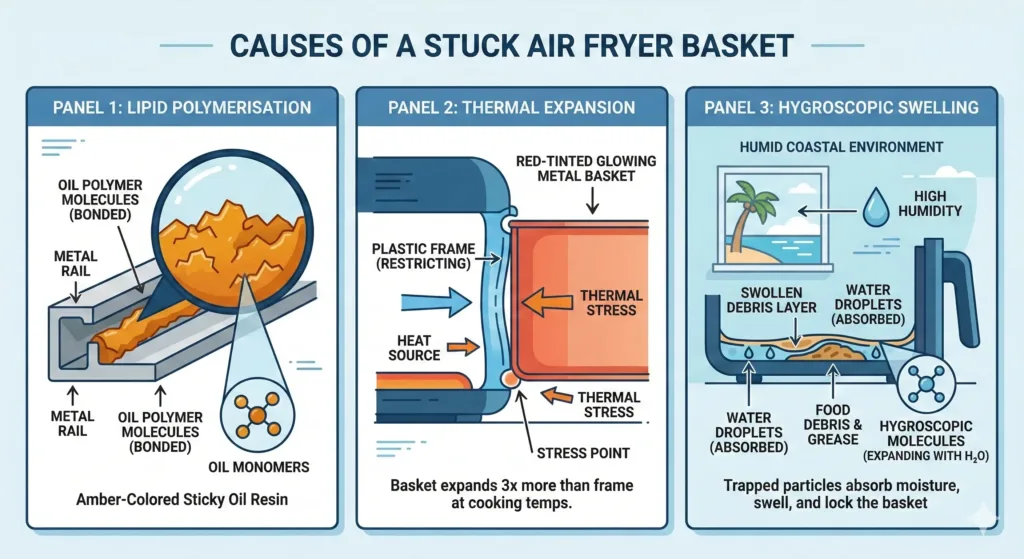
The air fryer’s internal chamber reaches 200°C during operation. The basket is constructed from carbon steel or aluminium while the chassis and slide track walls are injection-moulded from ABS (Acrylonitrile Butadiene Styrene) plastic. These two materials expand at fundamentally different rates when heated. Metal expands significantly faster than ABS polymer.
If you extract or insert the basket while the appliance is still at peak temperature, you are forcing metal against plastic when the size mismatch is at its maximum. Each forced extraction micro-abrades the track surface. Over 30 to 50 cooking cycles, this converts a smooth glide into a chronic catch and eventually into a complete mechanical lock. Indian kitchen temperatures of 28°C to 35°C amplify this effect because the thermal delta between ambient and 200°C is larger here than in temperate climates.
Lipid Polymerisation: The Grease Lock
This is the dominant cause of basket seizure in Indian kitchens, responsible for an estimated 80% of jam incidents based on patterns observed across Indian appliance forums and resale listings.
Sunflower oil, groundnut oil, and mustard oil are routinely applied as spray coats before air frying samosas, pakoras, paneer tikka, and aloo tikki. The aerodynamic vortex inside the convection chamber atomises these oils into microscopic droplets that settle on the slide tracks and release button mechanism. At 200°C, the polyunsaturated fatty acids in these oils undergo rapid oxidation and cross-linking, the same chemical process that turns linseed oil into floor varnish. When the appliance cools, this resin solidifies into an industrial-strength adhesive on the sliding components. Mustard oil and unrefined groundnut oil polymerise faster than refined sunflower oil due to their lower smoke points. See our guide on using an air fryer for perfect results for correct oil application techniques.
Hygroscopic Swelling: The Monsoon Factor
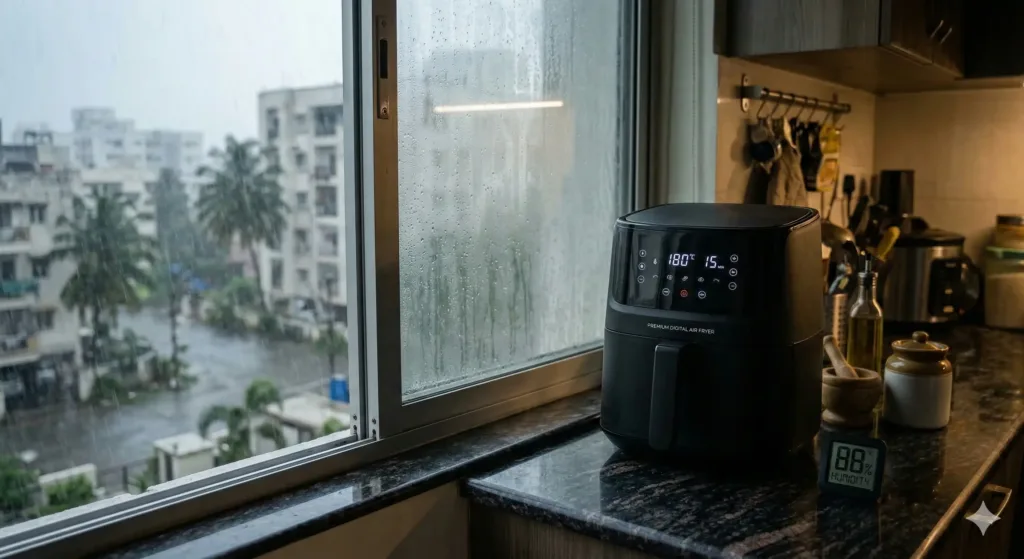
Carbonised food residue and oil resin on air fryer tracks are highly hygroscopic. In coastal cities including Chennai, Mumbai, and Kolkata, relative humidity regularly exceeds 85% for months. When an air fryer sits idle for 48 to 72 hours in a humid kitchen, the debris layer absorbs moisture and swells by up to 30% in volume, eliminating the microscopic clearance between the basket and the chassis rails entirely.
The same moisture accelerates galvanic corrosion on any scratched non-stick surface. Rust occupies a larger physical volume than the base iron from which it forms, further expanding and jamming the tracks. For the full consequences of coating damage, see our guide on air fryer non-stick coating peeling.
| Root Cause | Primary Trigger | Indian Risk Level | Resulting Failure |
| Thermal expansion | Extraction during or just after cooking | Medium | Rail micro-abrasion, progressive binding |
| Lipid polymerisation | Masala-heavy cooking, infrequent degreasing | High | Adhesive resin lock on tracks and release button |
| Hygroscopic swelling | Coastal humidity, monsoon season, idle storage | Very High (coastal zones) | Swollen debris, galvanic rust, track seizure |
The 6A vs 16A Socket Problem: An Indian-Specific Cause Nobody Talks About
A basket that jams progressively over weeks rather than all at once is frequently the result of incorrect electrical infrastructure. Indian domestic wiring uses two socket standards. The standard 6A socket is rated for approximately 1,440 Watts at India’s 240V supply. The 16A socket handles high-draw appliances safely.
Modern air fryers frequently exceed this threshold. The Philips HD9252/90 draws exactly 1,400W with zero margin for voltage fluctuations. The Agaro Regency operates at 1,800W and the Ninja AF100 at 1,550W, both exceeding 6A capacity entirely. Our air fryer buying guide for Indian kitchens covers socket compatibility for all major models.
Using an aftermarket 5A-to-16A converter plug to force a high-wattage unit into a standard 6A socket causes intense Joule heating at the socket interface. This heat absorbs into the ABS plastic at the rear chassis. Once the plastic exceeds its glass transition point, it sags microscopically, often by less than 1mm, permanently warping the slide track geometry.
Pro Tip: Before attempting any removal protocol, check your air fryer’s wattage on the base label and verify your socket rating. A chassis warped by electrical overload cannot be fixed by cleaning. Correct the socket first, or the jam will recur regardless of which protocol you use.
How Your Specific Model Fails: Forensic Vulnerability by Brand
The design architecture of each model creates a distinct mechanical weak point. For a comparative overview of top models, see our Top 5 Air Fryers in India guide.
| Model | Wattage | Primary Sticking Mechanism | Specific Weak Point | Socket Requirement |
| Philips HD9252/90 | 1400W | Polymerised grease on release button slider | Plastic slider covering release button seizes shut | 6A (marginal), verify voltage stability |
| Prestige PAF 6.0 | 1200W | Thermal warping of ABS track walls | Compact chassis places heat source too close to plastic rails | 6A |
| Ninja AF100 | 1550W | Silicone crisper plate feet degradation | Rubber stabilising feet fuse to ceramic basket walls | 16A mandatory |
| Agaro Regency 12L | 1800W | Polymerised resin on bare steel rack guides | Stainless steel mesh guides rust rapidly in humid zones | 16A mandatory |
Philips HD9252/90: The basket release button is covered by a plastic slider mechanism. Polymerised resin accumulates on the slider’s travel path and prevents the release button from being depressed. The basket appears fully seized, but the actual failure point is this single component. Always attempt to clear this slider with a toothpick before escalating to the full 7-protocol sequence.
Prestige PAF 6.0: The extremely compact 27.2 x 27.2 cm footprint places the 1200W heating element in unusually close proximity to the plastic track walls. Prolonged operation at 200°C causes the tracks to micro-warp and solidify in their deformed geometry. This failure is irreversible through cleaning alone.
Ninja AF100: The primary sticking mechanism is not the main drawer. The internal crisper plate sits on silicone stabilising feet that fuse to the ceramic basket walls under repeated exposure to acidic marinades such as tamarind and curd-based tikka preparations. Protocol 2 (Vinegar Steam) resolves this specifically.
Agaro Regency 12L: As a front-loading oven, failures manifest at the lateral stainless steel rack guides. The combination of 1800W heat, polymerised oil, and humidity-driven oxidation creates severe binding on the multi-tier tray guides. Never use abrasive cleaning pads on these rails. For related issues, see the complete air fryer error codes fix guide.
Read This Before You Touch the Basket
Safety Warning: Do Not Skip This Section
- Never power on the air fryer to heat and loosen the basket. Running the heating element without the fan’s aerodynamic regulation worsens chassis warping.
- Never insert metal tools. A flathead screwdriver or butter knife will gouge the PTFE or ceramic coating irreversibly.
- Never apply linear pulling force on the handle. The ABS plastic anchor points fracture before any resin bond breaks.
- Fully unplug the unit before attempting Protocols 3 through 7.
- If the basket jams mid-cook: Power off, unplug immediately, and wait a minimum of 10 minutes before attempting extraction.
For a complete safety analysis of air fryer operation, see Are Air Fryers Safe?
7 Safe Removal Protocols: From Easiest to Most Advanced
Start at Protocol 1. Stop the moment the basket releases. Do not skip ahead.
A note on why mid-cycle access matters: air frying protocols for carbohydrate-rich foods require the user to shake the basket halfway through cooking. When stationary food faces the heating element continuously, it over-processes and elevates acrylamide formation. The potential health implications of acrylamide have been assessed by both the European Food Safety Authority and the US National Cancer Institute. A seized basket is therefore a food safety issue, not just a mechanical inconvenience.
Protocol 1: Controlled Thermal Softening (Hair Dryer Method)
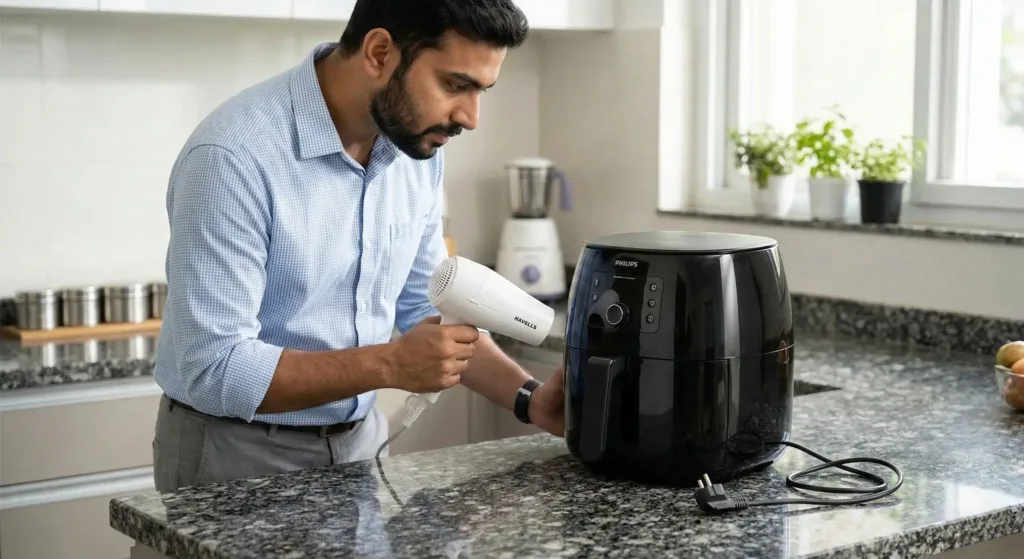
Best for: Cold grease binding the tracks after the appliance has cooled
- Ensure the air fryer is unplugged
- Set a hair dryer to low heat and hold at least 15 cm from the chassis seam
- Direct airflow evenly along the full drawer seam for 180 to 240 seconds
- Once the chassis feels warm to the touch, apply gentle oscillating outward pressure on the handle
- The resin softens from rigid solid to semi-fluid and the basket releases
If no release after 4 minutes, proceed to Protocol 2. Do not increase heat gun temperature.
Protocol 2: Acetic Acid Vapour Delamination (Vinegar Steam Method)
Best for: Deep carbonised resin and embedded food residue, including behind the Philips release button slider
White vinegar at 5% acetic acid concentration is available at any Indian grocery store for Rs 30 to Rs 60. Heat lowers the viscosity of congealed fats while acetic acid hydrates and fractures the carbonised resin bond from the PTFE or steel substrate.
If a gap exists at the seam: Inject 30 ml of equal-parts white vinegar and near-boiling water using a syringe directly into the seam. If hermetically sealed: Achieve partial release via Protocol 1 first, then inject.
- Plug into a verified 16A socket
- Set to 80°C and run for exactly 3 minutes
- Power off and rest for 5 minutes
- Attempt extraction. Resistance should be dramatically reduced.
If your air fryer produces unusual smoke during this cycle, see why air fryers smoke and how to fix it before continuing.
Pro Tip: If 80°C is not available and lowest setting is 100°C, reduce cycle duration to 2 minutes.
Protocol 3: Capillary Action Lubrication (Sunflower Oil Dropper)
Best for: Metal-on-metal dry friction from worn coating or rust-induced track expansion
- Ensure the unit is completely cold and unplugged
- Elevate the front feet on a 5 cm block to tilt the unit backward
- Apply 3 to 5 drops of refined sunflower oil along each lateral drawer seam using a dropper
- Leave undisturbed for 30 minutes to allow capillary penetration
- Attempt extraction with gentle oscillating pressure
Use only refined sunflower oil. Raw mustard oil and unrefined groundnut oil polymerise on heated tracks and recreate the seizure within 5 to 10 cooking cycles.
Protocol 4: Lateral Kinetic Oscillation (Wiggle Technique)
Best for: Misaligned or warped track geometry where linear pulling amplifies binding
- Place your non-dominant hand flat on top of the chassis to stabilise the unit
- Apply force left-to-right in rapid micro-oscillations of 1 to 2 mm each direction
- Simultaneously maintain a very light, constant outward tension
- The vibration converts static friction to kinetic friction and the basket walks itself free over 20 to 40 seconds
This technique is safe for all coatings and can be combined with Protocol 1 while the resin is still warm.
Protocol 5: Localised Cryo-Contraction (Ice Pack Method)
Best for: Basket jammed at peak heat and cooled into a differential tension lock
Symptom: basket opened during cooking but became impossible to move after full cooling.
- Verify at least a 2 cm gap is accessible in the basket cavity
- Insert a heavy-duty leak-proof bag of crushed ice directly into the cavity
- Keep the exterior ABS chassis at room temperature to maximise thermal differential
- Leave for 15 minutes to cause metallic interior to contract fractionally
- Remove ice pack and immediately execute Protocol 4. The contraction window is 2 to 3 minutes.
Protocol 6: Non-Marring Mechanical Leverage (Nylon Spudger Method)
Best for: Extreme hardened resin that has formed a physical perimeter seal unresolvable by Protocols 1 and 2
A nylon spudger (Rs 150 to Rs 300 on Amazon India) is rigid enough for leverage but soft enough to leave coatings undamaged. A firm silicone spatula is an acceptable alternative. Never use any metal tool.
- Insert the thin nylon edge into the tightest accessible point of the drawer seam
- Apply gentle twisting leverage to crack the brittle resin seal
- Work methodically around the entire faceplate perimeter
- Once the seal fractures at three or more points, the basket releases
On the Ninja AF100, restrict spudger contact to the metal faceplate frame only. Ceramic coatings can micro-fracture under point leverage.
Protocol 7: Inverted Kinetic Dislodgement (Flip and Tap Method)
Best for: A physical wedge blockage such as a dislodged screw, warped grill plate, or petrified food debris in the track
- Unplug completely and secure the power cord
- Place a heavy towel or silicone mat on a stable countertop
- Carefully invert the entire air fryer upside down onto the padded surface
- Gently tap the bottom and lateral sides using an open palm or soft rubber mallet
- While inverted, attempt to slide the basket outward
- Right the unit and inspect the track for the dislodged component before reassembling
If a screw is found, do not reinsert it without identifying its origin. A loose screw near the heating element is a fire risk. Log a service call before further use. For related error conditions, see Air Fryer Error Codes: Complete Fix Guide.
The India Humidity Fix: Stop Your Basket Jamming Before It Starts
Resolving a seized basket is reactive. In Indian kitchen conditions, the correct long-term strategy is environmental mitigation. For a broader discussion of humidity-related limitations of air fryers, see our article on the advantages and disadvantages of air fryers.
Why Standard Towel-Drying Is Not Enough
Microscopic water droplets remain trapped in track seams, rivet joints, and beneath rubber stabilising bumpers after towel-drying. In coastal kitchens in Chennai or Mumbai, these droplets do not evaporate through passive air drying because the ambient humidity is too high. Within 48 hours, residual moisture combines with cooking oil traces to form the hygroscopic paste that initiates track swelling.
The Heat-Dry Cycle: Step-by-Step
- Wash the basket and inner pan as normal and towel-dry as a first pass
- Reassemble the basket into the main chassis
- Power on the air fryer and set to 120°C
- Run completely empty for 3 to 4 minutes
- The thermal cycle evaporates moisture from mechanical joints and rivet recesses that a towel cannot reach
- Power off and cool for 5 minutes before storage
Why 120°C and not higher: Running an empty unit at 200°C subjects the unloaded PTFE or ceramic coating to maximum thermal stress without food mass to distribute the heat. This accelerates coating degradation. At 120°C, moisture evaporates thoroughly without damaging the non-stick surface. For safe temperature guidance, see Is Preheating Necessary in an Air Fryer? and What Temperature to Preheat Your Air Fryer.
Pro Tip: Users in Chennai, Kolkata, coastal Maharashtra, and Kerala should treat the Heat-Dry cycle as mandatory after every single wash. Relative humidity in these cities exceeds 75% year-round. The 4-minute investment after each wash costs substantially less than a Rs 2,800 basket replacement.
Surface Conditioning of the Slide Rails
Following the Heat-Dry cycle, apply a microscopic amount of refined sunflower oil to the outer lateral slide rails only using a cotton bud. This creates a hydrophobic boundary layer that actively repels ambient moisture between cooking sessions. Never apply oil to the cooking surface or inner basket mesh.
[UPCOMING: Rust Prevention in Coastal India, Heat-Dry Technique and Surface Treatment Guide]
Maintenance Checklist: Prevent the Next Jam
After every cooking session:
- Wait 5 minutes after powering off before pulling the basket
- Wipe the outer lateral slide rails with a dry cloth while still warm
After every wash:
- Run the Heat-Dry cycle: 120°C, empty, 3 to 4 minutes
- Apply a thin film of refined sunflower oil to the outer slide rails only
- Never use abrasive steel wool or metal scrubbers on any coated surface
If your air fryer is producing unusual smells or sounds during normal use, the same residue buildup causing basket seizure may be responsible. See air fryer making loud noise and air fryer smoking causes and fixes for related maintenance guidance.
Monthly:
- Inspect the release button slider (Philips users) and clear resin with a toothpick
- Check the non-stick coating for scratches, peeling, or discolouration. See air fryer non-stick coating peeling guide for full guidance.
- Verify the socket and plug for heat marks or looseness. A warm plug after use indicates Joule heating from an undersized circuit.
- Check digital panel responsiveness. Grease vapour buildup affects touch interfaces. See air fryer touch screen not working if issues arise.
Pro Tip: Once a week, run your finger along both lateral slide rails. Roughness or stickiness indicates early-stage polymerised resin. A 30-second wipe with white vinegar removes it completely at this stage. Left for a month, the same residue requires Protocol 6.
Repair vs Replace: The 2026 Cost Reality
Replacement parts in the 2026 Indian market are significantly more expensive than most users anticipate. For current new model pricing, see Air Fryer Price in India 2026.
| Model | Approx. MRP (2026) | Replacement Basket Cost | Cost as % of MRP | Recommended Action |
| Philips HD9252/90 | Rs 5,995 | Rs 2,800 to Rs 3,800 | 47 to 63% | Repair only if unit is under 12 months old |
| Prestige PAF 6.0 | Rs 2,499 to Rs 2,999 | Rs 600 to Rs 900 | 25 to 30% | Replace basket if chassis tracks are undamaged |
| Ninja AF100 | Rs 8,500 to Rs 10,000 (import) | Rs 7,400+ (ceramic via import) | 75%+ | Replacement uneconomical, protect coating aggressively |
| Agaro Regency 12L | Rs 7,499 to Rs 8,499 | Rs 1,200 to Rs 2,000 (rack set) | 16 to 24% | Replace rack set, most economical scenario |
Decision framework:
- Basket under 6 months old and jam is grease-only: execute Protocols 1 through 3 before spending anything
- Replacement cost exceeds 50% of current MRP: purchasing a new unit is more economical. See best air fryer for a small family in India and Top 5 Air Fryers in India for current recommendations.
- Coating is visibly peeling or rust is present: replacement is a safety requirement. The FDA has assessed acrylamide and food safety risks from high-temperature cooking, and coating integrity directly affects these outcomes.
Where to source replacement baskets: Amazon India (search exact model number followed by “replacement basket”), Flipkart (“compatible with” filter in kitchen accessories), and brand authorised service centres for OEM parts.
[UPCOMING: Do You Need a Stabilizer for Air Fryer? PCB Protection Guide]
Warranty and Service Centre Support
A basket jamming due to a manufacturing defect from day one is generally covered under the standard 1-year warranty for most Indian brands and 2 years for Philips on select models. Jamming caused by grease accumulation, incorrect socket use, or forced extraction damage is classified as user-induced damage and is not covered by any major brand.
Always attempt Protocols 1 through 3 before logging a service call. An unnecessary visit costs Rs 500 to Rs 800 in diagnostic fees.
For brand-specific troubleshooting, see Pigeon Air Fryer Not Turning On and Air Fryer Touch Screen Not Working.
Brand service contacts, verified 2026:
- Philips India: 1800-102-2929 (toll-free), philips.co.in/support
- Prestige (TTK): prestige-xclusive.com/service-centres
- Agaro: agaro.in/support, urban turnaround 3 to 5 working days
- Pigeon: pigeon-india.com, service consistency varies by city
Before calling: note your model number from the base label, retain your purchase invoice, and describe the symptom precisely. “Basket will not slide out” and “release button will not depress” require different diagnostic approaches from the technician.
For a comparative overview of service network reliability, see [UPCOMING: Best Air Fryer Service Networks in India Brand Ranking].
Conclusion
A stuck air fryer basket is not a random defect. It is the predictable outcome of polymerised grease, thermal expansion, and humidity acting on microscopic tolerances. The seven protocols in this guide address each cause in sequence, from the simplest hair dryer fix to the inversion technique for physical blockages. Work through them in order and stop the moment the basket releases.
The longer-term solution is the Heat-Dry cycle, the weekly rail check, and refined sunflower oil conditioning. These three habits, taking under 5 minutes combined, prevent the majority of jam incidents in Indian kitchens regardless of brand or model.
If your appliance needs replacing rather than repairing, start with our air fryer buying guide for Indian kitchens and Air Fryer Price in India 2026 before making a decision.
For the complete OurKitchen.in library of air fryer buying guides, troubleshooting articles, and usage guides built specifically for Indian home cooks, visit OurKitchen.in.
Frequently Asked Questions: Air Fryer Basket Stuck
Q1. How do I safely remove a stuck air fryer basket without breaking it?
Start with Protocol 1 and direct a hair dryer on low heat along the drawer seam for 180 to 240 seconds to soften the polymerised grease resin, then apply gentle oscillating outward pressure. If the basket does not release, escalate through the 7 protocols in sequence and stop the moment it frees. Never apply direct linear pulling force on the handle because the ABS plastic anchor points fracture before any resin bond breaks.
Q2. What are the most common reasons an air fryer basket gets stuck in India?
The three primary causes are polymerised cooking oil hardening into an adhesive resin on the slide tracks, thermomechanical expansion locking the basket when extracted at peak cooking temperature, and hygroscopic swelling of food residue in high-humidity Indian kitchens. In most stuck basket cases, two or three of these causes are operating simultaneously. Indian cooking oils, particularly mustard oil and unrefined groundnut oil, polymerise faster than refined sunflower oil due to their lower smoke points.
Q3. Why does my air fryer drawer keep getting harder to open over time, even after cleaning? Progressive difficulty opening the drawer is the classic symptom of chassis micro-warping caused by running a high-wattage air fryer through an undersized 6A socket. When the electrical draw exceeds the socket’s rated capacity of approximately 1,440W at India’s 240V supply, Joule heating transfers into the rear ABS plastic chassis, causing it to sag microscopically. A deformation of even 1mm permanently alters the slide track geometry and cannot be corrected by cleaning or lubrication alone.
Q4. Can I use household items to fix a jammed air fryer basket?
Yes. Five of the seven removal protocols use items already available in most Indian homes. A hair dryer, white vinegar available for Rs 30 to Rs 60 per bottle, refined sunflower oil, a precision dropper or syringe, and a bag of crushed ice cover Protocols 1 through 5 completely. A nylon spudger, available on Amazon India for Rs 150 to Rs 300, is the only specialist tool required and is only needed for Protocol 6.
Q5. Is a stuck air fryer basket covered under warranty in India?
A basket jamming due to a manufacturing defect is generally covered under the standard 1-year warranty for most Indian brands and 2 years for Philips on select models. Jamming caused by grease accumulation, incorrect socket use, corrosion from aggressive cleaning, or physical damage from forced extraction is classified as user-induced damage and is not covered. Always attempt Protocols 1 through 3 before logging a service call, as an unnecessary visit costs Rs 500 to Rs 800 in diagnostic fees.
Q6. Does monsoon humidity cause air fryer baskets to jam in India?
Yes, this is a documented problem in coastal India and during the June to September monsoon season. Carbonised food residue and polymerised oil on the slide tracks are highly hygroscopic, absorbing ambient moisture and swelling by up to 30% in volume, eliminating the microscopic clearance between the basket and the chassis rails. The standard preventative fix is the Heat-Dry cycle: run the air fryer completely empty at 120°C for 3 to 4 minutes after every wash.
Q7. Which oil should I use to lubricate air fryer basket rails?
Use only refined sunflower oil, applied in a microscopic amount to the outer lateral slide rails exclusively and never to the cooking surface or the inner basket mesh. Refined sunflower oil has the appropriate viscosity for capillary penetration and a sufficiently high smoke point to resist rapid polymerisation on subsequent heating cycles. Raw mustard oil, unrefined groundnut oil, and coconut oil all polymerise on the heated rails within 5 to 10 cooking cycles, recreating the seizure condition.
Q8. How much does an air fryer replacement basket cost in India in 2026?
A Prestige PAF 6.0 basket assembly costs Rs 600 to Rs 900, representing 25 to 30% of MRP. The Philips HD9252/90 inner and outer pan assembly together cost Rs 2,800 to Rs 3,800, representing 47 to 63% of MRP. Ninja AF100 ceramic replacement baskets are available via import specialists at upwards of Rs 7,400, making replacement economically unviable. If replacement cost exceeds 50% of current appliance MRP, purchasing a new unit is the more economical decision.
Q9. Can a stuck air fryer basket be a health risk?
Yes, indirectly, through two distinct pathways. If the basket jams mid-cook, the mandatory mid-cycle shake to redistribute food cannot be performed, and stationary food facing the heating element over-processes rapidly, significantly elevating acrylamide formation in carbohydrate-rich foods such as samosas, pakoras, and aloo tikki. Additionally, forced extraction that damages the PTFE or ceramic coating exposes the carbon steel substrate to rust and potentially introduces microscopic coating flakes into the food matrix.
Q10. How do I stop my air fryer basket from getting stuck again after fixing it?
Three habits, executed consistently, prevent recurrence in the vast majority of cases. First, wait a minimum of 5 minutes after powering off before extracting the basket to allow asymmetric thermal expansion to equalise. Second, run the Heat-Dry cycle at 120°C for 3 to 4 minutes after every wash to evaporate hidden moisture from track joints. Third, apply a thin film of refined sunflower oil to the outer slide rails after each Heat-Dry cycle to create a hydrophobic barrier that repels ambient humidity.

Prathap is the founder of ourkitchen.in and a B.Tech graduate in Agricultural Engineering from Tamil Nadu. His engineering background in thermodynamics, heat transfer, and food processing science gives him a fundamentally different approach to kitchen appliance reviews compared to typical lifestyle bloggers.
Rather than relying on manufacturer claims, Prathap measures actual power draw against rated wattage, evaluates basket airflow geometry, and stress-tests non-stick coatings over 90-plus cook cycles before recommending any product. He cross-checks every safety claim against BIS and FSSAI standards, and all pricing against live Amazon India and Flipkart listings.
He has written over 61 deep-dive articles on air fryers for the Indian market, personally testing models from Philips, Pigeon, Agaro, Kenstar, Havells, and Bajaj. His reviews are built around Indian realities: 220V power grids, high-humidity coastal kitchens, Indian cooking temperatures, and the price-performance expectations of Indian households.
Based in Chennai, Tamil Nadu.