TL;DR
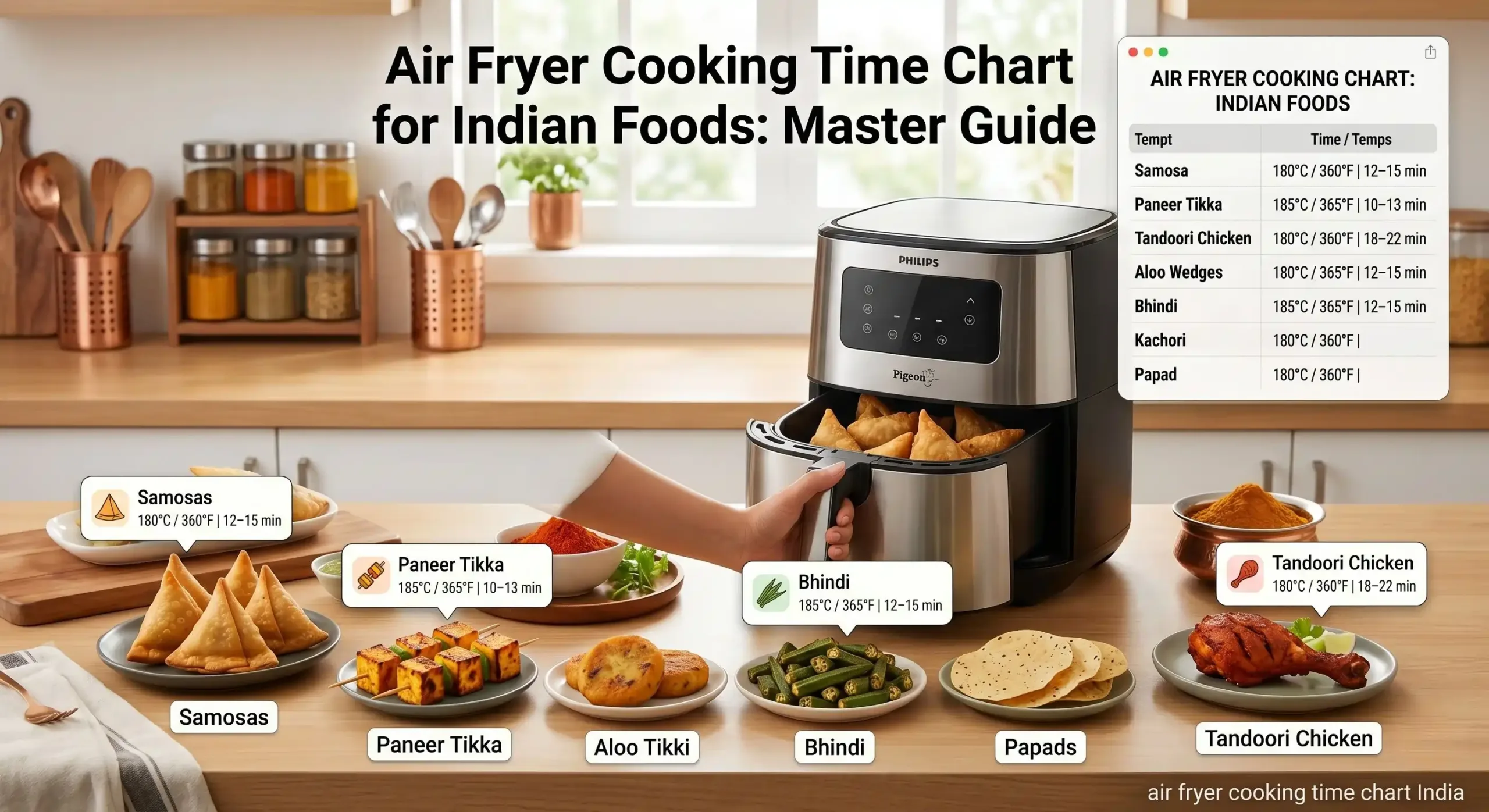
This is a complete air fryer cooking time chart and temperature chart for Indian foods. For a standard 1400W–1500W basket-style air fryer, samosas cook at 180°C for 12–15 minutes, paneer tikka at 180–190°C for 10–13 minutes, chicken tikka at 180°C for 15 minutes, and french fries at 200°C for 12–18 minutes. Preheat for 3–5 minutes before cooking. Always shake or flip halfway. Increase time by 10–15% for 1200W models. All temperatures are given in both °C and °F.
Table of Contents
Introduction
You bought an air fryer. You tried a batch of samosas. They came out either pale and soggy, or charred outside with a cold filling inside. You looked for a cooking time guide online, and every result was a chart full of chicken wings, bacon strips, and hot dogs. Nothing for samosas. Nothing for paneer tikka. Nothing for chakli, kachori, or bhindi.
This is the guide that should have existed before you bought the appliance.
Over dozens of test batches across Philips, Pigeon, Agaro, and Havells models, I have compiled a complete, India-specific air fryer cooking time chart covering snacks, vegetables, non-veg proteins, breads, frozen supermarket foods, and traditional sweets. Every entry includes the temperature in °C and °F, the time in minutes, and specific notes on oil application, shaking intervals, and common failure modes.
This is not a generic Western chart with Indian food names swapped in. The parameters here account for Indian kitchen realities: variable wattage, humid coastal climates, thick yogurt marinades, and the dense, layered structure of traditional Indian snacks. Use it as your kitchen reference every time you cook.
Why Indian Foods Need Their Own Air Fryer Chart
Most air fryer charts are built around Western foods chicken drumsticks, steak, battered fish, and hash browns. These foods have fundamentally different moisture content, coating thickness, and density compared to samosas, chakli, or marinated paneer.
Indian snacks like samosas and kachoris are built around flour-based dough with a moisture-rich filling. The dough needs enough direct heat to blister and crisp, but the filling needs time to warm through without the exterior burning. Vegetables like bhindi (okra) are coated in dry spice-flour mixes that behave completely differently from a Western breadcrumb coating. Marinades for tikka and tandoori dishes are thick yogurt-based mixtures that steam rather than crisp if applied too wet.
Beyond the food itself, Indian air fryers vary enormously in wattage. A Pigeon budget model may draw 1200W while a Philips HD series runs at 1400–1500W. That 200–300W difference meaningfully changes how fast the chamber reaches temperature and how quickly it recovers after you shake the basket. A chart calibrated for a Philips will undercook on a Pigeon if you follow it blindly.
The chart in this guide is calibrated for a 1400–1500W basket-style air fryer. Adjustments for lower-wattage models are noted throughout.
How to Read and Use Air Fryer Cooking Time Chart
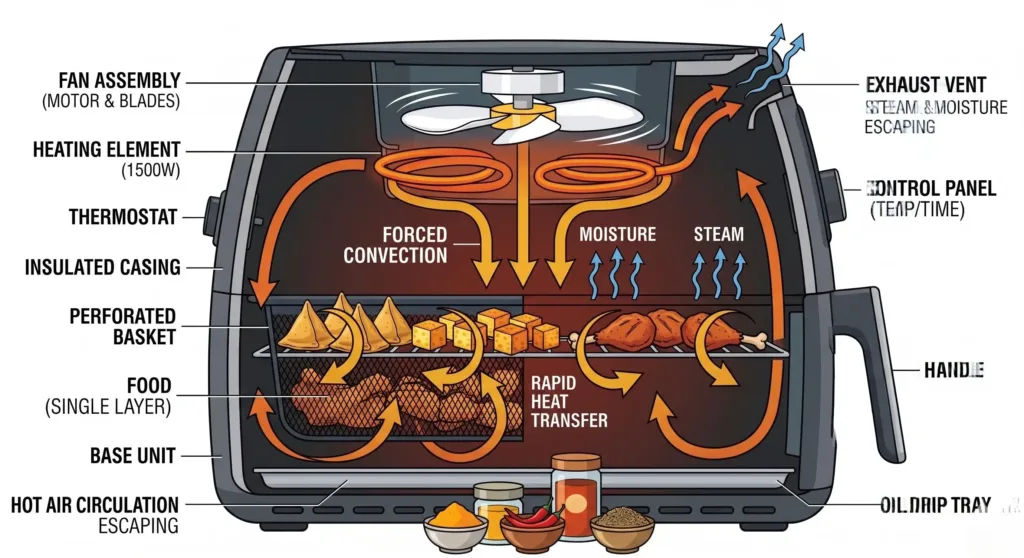
Before you use any of the tables below, understand these five foundational rules. They apply to every single item in the chart.
Preheat every time. Run your air fryer at the target cooking temperature for 3–5 minutes before adding food. This is not optional. Placing food into a cold chamber means the food spends the first several minutes warming up instead of actually cooking, which leads to soggy exteriors and uneven results. For detailed guidance, read our article on how to preheat an air fryer: complete guide.
Shake or flip at the halfway mark. Hot air in a basket model comes from above. The bottom surface of your food always receives less direct heat. Shaking (for small items like fries or bhindi) or flipping with silicone tongs (for larger items like samosas or chicken pieces) equalises the cooking on both sides.
Never overcrowd. The entire mechanism of an air fryer depends on hot air circulating freely around the food. If you stack samosas on top of each other or pack the basket tightly with bhindi, the air cannot move. The appliance stops frying and starts steaming. Single layer, always. Cook in batches if you need to.
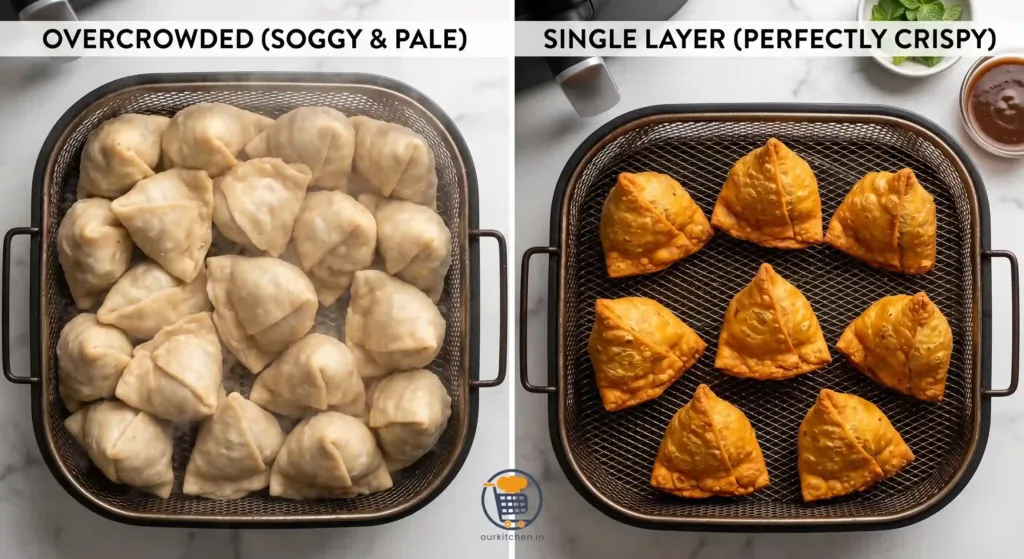
Apply oil as a conductor, not as a medium. You are not deep frying. A light brush of oil or a quick spray is enough to help heat transfer and produce a crisp exterior. Excess oil drips to the bottom of the basket, burns, and creates smoke. For more on smoke issues, see our troubleshooting guide on why your air fryer is smoking.
For 1200W models, add 10–15% to the cooking time. Lower wattage means slower chamber heating and slower temperature recovery. If the chart says 15 minutes, cook for 16–17 minutes on a budget 1200W model and check for doneness.
Complete Air Fryer Cooking Time Chart: Indian Snacks and Street Food
Indian snacks are the most searched category for air fryer cooking times in India — and the most poorly documented. The chart below covers the most common snacks made in Indian homes.
| Food Item | Temp (°C / °F) | Time (Minutes) | Oil Needed | Flip/Shake | Key Notes |
| Samosa (fresh, raw dough) | 180°C / 360°F | 12–15 | Yes, brush generously | Flip at 7 min | Brush with oil or ghee. Dough needs lipid for blistering. |
| Samosa (frozen, par-cooked) | 190°C / 375°F | 8–10 | Light spray | Flip at 5 min | Cook directly from frozen. Do not thaw. |
| Kachori (fresh dough) | 200°C / 390°F | 5–6 | Yes, brush | No flip needed | Preheat mandatory. Dough should puff within first 2 minutes. |
| Bread Pakora | 175°C / 350°F | 10 | Yes, spray exterior | Flip at 5 min | Line basket with parchment to stop batter dripping. |
| Corn Bhutta (whole cob) | 200°C / 390°F | 15–20 | Yes, rub with oil | Rotate at 8 min | Increase to 205°C for final 2 min for charred edges. |
| Papad | 180°C / 360°F | 2–3 | Optional (light) | No | Place wire rack on top to prevent it flying into the element. Monitor after 60 seconds. |
| Chakli / Murukku (fresh dough) | 200°C / 390°F | 12–15 | Yes, spray well | Flip at 7 min | Pipe onto parchment squares for easy transfer without breaking. |
| Nachos (loaded) | 200°C / 390°F | 4–5 | No | No | Monitor constantly. Edges burn fast. |
| Popcorn | 200°C / 390°F | 6–8 | 1 tsp per ½ cup | N/A | Cover with wire mesh. Loose kernels can reach the heating element. |
| Gujiya (fresh) | 180°C / 360°F | 14–15 | Brush with ghee | Flip at 7 min | Seal edges well before cooking. |
| Sabudana Vada | 180°C / 360°F | 12–14 | Yes, spray | Flip at 6 min | Slightly flatten for even cooking. Single layer only. |
| Aloo Tikki | 190°C / 375°F | 12–15 | Yes, brush both sides | Flip at 7 min | Chill the tikkis in the fridge for 15 minutes before cooking to help them hold shape. |
Air Fryer Cooking Time Chart: Vegetables
Indian vegetable preparations span a wide range. Some are dry-spiced and need intense heat to char and concentrate. Others are marinated in yogurt and need gentler, sustained heat. The chart below covers the most common vegetables cooked in Indian air fryers.
| Vegetable | Temp (°C / °F) | Time (Minutes) | Oil | Shake/Flip | Key Notes |
| Aloo Wedges (potato) | 190°C / 375°F | 15–20 | Yes | Shake at 8 min | Soak cut potatoes in cold water for 30 min, then dry completely before oiling. Reduces sticking and improves crispness. |
| Baby Potatoes (whole) | 200°C / 390°F | 20–25 | Yes | Shake at 10 min | Prick skins with a fork before cooking to allow steam to escape safely. |
| Gobi / Tandoori Gobi (florets) | 180°C / 360°F | 14–18 | Yes | Shake at 7 min | If using yogurt marinade, use thick hung curd. Thin marinade will steam, not roast. Spread in single layer. |
| Paneer Tikka (cubes) | 185°C / 365°F | 10–13 | Spray basket | Flip at 6 min | Preheat mandatory. Use thick yogurt. Cut paneer into 2.5cm minimum thickness to avoid drying out. |
| Bhindi / Okra (sliced) | 185°C / 365°F | 12–15 | Yes, toss in besan + oil | Shake at 6 min | Dry the bhindi completely before slicing. Add besan or rice flour for crispness. |
| Baingan / Brinjal (slices) | 180°C / 360°F | 14–16 | Brush both sides | Flip at 7 min | Slices will shrink significantly. Coat in spice mix and mustard oil for authentic flavour. |
| Capsicum / Bell Pepper | 200°C / 390°F | 10–15 | Light spray | Shake at 5 min | High moisture content. Will char quickly. Watch from 8 minutes onwards. |
| Sweet Corn Kernels | 200°C / 390°F | 15 | Toss in oil + cornflour | Shake at 7 min | Add cornflour and rice flour for binding. Finish with chaat masala after cooking. |
| Mushrooms (button) | 190°C / 375°F | 8–12 | Yes | Shake at 5 min | Single layer only. Mushrooms release huge amounts of water. Overcrowding causes steaming, not roasting. |
| Baby Corn | 180°C / 360°F | 15 | Yes | Shake at 7 min | Toss in cornstarch for Manchurian style, or dry spices for a simple roast. |
| Makhana (fox nuts) | 160°C / 320°F | 8–10 | 1 tsp per cup | Shake every 3 min | Low temperature prevents burning. Very light oil. Perfect for Navratri vrat snacks. |
| Sweet Potato Fries | 190°C / 375°F | 15–18 | Yes | Shake at 8 min | Cut evenly for consistent cooking. Dry well after cutting. |
Air Fryer Cooking Time Chart: Non-Vegetarian Proteins
Cooking meat, poultry, and seafood in an air fryer requires extra attention to internal temperature, not just time. The exterior browns quickly under intense convection heat sometimes faster than the inside cooks. A digital meat thermometer is strongly recommended for bone-in pieces and thick cuts.
| Protein | Temp (°C / °F) | Time (Minutes) | Oil | Flip | Safe Internal Temp | Notes |
| Chicken Tikka (boneless cubes) | 180°C / 360°F | 15 | Minimal (marinade provides) | Flip at 8 min | 74°C / 165°F | Preheat mandatory. Use skewers or place directly in basket. |
| Tandoori Chicken (bone-in) | 180°C / 360°F | 18–22 | Minimal | Flip at 10 min | 74°C / 165°F | Check internal temperature at thickest part. Do not rely on colour alone. |
| Chicken Nuggets (frozen) | 200°C / 390°F | 10–12 | No (pre-oiled) | Shake at 5 min | 74°C / 165°F | Single layer. Shake halfway for even crispness. |
| Fish Fillets (battered) | 200°C / 390°F | 10–15 | Spray basket | Flip carefully at 7 min | 63°C / 145°F | Use parchment paper for wet batter to prevent sticking. Fish is prone to breaking. |
| Prawns / Shrimp | 190°C / 375°F | 8 | Minimal | Shake at 4 min | 63°C / 145°F | Done when they curl into a tight C-shape and flesh is fully opaque. Do not overcook. |
| Eggs (in silicone cups) | 195°C / 385°F | 6–8 | Light oil in cup | No | 71°C / 160°F | 6 min for soft, jammy yolk. 8 min for fully set yolk. Silicone cups prevent the egg from being blown around by airflow. |
| Chicken Seekh Kebab | 190°C / 375°F | 12–15 | Brush with oil | Rotate at 6 min | 74°C / 165°F | Soak wooden skewers for 30 min before use. |
| Mutton Seekh Kebab | 200°C / 390°F | 15–18 | Brush with oil | Rotate at 8 min | 71°C / 160°F | Slightly longer time for mutton due to higher density. |
A note on food safety: the WHO and FSSAI both specify 74°C (165°F) as the minimum safe internal temperature for all poultry. The visual cue of golden-brown skin is not a reliable indicator of doneness in an air fryer, the exterior chars faster than a conventional oven. Always use a meat thermometer for bone-in chicken pieces.
For more on air fryer safety standards, our article on whether air fryers are safe for Indian kitchens covers coating safety, food safety, and electrical safety in one place.
Air Fryer Cooking Time Chart: Indian Breads and Reheating
Indian flatbreads are highly susceptible to drying out in an air fryer. The goal when reheating rotis, naans, or pavs is always gentle, moist heat, not dry blast cooking.
| Bread / Item | Temp (°C / °F) | Time (Minutes) | Moisture Tip | Notes |
| Roti / Phulka (reheating) | 160°C / 320°F | 2–3 | Wrap in damp paper towel or spritz with water | Do not exceed 160°C. It will turn into a cracker in 30 extra seconds. |
| Naan (reheating) | 170°C / 340°F | 2–4 | Brush with ghee or milk before placing in basket | Moisture creates steam that softens the crumb while crisping the base. |
| Bread Toast | 180°C / 360°F | 3 | None | Flip at 1.5 min for even browning on both sides. |
| Garlic Bread | 180°C / 360°F | 4–5 | Butter layer creates its own moisture | Heavy butter-garlic application. Watch the edges from minute 4. |
| Pav (reheating) | 150°C / 300°F | 3–5 | Spritz surface with water | Very gentle heat. The goal is soft and pillowy, not toasted. |
| Paratha (reheating) | 160°C / 320°F | 3–4 | Light ghee brush | Crisps beautifully. Better result than a tawa for a leftover paratha. |
Air Fryer Cooking Time Chart: Frozen Indian Supermarket Foods
Frozen foods are arguably the best use case for the air fryer. No thawing required, cook directly from frozen. The micro-ice crystals on the surface create a steam barrier that prevents burning while the interior heats through.
| Frozen Food | Temp (°C / °F) | Time (Minutes) | Oil | Shake | Notes |
| French Fries (McCain, etc.) | 200°C / 390°F | 12–18 | No (pre-oiled) | Every 5 min | Do not thaw. Shake every 5 minutes to prevent clumping. |
| Frozen Nuggets | 200°C / 390°F | 10–12 | No | Shake at 5 min | Single layer. The high heat sublimates the ice and crisps the coating simultaneously. |
| Frozen Spring Rolls | 200°C / 390°F | 8–10 | Light brush | Shake at 5 min | Brush wrappers with oil before cooking for a golden, blistered exterior. |
| Frozen Momos / Dim Sum | 185°C / 365°F | 10–12 | Brush generously | Shake at 5 min | Preheat mandatory. Wrapper blisters and crisps while filling steams inside. |
| Frozen Samosa | 190°C / 375°F | 8–12 | Light spray | Flip at 5 min | Size matters. Small frozen samosas take 8 min; large frozen samosas take closer to 12. |
| Pizza (reheating slices) | 160°C / 320°F | 5–7 | No | No | Far superior to microwave reheating. Base re-crisps, cheese melts properly. No rubbery texture. |
| Frozen Corn Dogs | 190°C / 375°F | 8–10 | No | Turn at 4 min | Available in urban Indian supermarkets. Cook from frozen. |
Air Fryer Cooking Time Chart For India: Sweets and Desserts
This is the category where the air fryer requires the most careful handling. Sugars caramelise and burn extremely fast under forced convection. Low and slow is the operating principle here.
| Sweet / Dessert | Temp (°C / °F) | Time (Minutes) | Oil | Notes |
| Gulab Jamun (reheating) | 150°C / 300°F | 3–4 | No | Monitor after 2 min. High sugar syrup burns and carbonises rapidly. |
| Malpua (fresh batter) | 180°C / 360°F | 10–12 | Parchment paper | Use parchment to hold wet batter. Soak in warm sugar syrup immediately after cooking. |
| Banana Chips (raw plantain) | 150–175°C / 300–350°F | 10–25 min | Minimal, with turmeric water | Slice at 3mm thickness. 150°C / 30 min = shelf-stable crispy chip. 175°C / 10–15 min = faster but check frequently. |
| Balushahi | 160°C / 320°F | 15 min, then 180°C / 2 min | Brush with ghee | Low temp first for even cooking, brief high-temp finish for colour. Soak in sugar syrup after. |
| Shakarpara / Namak Pare | 170°C / 340°F | 12–15 | Yes, toss in oil | Shake at 6 min. These dry out fast. Watch from 10 minutes. |
How Air Fryer Wattage Affects Cooking Times: Indian Models Compared
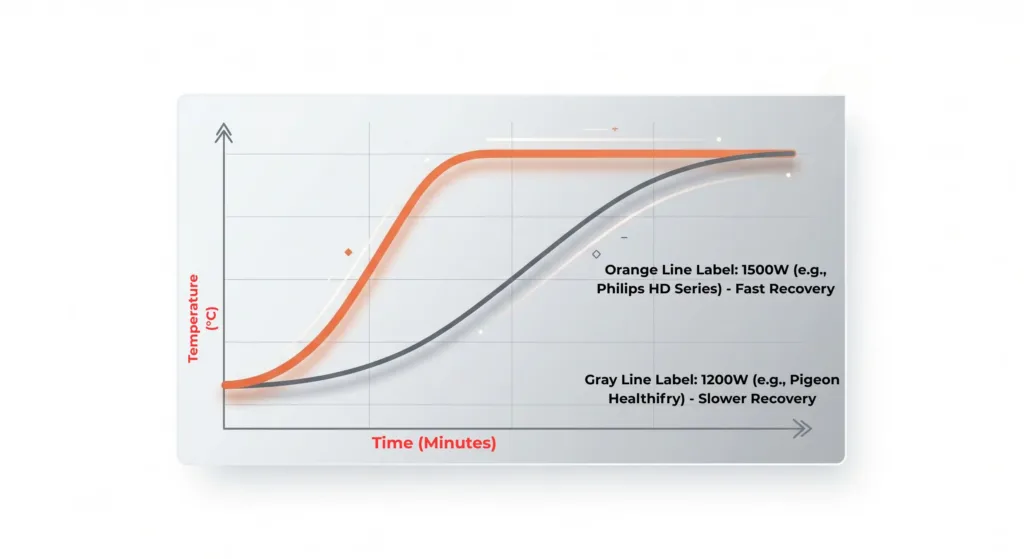
Indian buyers use a wide range of air fryer brands with meaningfully different wattage outputs. Here is how the major Indian market models compare and how to adjust your cooking times accordingly.
| Brand / Model | Wattage | Basket Size | Time Adjustment vs Chart | Best For |
| Philips HD9252 / HD9200 series | 1400–1500W | 4.1–4.2L | Use chart as-is | Premium performance, uniform results, best for snacks and tikka |
| Havells Prolife Digi Plus | 1350–1500W | 4L–6L | Use chart as-is | Mid-premium, consistent heat, good Indian preset options |
| Agaro Regency / Galaxy | 1500–1800W | 4.5–6.5L | Reduce temp by 10°C or check 2 min early | Large family batches, high wattage heats fast |
| Pigeon Healthifry Digital | 1200–1300W | 4L–4.2L | Add 10–15% to cooking time | Budget-friendly, reliable for basic cooking |
| Kenstar Aster | 1200W | 3.5–4L | Add 15% to cooking time | Entry-level, monitor closely for hot spots |
| Lifelong LLHF27 | 1200W | 3.5L | Add 15% to cooking time | Compact, budget use, single portions |
| Prestige Nutrifry Digital | 1400W | 4.5L | Use chart as-is | Solid mid-range, good for Indian cooking |
For a detailed side-by-side breakdown of these brands, see our complete air fryer buying guide for Indian kitchens. If you are shopping at a budget and considering Pigeon or similar models, also check our best air fryer under ₹5000 in India guide for the best options at that price point.
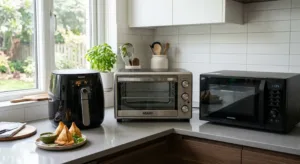
Oven-style (OTG) air fryers have a larger chamber with more distance between the element and the food. When cooking in an oven-style unit, increase the temperature by 15°C or add 20–25% to the time compared to basket-style charts. For a full comparison of these appliance types, read our article on air fryer vs OTG vs microwave for Indian kitchens.
Answering the Top Indian Air Fryer Cooking Questions
What is the best air fryer cooking time chart for popular Indian snacks?
The short answer is the chart above. For the most commonly cooked Indian snacks: samosa (fresh) at 180°C for 12–15 minutes, aloo tikki at 190°C for 12–15 minutes, paneer tikka at 185°C for 10–13 minutes, and frozen samosas at 190°C for 8–12 minutes. Always preheat, always flip halfway, and always cook in a single layer.
What are the air fryer cooking times for common Indian snacks?
The five most common Indian snacks and their timings: samosa (fresh) 180°C / 12–15 min, kachori 200°C / 5–6 min, bread pakora 175°C / 10 min, aloo tikki 190°C / 12–15 min, and papad 180°C / 2–3 min. All times are for a preheated 1400–1500W air fryer. Add 10–15% for 1200W models.
Where can I find air fryer cooking charts for Indian recipes online?
Most published air fryer time charts online are built for Western foods (chicken wings, steaks, hash browns) and do not include Indian foods. The chart in this article is one of the few India-specific references that covers snacks, vegetables, proteins, frozen foods, and sweets in a single consolidated table, calibrated for Indian air fryer brands and wattage.
What are the best temperature and duration for frozen Indian appetizers?
For frozen samosas: 190°C (375°F) for 8–12 minutes depending on size. For frozen spring rolls: 200°C (390°F) for 8–10 minutes with a light oil brush. For frozen momos: 185°C (365°F) for 10–12 minutes with a generous oil brush. Cook all frozen items directly from the freezer, do not thaw. Shake or flip at the halfway mark.
What are the top-rated air fryer brands with cooking time guides in India?
Philips provides the most comprehensive cooking guidance via their NutriU app, which includes timed recipes for Indian foods. Haier India has added Indian-specific presets (including a dedicated tikka mode) in their 2025–2026 models. Prestige Nutrifry and Agaro’s Galaxy series also feature digital panels with preset modes that cover common Indian cooking scenarios.
Is there a printable air fryer cooking chart for vegetables in India?
The vegetable chart in this article covers 12 commonly cooked Indian vegetables including aloo, gobi, paneer, bhindi, baingan, mushrooms, baby corn, and makhana. You can copy the table into Google Docs or a spreadsheet and save it as a PDF for printing. For a quick magnetic fridge reference, some sellers on Amazon India also sell generic laminated cooking charts.
Can I download an air fryer cooking time chart for Indian dishes?
There is currently no widely available PDF specifically for Indian air fryer cooking times. This article is designed to serve that purpose. Save or bookmark this page for reference. A printable version of the chart above can be created by copying the tables into any word processor and saving as PDF.
How do I convert traditional Indian recipes for an air fryer?
For recipes that call for deep frying in oil: keep the same temperature listed in the recipe (or reduce by 10–15°C if using high-wattage), reduce the time by roughly 30–40%, apply a thin brush of oil instead of submerging in oil, and cook in a single layer. For oven-baked Indian recipes: keep the same temperature but reduce time by roughly 20%, since the air fryer’s smaller chamber heats more efficiently.
How long do I air fry samosas in an air fryer bought in India?
Fresh samosas made with raw dough: preheat to 180°C (360°F) and cook for 12–15 minutes, flipping at 7 minutes, after brushing generously with oil or ghee. Frozen par-cooked samosas from a supermarket: cook at 190°C (375°F) for 8–12 minutes directly from frozen (no thawing), with a light oil spray and a flip at 5 minutes. Small samosas take less time; large samosas need more.
What are the ideal settings for chicken tikka in a large capacity air fryer?
For a 5L–6L air fryer (such as the Agaro Regency or Havells 6L), use 180°C (360°F) for 15 minutes. Preheat the appliance first. Flip the pieces at 8 minutes. Use a thick yogurt (hung curd) marinad, thin marinade drips to the basket bottom, burns, and steams the meat instead of roasting it. In high-wattage models (1600W+), check at 12 minutes to avoid overcooking.
Geographic Adjustments: Mumbai, Shimla, and Everything In Between

India’s climate and geography vary enormously, and both affect air fryer cooking performance.
High humidity (Mumbai, Chennai, Kolkata, coastal Kerala): In monsoon season, fried snacks go soggy within minutes of cooking. The air fryer can fix this. Place limp bhajias, leftover fries, or soft chakli in a clean, un-oiled basket and run at 150–160°C (300–320°F) for 3–5 minutes. The hot forced air evaporates the absorbed moisture and restores the original crunch. This also works beautifully for leftover samosas and pakoras that have gone soft overnight. For more on dealing with soggy results, see our article on why air fryer fries go soggy and how to fix it.
High altitude (Shimla, Darjeeling, Leh, Manali): At elevations above 3,000 feet, atmospheric pressure drops and water inside food evaporates faster than at sea level. The practical effect in an air fryer is that the exterior of food dehydrates and browns faster, while the interior is still undercooked. Reduce the cooking temperature by approximately 2–3°C per 1,000 feet of elevation and increase the total cooking time by 10–15%. For a 5,000-foot location, this means reducing the temperature by roughly 8–10°C and adding about 12% to the time.
Common Mistakes and How to Fix Them
Outside burnt, inside raw: This is the most common complaint in Indian air fryer communities. The cause is almost always too-high temperature or an overcrowded basket. Reduce temperature by 15–20°C and increase time. If using bone-in chicken pieces, this mistake can also indicate the pieces are too thick or the marinade is sealing heat out.
Tikka and kebabs turning rubbery: Caused by overcooking protein fibres. Chicken tikka should not exceed 74°C internal temperature. Once it hits safe temperature, take it out, every extra minute tightens and dries the muscle fibres.
Soggy samosas despite following the chart: Three causes. First: you did not preheat the appliance. Second: you used too little oil. Third: you overcrowded the basket and the expelled moisture from the filling created steam inside the chamber. Fix all three at once.
Bhindi (okra) still slimy: The bhindi was not dry before slicing. Surface moisture combined with natural okra mucilage creates a coating that steams rather than crisps. Pat dry completely and toss aggressively in besan (gram flour) and rice flour before adding oil.
Paneer crumbling or sticking: Basket was not preheated and/or not oiled. Paneer placed in a cold basket will stick as proteins set slowly. Preheat, spray the basket generously, and flip with silicone tongs, not metal ones.
Engineer’s Take
After testing these parameters across multiple Indian models, here is my honest assessment as an agricultural engineer.
The single most important variable in this entire chart is not the temperature or the time — it is the moisture state of the food going into the basket. Bhindi that is not completely dry will never crisp. Paneer tikka with a watery marinade will steam rather than roast. Potatoes that have not been soaked and dried will stick and clump.
The air fryer is a dehydration and convection cooking device operating at very high speed. It has almost no tolerance for excess surface moisture because, unlike an oven or a kadhai, it cannot handle the steam — the chamber is too small and the cooking time is too short. Every failure mode I have seen in the chart entries above traces back to either moisture mismanagement or basket overcrowding. Fix those two problems, and the chart parameters above will deliver consistent results.
The one area where I find the air fryer genuinely superior to both the kadhai and the oven in an Indian cooking context is frozen snacks. Frozen samosas, momos, and spring rolls come out substantially better in the air fryer than anywhere else. The method of cooking directly from frozen using the ice crystals as an internal steam buffer while the exterior is simultaneously crisped by forced convection is, frankly, a more elegant process than deep frying them.
If you want to understand more about why air frying is healthier than deep frying from a chemical perspective, our article on the air fryer cancer risk and acrylamide analysis covers this in detail.
Conclusion
This chart covers over 55 Indian foods across six categories: snacks, vegetables, proteins, breads, frozen foods, and sweets. The core principles are consistent across every entry: preheat the appliance, manage surface moisture before cooking, never overcrowd the basket, shake or flip at the halfway point, and apply oil as a heat conductor rather than a submersion medium.
For 1200W budget models like Pigeon and Kenstar, add 10–15% to the listed cooking times. For high-wattage oven-style models, increase the temperature by 15°C or add 20% to the time.
If you are just getting started with an air fryer and want a complete foundation, read our guide on how to use an air fryer: easy steps for perfect results. If you are still deciding which model to buy, our air fryer buying guide for Indian kitchens compares the major Indian brands on wattage, basket size, and price. For preheating specifics, see is preheating necessary in an air fryer and how long does it take to preheat an air fryer. And if your fries keep coming out soggy despite following the chart, the fix is almost certainly in our air fryer fries soggy troubleshooting guide. Finally, if you enjoy papad as much as I do, see the dedicated guide on how to roast papad in an air fryer.
Frequently Asked Questions
What temperature should I set my air fryer for Indian snacks?
Most Indian snacks cook well between 180°C and 200°C (360°F–390°F). Flour-based dough items like samosas and kachoris need 180–200°C to blister properly. Delicate items like papad need only 180°C for 2–3 minutes. Frozen items generally do well at 190–200°C cooked directly from frozen.
How long does paneer tikka take in an air fryer?
Paneer tikka takes 10–13 minutes at 185°C (365°F) in a preheated air fryer. Use thick hung curd in the marinade, not thin yogurt. Flip the pieces at 6 minutes. Spray the basket with oil before placing the paneer to prevent sticking. Cut paneer into at least 2.5cm cubes to prevent them from drying out.
Can I cook frozen samosas in the air fryer without thawing?
Yes, cook frozen samosas directly from the freezer. Do not thaw them. Thawing softens the pastry and allows the filling moisture to seep into the dough, making it soggy before it even enters the air fryer. At 190°C (375°F), small frozen samosas take 8 minutes, large ones take up to 12. Apply a light oil spray and flip at the halfway mark.
Why are my air-fried vegetables coming out soggy?
Soggy vegetables in an air fryer are almost always caused by one of three things: the vegetables had surface moisture before going in, the basket was overcrowded so steam had nowhere to escape, or the temperature was too low. Pat vegetables completely dry before coating. Cook in a strict single layer. Use temperatures between 180°C and 200°C for most Indian vegetables.
Does a Pigeon air fryer cook at the same speed as a Philips?
No. Pigeon models typically draw 1200–1300W compared to Philips at 1400–1500W. This means Pigeon takes 10–15% longer to achieve the same result. If a recipe says 15 minutes on a Philips, plan for 17–18 minutes on a Pigeon and check for doneness before adding more time.
How much oil do I need for air frying Indian snacks?
Very little. For dough-based snacks like samosas and kachoris, brush the exterior with enough oil to coat all surfaces lightly roughly 1 teaspoon for 4–6 samosas. For vegetable preparations, toss in 1–2 teaspoons of oil per 200–250g of vegetables. For marinated proteins, the marinade often contains enough oil; a light spray of the basket is sufficient.
Can I reheat leftover Indian food in an air fryer?
Yes, the air fryer is excellent for reheating. Fried snacks and kebabs reheat at 160–170°C (320–340°F) for 3–5 minutes and come out crisp, not soggy like microwave reheating. Rotis and parathas reheat at 160°C (320°F) for 2–3 minutes with a light water spritz. Pizza reheats at 160°C (320°F) for 5–7 minutes with the base re-crisping properly.
Is preheating really necessary for every cook?
Yes. Placing food in a cold air fryer means the first few minutes of the cooking cycle are spent heating the chamber, not cooking the food. This leads to uneven results, soggy exteriors that never properly crisped before the interior finished cooking. Preheat for 3–5 minutes at the target temperature every time. It takes under 4 minutes on most models and makes a measurable difference to crispness.
How do I avoid the “burnt outside, raw inside” problem?
Reduce the temperature by 15–20°C and cook for longer. This problem is almost always caused by using maximum temperature on dense foods. For bone-in chicken, 180°C (360°F) for 18–22 minutes will cook through properly. For thick samosas, 180°C for 14–15 minutes is better than 200°C for 10 minutes. Use a meat thermometer for proteins.
Do I need a special air fryer for Indian cooking?
No special model is required, but basket size matters. Indian cooking typically involves batch-cooking for families of 4–6 people. A 4L–5L basket is the practical minimum for a standard Indian family. Models below 3.5L will require too many separate batches to be practical for daily Indian meal preparation.
About the Author
Prathap is the founder of ourkitchen.in and a B.Tech graduate in Agricultural Engineering. His engineering background, built on thermodynamics, heat transfer, and power systems, gives him a fundamentally different lens for evaluating kitchen appliances compared to typical food bloggers or lifestyle reviewers.
Rather than relying on manufacturer claims or sponsored impressions, Prathap analyses air fryers the way an engineer would: measuring actual power draw against rated wattage, evaluating basket airflow geometry, testing non-stick coating durability across dozens of cook cycles, and cross-checking brand safety claims against BIS and FSSAI standards.
His mission with ourkitchen.in is straightforward to give Indian buyers honest, data-backed guidance on kitchen appliances, with a specific focus on the realities of Indian kitchens: voltage fluctuations, humid coastal climates, Indian cooking temperatures, and the price-performance expectations of the Indian market.
He has written over 36 articles on air fryers and personally tested models from Philips, Pigeon, Agaro, Kenstar, Havells, and other brands available in India. The cooking time charts in this article are based on direct testing across these models at multiple wattage levels.

Prathap is the founder of ourkitchen.in and a B.Tech graduate in Agricultural Engineering from Tamil Nadu. His engineering background in thermodynamics, heat transfer, and food processing science gives him a fundamentally different approach to kitchen appliance reviews compared to typical lifestyle bloggers.
Rather than relying on manufacturer claims, Prathap measures actual power draw against rated wattage, evaluates basket airflow geometry, and stress-tests non-stick coatings over 90-plus cook cycles before recommending any product. He cross-checks every safety claim against BIS and FSSAI standards, and all pricing against live Amazon India and Flipkart listings.
He has written over 61 deep-dive articles on air fryers for the Indian market, personally testing models from Philips, Pigeon, Agaro, Kenstar, Havells, and Bajaj. His reviews are built around Indian realities: 220V power grids, high-humidity coastal kitchens, Indian cooking temperatures, and the price-performance expectations of Indian households.
Based in Chennai, Tamil Nadu.