
TL;DR
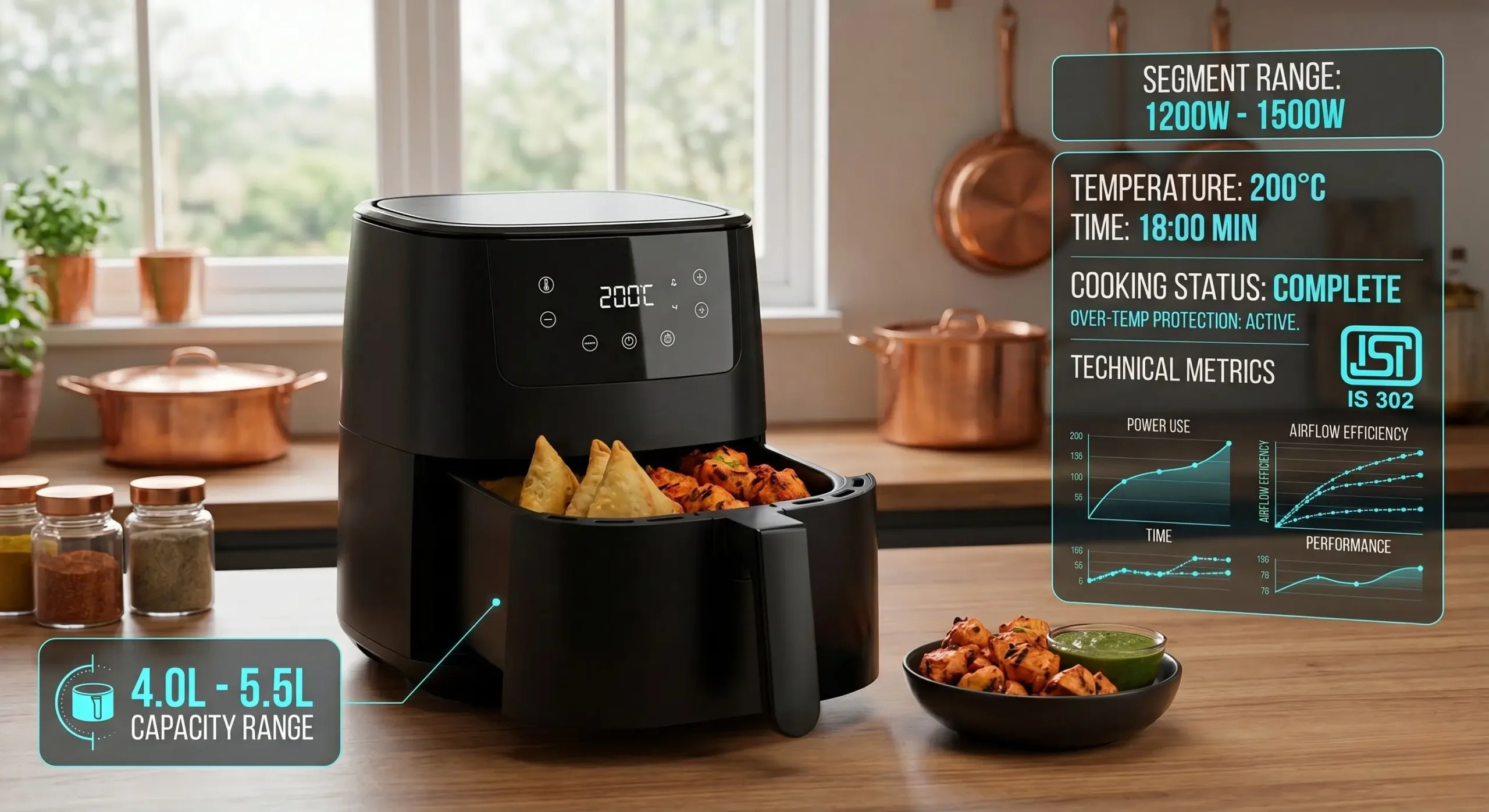
The best air fryers under ₹5000 in India in 2026 are the Philips NA120/00 (4.2L, 1500W, ~₹4,791), Pigeon Healthifry Digital (4.2L, 1200W, ~₹2,899), and Inalsa Tasty Fry Digital (4.5L, 1400W, ~₹4,700). All three carry BIS certification. Budget air fryers in this price segment work well for frozen snacks, dry marinades, and roasting for 2–3 people. They are not suitable for wet-batter pakoras or reheating curries. Choose Philips for reliability, Pigeon for maximum value, and Inalsa for extra capacity.
Table of Contents
Introduction
You are standing in front of your screen, looking at air fryers priced between ₹2,500 and ₹5,000, and you cannot tell which ones are genuinely good and which are cleverly marketed junk.
The sub-₹5000 air fryer market in India has exploded. Dozens of brands, hundreds of SKUs, and nearly all of them claim to be “8-in-1 smart appliances” that will replace your entire kitchen. Most of that is noise.
I tested and researched this segment thoroughly so you do not have to waste your money. In this guide, I will show you exactly which models are worth buying in 2026, what their real-world limitations are for Indian cooking, what to look for on the BIS certification label, and the one mistake that makes even a good air fryer produce soggy food.
By the end of this article, you will have a clear shortlist, a comparison table, and enough technical understanding to walk past the marketing claims and make a decision you will not regret.
Quick Comparison: Best Air Fryers Under 5000 in India (2026)
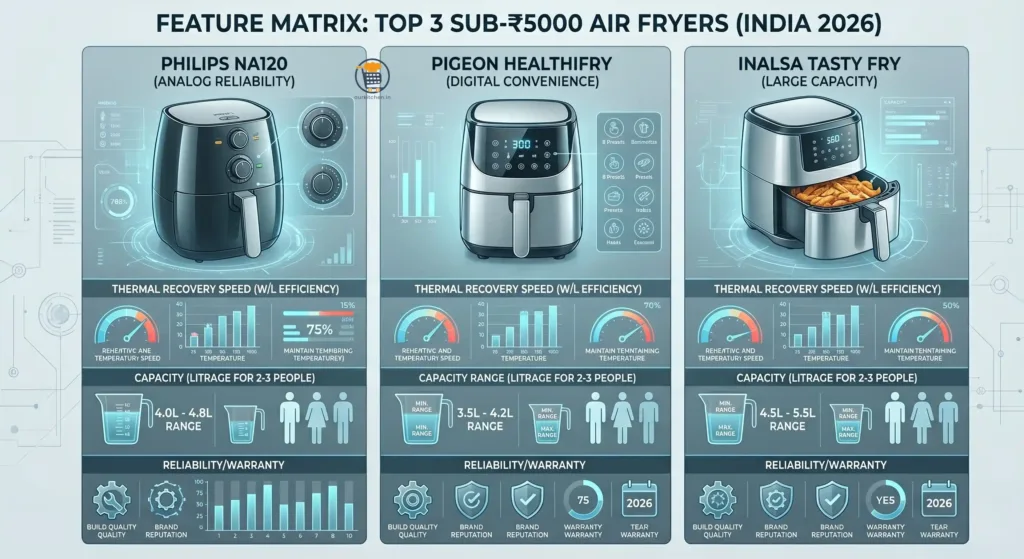
This table covers all the models worth serious consideration. Check current prices on Amazon India and Flipkart before buying, as prices shift during sale events.
| Model | Capacity | Wattage | Interface | Approx. Price | Warranty | Best For |
| Philips NA120/00 | 4.2L | 1500W | Manual analog | ₹4,791 | 2 years | Best overall reliability |
| Pigeon Healthifry Digital | 4.2L | 1200W | Digital touch | ₹2,899 | 1 year | Best value under ₹3,000 |
| Inalsa Tasty Fry Digital | 4.5L | 1400W | Digital touch | ₹4,700 | 1 year | Best capacity at this price |
| Havells Prolife Brio | 4.2L | 1350W | Manual analog | ₹4,595 | 1 year | Best brand service network |
| Prestige Nutrifry Digital | 4.5L | 1400W | Digital touch | ₹3,740 | 1 year | ISI-certified mid-budget |
| Kenstar Aster Digi Pro | 5.5L | 1700W | Digital touch | ₹3,349 | 1 year | Best capacity for the price |
| Kent Ultra 4L | 4.0L | 1300W | Digital touch | ₹2,899 | 1 year | Budget digital option |
| Lifelong LLHF25 | 2.5L | 800W | Manual analog | ₹1,800 | 1 year | Students and bachelors only |
Who Should Buy a Budget Air Fryer Under 5000?
Before jumping to specific models, you need to be honest with yourself about your household and cooking habits. A budget air fryer is a powerful tool for the right person and a frustrating disappointment for the wrong one.
This Price Segment Is Ideal For
Students and bachelors living in hostel rooms or paying guest accommodations make up the largest and happiest user group for sub-₹3000 models. A Pigeon Healthifry 4.2L sitting on a small table, reheating last night’s paratha or crisping up frozen momos in 8 minutes, is a genuinely life-improving appliance for this demographic.
Couples and small nuclear families of 2 to 3 people are well-served by the 4.2L segment. You can cook one full batch of chicken tikka or two generous portions of french fries without splitting into multiple rounds.
First-time buyers who are curious about air frying but unwilling to spend ₹8,000 to ₹15,000 on a premium model are the exact demographic this market was built for. A ₹3,000 Pigeon lets you experiment and learn the technology before committing to a premium dual-basket model later.
Who Should Skip This Segment
Families of 4 or more who want to cook everything in a single batch will constantly feel frustrated. A 4.2L basket sounds large, but air frying requires food laid out in a single layer. That physical constraint limits how much food you can actually cook at once. If you are routinely cooking for four or five people, step up to a 5.5L or 6L model in the ₹6,000 to ₹9,000 range.
Anyone who wants to cook fresh pakoras, wet-batter bhajias, or thin rotis should know upfront that air fryers cannot replicate these specific dishes. I cover this in detail in the cooking realities section below.
Top 5 Best Air Fryers Under 5000 in India: Detailed Analysis
1. Philips NA120/00 (4.2L, 1500W) Best Overall
The Philips NA120/00 is the most consistent performer in this price bracket, and it earns that position through engineering rather than marketing.
At 1500W, it preheats faster and recovers temperature more quickly after you open the drawer mid-cook. When you are making a second shake of french fries, that thermal recovery matters. Lower-wattage budget models at 1200W take noticeably longer to get back up to temperature, which adds cooking time and risks drying out the food.
The NA120/00 uses a manual analog dial, not a digital touch panel. Some buyers see this as a disadvantage. As an engineer, I see it as a reliability feature. There are no capacitive sensors or microprocessors to fail from voltage spikes. You set the temperature, set the timer, and it runs. Simple, durable, predictable.
Philips’ 2-year warranty is the best in this price category, and their service network is genuinely operational in Tier 1 and Tier 2 cities. If something goes wrong, you will not be fighting a third-party courier service.
The one drawback: it offers no preset cooking modes. If you want to press a “chicken” button, look at the Pigeon or Inalsa digital models instead. But if you care more about consistent results than digital conveniences, the NA120 is the choice.
BIS/FSSAI coating note: Philips NA120 uses a PTFE non-stick basket coating that is PFOA-free. Philips publicly confirms compliance with relevant EU food-contact material standards. BIS certification for the appliance is confirmed under IS 302 standards. If you want the full picture on PTFE safety in Indian kitchens, our detailed guide on whether air fryer coatings are toxic (Teflon, PTFE and BPA truth) covers this in depth.
Current price: Around ₹4,791 on Amazon India. Historical low was ₹3,699 during the September 2025 sale. If a major sale is coming, wait.
2. Pigeon Healthifry Digital (4.2L, 1200W) Best Value Under ₹3,000
Pigeon (made by Stovekraft) has done something remarkable with the Healthifry Digital: it has brought a digital touch panel, 8 preset cooking modes, and a 4.2L basket to a price point below ₹3,000. For sheer rupee-per-feature value, nothing else in this segment comes close.
The 8 presets cover fries, chicken, fish, steak, shrimp, cake, pizza, and a custom mode. For Indian cooking, I find the fries and chicken modes most useful as a starting point, though you will need to adjust times based on your specific food. Treat the presets as suggestions, not commands.
The trade-off for the low price is a 1200W heating element, which is 20% less powerful than the Philips NA120. In practice, this means two things: slightly longer cooking times for dense items like chicken drumsticks, and slower thermal recovery when you open the basket to shake the food.
Build quality is adequate but not impressive. The plastic chassis feels lighter than the Philips, and user reports on Amazon India suggest the basket hinge can loosen after 12 to 18 months of daily use. This is consistent with what I see from Stovekraft’s budget products across the board. It is not a defect in the critical sense, but it is a signal that this appliance is built to a price.
BIS/FSSAI coating note: The Pigeon Healthifry Digital uses a PTFE non-stick coating. Stovekraft confirms BIS certification for the appliance. The manufacturer has not prominently published PFOA-free or FSSAI food-grade compliance data for the basket coating specifically, which is worth noting if this is a priority for you.
Who should buy this: Students, young couples, first-time buyers, and anyone who wants to try an air fryer without significant financial commitment. At under ₹3,000, this is almost a risk-free purchase.
3. Inalsa Tasty Fry Digital (4.5L, 1400W) Best Capacity Under ₹5,000
Inalsa has consistently punched above its weight in the Indian kitchen appliance market, and the Tasty Fry Digital is a good example. At 4.5L, it offers more cooking surface area than the standard 4.2L models, which matters when you are making one batch of snacks for 3 people rather than 2.
The 1400W element hits a good middle ground between the Pigeon’s 1200W and Philips’ 1500W. Preheating takes around 4 to 5 minutes at 180°C (360°F), which is reasonable.
Digital controls work well, with clear display readouts and responsive touch buttons. The preset modes are similar to the Pigeon, covering common categories. Build quality is a step above the Pigeon, with a slightly heavier plastic body and a more secure basket latch.
The 5.5L Inalsa Tasty Fry (a larger sibling) has an MRP of ₹11,995 but periodically goes on sale below ₹5,000 at Reliance Digital and Amazon. If you see it below ₹4,800, it is exceptional value.
BIS/FSSAI coating note: Inalsa confirms BIS certification. PTFE coating is used on the basket. PFOA-free status is listed in product documentation.
Current price: Around ₹4,700 on Amazon India for the 4.5L digital version.
4. Havells Prolife Brio (4.2L, 1350W) Best Service Network
Havells brings something the budget brands simply cannot match: a pan-India service infrastructure that actually works. If you are in a smaller city or town and the appliance develops a fault after 8 months, Havells will have a service center or authorised technician closer to you than Pigeon or Inalsa.
The Prolife Brio runs on a manual analog dial with a clean, simple design. 1350W is adequate. The build quality is noticeably better than the Pigeon, with a heavier chassis and a more solid feel to the basket mechanism.
The drawback is price relative to features. At around ₹4,595, you are paying a premium over the Pigeon Healthifry Digital that is almost entirely for the brand trust and service network. If you live in a Tier 1 city where any brand’s warranty support is accessible, this premium is harder to justify versus the Philips NA120.
BIS/FSSAI coating note: Havells is transparent about BIS compliance and PTFE coating specifications. PFOA-free confirmed in product documentation.
5. Kenstar Aster Digi Pro (5.5L, 1700W) Largest Basket Under ₹4,000
The Kenstar Aster Digi Pro is the sleeper pick in this list. At around ₹3,349, you are getting a 5.5L digital air fryer with 1700W of power. On pure specifications, this beats every other model on the list.
So why is it ranked fifth? Because capacity on paper and capacity in practice are different. A 5.5L basket at this price point uses thinner materials, and the larger plastic body means more surface area radiating heat outward. The 1700W element has to work harder to maintain temperature than a smaller 1500W Philips heating a tighter cavity.
Kenstar’s service network is adequate in major cities but thinner than Havells or Philips in smaller markets. User reviews are mixed: strong appreciation for the value and features, but scattered complaints about the basket coating quality after 6 to 8 months of regular use.
For a family of 3 to 4 people who primarily want to air fry frozen snacks and do not need the appliance to last more than 2 to 3 years, this is a genuinely tempting value proposition. For anyone with expectations of premium longevity, look at the Philips NA120 instead.
What Budget Air Fryers Can and Cannot Do in Indian Kitchens
This is the section that most buying guides skip. I am not skipping it because it is the most important thing you need to know before spending money.
What Works Well
Frozen commercial snacks: Frozen samosas, momos, nuggets, potato wedges, and spring rolls are where budget air fryers genuinely shine. These products are par-fried during manufacturing, which means they already have lipids embedded in the surface. At 200°C (392°F), the air fryer triggers the Maillard reaction on these lipids and produces a genuinely crispy exterior in 10 to 15 minutes. Results are excellent and consistent.
Dry-marinated proteins: Chicken tikka, fish tikka, paneer tikka, and tandoori-style preparations work very well. The dry heat mimics a small tandoor far better than a microwave ever can, sealing the marinade and creating exterior char while keeping the interior moist. This is one area where even a budget air fryer produces genuinely impressive results for Indian home cooks.
Roasted snacks: Makhana, peanuts, chana, and papad roast quickly and evenly. Our step-by-step guide on how to roast papad in an air fryer is worth bookmarking if this is a regular snack in your home.
Reheating dry foods: Leftover pizza, bread pakoras, samosas, pastries, and fried snacks reheat to a genuinely crisp texture that no microwave can match.
What Does Not Work
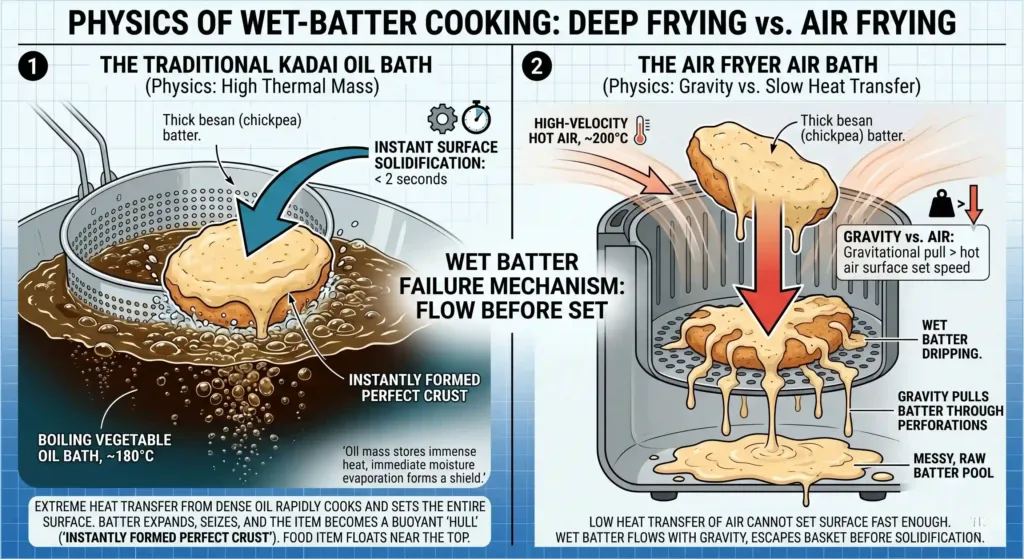
Wet-batter pakoras and bhajias: This is the biggest source of buyer disappointment across all Indian air fryer reviews, and it comes down to physics. When you drop wet besan batter into a hot kadhai, the dense oil bath instantly seizes the proteins and starches, forming a solid crust that holds the shape. Air has a fraction of the thermal mass of oil. Before the hot air can solidify the batter surface, gravity pulls the wet mixture through the basket perforations. You end up with a burned mess at the bottom of the drawer. The fix is to make the batter significantly thicker and dough-like, which changes the texture entirely, or to bread the vegetables instead of battering them.
Fresh rotis and parathas: A soft roti requires rapid conductive heat from a hot tawa to create internal steam that puffs the dough while keeping the exterior pliable. An air fryer removes moisture aggressively. The result is a hard, dry, cracker-like disc.
Reheating wet curries, dal, and gravies: High-velocity hot air scorches the surface of wet dishes and leaves the centre cold. A microwave is the correct tool here. Using an air fryer for this purpose wastes electricity and produces an unpleasant result.
For a broader look at the honest trade-offs, our advantages and disadvantages of air fryer guide covers the full picture without the marketing gloss.
BIS Certification and the 2026 QCO: What Indian Buyers Must Know
This matters far more than most buying guides acknowledge.
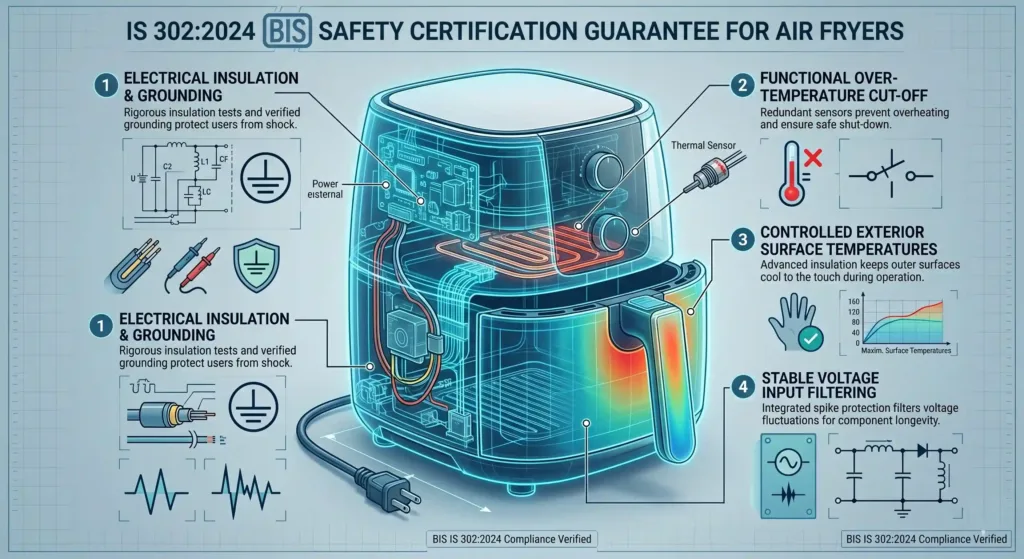
The Government of India’s Quality Control Order (QCO) for household electrical appliances came into force in 2026. Under this order, all air fryers sold in India must carry BIS certification under IS 302 (Part 1): 2024 and the relevant Part 2 sectional requirements for frying appliances. The ISI mark on the product confirms this compliance.
What does compliance actually guarantee? It ensures the appliance has been tested for adequate electrical insulation, proper grounding to prevent electric shocks, controlled external surface temperatures, and a functional over-temperature cut-off that prevents thermal runaway and fire.
What it does not guarantee is long-term build quality, coating durability, or the honesty of the wattage specification printed on the box.
Practical guidance: Before completing any online purchase, search for “BIS certificate [model name]” and check the BIS India portal (bis.gov.in) to verify the registration number is valid. Unregistered white-label imports flooding Amazon and Flipkart are a real risk in the budget segment. A model priced at ₹2,000 with an 8-litre capacity and 2000W on the spec sheet is almost certainly misrepresenting its specifications.
For a full safety analysis of air fryers in the Indian context, our guide on are air fryers safe in India covers electrical, thermal, and chemical safety in detail.
Power and Electricity: What Budget Air Fryers Cost to Run
A 1500W air fryer running for 20 minutes consumes 0.5 units (kWh) of electricity. At the average Indian residential tariff of approximately ₹6 to ₹8 per unit, that is ₹3 to ₹4 per session.
If you use the air fryer once a day for snacks, your monthly electricity cost is roughly ₹90 to ₹120. This is meaningfully lower than heating a gas stove to maintain a full kadhai of oil for 20 to 30 minutes, once you account for the LPG cost.
For a detailed electricity cost breakdown by state and usage pattern, our air fryer electricity consumption guide for India has the complete tariff-wise calculations.
Important for Tier 2 and 3 cities: The Indian power grid in smaller cities and semi-urban areas experiences voltage fluctuations that can damage sensitive electronics. Digital air fryers with touch panels and microprocessors are more vulnerable than analog dial models. If your area suffers from frequent brownouts or surges, either choose an analog model (Philips NA120, Havells Prolife Brio) or use the appliance on a voltage stabiliser rated at minimum 2 kVA (for a 1500W appliance, you need 20-25% headroom above the rated load).
The Acrylamide Question: Is Air-Fried Food Actually Healthier?
The oil reduction benefit is real and significant. A traditional deep-fried samosa absorbs 10 to 15 grams of oil during frying. The same samosa in an air fryer, brushed lightly with oil, uses 1 to 2 grams. That is a 70% to 90% reduction in oil intake per serving.
However, there is a nuance that most air fryer marketing deliberately avoids. Research published in food science journals has found that air frying starchy foods like potatoes can produce higher levels of acrylamide (a probable carcinogen formed during high-heat cooking of carbohydrate-rich foods) compared to deep frying. The aggressive surface dehydration of air frying, without the insulating buffer of an oil bath, can accelerate acrylamide formation. A 2024 study comparing air-fried, deep-fried, and oven-fried potatoes found the highest acrylamide levels in air-fried samples when temperatures were pushed above 220–230°C.
https://www.frontiersin.org/journals/nutrition/articles/10.3389/fnut.2023.1297069/full
pmc.ncbi.nlm.nih
The mitigation is straightforward: soak cut potatoes in warm water for 30 minutes before air frying. This leaches out surface asparagine and reducing sugars, the precursors to acrylamide formation, and brings levels down significantly, a reduction that has also been quantified in controlled lab studies on fried potatoes.
Our detailed guide on the air fryer cancer risk and acrylamide analysis covers the underlying biochemistry and specific mitigation steps if you want the full picture.
Net verdict: for most Indian cooking applications, an air fryer is a meaningfully healthier tool than a deep-frying kadhai, provided you are mindful of potato preparation. The reduction in reused oil consumption alone is a significant health benefit for daily Indian cooking.
Common Mistakes That Ruin Results (Even on Good Air Fryers)
Overcrowding the basket. This is the single most common reason for soggy, unevenly cooked food. Air frying is a surface dehydration process: hot air must contact every surface of every piece of food to work properly. Stack food on top of each other and you convert the air fryer into a steamer. Cook in batches, and shake the basket halfway through every session.
Skipping the burn-off cycle. New air fryers off-gas residual manufacturing lubricants and protective coatings from the heating coil during the first few uses. Run the appliance empty at 200°C (392°F) for 20 to 30 minutes in a well-ventilated area before cooking food for the first time. Then wash the basket with dish detergent and warm water. If you skip this and notice a chemical smell or strange taste during early uses, this is the reason. Our guide on plastic smell in new air fryers explains exactly why this happens and how to resolve it.
Treating presets as exact instructions. Digital preset modes are averages calibrated for generic food sizes. A small samosa and a large samosa behave completely differently. Use presets as starting points, check food 5 minutes before the timer ends, and adjust from there. Our guide on how to preheat your air fryer correctly is worth reading before your first few cooking sessions.
Buying on capacity alone. A 5.5L air fryer sounds significantly better than a 4.2L model. But at the same price point, the larger model often uses thinner materials, a weaker heating element spread across a bigger cavity, and inferior airflow geometry. A well-engineered 4.2L frequently outperforms a poorly-engineered 5.5L. Specifications matter in combination, not in isolation.
Where to Buy and When to Buy
Amazon India and Flipkart are the primary channels for most of these models. Both platforms have authentic stock from the major brands listed above.
When to buy: The best prices on air fryers in India appear during: Amazon’s Great Indian Festival (October), Flipkart’s Big Billion Days (October), Republic Day sales (January), and Independence Day sales (August). The Philips NA120 dropped to ₹3,699 in September 2025 during one such sale, versus its regular price of around ₹4,791. If you are not in a rush, checking price history on tools like Camelcamelcamel or PriceHistory.app for the exact model you want will tell you whether the current price is genuinely a deal.
Reliance Digital sometimes has the Inalsa 5.5L Tasty Fry at significantly discounted prices, bringing a model that typically sells above ₹5,000 into the budget range.
Engineer’s Take
I want to be direct about something the comparison tables and marketing language tend to obscure.
The Philips NA120/00 is the correct choice for most buyers in this segment, and the reason is not brand prestige. It is engineering honesty. At 1500W in a compact 4.2L cavity, the thermal efficiency is higher than any other model on this list. The manual analog dial removes the weakest failure point (a digital control board) from a product category notorious for voltage spike damage. The 2-year warranty is backed by a service network that actually picks up the phone.
If money is genuinely tight and you want to try air frying for the first time, the Pigeon Healthifry Digital at under ₹3,000 is a sensible experiment. Buy it, use it for a year, and if you love air frying, upgrade to a Philips or a premium dual-basket model with confidence.
What I would actively avoid: any brand with zero prior history in the Indian appliance market selling a basket over 6L for under ₹3,000 with a digital interface and “12-in-1” preset claims. The wattage will be overstated, the coating will fail within 6 months, and you will spend more time filing warranty claims than cooking. The QCO 2026 certification requirement has cleaned up some of this, but dishonest listings still exist.
The sub-₹5000 air fryer market rewards buyers who understand what they are actually buying: a compact convection oven optimised for surface crisping, not a deep fryer replacement. Calibrate your expectations correctly and even a ₹2,900 Pigeon will genuinely improve your daily cooking.
Conclusion
The best air fryer under 5000 in India in 2026 is the Philips NA120/00 for most buyers, the Pigeon Healthifry Digital for maximum value under ₹3,000, and the Kenstar Aster Digi Pro for anyone who needs 5.5L of capacity at a budget price. All three carry BIS certification, which is non-negotiable in 2026.
Before you finalise your choice, it is worth spending 10 minutes on our complete air fryer buying guide for Indian kitchens, which covers capacity selection, wattage requirements, and brand service networks in detail across all price segments. If you are comparing air fryers with other cooking appliances, our air fryer vs deep fryer breakdown explains exactly where each one wins and loses for Indian cooking.
New to air fryers entirely? Our beginner’s guide to what an air fryer is and its 7 benefits is the right starting point. Once you have your appliance, our guide on how to use an air fryer for perfect results will get you cooking confidently in the first week.
If you are comparing within a broader budget, our air fryer price guide for India 2026 covers the full market from ₹1,500 to ₹25,000 so you can see exactly what additional money buys you at each step up.
Buy smart, cook one layer at a time, and do the burn-off cycle before your first meal.
Frequently Asked Questions
Which brand is best for air fryers in India under 5000?
Philips is the most reliable brand under ₹5000 due to its 2-year warranty, established service network, and consistent cooking performance. For buyers with a tighter budget, Pigeon (Stovekraft) offers the best value under ₹3,000 with its Healthifry Digital model. Both carry BIS certification.
What is the best air fryer under 5000 in India in 2026?
The Philips NA120/00 (4.2L, 1500W) is the top-rated air fryer under ₹5000 in India for 2026 based on cooking performance, reliability, and after-sales support. It sells for approximately ₹4,791 on Amazon India and drops further during sale events.
Is 4.2 litres enough for a family of 4?
A 4.2L air fryer is comfortable for 2 to 3 people cooking in a single batch. For 4 people, you will need to cook in sequential batches, which adds time. Families of 4 would be better served by a 5.5L to 6L model, which typically starts at ₹5,500 to ₹7,000.
Can a budget air fryer make pakoras?
Not with traditional wet besan batter. Air fryers lack the thermal mass of hot oil needed to instantly set the batter. You can make a version by using a very thick, dough-like batter or by breading vegetables instead of battering them, but the result is different from traditional pakoras.
Are cheap air fryers safe to use in India?
Air fryers with a valid BIS certification (look for the ISI mark and a verifiable registration number on bis.gov.in) meet India’s mandatory safety standards for electrical insulation, grounding, and thermal cut-offs. Uncertified white-label imports, however, carry real risk. Always verify BIS certification before buying a budget appliance.
Which brand is best for after-sales service in smaller Indian cities?
Havells and Philips have the most reliable after-sales networks outside major metros. Pigeon (Stovekraft) is reasonably accessible in Tier 2 cities. Brands with limited Indian operations often require carry-in service to distant centers, which makes them a poor choice for buyers outside Tier 1 cities.
Why is air-fried food sometimes considered unhealthy?
Air frying significantly reduces oil consumption, which is a genuine health benefit. The concern centres on acrylamide, a compound that can form in starchy foods (like potatoes) cooked at high temperatures. Research shows acrylamide can be higher in air-fried potatoes than deep-fried ones. Soaking cut potatoes in water for 30 minutes before air frying reduces acrylamide formation substantially.
What is the difference between a digital and analog air fryer at this price?
Digital models offer preset cooking modes and a timer display. Analog models use mechanical dials. At the sub-₹5000 price point, analog models (Philips NA120, Havells Prolife Brio) are often more voltage-fluctuation-resistant because they lack sensitive microprocessors. Digital models are more convenient but more vulnerable to power surges in areas with unstable electricity supply.
Best air fryer under 5000 on Amazon India vs Flipkart any difference?
Pricing is generally similar, but promotional periods differ. Amazon tends to run deeper discounts during Great Indian Festival, while Flipkart’s Big Billion Days can offer better bank card discounts. Check both platforms and use a price-tracking tool to confirm the deal is genuine before buying.
Is it worth buying an air fryer under 5000 in India or should I save more?
For students, bachelors, and small families of 2 to 3 people, a ₹3,000 to ₹5,000 air fryer delivers excellent value for specific use cases: frozen snacks, dry-marinated proteins, roasted snacks, and reheating dry foods. If you cook for 4 or more people daily or want to use it as your primary cooking appliance, save for a 5.5L to 6L model in the ₹6,000 to ₹9,000 range.
About the Author
Prathap is the founder of ourkitchen.in and a B.Tech graduate in Agricultural Engineering. His engineering background, built on thermodynamics, heat transfer, and power systems, gives him a fundamentally different lens for evaluating kitchen appliances compared to typical food bloggers or lifestyle reviewers.
Rather than relying on manufacturer claims or sponsored impressions, Prathap analyses air fryers the way an engineer would: measuring actual power draw against rated wattage, evaluating basket airflow geometry, testing non-stick coating durability across dozens of cook cycles, and cross-checking brand safety claims against BIS and FSSAI standards.
His mission with ourkitchen.in is straightforward: to give Indian buyers honest, data-backed guidance on kitchen appliances, with a specific focus on the realities of Indian kitchens voltage fluctuations, humid coastal climates, Indian cooking temperatures, and the price-performance expectations of the Indian market.
He has written over 36 articles on air fryers and personally tested models from Philips, Pigeon, Agaro, Kenstar, Havells, and other brands available in India.

Prathap is the founder of ourkitchen.in and a B.Tech graduate in Agricultural Engineering from Tamil Nadu. His engineering background in thermodynamics, heat transfer, and food processing science gives him a fundamentally different approach to kitchen appliance reviews compared to typical lifestyle bloggers.
Rather than relying on manufacturer claims, Prathap measures actual power draw against rated wattage, evaluates basket airflow geometry, and stress-tests non-stick coatings over 90-plus cook cycles before recommending any product. He cross-checks every safety claim against BIS and FSSAI standards, and all pricing against live Amazon India and Flipkart listings.
He has written over 61 deep-dive articles on air fryers for the Indian market, personally testing models from Philips, Pigeon, Agaro, Kenstar, Havells, and Bajaj. His reviews are built around Indian realities: 220V power grids, high-humidity coastal kitchens, Indian cooking temperatures, and the price-performance expectations of Indian households.
Based in Chennai, Tamil Nadu.
![Read more about the article Air Fryer Fries Soggy? India’s Humidity Starch Secrets & Convection Hacks [2026 Guide]](https://ourkitchen.in/wp-content/uploads/2026/03/Air-Fryer-Fries-Soggy-Humidity-Fix-India-2026-300x164.webp)