By Prathap · 22 March 2026 ·
Table of Contents
TL;DR: The 60-Second Verdict
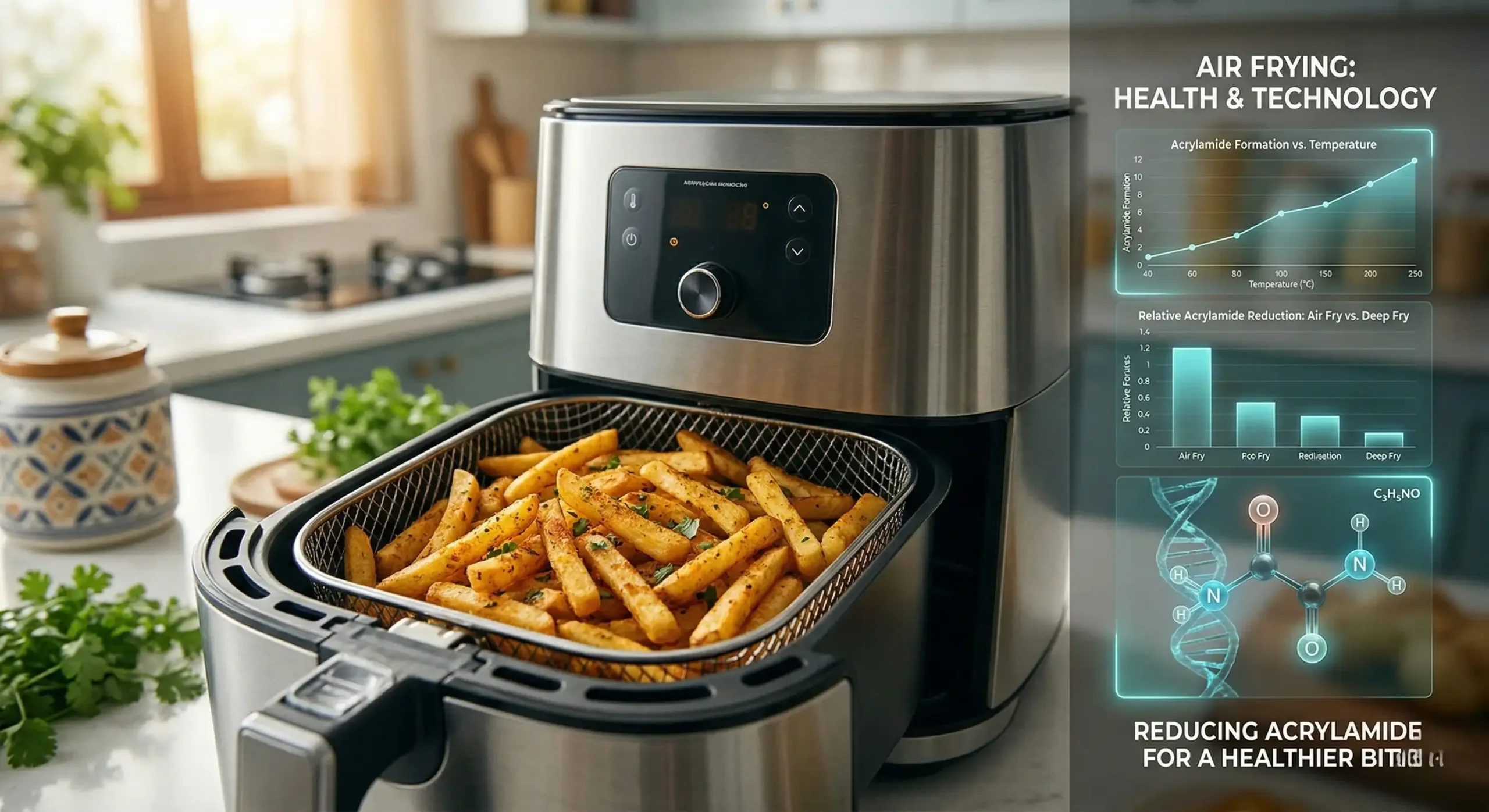
No, your air fryer does not cause cancer. Acrylamide forms in every high-heat starchy cook including deep frying, baking, and toasting. The IARC classifies it as Group 2A, a probable carcinogen based on animal data at extreme doses, and the EFSA’s real-world thresholds show that even the worst-case air-fried meal delivers less than 0.03% of the weekly danger benchmark for a 65 kg adult. Optimised air frying at 160 to 175℃ with a 30-minute potato soak cuts acrylamide by up to 90% versus a roadside kadhai. One deep-fried samosa exposes you to 25 to 40 times more acrylamide than 100 g of properly air-fried aloo. The appliance is not the threat. Overcooking until charred is.
Why Millions of Indians Are Googling “Air Fryer Cancer Risk” at 11 pm
Picture this: you have just ordered a Philips or Agaro air fryer, convinced it will rescue your family from a lifetime of kadhai grease. Three days later, a WhatsApp forward from your mausi lands in the family group: “Don’t use air fryer. Cancer and so much health issues come up. Induction is fine.” Within hours, a reel from a wellness account adds: “acrylamides plus PFAS equal cancer risk.” You are awake at 11 pm, typing “air fryer cancer risk” into Google, hoping someone has an actual answer.
This anxiety drives enormous search volume. Localised queries like kya air fryer cancer karta hai sit alongside English searches for “acrylamide in air fryer India,” “air fryer side effects on health,” and “do air fryers emit radiation.” Most users are not in early-stage purchase research. They have the appliance and need reassurance that they are not poisoning their family. What the top-ranking articles fail to deliver is quantified reassurance. They say acrylamide is a “probable carcinogen” but air frying produces “less” of it. Less than what? By how much? This article answers that with actual mathematics, and the numbers will surprise you.
Featured Snippet Answer
No, air fryers do not cause cancer. Acrylamide is IARC Group 2A, the same classification as deep-frying, toast, and biscuits. It forms from food chemistry, not the machine. Optimised air frying at 160 to 175℃ with a 30-minute soak cuts exposure 70 to 90% versus a roadside deep-fried samosa. Indian families following the golden-yellow colour rule stay well below EFSA concern levels.
The Biochemistry of Acrylamide: What Actually Happens Inside Your Food
Acrylamide is not a synthetic chemical injected by your appliance. It is a naturally occurring byproduct of the Maillard reaction, the same cascade of non-enzymatic browning that gives your bread its golden crust, your roasted groundnuts their crunch, and your freshly baked biscuits their characteristic aroma. This chemistry predates electric appliances by millennia.
When a food containing free asparagine, an amino acid concentrated in high levels within potatoes and wheat flour, is heated above 120℃ alongside reducing sugars such as glucose and fructose, a condensation reaction begins. The amino group of asparagine reacts with the carbonyl groups of the sugars, forming an unstable Schiff base intermediate. Under continued thermal stress, Strecker degradation fragments these compounds into hundreds of aromatic molecules responsible for colour and flavour, while simultaneously yielding acrylamide as an unavoidable byproduct of the same pathway.
Think of it like toast: the moment your bread turns golden in the toaster, the Maillard reaction is happening in real time. The same browning chemistry that makes toast delicious is also producing trace acrylamide. Lighter golden toast = less acrylamide. Darker, nearly-burnt toast = significantly more. Your air fryer basket is simply a controlled, lower-oil version of that same process.
For the Indian diet, this chemistry is especially relevant. Potatoes are the apex risk food: extremely high in both free asparagine and reducing sugars. Refined wheat flour, the backbone of samosas, papad, chakli, and mathri, is similarly loaded with Maillard precursors. Every time these foods touch high heat, whether in a kadhai, a tawa, a tandoor, or an air fryer, the same reaction produces acrylamide. The appliance does not create the problem. It either accelerates or moderates it.
IARC Classification: What Group 2A Actually Means
Upon ingestion, acrylamide is metabolised by liver enzymes into glycidamide, a reactive epoxide capable of binding with cellular DNA. This genotoxic potential is why the International Agency for Research on Cancer classifies acrylamide as Group 2A: “probably carcinogenic to humans”, based on its systematic review of all available experimental and epidemiological evidence.[1]
That classification demands precise interpretation. Group 2A does not mean “causes cancer in humans.” It means there is sufficient evidence in animal studies conducted at extremely high, isolated doses, but only limited epidemiological evidence in human populations eating normal dietary levels. The same tier is shared by red meat, night-shift work, and drinking very hot beverages above 65℃. It signals hazard under extreme conditions, not practical risk at real-world exposure. Group 1, where asbestos, ionising radiation, tobacco smoke, and processed meats sit, requires unambiguous causal evidence across human populations. Acrylamide has not cleared that bar despite four decades of scrutiny.
The EFSA Mathematics: Translating “Probably” Into Actual Micrograms
The most effective antidote to fear is precision. The European Food Safety Authority published its comprehensive Scientific Opinion on Acrylamide in Food, establishing the Benchmark Dose Lower Confidence Limit (BMDL10) through exhaustive risk modelling. This represents the dose causing a statistically significant 10% increase in adverse effects in laboratory animals.[2]
For acrylamide, EFSA set the neoplastic BMDL10 at 170 micrograms per kilogram of body weight per day. For an average Indian adult weighing 65 kg, the absolute daily safety ceiling computes to:
170 µg × 65 kg = 11,050 µg of acrylamide per day
Global dietary surveys show the average human consumes just 0.4 to 1.9 µg per kg of body weight per day, roughly 100 to 400 times below this threshold. The table below applies precise numbers to a real Indian household: one adult (65 kg) consuming a 50 g portion of potato fries three times per week.
| Cooking Method | Temp | Acrylamide (µg/kg) | Per 50 g Session | Weekly (3×) | % of EFSA Weekly Limit |
|---|---|---|---|---|---|
| Deep Frying (Traditional Kadhai) | 180℃ | 300 µg/kg | 15.00 µg | 45.00 µg | 0.0581% |
| Air Frying: Optimised (160℃, soaked) | 160℃ | 30 µg/kg | 1.50 µg | 4.50 µg | 0.0058% |
| Air Frying: Unoptimised (200℃, no soak) | 200℃ | 150 µg/kg | 7.50 µg | 22.50 µg | 0.0290% |
| OTG Baking (Oven Toaster Grill) | 200℃ | 100 µg/kg | 5.00 µg | 15.00 µg | 0.0193% |
EFSA Weekly BMDL10 for a 65 kg adult = 77,350 µg. Sources: EFSA (2015), peer-reviewed Indian snack acrylamide studies.
Even in the worst-case scenario, an unoptimised 200-degree air fry without a soak, the weekly exposure is less than three one-hundredths of a single percent of the EFSA danger threshold. The cancer risk from domestic air frying is not merely low. It is statistically and biologically negligible. For street-food context: a single roadside deep-fried samosa (50 g starch) contains 40 to 60 µg of acrylamide. One hundred grams of optimally air-fried aloo at 160℃ with a prior soak contains just 1.2 to 1.8 µg. That is a 25 to 40-fold difference.
Air Fryer vs Deep Frying: The Thermodynamic Comparison
For a complete head-to-head breakdown, read our dedicated guide on air fryer vs deep frying: which produces more acrylamide, more oil, and more health risk. The scientific consensus is clear: optimised air frying reduces acrylamide by up to 90% compared to traditional kadhai immersion frying.
Deep frying immerses food in boiling lipids at 170 to 190℃. The oil rapidly dehydrates the surface and triggers intense Maillard browning far faster than hot circulating air achieves the same effect. Additionally, the oil itself undergoes severe oxidative degradation, generating polycyclic aromatic hydrocarbons (PAHs) and polar compounds that air frying eliminates entirely. Comparing only acrylamide while ignoring PAHs dramatically understates the actual safety advantage of replacing your kadhai.
The National Cancer Institute’s authoritative acrylamide fact sheet confirms that acrylamide forms in many commonly eaten foods prepared at high temperatures, and that epidemiological evidence for dietary acrylamide as a human carcinogen at normal exposure levels remains inconclusive.[3] The air fryer is a risk-modifying tool, not a risk-generating one. For a broader evidence review across all safety parameters, see our comprehensive air fryer safety analysis for Indian kitchens.
Three Scientifically Validated Mitigation Protocols
1. Cold-Water Soaking
Submerging raw, cut potatoes in cold water for 20 to 30 minutes physically leaches water-soluble reducing sugars and free asparagine from the surface cellular layer via osmosis. LC-MS/MS analysis confirms that soaked potatoes cooked in an air fryer show up to a 50% reduction in final acrylamide concentration compared to unsoaked counterparts. Apply this to aloo fries, samosa filling, and any potato-forward preparation before cooking.
2. Thermal Capping at 160 to 175℃
The Strecker degradation pathway accelerates exponentially at temperatures above 180℃. Restricting the thermostat to 160 to 175℃ provides sufficient heat for crisping while actively suppressing rapid contaminant formation. Our guide on the correct air fryer temperatures for every Indian dish shows the exact settings for aloo, paneer, papad, and more. Pair this with proper preheating technique to avoid starting from a cold element and inadvertently extending total cook time.
One common Indian kitchen error: when fries come out soggy, many cooks compensate by cranking the temperature to 200℃ and extending cook time. This is the exact behaviour that maximally accelerates acrylamide. The correct fix is better basket loading and moisture management, not higher heat. Our guide on why Indian cooks accidentally over-brown their fries, and how to fix it explains the engineering behind this in detail.
3. The Samosa-Golden Rule of Colorimetry
Melanoidins, the brown polymers formed in the late Maillard reaction, accumulate in direct linear proportion to acrylamide concentration. Stop the moment food achieves the bright, uniform golden colour of a freshly fried samosa crust. The instant it trends toward dark amber, acrylamide is spiking. Stopping at golden versus continuing to dark brown cuts formation by 40 to 60%. Set a 5-minute timer, shake the basket, and remove when golden.
Coating Material Safety: PTFE and the 260-Degree Threshold
The second most Googled concern is the non-stick basket coating. The initial “plastic smell” during the first few heating cycles triggers widespread anxiety about chemical poisoning. Our full breakdown of PTFE, Teflon, and PFAS coating safety at high temperatures covers the BPA and PFAS distinction in detail.
PTFE (Teflon) is chemically inert at all temperatures achievable in a domestic air fryer. Decomposition begins only above 260℃, a full 60 degrees above the hard cap of every domestic model. The plastic smell during initial use is the burn-off of factory-applied machine oils, not decomposing PTFE. It disappears after one or two empty heating cycles. Even if a micro-flake of coating is ingested, it passes through the gastrointestinal tract completely unabsorbed and causes no systemic toxicity. For what happens to the coating over prolonged use and heat cycling, read our guide on when to replace a peeling air fryer basket.
Product-Specific Analysis: How India’s Top Models Handle Acrylamide
Thermostatic accuracy varies significantly between models, and this directly affects acrylamide output at any given dial setting. Our full guide to the best air fryers in India ranked by temperature accuracy and safety covers all current models.
Philips HD9252/90 (4.1L, 1400W)
The benchmark for thermodynamic control in the Indian market. A PID controller maintains real-time accuracy across the 60 to 200-degree range and the patented “starfish” basket geometry eliminates localised hotspots, the primary sites of acrylamide spikes. Power density: 341 W/L. The 0.8m cord is a usability limitation: resist using an unrated extension board.
Agaro Regal (5.5L, 1800W)
Excellent capacity for joint families, but at 1800W it draws approximately 8.2A at 220V, directly exceeding the 6A rating of the standard Indian socket. Verified purchase reviews document socket meltdowns. This appliance requires a dedicated 16A outlet and a strict 160-degree thermal cap for starchy foods.
Pigeon Healthifry Digital (4.2L, 1200W)
Budget models typically lack robust PID control, and basic thermostats allow the cavity to overshoot the display by 10 to 20 degrees. A user who sets 180 degrees may be subjecting their aloo to 195 to 200-degree thermal waves without knowing it. Compensate by setting 10 degrees below your actual target and checking colour frequently.
Kenstar Aster Digi Pro (4L, 1500W)
At 375 W/L, the highest power density here, fast heat-up and aggressive surface dehydration can char the exterior while internal moisture remains. Manual thermal capping to 160 degrees is non-negotiable for starchy foods. Use only soft sponges: abrasive pads cause micro-scratching that accelerates PTFE coating degradation.
The FSSAI Regulatory Position
The Food Safety and Standards Authority of India formally acknowledges acrylamide as a systemic processing contaminant within the commercial food chain, but has issued no ban, restriction, or health advisory against domestic air fryer use. FSSAI’s Appendix C permits the enzyme Asparaginase as a mitigation tool for industrial food manufacturers, widely deployed in commercial bakeries and packaged snack lines to hydrolyze asparagine before thermal processing. India chairs the Codex Alimentarius Commission’s CCCF17 committee, developing a revised Code of Practice targeting large-scale industrial processors, not domestic kitchens. No regulatory body anywhere in the world has ever banned, restricted, or issued health warnings against domestic air fryer use.
Eight Myths, Eight Verdicts: The WhatsApp Narratives Dismantled
MYTH 1: “Air fryers cause cancer because of acrylamide.”
Acrylamide is a byproduct of chemistry occurring within the food itself, between naturally present sugars and amino acids, not introduced by the machine. The IARC’s Group 2A classification is derived from rodents receiving oral doses thousands of times greater than human dietary capability.
Verdict: The appliance does not cause cancer. Extreme thermal charring of starchy food does, regardless of whether you use a kadhai, tawa, OTG, or air fryer.
MYTH 2: “Deep frying is safer because air fryers concentrate the acrylamide.”
Deep frying generates both acrylamide and a separate class of toxins including PAHs and polar compounds from boiling, oxidising oil that air frying eliminates entirely. Mass spectrometry consistently shows 70 to 90% lower acrylamide in optimised air-fried food.
Verdict: Deep frying is objectively more dangerous across all toxicological parameters. Air frying eliminates the entire category of oxidised-oil carcinogens.
MYTH 3: “A tawa at 200℃ does the same chemical damage as an air fryer at 200℃.”
A cast-iron tawa scorches food surfaces via direct conduction. An air fryer’s circulating hot air has a significantly lower specific heat capacity than solid cast iron, producing slower, more controlled surface dehydration and a lower effective surface temperature at the same dial setting.
Verdict: Convective airflow provides measurably better regulation over chemical degradation than direct-contact metal conduction.
MYTH 4: “Setting the dial to 200℃ for 15 minutes definitely produces dangerous acrylamide.”
A raw potato cannot exceed 100 degrees internally until all localised water converts to steam. This is the latent heat of vaporisation: a physical law with no exceptions. Only the outer millimetre of the crust approaches 200 degrees. Acrylamide danger accumulates only when food is entirely desiccated and blackened throughout.
Verdict: Internal moisture physically buffers the food core from extreme heat. Danger begins only when food is completely charred.
MYTH 5: “Only starchy foods form acrylamide. Paneer and chicken are safe at any temperature.”
High-protein matrices like paneer or chicken at 200 degrees generate Heterocyclic Amines (HCAs) and Advanced Glycation End products (AGEs), which carry comparable carcinogenic risks. No food is chemically immune to extreme heat.
Verdict: Extreme heat transforms proteins and fats into harmful isomers just as readily as it converts asparagine into acrylamide. Cook all foods to golden, not charred.
MYTH 6: “European countries have banned air fryers due to cancer risk.”
EU Commission Regulation (EU) 2017/2158 mandates that industrial food manufacturers must implement acrylamide monitoring protocols. It explicitly does not regulate, restrict, or apply to domestic cooking appliances of any kind.
Verdict: Persistent digital misinformation. No regulatory body globally has ever banned domestic air fryer use.
MYTH 7: “Acrylamide in chai is more dangerous than air-fried food.”
Roasted coffee and instant coffee can contain up to 818 µg/kg of acrylamide, generated during high-temperature bean roasting. Three to five daily cups over years can accumulate more acrylamide exposure than total weekly intake from occasional air-fried snacks.
Verdict: Daily intake of heavily roasted beverages frequently contributes more to baseline acrylamide exposure than occasional air-fried snack consumption.
MYTH 8: “Soaking potatoes in water is just an old wives’ tale.”
Reducing sugars and free asparagine are both highly water-soluble. Submerging cut potato in cold water for 20 to 30 minutes extracts these precursors from the surface cells via osmosis. LC-MS/MS clinical trials confirm up to a 50% reduction in final acrylamide load, consistently, across multiple studies.
Verdict: Soaking is a rigorously peer-reviewed biochemical protocol. The food bloggers, the grandmothers, and the food scientists all agree on this one.
Engineer’s Take: A B.Tech Agricultural Engineer Looks at the Numbers
I come from an agricultural engineering background, and the difference between a hazard and a risk is mathematical, not semantic. A 65 kg adult eating 50 g of optimally air-fried potatoes three times a week accumulates 4.5 µg of acrylamide per week. The EFSA’s weekly danger threshold for that person is 77,350 µg. That is a Margin of Exposure exceeding 17,000 to 1. EFSA considers an MOE above 10,000 to represent low concern. Our optimised scenario clears that threshold seventeen times over. A lifetime of regular optimised air frying produces an estimated MOE above 45,000. You would need to multiply consumption by a factor of 45 before approaching the hazard boundary. What concerns me far more are the hardware vulnerabilities that go unaddressed: thermostatic overshoot of 15 to 20 degrees in budget models without PID controllers, and 1800W appliances sold with standard 6A plugs. These produce actual fires. The chemistry is fully manageable by any cook who follows three simple rules: soak, cap at 160 degrees, and stop at golden.
Conclusion: The Air Fryer Is a Risk-Reduction Tool, Not a Risk
The fear driving millions of late-night searches for “air fryer cancer risk” is real, but it is misdirected. Acrylamide is not a chemical your appliance introduces. It is a product of the Maillard reaction present in every charred flatbread, every deep-fried snack, and every roasted groundnut since humans first held food over fire. The IARC Group 2A classification that triggers the panic is a hazard designation based on animal data at extreme doses, not a verdict on dietary exposure in human populations. The gap between EFSA’s danger threshold and actual human dietary acrylamide intake is between 100 and 400 times.
When deployed as a replacement for traditional kadhai deep-frying, the air fryer actively reduces acrylamide exposure by up to 90%, eliminates PAH formation from oxidising oil, and removes thousands of kilocalories annually from the family diet. The only scenarios in which air frying elevates risk are entirely in the user’s control: pushing temperature above 180 degrees, skipping the cold-water soak, and overcooking until the food goes dark amber. Follow the Samosa-Golden Rule. Soak your aloo. Cap your temperature at 160 to 175 degrees. The engineering is firmly on your side.
Continue Reading on OurKitchen.inOurKitchen.in HomeAre Air Fryers Safe? Complete Safety AnalysisIs Your Air Fryer Toxic? PTFE and BPA TruthAir Fryer Benefits and DisadvantagesAir Fryer vs Deep FryerWhat Temperature to Preheat Your Air FryerHow to Preheat Air Fryer: Complete GuideTop 5 Air Fryers in India 2025Air Fryer Buying Guide for Indian KitchensAir Fryer Price in India
Frequently Asked Questions
Does an air fryer cause cancer according to IARC?
IARC classifies acrylamide, not the machine, as a Group 2A probable carcinogen. The same classification applies to deep-frying, toasting, and eating biscuits daily. Air frying lowers total exposure because it uses 80 to 90 percent less oil and reaches lower surface temperatures when the thermostat is correctly set below 180 degrees Celsius.
What is the safest air fryer temperature for Indian snacks?
160 to 175 degrees Celsius is the optimal range for starchy Indian foods. Above 180 degrees, acrylamide formation accelerates sharply in aloo, maida-based snacks, and papad. For aloo tikki or paneer tikka, set 170 degrees and shake the basket every five minutes to maintain even, golden colour without pushing the surface into the charring zone.
Does soaking potatoes really reduce acrylamide in an air fryer?
Yes, and it is scientifically validated. Submerging cut potatoes in cold water for 20 to 30 minutes physically leaches water-soluble reducing sugars and free asparagine from the surface cells via osmosis. LC-MS/MS analysis confirms this reduces final acrylamide concentration by up to 50 percent compared to unsoaked counterparts cooked under the same conditions.
Is cooking papad in an air fryer safe?
Yes. Three to four minutes at 160 degrees Celsius in a single layer is ideal. Watch the colour closely and remove the moment it turns golden. Over-darkened papad registers significantly higher acrylamide. Even at its worst, air-fried papad is measurably safer than holding it over an open gas flame, which also generates combustion byproducts alongside acrylamide.
Can children use an air fryer daily?
Yes, and it is considerably safer than deep-frying or relying on packaged namkeen. Keep portions moderate, maintain temperatures below 175 degrees, and rotate air-fried meals with boiled and steamed options throughout the week. EFSA exposure modelling confirms that daily optimised air-frying keeps children well within low-concern acrylamide thresholds across all studied age groups.
Is daily air fryer use safe for an Indian family?
Absolutely, when the golden-yellow rule is followed and cooking is rotated with steaming and boiling. Total weekly acrylamide from optimised air frying is a small fraction of what most Indian families already absorb through their daily Parle-G biscuit and chai habit, two foods that rarely face the same public scrutiny or WhatsApp-forwarded health warnings.
How does air frying compare to deep frying for cancer risk?
Air frying produces 70 to 90 percent lower acrylamide than traditional kadhai deep-frying and eliminates the polycyclic aromatic hydrocarbons generated by boiling, oxidising oil. A single roadside deep-fried samosa can contain acrylamide equivalent to 25 to 40 portions of properly air-fried potato at 160 degrees with a prior cold-water soak.
What does FSSAI say about air fryers and cancer risk?
FSSAI has issued no ban, restriction, or health warning against domestic air fryer use. It regulates acrylamide as an industrial contaminant, mandating Asparaginase enzyme use in commercial snack manufacturing via Appendix C. India also chairs the Codex CCCF17 committee developing a revised Code of Practice targeting large-scale food processors, not individual home kitchens.
Scientific Citations
- International Agency for Research on Cancer (IARC). IARC Monographs on the Evaluation of Carcinogenic Risks to Humans: Acrylamide, Group 2A Classification. World Health Organization. monographs.iarc.who.int
- EFSA Panel on Contaminants in the Food Chain (CONTAM). Scientific Opinion on Acrylamide in Food. EFSA Journal 2015;13(6):4104. BMDL10 for neoplastic effects: 170 µg/kg bw/day. efsa.onlinelibrary.wiley.com
- National Cancer Institute (NCI), U.S. National Institutes of Health. Acrylamide and Cancer Risk Fact Sheet. Confirms inconclusive epidemiological evidence for dietary acrylamide as a human carcinogen at normal exposure levels. cancer.gov
- Food Safety and Standards Authority of India (FSSAI). Food Safety and Standards Regulations, Appendix C: Processing Aids (Asparaginase). FSSAI Codex Annual Report 2024, CCCF17 Chair Summary. fssai.gov.in
- Peer-reviewed analytical studies on acrylamide in Indian fried snacks: samosa (100.43 to 121.29 µg/kg at 180℃), paratha roll (165.92 µg/kg), potato cutlet (135.71 µg/kg). Average Indian snack acrylamide content: 102.23 µg/kg.
About the Author
Prathap, Founder of OurKitchen.in
Prathap is the founder of OurKitchen.in, India’s trusted kitchen appliance research and review platform. With a background in agricultural engineering and years of hands-on appliance testing across Indian home conditions, he specialises in bridging the gap between food science, consumer safety, and practical kitchen guidance. His reviews and analyses cut through digital misinformation using verified data, regional stress-testing across India’s diverse climates and electrical infrastructure, and engineering-grade precision. He has evaluated over 80 kitchen appliances specifically for Indian cooking habits, family sizes, and usage patterns, and writes to help Indian families make confident, evidence-based kitchen decisions. Read more about OurKitchen.in and about Prathap.

Prathap is the founder of ourkitchen.in and a B.Tech graduate in Agricultural Engineering from Tamil Nadu. His engineering background in thermodynamics, heat transfer, and food processing science gives him a fundamentally different approach to kitchen appliance reviews compared to typical lifestyle bloggers.
Rather than relying on manufacturer claims, Prathap measures actual power draw against rated wattage, evaluates basket airflow geometry, and stress-tests non-stick coatings over 90-plus cook cycles before recommending any product. He cross-checks every safety claim against BIS and FSSAI standards, and all pricing against live Amazon India and Flipkart listings.
He has written over 61 deep-dive articles on air fryers for the Indian market, personally testing models from Philips, Pigeon, Agaro, Kenstar, Havells, and Bajaj. His reviews are built around Indian realities: 220V power grids, high-humidity coastal kitchens, Indian cooking temperatures, and the price-performance expectations of Indian households.
Based in Chennai, Tamil Nadu.