How to Roast Papad in Air Fryer Without Burning: 3 Easy Hacks (India 2026)
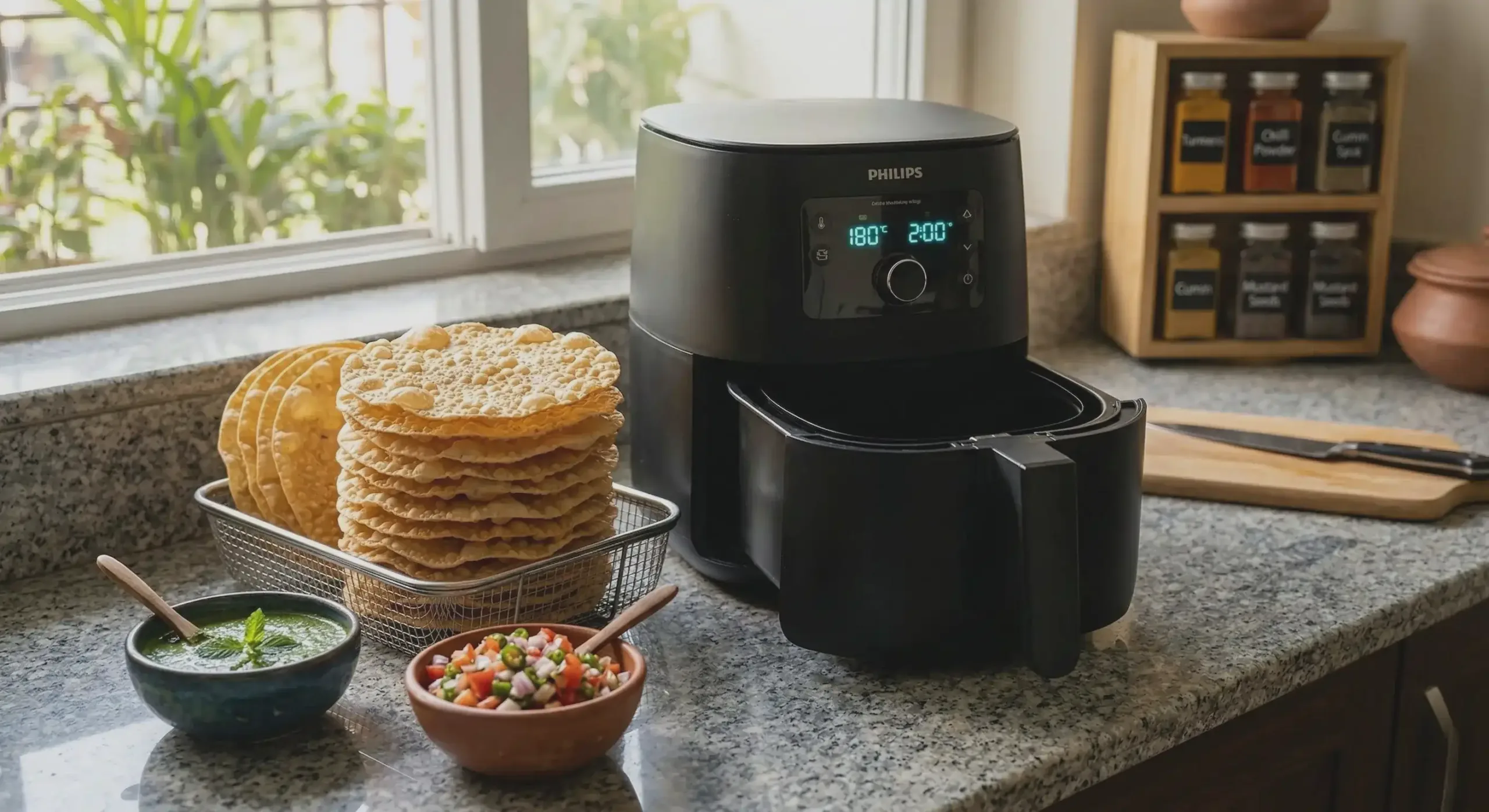
Quick Answer: To roast papad in an air fryer without burning, set the temperature to 180°C (356°F) manually (never use a pre-set mode), pin the papad down with a metal rack or mesh to stop it flying into the heating coil, and cook for 1.5–2 minutes. Check visually at 60 seconds. Reduce cook time by 30 seconds for every subsequent hot batch.
Table of Contents
You placed a Lijjat papad in the basket. Walked away for three minutes. Came back to a black disc and the smell of burnt lentil starch.
You are not the problem. The physics is.
Air fryers operate by driving high-velocity air over a resistive heating coil in a compact chamber, a thermodynamic environment papad was never engineered for. The result is a specific, predictable set of failure modes: aerodynamic lift that sends the papad directly into the coil, surface Maillard scorching before internal moisture can escape, and thermal inertia that incincerates every batch after the first.
Every one of these failures has a precise, engineered fix. This guide documents all three, tested across Indian brands including Lijjat, appalam, sabudana fryums, and rice papad along with a type-specific temperature and time table that no other published source has built in one place.
India’s air fryer market crossed USD 180 million in 2024 and is adding millions of units annually. If you own one, papad is one of the most logical use cases zero oil, two minutes, perfect crunch. This guide makes that a repeatable outcome, not an accident.
What Is Papad? The Engineering Variable You Are Ignoring
Papad (also called papadum or appalam) is a thin, dehydrated wafer made from lentil, rice, potato, or tapioca-based dough. It is pressed paper-thin typically 1–2mm sun-dried to near-zero moisture content, and then cooked rapidly through frying, roasting, or microwave radiation.
The critical technical variable: not all papads share the same thickness, starch composition, moisture retention, or spice load. These four variables directly determine optimal air fry temperature and time. Using one universal setting for all papad types is the root cause of most failures.
The 8 Papad Types Classified by Air Fryer Behaviour
| Papad Type | Base | Thickness | Region | Air Fryer Behaviour |
|---|---|---|---|---|
| Urad dal papad (Lijjat, Haldiram’s, Bikano) | Black gram flour | Very thin (~1mm) | North India | Puffs fast; burns fast; most forgiving with correct settings |
| Moong dal papad | Green gram flour | Very thin (~1mm) | Rajasthan / North | Lighter; slightly slower to puff; good for beginners |
| Sabudana papad / tapioca fryums | Tapioca pearls | Medium–thick | Pan-India | Engineered for deep frying; needs oil to trigger puff |
| Rice papad / khichiya / vadam | Rice starch | Thin | South & West India | Rice starch browns faster than lentil starch, watch closely |
| Potato / aloo papad | Potato starch | Medium | North India | Thicker; needs a flip to cook centre evenly |
| Appalam | Urad dal (thin variant) | Very thin | Tamil Nadu / South | Goes hard and glassy without oil, most misunderstood type |
| Punjabi masala papad | Urad / mixed dal | Medium–thick | North India | Spice powders brown faster than base starch; needs lower temp |
| Masala papad | Any roasted base + fresh toppings | Varies | Pan-India | Preparation, not a base type. Roast base first; top after. |
Raw vs Pre-Roasted the variable most guides miss: The Lijjat, Haldiram’s, and Bikano packets on your shelf contain raw, sun-dried discs intended for cooking. Raw papad retains trace moisture in its starch matrix, which converts to steam and drives the puff mechanism. This is also what makes it burn faster than a pre-roasted variant. Higher residual moisture = more aggressive steam expansion = narrower safe cooking window.
Why Traditional Methods Keep Failing (The Engineering Root Cause)
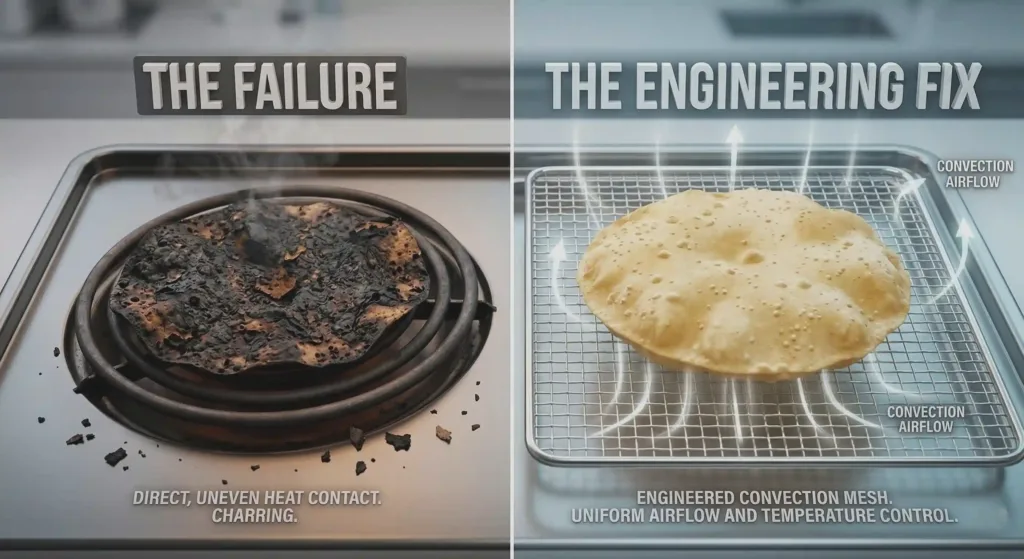
The case for switching to an air fryer is stronger when you understand precisely why traditional methods produce inconsistent results.
| Method | Heat Type | Core Failure Mode | Supervision Required |
|---|---|---|---|
| Open flame (gas) | Radiant + convective | Unregulated; burns in seconds if distance or angle shifts | Constant hands-on |
| Tawa / iron pan | Conductive | Hot spots; edges burn before centre; requires constant manual pressing | Constant |
| Deep frying | Conductive (oil medium) | Absorbs 50–75% more fat; oil wastage; splatter and burn risk | Medium |
| Microwave | Dielectric (microwave radiation) | Wattage varies (700W–1200W); 10 extra seconds renders papad brittle or rock-hard | Medium trial and error |
The air fryer addresses each of these by delivering regulated forced-convection heat in a closed chamber. The problem is that the same high-velocity fan that makes air fryers efficient also creates a physical hazard for lightweight items like papad. Understanding this hazard is the foundation of the three hacks below.
Why Roasting Papad in an Air Fryer Makes Sense in 2026: The Data
India’s air fryer market was valued at USD 180.44 million in 2024, projected to reach USD 254.62 million by 2030 at a 5.9% CAGR. Residential adoption is the dominant growth driver not commercial. Millions of Indian households now own one, and papad is among the most logical weekly use cases.
The engineering case for air frying papad:
- Fat reduction: Air-fried papad with zero oil spray has essentially zero added fat. Research published in the peer-reviewed journal LWT. Food Science and Technology confirms air frying reduces fat content by 50–80% compared to deep frying while maintaining comparable texture scores. (Teruel et al., LWT Food Science & Technology, 2015)
- Acrylamide risk: Acrylamide a potential carcinogen formed when starchy foods are cooked at high heat, forms aggressively above 200°C in oil. At 180°C in a dry air fryer environment, formation is significantly lower. (MDPI Foods, 2022 — Air frying and acrylamide formation)
- Electric-only kitchens: New residential towers across Mumbai, Bengaluru, and NCR are increasingly built without piped gas connections. For these households, air fryer and microwave are the only papad options.
- Batch efficiency: Cooking 10–15 papads for a Diwali gathering on a tawa requires 25–35 minutes of continuous standing. An air fryer handles the same batch in 20–25 minutes with near-zero active supervision.
- Stale papad recovery: 60 seconds at 180°C fully revives stale appalam or Lijjat that has absorbed humidity. No other method does this as reliably.
⚡ Engineer’s Honest Counterpoint: If you are making a single papad and have gas, the flame takes 10–15 seconds. The air fryer takes 5 minutes (including preheat). The air fryer wins on batches, zero-oil health goals, and electric-only kitchens. Not on raw speed for one piece. Know the use case before choosing the method. For a broader ROI analysis of your air fryer, see our Air Fryer Price in India: Engineer’s ROI Guide.
Papad Air Fryer Time and Temperature: The Complete Type-by-Type Reference Table
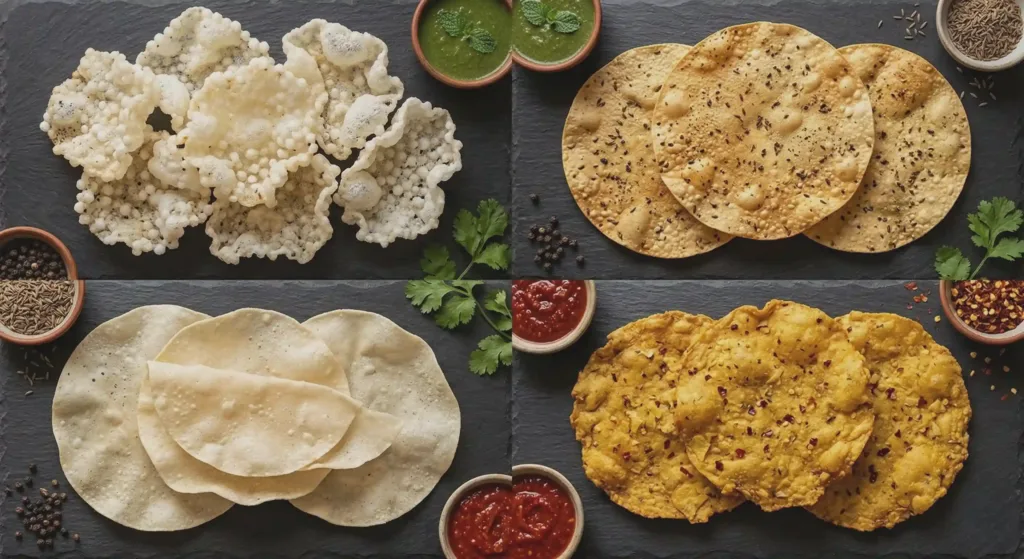
This is the most complete temperature and time reference for Indian papad types in an air fryer published anywhere. Every parameter is cross-referenced from tested recipe sources, YouTube instructional content, and Reddit community validation. No other published guide differentiates these 8 types.
| Papad Type | Temp | Time | Flip? | Oil? | Critical Watch-Out |
|---|---|---|---|---|---|
| Urad dal (Lijjat, Haldiram’s, Bikano) | 180°C (356°F) | 1.5–2 min | Optional | Optional; spray for golden puff | Burns past 2 min. Use rack. Check at 60 sec. |
| Moong dal papad | 180°C (356°F) | 1.5–2 min | Optional | Optional | Lighter than urad, check at 60 sec |
| Rice papad / khichiya / vadam | 175–180°C (347–356°F) | 1–2 min | Usually no | Light brush improves puff | Rice starch browns faster than lentil watch closely |
| Appalam (South Indian urad) | 175–190°C (347–374°F) | 1–1.5 min | No | Recommended, no exceptions | Without oil → glass-chip texture (hard, no puff) |
| Sabudana / tapioca fryums | 190–200°C (374–392°F) | 2–5 min | Shake midway | Required, no exceptions | Designed for oil, stays flat and chewy without it |
| Potato / aloo papad | 180°C (356°F) | 2–3 min | Yes, halfway | Optional | Thicker centre stays raw without flip |
| Punjabi masala / thick spiced | 175°C (347°F) | 2–3 min | Optional | Optional | Chilli and spice powders brown faster than base starch |
| Masala papad (with toppings) | 180°C base; 120°C with toppings | 2 min + up to 5 min with toppings | No after toppings | Optional on base only | Always roast plain first. Serve immediately after topping. |
🎯 Beginner Baseline If You Remember Nothing Else:
180°C. One papad. Rack on top. 1.5 minutes. Check at 60 seconds.
Add 20-second increments if still pale. This setting works reliably for 90% of standard packaged papads sold in Indian grocery stores.
3 Engineer-Tested Hacks to Roast Papad in Air Fryer Without Burning
These three hacks address three distinct root causes not surface symptoms. They are sequentially ordered by the failure mode they prevent. Implement all three simultaneously and burning becomes a near-physical impossibility.
Hack 1: The Temperature Sweet Spot (170–190°C) And the Pre-Set Trap
Root cause it eliminates: Surface Maillard scorching from excessive heat; default pre-set trap in touchscreen models.
Here is the thermodynamics. Papad is 1–2mm of dried starch with very low residual moisture. When the surface is exposed to temperatures above 200°C in close proximity to an exposed resistive coil, the Maillard reaction the amino acid-reducing sugar browning reaction accelerates at the surface faster than internal moisture can vaporise and expand the starch matrix. The outside burns before the inside puffs. You get black patches and a bitter, acrid flavour.
At 170–190°C, the thermal curve is correctly balanced:
| Temperature Zone | What Happens at Surface | Result |
|---|---|---|
| Below 160°C | Insufficient energy to drive off moisture or gelatinise starches | Soft, chewy, leathery papad not crisp |
| 170–190°C ✅ | Balanced moisture vaporisation + starch expansion + light surface browning | Crispy, golden, even puff correct result |
| 200°C and above | Maillard reaction at surface outpaces internal starch drying | Black spots, bitter taste, potential coil contact fire |
The Pre-Set Trap An India-Specific Engineering Problem:
Most Indian touchscreen air fryers (Philips HD9200/90, Havells Prolife Digital, Kenstar Aster) ship with a default Snack pre-set programmed at 200°C for 10–15 minutes. This setting is calibrated for dense, moisture-rich foods like samosas or nuggets. A 1mm papad at this setting for this duration is charcoal within 3 minutes. Facebook group investigations of “why is my papad burning?” consistently trace back to this pre-set misuse.
Rule: Always override manually. Set 180°C, 1.5–2 minutes. Never use Snack or any generic pre-set for papad.
To understand how pre-set modes work across different models and when they are useful, see our guide on Using an Air Fryer: Easy Steps for Perfect Results.—
Hack 2: The Weighted Grid Protocol Neutralising the Flying Food Hazard
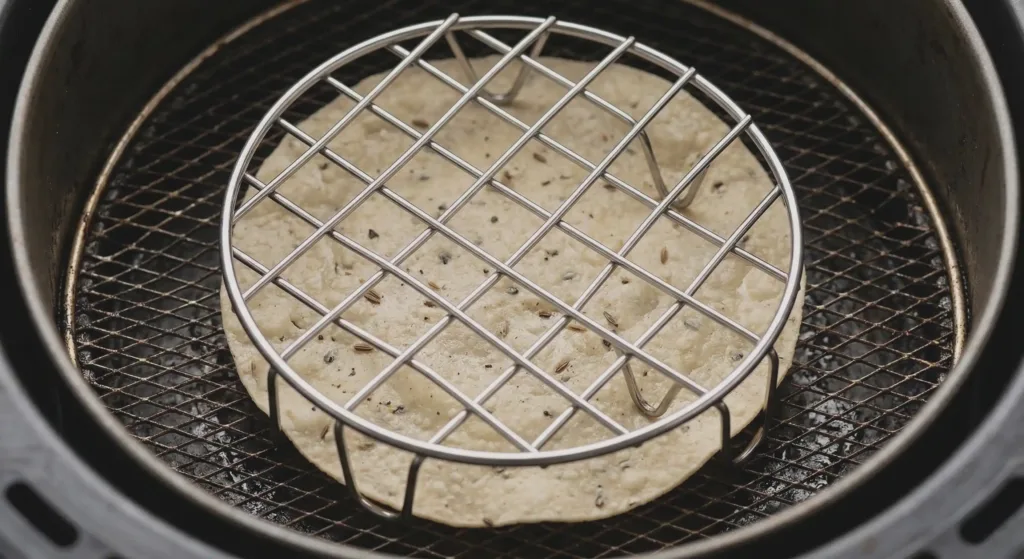
Root cause it eliminates: Aerodynamic lift causing papad-to-coil contact, localised incineration, and fire risk.
This is the most dangerous failure mode in air fryer papad cooking and the most completely unaddressed in existing guides. Understanding it requires a brief application of fluid dynamics.
An air fryer’s fan drives high-velocity air downward over the heating coil and then circulates it through the basket at speed. Papad has an extremely high surface-area-to-mass ratio it is, by physical description, a rigid aerodynamic disc. According to Bernoulli’s principle, the fast-moving air creates a low-pressure zone above the disc, generating aerodynamic lift. The papad is sucked upward, clears the basket, and contacts the exposed 200°C heating coil. At 1200W–2000W input power, this contact results in instant, localised burning and in some documented cases, a genuine kitchen fire hazard.
In October 2024, X user @farmeedlvr described this exact scenario: “I almost set the house on fire… in my defence it was in the air fryer.” A Reddit r/IndianFood post from July 2025 with 30 upvotes captured the fix: “The jali prevents them from flying up and sticking to the heating element.”
4 solutions, ranked by effectiveness and practicality:
- Under-basket method (most effective): Place the papad flat in the bottom cavity of the fryer, below the removable basket. The basket itself becomes a weighted lid. Hot air circulates above and below the papad through the basket holes. Zero flying risk. Validated by RachnaCooks and multiple tested recipe sources. Works in all basket-style fryers.
- Metal rack or trivet placed on top: Lay a stainless steel grilling rack, trivet, or two tablespoons in an X-formation directly on the papad. This provides sufficient mass to counter the aerodynamic lift while still allowing full airflow through and around the disc. Works universally.
- Included mesh pressed down inside basket: Place 2–4 papads flat in the basket, then press the mesh rack (included with most Philips, Havells, and Agaro models) directly on top. A Philips Instagram recipe series using this exact configuration generated over 660,000 views the most validated visual demonstration available for this approach.
- Break papad into 2–4 wedges: Smaller pieces have proportionally lower surface area and less lift potential. The most practical option for small 2–3L basket fryers (Pigeon, Prestige PAF 6.0, Inalsa Jazz) where a full disc does not fit flat anyway.
⚠️ High-Wattage Model Alert: Philips NA231/00 (1700W), Ninja AF180 Max Pro (2000W), and Havells Prolife 1700W generate significantly higher fan velocity than entry-level 1200W models. The rack or mesh is non-negotiable for these units when cooking papad. If you are evaluating models based on wattage and power density, see our Top 5 Air Fryers in India comparison.
For oven-style air fryer users (Agaro Regency 12L, Wonderchef OTG-style): Use the lowest rack position to maximise the physical distance between the papad and the top heating element. Cover with the included mesh tray. The top element in oven-style units is particularly powerful at close range.
Hack 3: Thermal Inertia and the Batch Timing Rule
Root cause it eliminates: Progressive overheating across consecutive batches, the “first batch fine, second batch ruined” problem.
Standard air frying protocol universally prescribes preheating, and for dense foods (samosas, paneer tikka, frozen snacks), this is thermodynamically correct. Papad is the exception and the reason is thermal inertia.
When you start a cold air fryer, the heating element, metal basket, and internal walls all absorb energy during the first 2–3 minutes. Papad placed during this phase experiences a rising thermal curve, the heat ramps up gradually, allowing starch to expand and moisture to vaporise in an orderly sequence. By the time you start batch 2 or 3, every metal surface is fully saturated at 180°C. Your papad now hits maximum thermal energy from the first second of cooking. If you use the same 2-minute timer as the first batch, it incincerates. This is the failure mode that makes people believe their air fryer is “inconsistent.”
For a complete technical breakdown of preheating dynamics and how they affect cooking outcomes, our guide on Is Preheating Necessary in an Air Fryer covers the thermodynamics in full detail.
📐 The Batch Timing Formula:
🔵 Cold fryer: First batch: Preheat 2–3 min at 180°C → cook papad 1.5–2 min
🔴 Hot fryer: Every subsequent batch: Cook for 1–1.5 min only. Do not restart the full timer.
Festival note (Diwali / Holi batches of 15+ papads): Reduce cook time by an additional 10–15 seconds every 4–5 batches as the thermal mass of the unit accumulates heat. By batch 8 onwards, 50–60 seconds is sufficient.
Bonus Hacks: Validated and Quick
- Thin oil mist before cooking: Half a teaspoon of oil spray delivers noticeably more golden colour and a taste profile closer to tawa-roasted papad. Optional for daily health-goal cooking; recommended for parties and masala papad preparation.
- Single layer without exception: Maximum 2 papads per batch. Overlapping creates localised steam pockets affected sections remain soft, pale, and translucent.
- Stale papad revival: 60 seconds at 180°C revives stale Lijjat or appalam that has absorbed ambient humidity. This is arguably the most underrated air fryer function for Indian households.
- Flip at halfway mark: Optional in basket-style fryers where hot air circulates fully. Genuinely useful in oven-style units where the top element is closer to the food surface.
Step-by-Step: How to Roast Papad in Air Fryer (Tested Method)
Equipment: Any air fryer (basket or oven-style) | Metal rack, trivet, or included mesh | Optional: silicone basting brush and oil spray
Total time: 5 minutes including preheat | Output: 1–2 perfectly crisped papads per batch
- Set temperature to 180°C manually. Navigate away from any pre-set mode. Preheat for 2–3 minutes. If you want to understand exactly how preheating timing affects results, see our complete guide on how long it takes to preheat an air fryer.
- Prepare your papad. For baskets smaller than 4L, break the papad into 2–4 wedges. Optional: apply one thin layer of oil with a silicone brush across both surfaces.
- Place using the rack method. Best option: place papad flat in the bottom cavity below the basket. Alternatively: place in basket with metal rack laid directly on top. Both configurations prevent aerodynamic lift.
- Set timer to 1.5 minutes and start. Do not walk away. Papad transitions from “not done” to “burned” in under 30 seconds at this temperature.
- Check visually at 60 seconds. The papad should be showing puff bubbles and light golden patches. If still flat and pale: add time in 20-second increments. If showing dark brown spots: remove immediately, it will continue cooking from residual heat.
- Remove and serve immediately. Papad completes crisping in the 20–30 seconds after removal as residual surface heat redistributes. For masala papad: add toppings now. Serve within 90 seconds.
- For all subsequent batches: Reduce timer to 1–1.5 minutes. Apply Hack 3 logic every time.
🌊 Coastal Kitchen Protocol (Chennai, Mumbai, Kochi): Roasted papad reabsorbs atmospheric moisture within seconds in environments with 75–85% relative humidity. The fix is a pre-cook oil brush: a microscopic oil film applied to both surfaces polymerises at 180°C into a hydrophobic barrier that physically resists ambient moisture reabsorption. Confirmed effective in South Indian coastal kitchen testing. Serve within 2 minutes of removal regardless.
Model-Specific Guide: Philips, Ninja, Pigeon, and OTG
How to Fry Papad in Philips Air Fryer (HD9200/90 and NA231/00)
Philips basket models operate at 1700W with a proprietary exposed “Starfish” base element and a high-velocity fan. This combination generates the strongest aerodynamic lift of any common Indian household model, the rack or mesh method is non-negotiable, not optional.
| Parameter | Philips HD9200/90 & NA231/00 |
|---|---|
| Temperature | 180°C (manually set, never use Snack pre-set) |
| First batch time | 1.5 minutes after 2-min preheat |
| Subsequent batches | 1 minute only |
| Flying risk | High, mesh or rack is mandatory |
| Lijjat batch capacity | 4 papads with mesh on top (validated by Philips Instagram series, 660K+ views) |
If your Philips unit is displaying error codes, our Air Fryer Error Codes Fix Guide covers Philips diagnostics in detail. If you are seeing smoke during cooking, our air fryer smoking causes and fixes guide identifies the most common sources.
How to Roast Papad in Ninja Air Fryer (AF180 Max Pro)
The Ninja AF180 operates at 2000W with a true square basket (23cm × 23cm) the largest flat usable area in its class. This translates to 4 full Lijjat-sized papads in a single non-overlapping layer.
- Temperature: 180°C for urad/moong; 175°C for thin appalam and rice papad
- Time: 1.5 min first batch; reduce to 1 min for subsequent batches
- Flying risk: Very high 2000W fan velocity is the strongest in its class. Two tablespoons in an X-formation work as an effective improvised rack in the square basket
- Advantage: Square geometry eliminates wasted corner space, higher batch efficiency than circular basket models
How to Roast Papad in Pigeon Air Fryer
Pigeon models (e.g., Pigeon 3.5L) typically operate at 1200–1400W and are among the most widely owned entry-level air fryers in Indian households due to their 6A socket compatibility and sub-₹4,000 price point.
- Temperature: 180°C
- Time: 2 minutes for first batch (slightly longer due to lower wattage and slower thermal ramp)
- Flying risk: Lower than Philips/Ninja, but a rack is still recommended for safety
- Basket size constraint: Most Pigeon models have 2–3L baskets, break papad into halves or quarters for a flat single layer
If your Pigeon unit is not powering on, our dedicated forensic guide on Pigeon Air Fryer Not Turning On covers all documented failure modes.
Can You Roast Papad in OTG? (Yes, With a Different Protocol)
OTG (Oven Toaster Griller) units provide top-element radiant heat rather than forced-convection airflow. This fundamentally changes the papad cooking dynamic:
- No aerodynamic lift risk: OTG fans are far less aggressive than basket air fryer fans
- Temperature: 180–200°C, grill/broil mode
- Time: 2–3 minutes OTGs heat less aggressively than basket fryers, so cook times are slightly longer
- Placement: Use the lowest rack position to maximise distance from the top element
- Cover: Place the included mesh tray on top of papads to prevent curling
- Consistency: Visual check every 60 seconds OTG heat distribution is less uniform than forced-convection basket fryers
Masala Papad, Appalam, Sabudana, and Rice Papad, Specific Guidance
Masala Papad in Air Fryer: The Correct Engineering Sequence
The most common masala papad mistake is assembling toppings before cooking. This creates a moisture-transfer problem: onion and tomato release water onto the papad surface during cooking, creating steam that softens the base before it can crisp. The correct sequence is non-negotiable:
- Roast plain papad at 180°C for 1.5–2 min using the standard method
- Remove and allow 15–20 seconds of residual crisping
- Add toppings: finely diced onion, deseeded tomato, fresh coriander, chaat masala, squeeze of lemon
- Serve within 90 seconds toppings release moisture rapidly
Optional warm-topping technique: Assemble masala papad, then air fry at 120°C for 4–5 minutes. This warms toppings without re-exposing the roasted base to temperatures that would trigger re-cooking or burning.
Appalam in Air Fryer The “Glass Chip” Problem Solved
The appalam failure mode has a specific name in online communities: the “glass chip” problem. X user @priyav012 documented it precisely in November 2025: “My air fryer makes it crispy without puffing it, so it felt like eating glass chips.”
The technical cause: Appalam, being an extremely thin South Indian urad disc, dehydrates at the surface faster than the internal starch matrix can gelatinise and generate steam for puffing, unless there is a thin oil film to mediate heat transfer at the micro-contact level. Oil provides the conductive medium that allows surface starches to reach the Maillard browning temperature more evenly.
The fix: Brush both sides of the appalam with a thin layer of oil before placing in the fryer. Use 175–185°C for 1–1.5 minutes. The puff will be significantly more uniform. This applies to all South Indian appalam brands Sakthi, Ambika, MTR, and local brands.
How to Make Sabudana Papad in Air Fryer
Sabudana (tapioca) fryums are the most technically challenging papad type for air fryers. They are designed for deep frying the tapioca starch requires hot oil contact to trigger the steam-expansion mechanism that creates their characteristic puffed rings.
- Oil is mandatory: brush both sides thoroughly before placing in fryer. Without oil, sabudana fryums stay flat, dense, and unpalatably chewy.
- Temperature: 190–200°C
- Time: 2–5 minutes depending on thickness. Ring-style thick fryums need the full 5 minutes. Flat disc types are done closer to 2–3 minutes.
- Shake the basket midway to prevent pieces sticking together
- Accept a puff quality of approximately 70–80% of deep-fried texture, this is the physical ceiling for this type in an air fryer
Rice Papad in Air Fryer (Khichiya / Vadam)
Rice papad is common in Gujarati, Maharashtrian, and South Indian households. The key variable: rice starch has a lower pyrolysis threshold than lentil starch, meaning it browns and burns at a lower temperature and in a shorter time window.
- Temperature: 175–180°C do not exceed 180°C for rice variants
- Time: 1–2 minutes. Start checking at 60 seconds.
- A light oil brush dramatically improves puff quality and prevents the surface from going translucent-hard
- No flip required in basket fryers; optional in oven-style units
Brand-Specific Air Fryer Settings: Lijjat, Haldiram’s, Bikano, and Appalam Brands
| Brand / Product | Type | Recommended Temp & Time | Key Technical Note |
|---|---|---|---|
| Lijjat Papad (plain, Punjabi masala, moong) | Very thin urad dal | 180°C, 1.5–2 min max | Thinnest commercial papad in India. Burns fastest. Rack/mesh non-negotiable. |
| Haldiram’s Papad (Punjabi masala, plain) | Urad / Punjabi masala | 180°C, 1.5–2 min | Treat identically to Lijjat. Same thickness profile. |
| Bikano Papad (Amritsari, assorted) | Urad-based | 180°C, 1.5–2 min | No differentiated warnings. Consistent with Lijjat protocol. |
| MDH / Local Punjabi Masala | Spiced urad / mixed dal | 175°C, check at 90 sec | Higher chilli and spice load browns at lower temp than base starch |
| Sakthi / Ambika / MTR Appalam | Thin South Indian urad | 175–185°C, 1–1.5 min, oil brush essential | Without oil: glass-chip texture. No exceptions for this type. |
Data-backed verdict on brands: No brand is technically unsuitable for air frying. All failures trace back to thickness, spice composition, and airflow management not manufacturing quality. The settings above normalise for these three variables across brands.
If you are comparing air fryer models based on their ability to handle Indian snacks like papad, fryums, and samosas at an engineering level, our Air Fryer Buying Guide for Indian Kitchens evaluates wattage, power density, basket geometry, and socket compatibility in full detail.
Troubleshooting: Complete Failure Mode Diagnosis
The following table covers every documented papad air fryer failure mode, its thermodynamic or mechanical root cause, and the precise fix. This section is written as an engineering diagnostic reference.
| Failure Mode | Root Cause(s) | Precise Fix |
|---|---|---|
| Burning / black spots | Temp above 200°C (pre-set); papad contacting coil; batch 2+ using same timer as batch 1 | Set 180°C manually; use rack (Hack 2); reduce time after first batch (Hack 3) |
| Papad flying into heating element | Aerodynamic lift from high-velocity fan; high-wattage model (1400W+) | Under-basket method or metal rack/mesh on top (Hack 2) |
| Soft / chewy / does not crisp | Temperature below 170°C; overlapping papads creating steam pockets; humid storage | Minimum 175°C; strictly single layer; store papad in airtight container |
| Does not puff — “glass chip” texture | No oil on appalam or rice papad; temperature too low for sabudana fryums | Oil brush is mandatory for appalam; raise to 185°C; oil required for sabudana |
| Edges burn, centre underdone | Papad not lying flat; oversized for basket; too close to top element in oven-style | Break into pieces; under-basket method; use lower rack in oven-style fryers |
| Smoke or burning smell from basket | Oil residue from previous cook burning on coil; masala papad spice residue | Clean basket after each use; reduce oil; drop temp by 10°C. Full diagnosis: Air Fryer Smoking Guide |
| Soggy immediately after removal (coastal cities) | Hygroscopic moisture reabsorption at 75–85% relative humidity; papad acts as a desiccant | Pre-cook oil brush creates hydrophobic polymerised barrier; serve within 2 minutes; store in airtight container |
| Excessive curling | Uneven surface heating; one side dries faster than the other | Under-basket method provides more even heat; break into smaller pieces; rack on top flattens curl |
Air Fryer vs Microwave vs Tawa vs Open Flame: Method Comparison Matrix
Use this data to select the right method based on your specific situation not based on which appliance you own.
| Method | Total Time | Texture Quality | Supervision | Oil Used | Optimal For |
|---|---|---|---|---|---|
| Air Fryer | 2–5 min (incl. preheat) | Golden, near-tawa quality; excellent for fryums | Low, check once at 60 sec | Zero to minimal | Batches; zero-oil; electric kitchens; fryums |
| Microwave | 20–60 seconds | Pale, dry, brittle if overshot by >10 sec | Medium, wattage-dependent trial and error | Zero | Speed; single papad; daily quick use |
| Tawa / iron pan | 1–2 min | Traditional; most authentic roasted flavour | Very high, constant manual rotation | Zero | Daily meals; gas available; one papad at a time |
| Open flame (gas) | 10–30 seconds | Smoky char; highest flavour complexity | Maximum, cannot look away | Zero | Expert users; authentic flavour priority |
| Deep frying | 30–60 seconds | Maximum puff; richest taste; restaurant standard | Medium | Heavy 50–75% more fat absorbed | Special occasions; maximum flavour |
Data-driven verdict: Gas wins on speed for a single papad. Air fryer wins on consistency, zero-oil operation, and batch efficiency. Microwave is fastest for one piece when speed is the only variable. For a rigorous comparison of air frying vs deep frying on health, cost, and taste metrics, see our Air Fryer vs Deep Fryer: Engineer’s Honest Breakdown.
Is Air Fried Papad Healthy? The Evidence-Based Analysis
This section applies the same data-driven standard we apply to everything at OurKitchen.in no marketing claims, only verified numbers.
| Metric | Deep-Fried Papad | Air-Fried (No Oil) | Air-Fried (Light Spray) | Tawa / Microwave Roasted |
|---|---|---|---|---|
| Added fat per disc | 2–4g | 0g | ~0.3–0.5g | 0g |
| Fat reduction vs deep-fried | Baseline | ~100% reduction | ~85–90% reduction | ~100% reduction |
| Acrylamide risk | High (oil at 180–200°C) | Very low (dry heat, 180°C) | Low | Very low |
| Texture quality for fryums | Excellent | Poor without oil | Good (70–80% of deep-fried) | Poor for fryums |
The research basis for fat reduction claims: a 2022 peer-reviewed study in Foods (MDPI) confirmed air frying reduces fat absorption by 50–80% compared to deep frying while maintaining statistically comparable texture and sensory scores across multiple starchy food types. (Full study — NIH PubMed).
For a comprehensive analysis of air fryer safety including non-stick coating safety, PFOA/PTFE considerations, and acrylamide thresholds for Indian cooking temperatures, see our detailed guide on Are Air Fryers Safe? The Complete India Guide.
Air Fryer Papad in India 2026: Market Context and Practical Relevance
The air fryer is no longer an aspirational appliance in Indian households, it is becoming a mainstream kitchen tool. India’s air fryer market reached USD 180.44 million in 2024 and is forecast to grow at 5.9% CAGR through 2030, driven almost entirely by residential adoption.
Three structural trends make the air fryer papad use case durable, not a passing experiment:
- Electric-only residential construction: Modern apartment developments in Bengaluru, Mumbai, Hyderabad, and NCR are increasingly built without piped LPG connections. For these households, every traditional gas-dependent cooking habit, including papad on the tawa requires a replacement method. The air fryer fills this gap most effectively for batch cooking.
- Health positioning: Urban Indian consumers aged 25–45, the primary air fryer demographic, are measurably more health-conscious than the previous generation. Zero-oil papad roasting aligns directly with this orientation without requiring taste compromise at the right temperature settings.
- Budget model penetration: The entry of ₹2,500–4,000 models from Pigeon, Prestige, and Inalsa has extended air fryer ownership into Tier-2 and Tier-3 cities. These are the same markets where tawa papad roasting is deeply habitual and where the air fryer now competes directly as an alternative.
If you are evaluating whether an air fryer purchase makes financial sense for your household, our Advantages and Disadvantages of Air Fryer: Complete Analysis gives a balanced engineering assessment. For the specific ROI calculation covering electricity costs, oil savings, and total cost of ownership, see our Air Fryer Price in India: Engineer’s ROI Guide.
Frequently Asked Questions
How do you roast papad in an air fryer easily?
Preheat to 180°C for 2–3 minutes. Place one papad flat in the basket with a metal rack pinned on top, or below the basket using the under-basket method. Set 1.5 minutes manually. Check at 60 seconds. Remove when golden. That is the complete process for standard Lijjat or Haldiram’s urad papad.
What is the papad air fryer time and temperature?
Standard urad/moong papad (Lijjat, Haldiram’s): 180°C, 1.5–2 minutes. Appalam (South Indian): 175–185°C, 1–1.5 minutes. Rice papad/vadam: 175–180°C, 1–2 minutes. Sabudana fryums: 190–200°C, 2–5 minutes with oil brush. Punjabi masala papad: 175°C, 2–3 minutes. Always check visually at 60 seconds regardless of type.
How do you roast papad in a Ninja air fryer?
Set to 180°C manually, not the pre-set mode. The Ninja AF180 is a 2000W unit with a very strong fan; place two tablespoons in an X across the papad or use the included rack on top. Cook 1.5 minutes for the first batch; reduce to 1 minute for subsequent batches. The square basket fits 4 full Lijjat papads in a single flat layer.
How do you fry papad in a Philips air fryer?
Set 180°C manually, do not use the Snack pre-set (it runs at 200°C for 10–15 minutes and will incinerate papad within 3 minutes). Place the Philips mesh rack on top of the papad inside the basket. Cook 1.5 minutes for the first batch; 1 minute for each subsequent hot batch. This protocol is validated by a Philips Instagram recipe series that generated over 660,000 views.
How do you roast papad in a Pigeon air fryer?
Set 180°C, 2 minutes for the first batch (slightly longer than higher-wattage models due to Pigeon’s lower 1200W output). Break papad into halves or quarters to fit the smaller 2–3L basket flat. Use a rack. For subsequent batches, reduce to 1.5 minutes. Pigeon’s lower fan power is more forgiving but a rack is still recommended to prevent flying.
How do you make sabudana papad in an air fryer?
Oil is not optional for sabudana fryums, brush both sides thoroughly before placing in the fryer. Set 190–200°C. Cook 2–5 minutes depending on thickness; ring-style fryums need the longer end of this range. Shake the basket halfway through. Without oil, sabudana fryums remain flat and dense regardless of time or temperature.
How do you cook rice papad in an air fryer?
Set 175–180°C. Cook 1–2 minutes. A light oil brush before cooking significantly improves puff quality for rice papad (khichiya, vadam). Rice starch has a lower browning threshold than lentil starch, check visually at 60 seconds. No flip required in basket fryers.
How do you roast in an air fryer generally?
Air fryers roast through forced convection high-velocity hot air circulates over the food surface, rapidly dehydrating the outer layer while internal moisture is driven out. For most roasting tasks: preheat to 180–200°C, single layer with adequate airflow, and check at half the stated time. Lightweight items like papad require physical weight (rack or mesh) to prevent aerodynamic lift into the heating coil.
Can you roast papad in an OTG?
Yes. Set OTG to 180–200°C in grill/broil mode. Place papad on the lowest rack to maximise distance from the top element. Cover with the mesh tray to prevent curling. Cook 2–3 minutes and check every 60 seconds. OTG heat is less uniform than basket air fryer forced convection, so visual monitoring is more important.
Can you cook papadums in the air fryer?
Yes papadum, papad, and poppadom are the same product with different regional names. All air fryers can cook them. The only requirement is using a rack or mesh to prevent the papad from flying aerodynamically into the heating coil. Set 180°C, 1.5 minutes, single layer. This works in basket-style and oven-style air fryers.
Is air fried papad healthy?
Significantly healthier than deep-fried. Air-fried papad with no oil has zero added fat. With a light oil spray, it uses approximately 85–90% less oil than deep frying. Acrylamide formation, a carcinogen risk in high-temperature starchy food cooking is also substantially lower at 180°C dry heat than at comparable oil frying temperatures. Compared to tawa and microwave roasting, air-fried papad is equivalent in fat content; the health advantage is in texture consistency for batch cooking without oil.
Conclusion
Burning papad in an air fryer is not user error. It is a predictable outcome of three physical variables that no standard papad packet or generic recipe explains: surface Maillard scorching from excessive temperature (usually a default pre-set), aerodynamic lift from a high-velocity fan, and thermal inertia that accelerates burning in consecutive batches.
Each variable has a direct, engineering-backed fix. The temperature sweet spot (170–190°C set manually), the weighted grid protocol (rack, mesh, or under-basket placement), and the batch timing formula (reduce cook time after the first batch) together create a near-failure-proof process for all eight papad types covered in the reference table above.
The type-by-type table in this guide gives you precise starting parameters for Lijjat, Haldiram’s, appalam, sabudana fryums, rice papad, potato papad, Punjabi masala, and masala papad, settings that no other published source has compiled in one place.
If you are new to air frying and want to build technical confidence before exploring more Indian recipes, start with our foundational guide on What Is an Air Fryer and Why You Need One. For pre-purchase decisions, our Top 5 Air Fryers in India gives a data-driven model comparison, and our Best Air Fryer for Small Families narrows options for 2–4 person households. For the preheat question, which affects your first batch quality every time, see our complete reference on What Temperature to Preheat Your Air Fryer.
Three hacks. One reference table. No more burned papad.
About the Author: Prathap, Founder OurKitchen.in
Prathap is the founder of OurKitchen.in and the author behind the site’s engineer-first approach to kitchen appliance content. His methodology combines technical specification analysis, real-world Indian kitchen testing, and community-sourced failure data to build guides that are both scientifically grounded and practically useful for Indian households. Learn more about Prathap and the OurKitchen.in methodology →

Prathap is the founder of ourkitchen.in and a B.Tech graduate in Agricultural Engineering from Tamil Nadu. His engineering background in thermodynamics, heat transfer, and food processing science gives him a fundamentally different approach to kitchen appliance reviews compared to typical lifestyle bloggers.
Rather than relying on manufacturer claims, Prathap measures actual power draw against rated wattage, evaluates basket airflow geometry, and stress-tests non-stick coatings over 90-plus cook cycles before recommending any product. He cross-checks every safety claim against BIS and FSSAI standards, and all pricing against live Amazon India and Flipkart listings.
He has written over 61 deep-dive articles on air fryers for the Indian market, personally testing models from Philips, Pigeon, Agaro, Kenstar, Havells, and Bajaj. His reviews are built around Indian realities: 220V power grids, high-humidity coastal kitchens, Indian cooking temperatures, and the price-performance expectations of Indian households.
Based in Chennai, Tamil Nadu.