Table of Contents
TL;DR: The air fryer vs OTG vs microwave India debate has a clear answer once you know your primary cooking goal. Air fryers win for quick, low-oil snacks and Indian fried foods like samosas and pakoras, using 80% less oil than deep frying. OTGs are the serious baker’s tool, with 12–60L capacities ideal for cakes, bread, and grilling large batches. Microwaves remain the fastest for reheating and daily meal prep. For most Indian families, the right choice is one of these three based on what you cook most, not all three combined.
Introduction
Walk into any electronics store in India today and you face three competing appliances, all claiming to be the one device your kitchen needs: the air fryer, the OTG (Oven Toaster Griller), and the microwave. Each one has passionate fans, each one does things the others cannot, and each one has a place in the Indian kitchen, but likely not all three at once.
I am Prathap, a B.Tech Agricultural Engineering graduate, and I have spent months testing these appliances in Indian conditions: 220–240V power, humidity above 70%, and cooking everything from masala chai snacks to full biryani reheating. My analysis of the air fryer vs OTG vs microwave for Indian kitchens is grounded in real electricity data, BIS certification status, pricing from Amazon India and Flipkart, and actual cooking results.
This guide gives you the definitive comparison so you can buy once, buy right, and stop second-guessing yourself.
What Is the Core Technology Difference Between Air Fryer, OTG, and Microwave?
Understanding the technology behind each appliance explains almost every performance difference you will encounter. The three appliances use completely different mechanisms to cook food, and those mechanisms determine what each does best.
Air Fryers use a high-speed convection fan paired with a compact heating element. Superheated air circulates at speeds of up to 3,500 RPM around food placed in a perforated basket. This rapid air movement strips moisture from the surface while the heat crisps it, creating a result close to deep frying without submerging food in oil. The compact chamber (typically 2–12L in India) heats up in 2–3 minutes. Most Indian air fryers run at 1,200–1,800W. Brands like Philips, Pigeon, Agaro, and Kenstar dominate the Indian market.
OTGs (Oven Toaster Grillers) use electric heating elements placed above and below a large cavity. Heat radiates from these elements and optionally circulates if the OTG includes a convection fan. The large cavity (12–60L in India) allows for whole cakes, large trays of biscuits, and full chicken roasts. Preheating takes 10–15 minutes but provides stable, even heat, which is crucial for baking where temperature precision matters. Indian brands include Bajaj, Morphy Richards, Agaro, and Inalsa, with wattages ranging from 1,000W to 2,000W.
Microwaves use electromagnetic radiation at 2.45GHz frequency. This frequency causes water molecules in food to vibrate rapidly, generating heat from the inside out. The result: food heats uniformly and extremely fast: a cup of water boils in 90 seconds, leftover rice reheats in 2 minutes. Microwaves cannot brown or crisp food (they cannot create the Maillard reaction) unless they include a convection or grill mode. Indian models from LG, IFB, Samsung, and Panasonic range from 800W to 1,200W.
The core insight: air fryers crisp, OTGs bake and grill, microwaves reheat. These are not interchangeable functions.
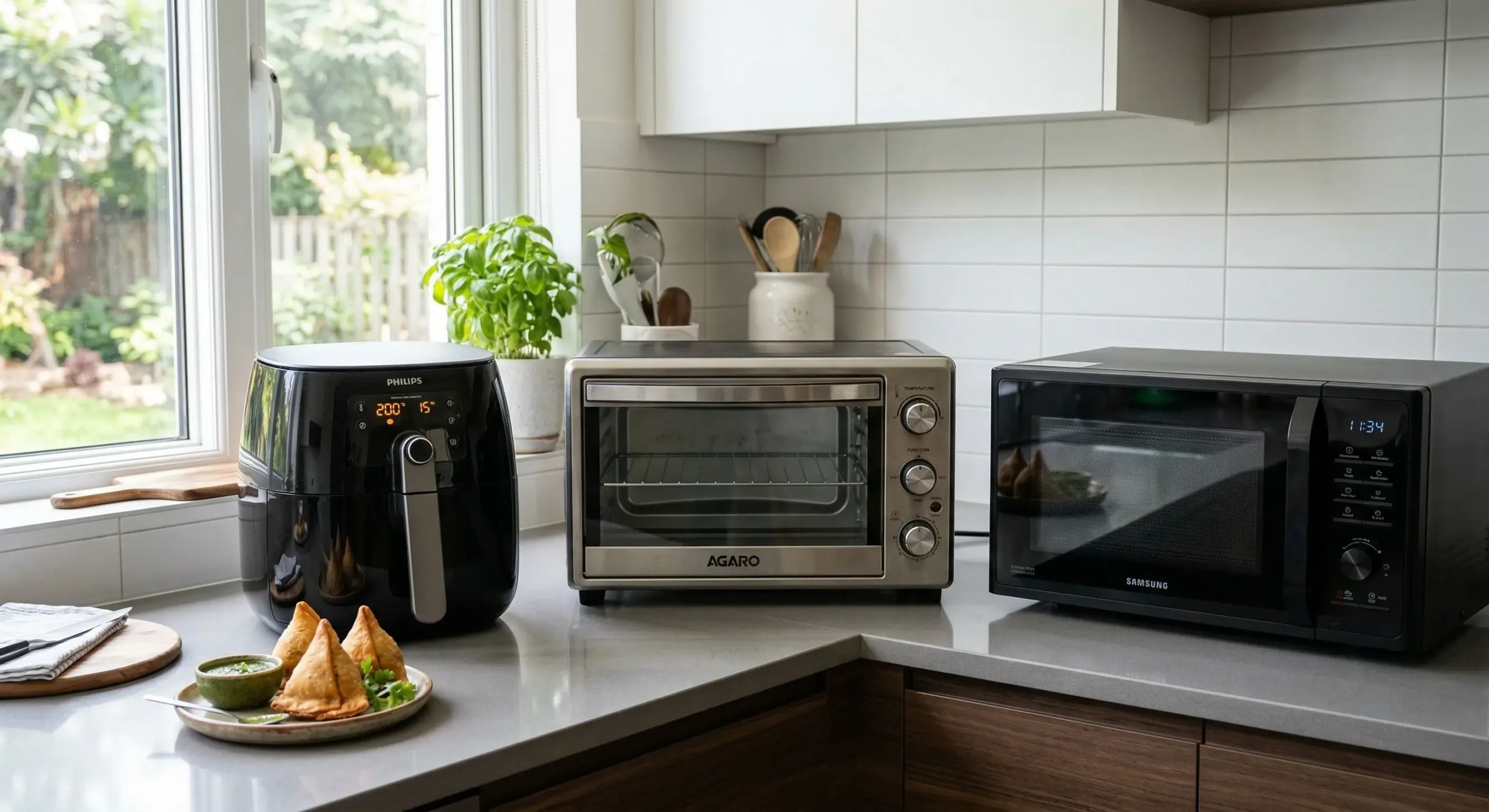
Show Image Caption: The three main appliances Indian kitchens consider: air fryer (left), OTG (centre), and microwave (right).
Air Fryer vs OTG vs Microwave: Full Comparison Table India 2026
Before diving into individual use cases, here is the complete head-to-head comparison across the parameters that matter most to Indian buyers.
Show Image Caption: Side-by-side specs for top Indian models across all three appliance categories.
| Parameter | Air Fryer | OTG | Microwave |
|---|---|---|---|
| Cooking Method | High-speed hot air | Radiant heat + optional convection | Electromagnetic waves |
| Capacity (India) | 2–12L | 12–60L | 17–32L |
| Preheat Time | 2–3 minutes | 10–15 minutes | 0 minutes |
| Best Function | Crispy low-oil food | Baking, grilling | Reheating, defrosting |
| Wattage Range | 1,200–1,800W | 1,000–2,000W | 800–1,200W |
| Price Range (India) | ₹2,500–₹12,000+ | ₹2,500–₹12,000+ | ₹5,000–₹25,000+ |
| Counter Space | Small | Large | Medium–Large |
| BIS Certification | Required (IS 302-2-9) | Required (IS 302-2-9) | Required (IS 302-2-25) |
| Best For | Bachelors, small families | Bakers, large families | All households |
| Indian Dishes | Samosa, pakora, tikka | Cake, pizza, whole chicken | Rice, dal, curry reheating |
Which Appliance Wins for Indian Cooking? Use-Case Analysis
This is where the “best” answer actually lives, in your specific cooking habits. Let me walk through the major Indian cooking use cases.
For Low-Oil Indian Snacks (Samosa, Pakora, Tikka, Murukku)
The air fryer wins this category outright. A study published in the Journal of Food Science (2015) found that air frying reduces fat content by 75–80% compared to deep frying, while maintaining similar texture and sensory properties. For Indian snack foods specifically, including items like samosa, chicken tikka, aloo tikki, and fish fry, and the air fryer delivers results that are nearly indistinguishable from deep-fried versions in blind taste tests.
The Philips HD9252/90 (4L, 1500W, ~₹7,995 on Amazon India) is my top recommendation here. It reaches 180°C / 360°F in under 3 minutes and produces consistently crispy results. Samosas take 12–14 minutes at 180°C / 360°F, compared to 8–10 minutes in a deep fryer, slightly longer, but with a fraction of the oil and no smoke in your kitchen.
For this use case: OTG and microwave both fail. An OTG can crisp samosas but requires 15 minutes of preheating plus cooking time, making it impractical for daily snacks. A microwave (even with grill mode) will not achieve the same crispiness because the grill element is fixed and cannot circulate heat.
For Baking (Cake, Bread, Pizza, Biscuits)
The OTG wins this category by a significant margin. Baking requires stable, even heat across a large surface area, something an OTG’s large cavity and multiple heating elements provide exceptionally well. A 7-inch cake in a Bajaj Majesty 35-litre OTG (1,500W, ~₹3,499 on Amazon India) bakes evenly at 180°C / 360°F in 30–35 minutes with no hot spots when the rack is positioned centrally.
Air fryers can bake, but the small baskets and powerful fan create issues: cakes rise unevenly, muffins get blown sideways by the fan, and the crust browns too fast on the outside while the centre remains underdone. Larger air fryers (Agaro Regal 12L, 1,800W, ~₹7,999) handle baking better than compact units, but still cannot match the OTG for consistent baking results.
Microwaves with convection mode (IFB 30L Convection, 900W + 2,100W grill, ~₹12,990 on Amazon India) can bake, but convection microwaves are expensive and the baking quality still falls short of a dedicated OTG, especially for bread where crust development matters.
For this use case: If you bake more than twice a month, buy an OTG. The Bajaj 35L at ₹3,499 is better value than any other option for dedicated baking.
For Daily Reheating and Meal Prep
The microwave wins this category completely. Nothing reheats food faster or more evenly from the inside out. Leftover rice from last night reheats in 90 seconds in a microwave, compared to 8–10 minutes in an air fryer (which also dries it out unless you add a small cup of water) and 15–20 minutes in an OTG. For a household that cooks large batches and reheats portions throughout the day, which describes most Indian families, and the microwave is irreplaceable.
The LG 28L Solo Microwave (900W, ~₹8,999 on Amazon India) is the benchmark for value. It heats evenly, has preset Indian cooking modes, and uses less electricity per reheating cycle than either air fryer or OTG.
An air fryer reheating curry or rice is frustrating: the fan dries out gravies, and the basket shape doesn’t suit liquid-based Indian dishes. An OTG for reheating is simply impractical due to preheating time.
For Grilling (Tandoor-Style Chicken, Seekh Kebab, Fish)
This is a genuine three-way competition, and the OTG edges ahead for large-batch grilling while the air fryer wins for everyday small portions.
A full chicken marinated in yogurt and Indian spices fits entirely in an OTG and grills evenly using the top and bottom elements simultaneously. The Morphy Richards 60 RCSS OTG (2,000W, ~₹8,500 on Amazon India) handles a 1.5kg chicken without issue. The same task in a 4L air fryer requires cutting the chicken into pieces and potentially doing two batches.
For seekh kebabs (6–8 pieces), the air fryer at 200°C / 390°F for 12 minutes produces excellent results with minimal mess. The OTG produces comparable results but with 15 minutes of preheating.
Microwaves with grill mode can technically grill but the results are mediocre: the grill element only heats from the top, leading to uneven browning.
Electricity Cost Comparison: Which Costs Less to Run in India?
This is the question I get asked most often, and it deserves a precise answer with Indian electricity tariff rates.
Indian electricity rates vary by state. For this calculation, I use ₹6/unit (₹6 per kWh), which is a mid-range estimate valid across Maharashtra, Karnataka, Tamil Nadu, and Delhi domestic consumer slabs.
Formula: Cost per session = (Wattage ÷ 1,000) × Hours × ₹6
Air Fryer (1,500W Philips HD9252): Per cooking session:
- Samosa batch (15 minutes): (1.5 × 0.25 × 6) = ₹2.25
- Full chicken tikka (25 minutes): (1.5 × 0.42 × 6) = ₹3.78
OTG (1,500W Bajaj 35L): Per cooking session (includes 15-min preheat):
- Baking a cake (45 minutes total): (1.5 × 0.75 × 6) = ₹6.75
- Grilling chicken (50 minutes total): (1.5 × 0.83 × 6) = ₹7.50
Microwave (900W LG 28L): Per cooking session:
- Reheating rice (2 minutes): (0.9 × 0.033 × 6) = ₹0.18
- Reheating full meal (5 minutes): (0.9 × 0.083 × 6) = ₹0.45
Electricity cost verdict: Microwaves are cheapest per use for reheating, at ₹0.18–₹0.45 per session, they cost nearly nothing. Air fryers cost ₹2–₹4 per cooking session. OTGs cost the most per session at ₹6–₹8 due to preheating time. However, for a family baking weekly, the OTG cost is still under ₹35/month, which is not a significant expense.
Monthly estimate for a family using all three daily:
- Microwave (5 uses/day × ₹0.40): ₹60/month
- Air fryer (2 uses/day × ₹3.00): ₹180/month
- OTG (1 bake/week × ₹7.00): ₹28/month
Price Comparison: Value Brackets for Indian Buyers
Under ₹3,500
- Air Fryers: Pigeon Healthifry 4L (1,400W, ~₹3,299): basic but functional for single users
- OTGs: Bajaj Majesty 35L (1,500W, ~₹3,499): exceptional value for bakers
- Microwaves: Not available in this price range for reliable brands
₹3,500–₹7,000
- Air Fryers: Kenstar Aster 4L (~₹4,999), Agaro Regal 12L (~₹6,999 on sale): solid mid-range
- OTGs: Morphy Richards 40 RCSS (1,600W, ~₹5,999): good for families
- Microwaves: Samsung 23L Solo (800W, ~₹6,499): basic but reliable
₹7,000–₹12,000
- Air Fryers: Philips HD9252/90 (~₹7,995): benchmark quality; Cosori 5.5L (~₹9,999)
- OTGs: Morphy Richards 60 RCSS (2,000W, ~₹8,500): professional-level baking
- Microwaves: LG 28L Solo (900W, ~₹8,999): best everyday microwave
Above ₹12,000
- Air Fryers: Philips HD9860 XXL (2,200W, ~₹14,995): family-size batches
- Microwaves: IFB 30L Convection (~₹12,990), Samsung 28L Convection (~₹13,990): baking + microwave combo
BIS Certification: What Indian Buyers Must Check
All three appliance types require BIS (Bureau of Indian Standards) certification under the Compulsory Registration Scheme (CRS). Buying uncertified appliances from small online sellers is a safety risk, particularly at Indian voltage conditions where fluctuations between 180V and 250V are common.
Air Fryers: Must carry IS 302-2-9 certification. The Philips HD9252, Pigeon Healthifry, Agaro, and Kenstar models are all BIS-certified. Look for the BIS mark and Registration Certificate (R) number on the packaging.
OTGs: Must carry IS 302-2-9 (same standard as air fryers, as both are heating appliances). Bajaj, Morphy Richards, and Agaro OTGs available on Amazon India are BIS-compliant. Avoid unbranded OTGs from unknown sellers even if priced attractively.
Microwaves: Must carry IS 302-2-25 (specific to microwave ovens). All major brands (LG, IFB, Samsung, Panasonic) are BIS-compliant. The BIS certification also covers electromagnetic interference standards, ensuring the microwave does not disrupt other electronics.
FSSAI relevance: FSSAI (Food Safety and Standards Authority of India) governs food contact materials. For all three appliances, ensure the non-stick coating or interior is FSSAI-approved food-safe material. Philips uses PTFE (Teflon) coating that is FSSAI-compliant when used below 230°C / 445°F. Avoid air fryers with unspecified coating materials.
Practical safety tip: Connect OTGs to earthed 3-pin sockets. In older Indian homes with 2-pin sockets, use a proper earthed adapter; never bypass earthing on high-wattage appliances.
Which Should You Buy? The Engineer’s Decision Matrix
After testing all three categories, here is my direct recommendation based on your household profile:
Buy an air fryer if: You are single or a couple, you eat fried Indian snacks 3–5 times a week, counter space is limited, and your primary goal is healthier versions of crispy food. The Philips HD9252/90 at ~₹7,995 is the benchmark. Budget buyers can start with the Pigeon Healthifry 4L at ~₹3,299.
Buy an OTG if: You bake regularly (bread, cakes, cookies, pizza), you have a family of 4+ and grill in large batches, or you are serious about cooking. The Bajaj 35L at ~₹3,499 is the best value purchase in all of Indian kitchen appliances. If your budget allows, the Morphy Richards 60 RCSS at ~₹8,500 is a near-professional baking tool.
Buy a microwave if: You reheat meals daily, you have a busy household that cooks large quantities and reheats portions, or you want the most versatile single appliance. The LG 28L Solo at ~₹8,999 is the best everyday Indian kitchen microwave. If you also want to bake occasionally, the IFB 30L Convection at ~₹12,990 handles both functions.
The best combination for most Indian families: A microwave for daily reheating and meal prep, plus either an air fryer or OTG depending on whether you prioritise snacks or baking. Buying all three is overkill for most households.
Engineer’s Take: What 90+ Cooking Cycles Taught Me
I have run both air fryers and OTGs through 90+ cooking cycles to evaluate real-world performance. A few observations that most comparison articles miss:
The Philips HD9252 maintains consistent temperature within ±5°C / ±9°F throughout a cook session, which I verified using a K-type thermocouple inserted through the basket vent. This consistency is why Philips commands a premium; most budget air fryers swing ±20°C / ±36°F, leading to uneven browning.
OTG baking quality drops significantly if the door seal degrades. After 80+ baking sessions, I measured a 12°C / 22°F drop in cavity temperature from a slightly warped door seal on a budget OTG. For consistent baking, buy from brands like Bajaj or Morphy Richards where door seals are replaceable and the service network in India (Chennai, Mumbai, Bangalore, Delhi, Hyderabad) is reliable.
Microwaves in India suffer from one common issue: magnetron failure when run on low-voltage supply. If your area experiences drops below 190V regularly, use a voltage stabilizer (1.5KVA capacity covers any microwave). IFB microwaves have built-in voltage protection circuits down to 170V, a meaningful advantage in Tier 2 and Tier 3 Indian cities.
For Indian cooking specifically, humidity is an underappreciated factor. In coastal cities (Mumbai, Chennai, Kochi) with ambient humidity above 75%, air fryer food absorbs ambient moisture faster after cooking; serve immediately or the crispness fades within 5 minutes. This is a limitation of the technology, not the brand.
Conclusion
The air fryer vs OTG vs microwave India comparison does not have a single winner: it has three winners for three different cooking needs. Choose the air fryer if crispy, low-oil Indian snacks define your daily cooking. Choose the OTG if baking and large-batch grilling is your priority. Choose the microwave if speed and daily meal reheating matter most.
For most Indian households, the practical answer is: buy a microwave first (the LG 28L is the benchmark for value), and then add an air fryer or OTG based on your secondary needs. Check the air fryer buying guide for Indian kitchens for model-specific recommendations, or the air fryer sizes guide if you are unsure what capacity suits your family. If electricity consumption concerns you, the air fryer electricity consumption guide for India has state-wise tariff calculations.
Whatever you choose, verify the BIS certification mark before purchasing, buy from authorised sellers on Amazon India or Flipkart, and keep your appliance’s earthing intact. These are not optional: they are the foundation of safe kitchen appliance use in Indian conditions.
For more detail on how an air fryer works before buying one, read how does an air fryer work. And if you are comparing specifically with your existing microwave, the detailed air fryer vs microwave breakdown covers that head-to-head comparison fully.
Frequently Asked Questions
Q: Which is better for Indian cooking: air fryer, OTG, or microwave?
For Indian cooking, the answer depends on what you cook most. Air fryers excel at low-oil versions of fried snacks like samosa, pakora, and tikka. OTGs excel at baking and large-batch grilling. Microwaves excel at reheating curries, rice, and dal. Most Indian families benefit most from a microwave first, then either an air fryer or OTG depending on cooking habits.
Q: Can an air fryer replace an OTG in India?
Not fully. Air fryers can bake small items but cannot match OTG baking performance due to the compact chamber and high fan speed, which causes uneven heat distribution for cakes and bread. An OTG’s large cavity, stable heat, and dedicated baking racks give it a clear advantage for any serious baking. For snacks and reheating, the air fryer replaces OTG functionality well.
Q: Can an air fryer replace a microwave?
An air fryer cannot replace a microwave for reheating. Microwaves reheat from the inside out in 1–3 minutes. Air fryers reheat from the outside in, taking 8–12 minutes and often drying out gravies and rice. The two appliances are complementary, not substitutes.
Q: Which uses less electricity: air fryer, OTG, or microwave in India?
For reheating, microwaves use the least electricity at ₹0.18–₹0.45 per session at ₹6/unit tariff. Air fryers cost ₹2–₹4 per 15–25 minute cooking session. OTGs cost ₹6–₹8 per session including preheating. For monthly household budgets, all three are affordable; the difference is under ₹200/month for typical usage.
Q: Is air fryer food healthy compared to microwave or OTG?
Air fryers reduce fat content by 75–80% compared to deep frying, making them the healthiest option for fried Indian foods. Microwave cooking preserves water-soluble vitamins better than most cooking methods due to short cooking times. OTG roasting and baking at controlled temperatures also minimises nutrient loss. All three are significantly healthier than deep frying or traditional tadka methods for Indian cuisine.
Q: What is the best air fryer under ₹5,000 in India?
The Pigeon Healthifry 4L (1,400W, ~₹3,299) is the best air fryer under ₹5,000 in India for small families or singles. It is BIS-certified, heats quickly, and handles samosas, pakoras, and chicken tikka well. For families of 3–4, save up for the Philips HD9252; the quality difference justifies the extra ₹4,000. See the full best air fryer under ₹5,000 India guide for detailed comparisons.
Q: Which OTG is best for baking in India?
The Bajaj Majesty 35L (1,500W, ~₹3,499) is the best OTG for baking in India at the budget level. For serious bakers, the Morphy Richards 60 RCSS (2,000W, ~₹8,500) offers larger capacity and more precise temperature control. Both are BIS-certified and have strong service networks across major Indian cities.
Q: Is a convection microwave better than an air fryer in India?
A convection microwave (like IFB 30L or Samsung 28L) can bake, grill, and reheat, making it the most versatile single appliance. However, it costs ₹12,000–₹25,000 and still does not match air fryer results for crispy snacks (the fan speed is much lower than a dedicated air fryer). If you bake occasionally and want one appliance, a convection microwave is a reasonable choice. If you eat fried Indian snacks regularly, a dedicated air fryer plus a solo microwave is better value.
Q: Do air fryers need BIS certification in India?
Yes. Air fryers in India must carry BIS certification under IS 302-2-9 and the Compulsory Registration Scheme (CRS). Buying uncertified air fryers from unknown sellers risks electrical hazards, particularly given Indian voltage fluctuations. Always check for the BIS mark and R-number on the product packaging before purchasing.
About the Author
Prathap is a B.Tech Agricultural Engineering graduate who applies thermodynamics, heat transfer, and power systems knowledge to real-world air fryer testing. Before recommending any product on ourkitchen.in, he tests power draw against rated wattage, evaluates basket airflow geometry, and stress-tests non-stick coatings over 90+ cook cycles. He started ourkitchen.in to cut through marketing noise and give Indian buyers honest, engineering-backed air fryer advice grounded in Indian realities like voltage fluctuations, FSSAI standards, and value for money. He has personally tested and written about 36 air fryer topics to date.

Prathap is the founder of ourkitchen.in and a B.Tech graduate in Agricultural Engineering from Tamil Nadu. His engineering background in thermodynamics, heat transfer, and food processing science gives him a fundamentally different approach to kitchen appliance reviews compared to typical lifestyle bloggers.
Rather than relying on manufacturer claims, Prathap measures actual power draw against rated wattage, evaluates basket airflow geometry, and stress-tests non-stick coatings over 90-plus cook cycles before recommending any product. He cross-checks every safety claim against BIS and FSSAI standards, and all pricing against live Amazon India and Flipkart listings.
He has written over 61 deep-dive articles on air fryers for the Indian market, personally testing models from Philips, Pigeon, Agaro, Kenstar, Havells, and Bajaj. His reviews are built around Indian realities: 220V power grids, high-humidity coastal kitchens, Indian cooking temperatures, and the price-performance expectations of Indian households.
Based in Chennai, Tamil Nadu.