Air Fryer Non Stick Coating Peeling: Is It Safe to Keep Using?
Table of Contents
Quick Answer: Air fryer non stick coating peeling is alarming, but minor scratches on Philips, Pigeon, or Agaro baskets are food-safe. PTFE is biologically inert. Active flaking that exposes bare aluminium is a different story. Stop use immediately and replace the basket. Aluminium leaches into acidic Indian food. Oil savings pay back a new basket in weeks.
Disclaimer: This article provides engineering and appliance maintenance analysis based on published materials science and regulatory guidelines. It does not constitute medical advice. For health concerns related to chemical exposure, consult a qualified medical professional.
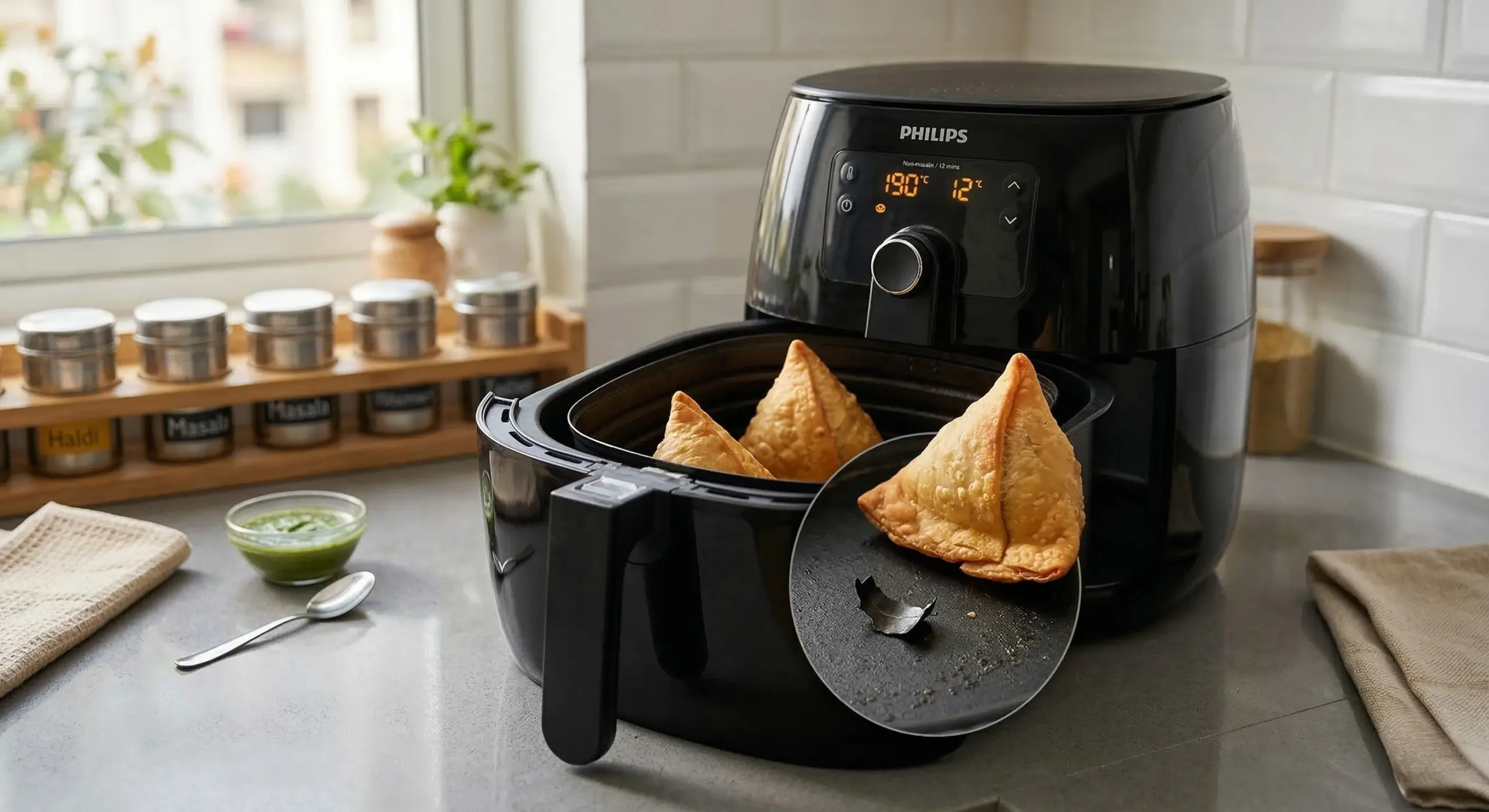
You pull the basket out of your Pigeon Healthifry after a batch of crispy samosas and there it is. A dark, peeling flake stuck to the crust. Your stomach drops. Did my family just eat Teflon?
This is one of the most anxiety-inducing moments for Indian air fryer users, and also one of the most misunderstood. The internet is flooded with alarm, half-truths, and marketing spin on both sides.
What is missing is a precise, science-backed answer grounded in the realities of the Indian kitchen: coastal humidity, hard water, voltage fluctuations, and acidic masala-heavy cooking. By the end of this guide, you will know whether your basket is still safe, when to stop using it, how to prevent it from happening again, and which brands hold up best in 2026.
What Is Air Fryer Non-Stick Coating Made Of?
The short answer: Polytetrafluoroethylene, globally recognised under Chemours’ commercial trademark Teflon, abbreviated as PTFE.
PTFE is a synthetic fluoropolymer built on a long chain of carbon atoms, each bonded to two fluorine atoms. The carbon-fluorine bond is one of the strongest in all of organic chemistry. That structural architecture gives PTFE three properties that make it valuable in a kitchen appliance:
- Extremely low coefficient of friction: Nothing bonds to its surface, which is why food slides off cleanly
- High thermal resistance: Chemically stable up to approximately 260 degrees Celsius under normal conditions
- Complete chemical inertness: Does not react with acids, fats, or alkalis under standard cooking temperatures
In a Philips NA120/00, a Pigeon Healthifry, or a Prestige Nutrifry, the aluminium basket is stamped, mechanically roughened through sandblasting, and then coated with a thin PTFE layer via spray application and high-temperature oven curing. When you weigh the advantages and disadvantages of air fryers, the PTFE coating is simultaneously the technology’s greatest convenience feature and its most mechanically vulnerable component.
The PFOA Concern: Why People Fear Teflon
Historically, PTFE was manufactured using Perfluorooctanoic acid (PFOA), a processing aid with demonstrated links to thyroid disorders, kidney disease, and carcinogenicity in epidemiological studies. This is where the genuine, justified public concern over Teflon originated, and it is a legitimate concern rooted in real science.
However, under regulatory pressure from the US Environmental Protection Agency and the European Chemicals Agency, major manufacturers globally phased out PFOA in manufacturing by 2013.
Every reputable air fryer sold in India today, including Philips, Pigeon, Prestige, and Agaro, uses strictly PFOA-free PTFE coatings. If your appliance was bought new from a legitimate Indian retailer after 2015, PFOA is not your concern. The material on your basket is PTFE, not PFOA. They are entirely different chemical entities with entirely different safety profiles.
Ceramic Coatings: The Alternative
Marketed as “toxin-free” and championed by brands like Ninja, ceramic coatings are the PTFE alternative. They are applied via a sol-gel process that creates a rigid, porous surface.
For Indian kitchens, ceramic has one critical structural weakness: turmeric staining. Curcumin, the active compound in haldi, is a highly lipophilic molecule. At air fryer temperatures, it liquefies and permanently penetrates the rigid ceramic micro-pores. Think of it like ink soaking into unglazed terracotta, once it is in, it does not come out.
PTFE’s ultra-low surface energy repels curcumin entirely. This is why PTFE-based coatings continue to dominate Indian-market air fryers despite the ceramic marketing push.
Why Does Air Fryer Non-Stick Coating Start Peeling?
Understanding the cause of peeling is not academic. It determines whether your usage habits are actively accelerating a problem that could have been prevented from day one.
Mechanical Abrasion: The Number-One Cause
Every time a metal spatula, steel tongs, or a wire brush makes contact with the basket, it creates micro-tears in the PTFE polymer matrix. At the microscopic level, these tears are invisible at first. Think of it like tiny cracks in a road surface, invisible to the naked eye until the season changes and they widen.
With each heating cycle, the aluminium substrate and the PTFE coating expand and contract at measurably different rates. These micro-tears act as stress fractures, propagating outward with each thermal cycle until they become the visible flaking you see today.
This mechanism explains the most common complaint from Indian air fryer users: “When I removed the burnt cheese, the Teflon peeled off the metal with the cheese.” The culprit is shear stress from differential thermal expansion between two bonded materials, not a manufacturing defect. It is physics, accelerated by metal tool usage.
If you are also seeing smoke alongside this peeling, the two problems share a common root in carbonised residue buildup. Our guide on why your air fryer is smoking covers the interaction in detail.
Thermal Shock: The Cold Water Mistake
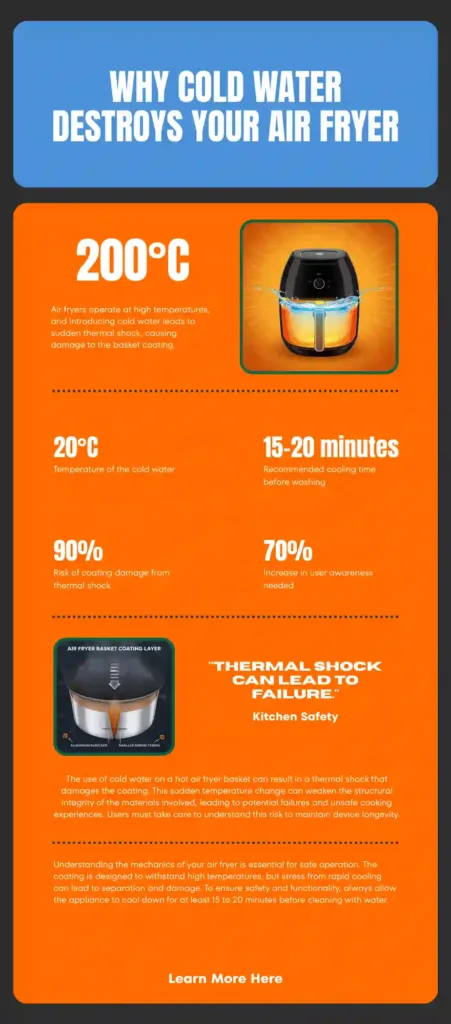
You have finished a batch of pakoras. The basket is at 200 degrees Celsius. You want to clean it quickly, so you run cold tap water directly onto it. This is the single fastest way to destroy your basket coating.
Here is the engineering reason in plain terms:
- Aluminium has a thermal expansion coefficient of approximately 23 micrometres per metre per degree Celsius
- PTFE’s coefficient is 112 to 125 micrometres per metre per degree Celsius, roughly five times higher
- When you force both materials to drop 170 degrees Celsius in seconds, the PTFE layer tries to shrink far faster than the aluminium beneath it
- This violent mismatch physically fractures the adhesive bond, resulting in large, sheet-like delamination
Think of it like peeling a sticker off a surface that has been warped by heat. The adhesive gives way all at once rather than gradually.
The rule is absolute: Allow the basket to cool to ambient room temperature, a minimum of 15 to 20 minutes, before any contact with water.
Coastal Humidity: Why Tamil Nadu and Mumbai Users See It Faster
For users in Chennai, Madurai, Kochi, Pondicherry, or coastal Maharashtra, your local environment is actively degrading the coating between every wash cycle, even when the appliance is sitting unused.
Ambient humidity regularly exceeds 85 percent, and atmospheric salinity introduces an electrolytic component to the moisture your basket is exposed to daily. In plain terms, the moist salty air acts like a very mild acid that seeps into any crack it can find.
This saline moisture penetrates through microscopic scratches in the PTFE surface. During subsequent cooking, that trapped moisture converts to steam and expands, a process called sub-surface delamination. Think of it like water getting under a phone screen protector and slowly pushing it off from the inside.
This is not a manufacturing quality issue. It is a materials science interaction with the operating environment. It explains why used air fryer resale listings on OLX in Madurai and Chennai show disproportionately high turnover compared to Delhi listings. Peeling-driven early replacement is a measurable real-world signal in humid coastal zones.
If your Pigeon model is experiencing other issues alongside coating degradation, check whether the Pigeon air fryer is not turning on, as moisture ingress through a compromised housing can affect electrical contacts simultaneously.
Voltage Fluctuations: The Hidden Accelerant
In rural Tamil Nadu, hill stations, and older urban distribution grids, voltage surges cause the heating element to temporarily overshoot its rated temperature. These micro-spikes thermally stress the coating from the inside out, accelerating bond fatigue between the PTFE layer and the aluminium substrate over hundreds of cooking cycles.
This is the same grid instability that causes PCB failure in digital air fryers. A voltage stabiliser rated for 2,000W or above, installed upstream of your air fryer, is a worthwhile investment in any unstable grid zone. Our air fryer error codes guide documents the full range of failure modes triggered by Indian grid instability.
Is It Safe to Keep Using a Peeling Air Fryer?
Direct Answer: Minor scratches with no visible bare metal, yes, continue with care. Active, large-scale flaking with visible aluminium, stop immediately and replace the basket.
The reasoning behind this two-tier verdict is grounded in three distinct scientific concerns that must be evaluated separately.
PTFE Flake Ingestion: Is It Toxic?
This is the fear that sends most people to search at midnight. The scientific consensus is clear: PTFE is entirely biologically inert. The carbon-fluorine bonds that give it non-stick properties also make it completely resistant to digestion, absorption, and metabolic incorporation.
If a visible flake of peeling PTFE from your Philips or Pigeon basket lands in your samosa and is consumed, it passes through the human gastrointestinal tract completely unchanged. Think of it like swallowing a tiny piece of wax paper. Your body has no mechanism to break it down, so it simply passes through.
The US Food and Drug Administration confirms PTFE is an acceptable material for food-contact applications and poses no acute toxicological risk upon ingestion under normal conditions. [1] The material peeling off your basket will not poison your family.
The Real Danger: Thermal Pyrolysis at 260 Degrees Celsius
The genuine hazard of PTFE is not ingestion-based. It is fume-based, and it occurs only at temperatures above 260 degrees Celsius through a chemical process called thermal pyrolysis, where molecular bonds break down under extreme heat.
When PTFE is heated beyond this threshold, it releases toxic fluoropolymer degradation products. Inhaling these fumes causes a severe, temporary flu-like illness in humans known as Polymer Fume Fever, colloquially called “Teflon flu”. In birds, these same fumes are nearly instantly fatal due to the extreme sensitivity of avian respiratory systems.
Here is the critical engineering point that most articles miss: commercial air fryers are thermostatically hard-capped at 200 degrees Celsius. The maximum temperature setting on a Philips NA120/00, a Pigeon Healthifry, or an Agaro Imperial is 200 degrees, a full 60 degrees below the pyrolysis threshold. Under normal functional operation, the PTFE in your basket physically cannot reach the temperature at which it becomes dangerous. You cannot get polymer fume fever from a basket that is merely peeling.
The Microplastics Caveat: What 2022 Research Found
This is where the safety picture becomes more nuanced, and intellectual honesty requires acknowledging it directly.
Research using advanced Raman spectroscopy imaging, published in 2022, demonstrated that heavily scratched and actively peeling PTFE surfaces can release millions of micro- and nanoplastic particles per cooking session into the food matrix. [2] These particles are orders of magnitude smaller than the visible flakes discussed above.
What makes this scientifically significant is not acute toxicity. It is the unknown long-term picture. The epidemiological consequences of chronic nanoplastic accumulation in human tissue are currently under intensive scientific investigation globally. No definitive verdict has been issued.
The precautionary principle argues clearly against continuing to cook with a basket that is actively shedding its coating in quantity. Minor scratches mean negligible nanoplastic release. Active delamination means measurable release with an unknown long-term effect on the human body.
Aluminium Leaching: The Indian Kitchen-Specific Problem
When the PTFE barrier is breached, the raw aluminium substrate is fully exposed, and aluminium is highly reactive in acidic environments. Indian cooking is built on acidity.
Consider what this means in practice for a typical Indian kitchen:
- Tamarind-based sambar and rasam gravies
- Lemon and lime juice in marinades for chicken tikka and seekh kebabs
- Tomato-heavy curries and gravies
- Yoghurt-based marinades for tandoori preparations
- Vinegar in pickled vegetable sides
All of these create a low-pH environment that accelerates the leaching of aluminium salts into food, producing a distinct metallic off-taste and contributing to dietary aluminium intake. In an Indian kitchen, acidic ingredients are the backbone of the cuisine. Exposed aluminium in an air fryer basket is a practical, daily food-safety concern, not a theoretical one.
The Engineering Verdict: A Two-Tier Safety Rule
| Basket Condition | Safety Status | Recommended Action |
|---|---|---|
| Hairline scratches, uniform coating, no bare metal visible | Safe | Continue use, enforce prevention rules |
| Visible flaking, bubbling, or bare silver/grey metal exposed | Replace immediately | Stop use, order OEM basket |
| Coating cracking near rivets or basket edge joints | Replace immediately | Structural stress zone, highest leaching risk |
| Persistent metallic taste in food | Replace immediately | Leaching is already occurring |
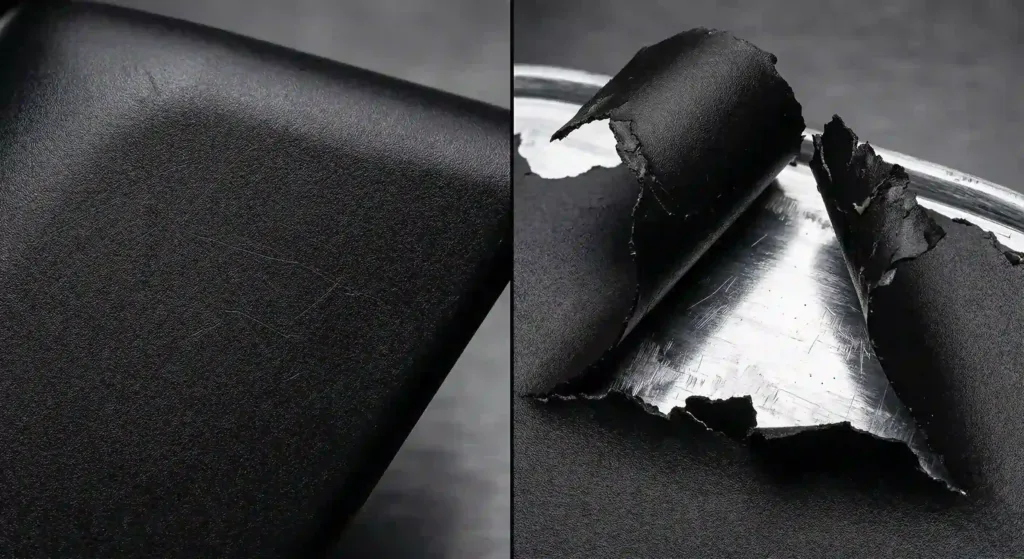
Signs Your Air Fryer Basket Needs Immediate Replacement
Do not wait until bare aluminium is obvious under direct light. These six signals indicate that basket replacement is no longer optional:
- Large, sheet-like flaking: Distinguishable from hairline scratches by the size and thickness of detached material
- Visible bare aluminium: Silver or grey metal visible beneath the coating layer
- Bubbling or blistering: Coating surface showing raised areas during or after the cooking cycle
- Persistent metallic taste: A flavour in food that cannot be attributed to any ingredient in the recipe
- Dark residue in food: Coating particles visibly contaminating the food matrix during cooking
- Cracking at structural joints: Near rivets, basket rim, or handle attachment points where mechanical stress concentrates highest
If two or more of these conditions are present simultaneously, basket replacement is a food-safety requirement, not a preference.
What to Do When Non-Stick Coating Comes Off an Air Fryer
Step 1: Diagnose the Severity Accurately
Apply the two-tier rule. Run a finger lightly across the basket surface. Hairline scratches produce a faint texture variation but no loose edges. Active delamination produces perceptible raised edges where coating is separating from metal.
Hold the basket at a 45-degree angle under a bright light source. Bare aluminium reflects light with a distinctly different quality from PTFE’s matte surface finish. This visual test takes ten seconds and gives you a clear answer.
Step 2: Source an OEM Replacement Basket
A replacement basket is the correct economic decision for any appliance under 36 months old and in otherwise functional condition.
Current Replacement Basket Costs (2026):
| Model | Basket Replacement Cost |
|---|---|
| Philips NA120/00 | Rs. 800 to Rs. 1,200 |
| Pigeon Healthifry 4.2L | Rs. 500 to Rs. 800 |
| Agaro Imperial / Regal variants | Rs. 900 to Rs. 1,400 |
In Tamil Nadu, authorised Philips and Pigeon service centres are listed on Justdial in both Chennai and Madurai. Search “Shri Meenatchi Electronics Madurai” for Pigeon servicing. These centres supply genuine replacement baskets and verify compatible part numbers for your specific model.
On DIY re-coating: PTFE re-coating sprays are commercially available but are categorically not recommended for food-contact surfaces. Food-grade PTFE application requires industrial spray booths, controlled curing temperatures, and calibrated coating thickness, none of which can be replicated at home. Always purchase an OEM basket. Think of it like trying to re-vulcanise a tyre in your garage with a can of rubber spray. The chemistry simply does not translate to a home setting.
For current market pricing to benchmark whether basket replacement is economical against a new unit purchase, our air fryer price guide for India provides the full 2026 market comparison. If you are considering an upgrade, our top 5 air fryers in India analysis covers which models hold up best technically.
Step 3: Interim Safe Cooking While Awaiting Replacement
If you need to continue using the appliance for a few days while the replacement basket is in transit, follow these interim rules:
- Line the basket with unperforated baking parchment, not aluminium foil, as foil restricts convective airflow and creates uneven heating zones
- Eliminate all acidic foods completely during this period: no tomato-based dishes, tamarind, lemon marinades, or yoghurt-heavy recipes
- Restrict cooking to dry, pH-neutral foods: papad, dry bread snacks, and plain corn, as these minimise chemical interaction with any exposed aluminium
How to Prevent Air Fryer Non-Stick Coating From Peeling
Prevention is measurably cheaper than replacement. These six engineering-backed rules, applied consistently, extend basket lifespan by two to three times compared to uninformed use.
Rule 1: Silicone and Bamboo Tools Only, Zero Metal Contact
Metal tongs, spatulas, and wire racks are the primary initiators of micro-tear propagation. This rule is non-negotiable. Switch to food-grade silicone-tipped tongs and bamboo spatulas for all basket interactions: loading food, flipping mid-cycle, and removing food after cooking.
Note that even the serrated ends of bamboo skewers can abrade PTFE at 200 degrees Celsius. Use rounded silicone instruments for any contact with the basket surface.
For correct loading technique and food spacing that avoids unnecessary basket contact, our guide on using an air fryer for perfect results provides the foundational method.
Rule 2: Eliminate Thermal Shock Entirely
Allow the basket to cool to ambient room temperature before any water contact. A minimum of 15 to 20 minutes after the cooking cycle ends is the required waiting period. Never pour cold water into a hot basket. Never run the basket under a cold tap while still warm.
The PTFE-aluminium differential thermal expansion makes rapid temperature drops the single most destructive event in the coating’s service life. One impatient wash can do more damage than a year of careful cooking.
Rule 3: The Heat-Dry Technique for Coastal Tamil Nadu
This is the most important region-specific maintenance protocol for users in Chennai, Madurai, Pondicherry, Kochi, and coastal Maharashtra. After washing and hand-drying the basket with a soft cloth, follow this three-step sequence:
- Replace the basket in the appliance
- Run the empty air fryer at 200 degrees Celsius for 3 minutes
- Allow to cool fully before storing
This three-minute cycle evaporates all residual moisture from the basket surface, the crevices of the Starfish base on Philips models, the mesh openings, and the retaining screw heads. It halts galvanic corrosion at the metal fasteners and prevents saline moisture from migrating beneath micro-scratches during the hours the appliance sits unused between cooking sessions.
In Chennai’s 85-plus percent ambient humidity environment, this step is the measurable difference between a basket lasting 18 months versus 36-plus months.
Rule 4: Maintain 15 to 20 cm Rear Clearance at All Times
When an air fryer is pushed flush against a kitchen wall, the exhaust vent is partially or fully blocked. Internal chamber temperature then overshoots the thermostat’s calibrated target, and the basket experiences sustained thermal stress beyond its designed operating parameters.
This is also the primary cause of the burning plastic smell and mid-cycle thermal shutdown that users report. Our air fryer smoking causes and fixes guide covers this failure mode in detail.
Maintain minimum 15 cm rear clearance at all times. In humid Tamil Nadu kitchens, increase this to 20 cm to assist moisture dissipation from the exhaust airstream.
Rule 5: Gentle Cleaning Protocol Only
The correct cleaning method is warm water, one drop of mild dish soap, and a soft sponge or microfibre cloth. Nothing else.
Strictly avoid:
- Baking soda paste: A mild abrasive that initiates surface micro-scratching over repeated use
- Steel wool or abrasive scourers: Immediately catastrophic to the PTFE surface
- Scotch-Brite pads: Same abrasive damage profile as steel wool
- Dishwasher cycles: High-temperature pressurised water jets degrade the thermal bonding adhesive over time, even on models labelled dishwasher-safe
Rule 6: Always Preheat Before Introducing Food
Preheating reduces mechanical and thermal stress on the coating during cooking. When cold, dense food is placed into a cold basket, both must heat together through a prolonged low-temperature phase. This extended mid-range exposure is thermally harder on the coating adhesive than the short, high-intensity cooking environment of a properly preheated chamber.
Preheating also carries a direct health benefit discussed in the next section. Our analysis on why preheating is necessary and the complete step-by-step preheating guide explain the thermodynamic rationale in full.
Prevention rules at a glance:
| Rule | Action | Why It Matters |
|---|---|---|
| Tool discipline | Silicone and bamboo only | Prevents micro-tear initiation |
| No thermal shock | Cool 15 to 20 min before washing | Prevents catastrophic delamination |
| Heat-Dry Technique | 200C empty run for 3 min post-wash | Critical for coastal humidity zones |
| Clearance | 15 to 20 cm rear space | Prevents temperature overshoot |
| Cleaning method | Soft sponge, mild soap only | Prevents abrasive surface damage |
| Preheat always | Heat to temp before adding food | Reduces coating thermal fatigue |
Air Fryer Coating and Cancer: What the Science Actually Says
The search query “air fryer coating cancer” reflects a legitimate concern that deserves a rigorous, evidence-based response. Not reassurance, not alarm, but precision. There are three distinct concerns embedded in this query, and they require three separate answers.
Concern 1: PTFE Itself Is Not a Carcinogen
Ingested PTFE has not been classified as carcinogenic by any major regulatory body including the US FDA, the European Food Safety Authority, the World Health Organisation, or the International Agency for Research on Cancer.
The FDA maintains explicitly that PTFE is an acceptable material for food-contact surfaces under normal use conditions. [1] The coating material flaking from your basket, when ingested, does not cause cancer. This is not industry assurance. It is the scientific and regulatory consensus based on the material’s demonstrated chemical inertness in biological systems.
Concern 2: PFOA Was a Carcinogen and Is Now Eliminated
PFOA, the manufacturing chemical historically used to produce PTFE, is classified as a Group 2B probable carcinogen by IARC. It remains a persistent environmental contaminant with documented health impacts. This is where the Teflon cancer concern legitimately came from, and dismissing that history would be dishonest.
However, the Indian appliance market has been PFOA-free since approximately 2015 following global phase-outs. Every Philips, Pigeon, Prestige, and Agaro unit sold in India today carries PFOA-free PTFE. Verify this by looking for explicit “PFOA-free” labelling when purchasing any new air fryer. All reputable manufacturers include this disclosure.
Concern 3: Acrylamide Is the Real Cancer-Adjacent Risk in Air Frying
The most under-discussed cancer-adjacent risk in air frying has nothing to do with the coating at all. It is acrylamide, a chemical compound that forms in starchy foods such as potatoes, wheat, and rice during prolonged exposure to temperatures above 120 degrees Celsius through a Maillard-pathway reaction.
The World Health Organisation and IARC classify acrylamide as a probable human carcinogen, Group 2A. [3] Acrylamide formation is dramatically increased when starchy food is subjected to a prolonged low-temperature warming phase, precisely what occurs in a cold-start air fryer.
Preheating the basket to 200 degrees Celsius before introducing raw potato or bread-based items creates immediate thermal shock at the food surface, searing the exterior rapidly and significantly reducing total acrylamide formation compared to a cold start.
The takeaway is clear. The coating does not cause cancer via ingestion. Cold-starting with starchy foods represents the measurable acrylamide risk, and preheating is the evidence-based mitigation.
Best Air Fryers in India That Do Not Peel Easily (2026)
Not all coatings are created equal. Coating durability is a function of three engineering variables:
- Coating thickness and adhesion quality during the manufacturing process
- Basket geometry and its creation of thermal stress concentration points
- The appliance’s thermal management design and how well it distributes heat evenly
| Model | Coating Type | Peeling Risk in Humid India | Socket Requirement | Price Range (Mar 2026) |
|---|---|---|---|---|
| Pigeon Healthifry 4.2L | PTFE flat-mesh | Low to Medium | 6A Safe | Rs. 2,399 to Rs. 4,995 |
| Prestige Nutrifry 4.5L | PTFE flat-mesh | Low to Medium | 6A Safe | Rs. 3,449 to Rs. 5,565 |
| Philips NA120/00 | PTFE Starfish exposed | Medium to High (coastal) | 16A Recommended | Rs. 4,550 to Rs. 5,995 |
| Agaro Imperial 9L | PTFE enclosed oven | Medium (hard water scale risk) | 16A Mandatory | Rs. 8,899 to Rs. 11,499 |
| Ninja AF101 3.7L | Ceramic crisper plate | Low (no peeling) but turmeric stains | 16A Recommended | Import Premium |
For Tamil Nadu and coastal users: The flat-mesh basket geometry of the Pigeon Healthifry and Prestige Nutrifry creates fewer thermal stress concentration points than the complex Philips Starfish design. Critically, both operate safely on a standard 6A Indian domestic socket, eliminating the Joule heating fire hazard that plagues high-wattage models on older Indian wiring. These two models represent the strongest coating durability-to-price ratio for humid coastal Indian conditions.
For maximum cooking performance: The Philips NA120/00 Starfish cyclonic design delivers measurably superior airflow dynamics and Maillard browning. In coastal zones, it is viable provided the Heat-Dry Technique is followed after every single wash cycle without exception.
What About Stainless Steel Air Fryers?
The growing search interest in stainless steel air fryers reflects a logical desire to eliminate coating-related concerns entirely. Fully stainless basket interiors achieve exactly this. There is no coating to scratch, delaminate, or degrade.
The trade-off is significant. Without a non-stick surface, food adheres aggressively, requiring baking parchment liners for every cooking session and negating much of the convenience advantage. Think of cooking dosas on an ungreased iron tawa versus a non-stick one. The physics of adhesion do not change simply because the appliance is different.
Stainless-interior air fryers are available in India at Rs. 8,000 and above. They are a viable choice for users who have made a deliberate decision to abandon non-stick surfaces entirely. For the majority of Indian households cooking oily, spiced, battered foods, a well-maintained PTFE basket remains the more practical daily-use solution.
For the complete specification-level buying decision, our air fryers buying guide for Indian kitchens and best air fryer for a small family in India provide the full engineering analysis.
Coating-Safe Recipes: Maximising Your Pigeon Air Fryer’s Lifespan
The way you cook determines how long your basket coating survives. Every technique choice, from oil application to tool selection to temperature setting, either extends or shortens your basket’s useful life. These recipes are optimised for both flavour outcome and coating longevity.
How to Make Crispy Samosas Without Damaging the Basket
The samosa is the benchmark snack for Indian air fryer performance, and it is coating-friendly when executed with the correct technique.
Engineering the batch correctly:
- Floor space matters more than volume. Each samosa requires a minimum 6 cm x 6 cm effective floor footprint, the samosa’s physical 5 x 5 cm base plus 1 cm convective clearance on all sides for forced airflow to circulate around the surface
- A 4.2L Pigeon Healthifry basket accommodates 9 samosas per batch maximum. Do not exceed this count as overcrowding traps steam, forces longer cooking at lower effective temperatures, and creates localised hot spots that stress the coating
- Apply oil via a mist spray bottle on the samosas themselves, not brushed directly onto the basket. Pooled oil polymerises at 200 degrees Celsius and bonds carbonised residue to the PTFE surface like cement
- Silicone tongs only for the halfway flip. No metal contact whatsoever
- Cook at 200 degrees Celsius for 12 to 15 minutes, single flip at 7 minutes
If your samosas are emerging soggy rather than crisp, the issue is moisture management physics rather than coating quality. Our guide to fixing soggy air fryer results explains the thermodynamic cause precisely.
Air Fryer Chicken Tikka: The Marinade Warning for Basket Safety
Chicken tikka is the most popular Indian air fryer protein recipe, and a coating safety consideration exists that is specific to this recipe: acidic marinades.
A standard tikka marinade contains hung curd, lemon juice, and red chilli, all of which introduce acidity to the basket surface during the cooking cycle. For a basket in good condition with intact PTFE, this is managed adequately. For a basket with visible scratches, lemon-heavy marinade in contact with micro-exposed aluminium begins the leaching process immediately.
Safe technique for any basket condition:
- Before placing marinated pieces in the basket, lightly wipe the underside and outer surfaces of the chicken with a paper towel
- This removes the bulk of the surface marinade that would directly contact the basket floor, without affecting the flavour-developing crust on the exposed upper surfaces
- Temperature and time: 200 degrees Celsius for 18 to 20 minutes, flip once at 10 minutes
- For visible coating wear: line the basket with perforated parchment paper before loading
Healthy Vegetarian Snacks: The Most Coating-Friendly Options
Paneer tikka at 180 degrees Celsius for 10 minutes is the most coating-gentle protein recipe in the Indian air fryer repertoire. The lower operating temperature reduces cumulative thermal cycling stress on the coating adhesive, and paneer’s relatively neutral pH eliminates the aluminium-leaching concern even through minor surface scratches.
Roasted papad is the coating-protective ideal: no oil, no direct pressure, minimal basket contact. Our dedicated how to roast papad in an air fryer guide provides the precise technique.
Corn on the cob requires no oil, no marinade, and minimal basket interaction. Line with perforated parchment for complete coating protection. This is genuinely the most basket-friendly recipe you can run, with neutral pH, zero fat polymerisation, and no scraping required on removal.
For the complete technique foundation across all recipe types, our beginner’s guide to using an air fryer correctly covers loading method, spacing, and handling from the ground up.
Replace the Basket or Buy a New Air Fryer? The ROI Calculation
Before spending money, run the numbers. Emotional decisions in appliance replacement are expensive decisions.
Basket Replacement vs. New Unit Cost (March 2026)
| Decision | Pigeon Healthifry | Philips NA120/00 |
|---|---|---|
| OEM basket replacement | Rs. 500 to Rs. 800 | Rs. 800 to Rs. 1,200 |
| New unit (full appliance) | Rs. 2,399 to Rs. 4,995 | Rs. 4,550 to Rs. 5,995 |
| Basket as percentage of new unit | 20 to 27 percent | 17 to 24 percent |
The economic logic is direct. If the motor, heating element, and electrical components are functional, a basket replacement recovers a working appliance at approximately 20 percent of the replacement cost. For any appliance under 36 months old with no other fault, basket replacement is the correct decision.
The Monthly Oil Savings ROI
As of March 2026, 1 litre of Sunpure Refined Sunflower Oil retails at Rs. 161.50 on Amazon India and BigBasket. A moderate Indian household conserving 250 ml per session through air frying versus deep frying, cooking three times per week:
| Metric | Value |
|---|---|
| Weekly oil savings value | Rs. 40.38 |
| Electricity cost per session (Pigeon 1200W, 15 min, TNEB tariff Rs. 8/unit) | Rs. 2.40 |
| Net weekly savings across 3 sessions | Approx. Rs. 33.30 |
| Net monthly savings | Rs. 133 to Rs. 145 |
| Replacement basket payback period (Rs. 700 basket) | Under 6 weeks |
| New Pigeon Healthifry payback period (Rs. 2,899) | 20 to 22 months |
The replacement decision rule:
- Basket damaged, appliance functional and under 3 years old: replace the basket
- Appliance over 3 years old with multiple faults: evaluate a new unit purchase
- Digital display malfunctioning alongside peeling: diagnose whether the display fault is independently repairable via our air fryer touch screen troubleshooting guide before writing off the entire appliance
For the full appliance economics including LPG displacement cost, our air fryer versus deep fryer analysis provides the comprehensive total cost of ownership comparison.
Frequently Asked Questions
Is it safe to use a peeling air fryer?
Minor surface scratches on a Philips, Pigeon, or Agaro basket are safe for continued use. PTFE is biologically inert and passes through the body without being absorbed or metabolised. However, if large sections of coating are actively flaking and exposing bare aluminium, stop using the basket immediately. Exposed aluminium leaches metallic salts into acidic Indian foods, and heavily compromised coatings release nanoplastics whose long-term epidemiological effects are under active scientific investigation.
What to do when non-stick coating comes off an air fryer?
First, assess the damage. Hairline scratches require more careful handling, not immediate replacement. Visible large flaking with exposed silver metal requires immediate basket replacement. Purchase an OEM replacement basket for your specific model, available for Rs. 500 to Rs. 1,200 on Amazon India and Flipkart. As an interim measure, line the basket with unperforated baking parchment and avoid all acidic food items until the new basket arrives.
Is it safe to eat from a nonstick basket that is peeling?
A small PTFE flake ingested accidentally causes no acute harm. The material passes through the body completely unchanged. The genuine concern with active large-scale peeling is twofold: nanoplastic release from heavily degraded coatings whose long-term effects are under investigation, and aluminium leaching from exposed substrate into acidic foods. All current Indian-market air fryers use PFOA-free PTFE, so the historical carcinogen concern from that manufacturing chemical does not apply to any appliance bought in India after 2015.
பீலிங் ஏர் பிரையர் பயன்படுத்துவது பாதுகாப்பானதா? (Is it safe to use a peeling air fryer?)
சிறிய கீறல்கள் மட்டுமே இருந்தால் Pigeon அல்லது Philips ஏர் பிரையர் தொடர்ந்து பயன்படுத்தலாம். PTFE ஒரு inert பொருள், உடல் அதை உறிஞ்சாது. ஆனால் பெரிய அளவில் coating உரிந்து aluminium வெளிப்பட்டால் உடனே பயன்பாட்டை நிறுத்தி basket மாற்றவும். Chennai, Madurai போன்ற கடலோர பகுதிகளில் ஈரப்பதம் காரணமாக peeling வேகமாக நிகழும். கழுவிய பிறகு Heat-Dry Technique, அதாவது 200 டிகிரியில் 3 நிமிடம் காலி ஓட்டம், பயன்படுத்துவது கட்டாயம்.
ஏர் பிரையரில் நான்ஸ்டிக் பூச்சு வெளியேறினால் என்ன செய்வது? (What to do when non-stick coating comes off an air fryer?)
முதலில் சேதத்தின் அளவை மதிப்பிடவும். சிறிய கீறல்கள் இருந்தால் silicone கருவிகளை மட்டும் பயன்படுத்தி தொடரலாம். பெரிய அளவில் உரிந்தால் OEM replacement basket, Rs. 500 to Rs. 1,200, வாங்கி மாற்றவும். Chennai மற்றும் Madurai-ல் Justdial மூலம் Philips மற்றும் Pigeon authorised service centres கண்டுபிடிக்கலாம். இடைப்பட்ட காலத்தில் perforated parchment பயன்படுத்தி புளிப்பான உணவுகளை தவிர்க்கவும்.
How do I fix air fryer non-stick coating peeling?
There is no safe DIY repair for a peeling air fryer basket. PTFE re-coating sprays available online require industrial application processes, including controlled spray environments and curing ovens, that cannot be replicated at home on a food-contact surface. The correct solution is an OEM replacement basket. To prevent recurrence, use only silicone tools, never cold-shock the basket, and follow the Heat-Dry Technique after every wash if you live in a coastal humid region.
Does the Ninja air fryer have non-stick coating peeling problems?
The Ninja AF101 uses a ceramic-coated crisper plate rather than standard PTFE, which eliminates classic Teflon delamination. However, ceramic coatings are rigid and brittle. They crack under thermal shock and are permanently stained by turmeric within weeks of Indian cooking. The Ninja is available in India at a significant import premium and requires 16A socket installation. For most Indian households, PTFE-based models from Pigeon or Prestige offer better practical coating durability at substantially lower cost.
What is the best air fryer in India that does not peel easily?
For humid coastal regions including Tamil Nadu, Kerala, and Maharashtra, the Pigeon Healthifry 4.2L and Prestige Nutrifry 4.5L offer the strongest coating durability. Their flat-mesh geometry creates fewer thermal stress concentration points and both operate on a standard 6A Indian domestic socket. For users who want to eliminate coating concerns entirely, fully stainless-interior models are available at Rs. 8,000-plus but require parchment liners for every session.
Where can I buy a replacement air fryer basket in India in 2026?
OEM replacement baskets for Philips, Pigeon, and Agaro are available on Amazon India and Flipkart. Search your brand name followed by “air fryer replacement basket 2026” with your specific model number for compatible results. Philips authorised service centres in Tamil Nadu are listed on Justdial. Avoid third-party universal baskets as they typically use lower-grade PTFE compounds and rarely fit precisely, creating hotspot temperature distribution issues that stress the new coating prematurely.
Conclusion
Air fryer non stick coating peeling is not a crisis. It is a predictable materials science outcome with a calibrated, evidence-based response.
The critical distinction is between two very different situations. Minor surface wear is safe and manageable with adjusted habits. Active delamination exposing bare aluminium requires immediate basket replacement. Getting this distinction right is what separates a measured, proportionate response from unnecessary panic or dangerous complacency.
The six prevention rules documented in this guide are not manufacturer boilerplate. They are engineering responses to the specific failure mechanisms that destroy PTFE coatings in Indian kitchens: coastal humidity, hard water, acidic masala cooking, voltage instability, and the universal tendency to reach for metal tongs. Apply them consistently, and a basket that might last 18 months under uninformed use will reliably reach 36 to 48 months of service.
When the time comes to replace, whether the basket alone or the full appliance, make that decision with complete ROI data, not anxiety. Your air fryer is not a liability. Managed correctly, it remains one of the most economically efficient cooking tools available to the Indian household.
For everything you need to understand, buy, use, and maintain your air fryer, from first principles to advanced troubleshooting, OurKitchen.in is your complete technical reference for the Indian kitchen.
References
[1] U.S. Food and Drug Administration. Nonstick Cookware and PFAS. U.S. Department of Health and Human Services. www.fda.gov/food/chemicals-metals-pesticides-food
[2] Environmental Science and Technology, 2022. Nanoplastics and Microplastics Released from Polytetrafluoroethylene (PTFE)-Based Cookware under High Heat Conditions: Characterisation via Raman Spectroscopy. American Chemical Society.
[3] World Health Organization. Acrylamide in Food: Questions and Answers. WHO Food Safety Unit. www.who.int/news-room/questions-and-answers/item/acrylamide
About the Author
Prathap, Founder of OurKitchen.in
Prathap is the founder of OurKitchen.in and a dedicated kitchen appliance specialist with a deep focus on the engineering realities of the Indian domestic cooking context. Combining technical precision with hyper-local relevance, he builds content that bridges the gap between manufacturer specification sheets and the actual daily demands of Indian kitchens, from the coastal humidity challenges of Tamil Nadu to the electrical infrastructure constraints of older urban grids.
His work is grounded in verified data, regional specificity, and an unwavering commitment to cutting through marketing noise with science-backed, actionable guidance.
Read more about Prathap and OurKitchen.in

Prathap is the founder of ourkitchen.in and a B.Tech graduate in Agricultural Engineering from Tamil Nadu. His engineering background in thermodynamics, heat transfer, and food processing science gives him a fundamentally different approach to kitchen appliance reviews compared to typical lifestyle bloggers.
Rather than relying on manufacturer claims, Prathap measures actual power draw against rated wattage, evaluates basket airflow geometry, and stress-tests non-stick coatings over 90-plus cook cycles before recommending any product. He cross-checks every safety claim against BIS and FSSAI standards, and all pricing against live Amazon India and Flipkart listings.
He has written over 61 deep-dive articles on air fryers for the Indian market, personally testing models from Philips, Pigeon, Agaro, Kenstar, Havells, and Bajaj. His reviews are built around Indian realities: 220V power grids, high-humidity coastal kitchens, Indian cooking temperatures, and the price-performance expectations of Indian households.
Based in Chennai, Tamil Nadu.