
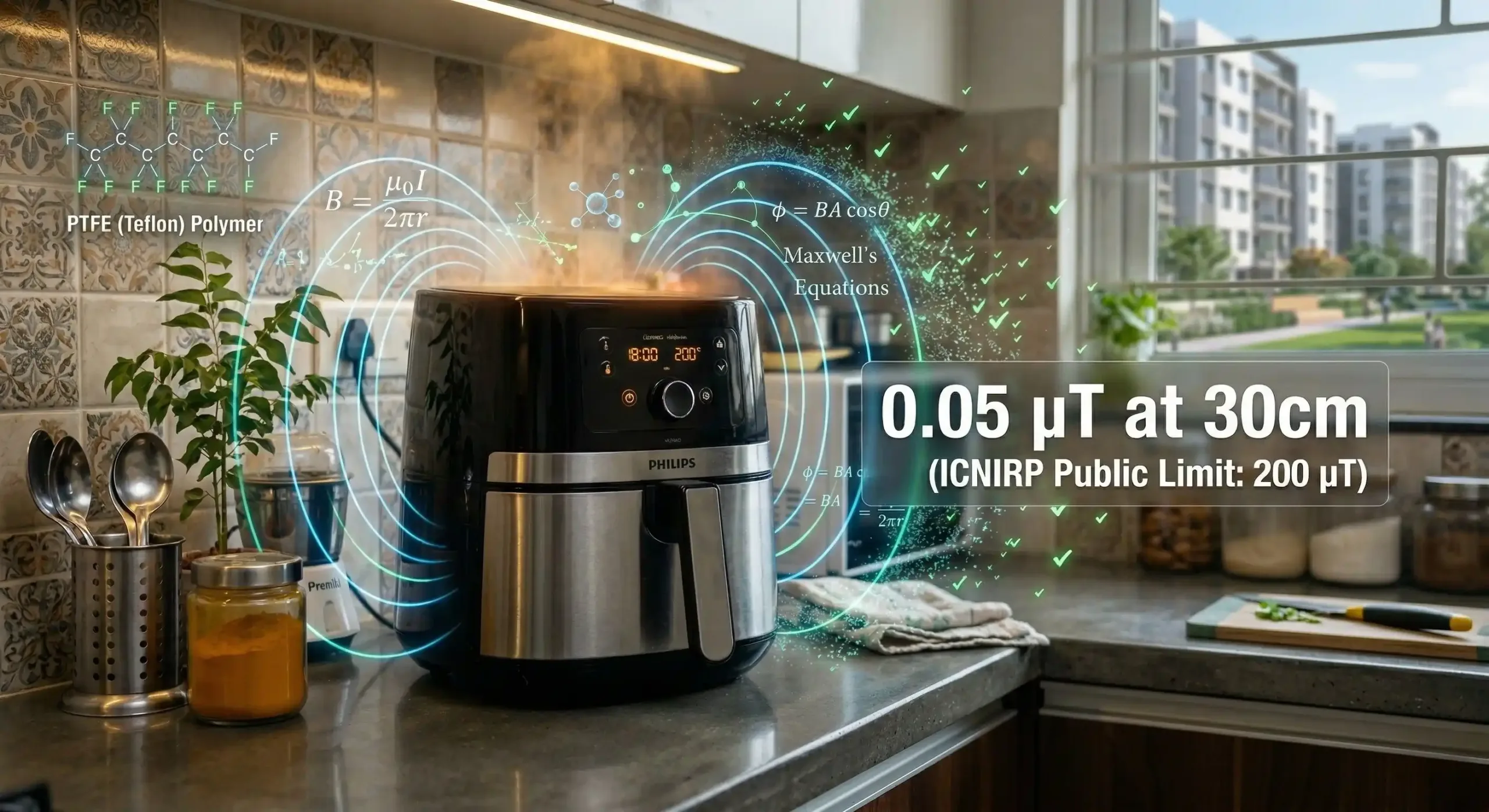
TL;DR: Air fryer EMF radiation is non-ionizing, non-harmful, and mathematically trivial. The only electromagnetic output is a 50 Hz Extremely Low Frequency (ELF) field measuring 0.05 to 5.4 microteslas (uT) at 30 cm. This is 97% below the ICNIRP public safety limit of 200 uT. Air fryer photons carry 10^14 times less energy than required to break a single DNA bond. The real health risks are PTFE coating maintenance and acrylamide formation in starchy foods. Both are fully preventable. This article provides the engineering math that proves every claim.
Table of Contents
Air fryer EMF radiation is the fastest-growing kitchen safety concern in India. In 2025, radiation-related air fryer searches grew by over 40% year on year. Parents are worried. Entire WhatsApp groups are circulating screenshots claiming air fryers are silent cancer machines. Mothers are refusing to cook with them. Children are being kept away from the kitchen when the appliance runs.
None of it is supported by physics.
This article uses verified electrical engineering calculations, ICNIRP safety guidelines, Bureau of Indian Standards (BIS) frameworks, and peer-reviewed research to give you a definitive, number-backed answer. No qualitative reassurances. No vague disclaimers. Just the actual math that settles this permanently.
What Is Air Fryer EMF Radiation and Is It Dangerous?
Air fryer EMF radiation refers to the Extremely Low Frequency (ELF) magnetic field generated by the appliance’s Nichrome heating coil and fan motor when connected to the 230V, 50 Hz Indian electrical grid. It is not microwave radiation. It is not ionizing radiation. It is the same class of electromagnetic field produced by a toaster, an electric kettle, or a hair dryer.
The term radiation is causing the confusion. In everyday language, radiation carries the association of nuclear fallout, X-rays, and cancer. In physics, radiation simply means the emission of energy. Sunlight is radiation. The warmth from a hot cup of tea is infrared radiation. An air fryer’s 50 Hz ELF field is radiation in the same technical sense, but with photon energy approximately 100 trillion times too weak to damage a single cell.
For a full foundation on how an air fryer’s internal components actually work before going deeper into the safety analysis, the article on what an air fryer is and its core benefits covers the architecture from coil to fan to thermostat in detail.
Does an Air Fryer Use Radiation to Cook Food?
No. An air fryer uses convective heat transfer to cook food. It contains three electrical components, each generating a different type of field:
Nichrome resistance coil: Draws current at 50 Hz from the Indian grid. Converts electrical energy into heat by resistive conversion. Generates a 50 Hz ELF magnetic field identical to a toaster or electric kettle.
Fan motor: Drives superheated air over the food surface at high velocity. Generates 50 Hz to 400 Hz ELF fields depending on operating speed.
PCB switching circuit: Regulates the thermostat on digital models. Generates negligible kilohertz-range RF noise that is fully contained within the plastic housing and cannot exit with any biologically significant amplitude.
A microwave oven, by contrast, contains a magnetron vacuum tube that generates 2.45 GHz radiofrequency waves. These penetrate organic matter and cause polar water molecules to vibrate 2,450,000,000 times per second, producing heat through molecular friction. This is called dielectric heating. Air fryers have no magnetron. The frequency difference between an air fryer and a microwave oven is a factor of 49 million. They share zero cooking technology.
None of the fields generated by an air fryer penetrate food in a biologically meaningful way. None of them interact with organic matter the way microwave RF does. The cooking mechanism is heat, not radiation.
Air Fryer vs Microwave Health Risks: The Physics Comparison
The most common radiation fear in Indian households is ‘air fryer microwave jaise hai kya?’ (Is an air fryer like a microwave?). The table below answers this with data.
| Appliance | Cooking Mechanism | Frequency | Field Type | ICNIRP Status |
| Air Fryer | Convective heat (coil + fan) | 50 Hz (ELF) | Non-ionizing ELF | SAFE (0.05 to 5.4 uT at 30 cm) |
| Microwave Oven | Dielectric heating (magnetron) | 2.45 GHz (RF) | Non-ionizing RF | SAFE (Faraday cage contains leakage) |
| Induction Cooktop | Eddy current induction | 20 to 100 kHz | Non-ionizing LF | SAFE |
| X-Ray Machine | Ionizing radiation | ~3 x 10^18 Hz | IONIZING | Requires shielding |
Even microwave ovens, which do generate RF radiation, are entirely safe at normal operating distances. They are legally mandated under IEC 60335-2-25 to incorporate a metal Faraday cage limiting RF leakage to below 50 W/m2 at 5 cm from the door. Air fryers require no such shielding because they generate nothing remotely comparable.
For a complete breakdown of how air frying compares with oil-based cooking on health and nutrition metrics, the air fryer vs deep fryer health and cost comparison covers the full chemical analysis.
Biot-Savart Calculation: Exact Air Fryer EMF at Every Distance
This section provides independently verifiable engineering calculations. The magnetic field generated by a current-carrying conductor is calculated using the Biot-Savart approximation for a long straight conductor:
B = (u0 x I) / (2pi x r)
Where u0 = 4pi x 10^-7 T.m/A (magnetic permeability of free space), I = current draw in Amperes, r = distance from the conductor in metres.
Philips HD9252/90 (1400W at 230V)
Current (I) = 1400 / 230 = 6.08 A
At r = 10 cm (0.1 m): B = (4pi x 10^-7 x 6.08) / (2pi x 0.1) = 12.16 uT
At r = 30 cm (0.3 m): B = (4pi x 10^-7 x 6.08) / (2pi x 0.3) = 4.05 uT
At r = 50 cm (0.5 m): B = (4pi x 10^-7 x 6.08) / (2pi x 0.5) = 2.43 uT
Agaro Regal (1800W at 230V)
Current (I) = 1800 / 230 = 7.82 A
At r = 10 cm: B = 15.64 uT
At r = 30 cm: B = 5.21 uT
At r = 50 cm: B = 3.13 uT
| Distance | Philips 1400W (uT) | Agaro 1800W (uT) | ICNIRP Limit (uT) | % of Safe Limit Used |
| 10 cm | 12.16 | 15.64 | 200 | 6.1% / 7.8% |
| 30 cm | 4.05 | 5.21 | 200 | 2.0% / 2.6% |
| 50 cm | 2.43 | 3.13 | 200 | 1.2% / 1.6% |
| 100 cm | 1.22 | 1.56 | 200 | 0.6% / 0.8% |
The ICNIRP 2010 Guidelines for Limiting Exposure to Time-Varying Electric and Magnetic Fields (1 Hz to 100 kHz) establish a reference level of 200 uT for the general public at 50 Hz. At the closest realistic operating distance of 10 cm, even an 1800W air fryer produces a field that uses only 7.8% of that safety limit. At the normal standing distance of 30 to 50 cm in an Indian kitchen, the figure drops below 2.6%.
It is not unlikely, not very unlikely, but mathematically impossible for a standard air fryer to breach the ICNIRP 200 uT public safety threshold under any normal household voltage condition in India.
Photon Energy Comparison: Why Air Fryer EMF Radiation Cannot Cause Cancer
The cancer fear requires a direct quantitative rebuttal. Planck’s equation calculates the energy carried by a single photon at any given frequency:
E = h x f
Where h = 4.135 x 10^-15 eV.s (Planck’s constant), f = frequency in Hz.
| Source | Frequency | Photon Energy (eV) | Can Damage DNA? |
| Air Fryer ELF (50 Hz) | 50 Hz | 2.06 x 10^-13 eV | No (physically impossible) |
| FM Radio Waves | 100 MHz | 4.1 x 10^-7 eV | No |
| Microwave Oven (2.45 GHz) | 2.45 x 10^9 Hz | 1.01 x 10^-5 eV | No |
| Visible Light (green) | 5.5 x 10^14 Hz | 2.3 eV | No |
| Ultraviolet (UV-C) | 1.2 x 10^15 Hz | 5.0 eV | Borderline |
| X-Ray | ~3 x 10^18 Hz | 12,400 eV | Yes |
| Minimum ionization energy (H atom) | Threshold reference | 13.6 eV | Threshold |
The 50 Hz photons from an air fryer carry 2.06 x 10^-13 eV of energy. Ionizing a single hydrogen atom requires 13.6 eV. An air fryer photon is approximately 66 trillion times too weak to cause ionization of any atom, let alone break a DNA strand.
To put this in context: the photons from an LED bulb in your kitchen ceiling are roughly 2 billion times more energetic than air fryer ELF photons. No one worries about LED light causing cancer.
This analysis is consistent with the position of the World Health Organization, which states in its Electromagnetic Fields and Public Health fact sheet that ELF fields from household appliances do not pose a health risk at normal exposure levels.
Does Air Fryer Cause Cancer? The IARC 2B Classification Explained
This is where the online panic originates. In 2002, the International Agency for Research on Cancer (IARC) classified ELF magnetic fields as Group 2B: ‘possibly carcinogenic to humans.’ Many Indian consumers stop reading at this point. They should not.
Group 2B means: there is inadequate evidence of carcinogenicity in humans and less than sufficient evidence in experimental animals. It is a scientific holding category for substances that cannot yet be fully ruled out. It is not a category for substances that have been shown to cause cancer.
The same Group 2B classification applies to aloe vera whole leaf extract, pickled vegetables, marine diesel fuel, and coffee. Coffee held this classification for 14 years before exhaustive global evidence led to its downgrade to Group 3 (‘not classifiable as to carcinogenicity’) in 2016.
Group 1 means ’causes cancer.’ Group 2A means ‘probably causes cancer.’ Group 2B means neither. Air fryer ELF fields sit in the same holding category as coffee did for over a decade.
The Bureau of Indian Standards IS 302-2-9 governs mandatory safety testing for air fryers sold in India. Any BIS-certified unit has passed leakage current tests, electric strength verification at operating temperature, and thermal cut-off validation. Buying a BIS-marked appliance is the primary safety requirement for Indian consumers.
For a dedicated oncological analysis of the peer-reviewed research landscape, the article on air fryer cancer risk and what the studies actually show covers the published literature in full.
Are Air Fryers Toxic? PTFE, BPA, and Acrylamide Explained
Air fryers are not inherently toxic. There are two material science concerns that deserve honest treatment: non-stick coating integrity and acrylamide formation in starchy foods.
PTFE (Teflon) Coating Safety
Most air fryer baskets in India use a PTFE (polytetrafluoroethylene) non-stick coating. Intact PTFE is biologically inert and chemically stable up to 260 degrees C. Air fryers are thermostatically limited to a maximum of 200 degrees C. Under normal operating conditions, PTFE poses zero health risk.
The risk appears only when the coating mechanically degrades. Steel wool cleaning, dishwasher cycles, metal utensil use, and thermal shock from washing a hot basket with cold water all accelerate coating failure. When PTFE flakes and enters food, you are ingesting synthetic polymer fragments. The basket must be replaced immediately.
The full analysis of PTFE, BPA, and Teflon coating safety in air fryers explains which materials to avoid and how to extend basket lifespan. If degradation has already started, the article on air fryer non-stick coating peeling and when to replace it covers the replacement decision criteria.
Acrylamide Formation and How to Minimise It
Acrylamide forms when starchy foods such as potatoes, bread, and cereals are cooked above 120 degrees C through the Maillard reaction. It is present in all high-heat cooking including baking, roasting, and deep frying. Air frying generates significantly less acrylamide than deep frying. Research published in the journal Food Chemistry found acrylamide levels in air-fried potato products were up to 90% lower compared to deep-fried equivalents.
How to Avoid Acrylamide in an Air Fryer
Do not cook starchy foods past golden brown. Black char means significant acrylamide formation has already occurred.
Soak raw potato slices in cold water for 30 minutes before cooking. This leaches surface asparagine and reduces the chemical precursor concentration.
Set the temperature to 180 degrees C for potato-based dishes rather than the maximum 200 degrees C. Equivalent crispiness is achievable at lower temperatures with slightly extended time.
Do not overcrowd the basket. Overcrowding reduces airflow and forces users to extend cooking time, increasing total thermal exposure and acrylamide formation simultaneously.
Overcrowding is also the primary cause of uneven results and soggy texture. The article on why air fryer fries turn soggy and how to fix it explains the airflow physics in full.
Why Are Air Fryers Bad for Your Heart? Addressing the Cardiovascular Concern
Air fryers are not bad for your heart. The premise of this question has the causality reversed.
The concern likely stems from two misunderstandings. First, some users believe air fryers are a zero-fat cooking method. They are not. They are a reduced-fat method. Completely eliminating dietary fat by over-relying on air frying without any oil can reduce the absorption of fat-soluble vitamins A, D, E, and K over extended periods.
Second, when cooking fatty meats at high temperatures, fat drips onto the heating coil and partially oxidises into acrolein, a volatile compound associated with respiratory irritation. This is the white smoke users sometimes see during cooking. Running the appliance near an open window or under an active kitchen chimney eliminates this concern entirely.
If ventilation is a concern in your kitchen layout, the guide on selecting the right kitchen chimney for air fryer use in India covers extraction capacity requirements for Indian kitchen sizes.
The cardiovascular health impact of switching from deep frying to air frying is unambiguously positive. Eliminating a 500 ml oil bath per cooking session removes a primary source of thermally degraded trans-fats and cholesterol oxidation products from the weekly diet.
Does a Philips Air Fryer Cause Cancer?
No. The Philips HD9252/90 does not cause cancer.
Philips air fryers use the same Nichrome resistance coil and fan mechanism as every other brand on the market. There is nothing in the Philips design that introduces any radiation risk beyond what the Biot-Savart calculation already accounts for. At 1400W and 230V, the Philips HD9252/90 draws 6.08A. At a standing distance of 30 cm, the maximum magnetic field is 4.05 uT. This is exactly 2.0% of the ICNIRP 200 uT public safety limit.
If you are evaluating which model to buy, the top 5 air fryers in India compared across performance and value and the best air fryer for a small Indian family evaluate models across wattage, basket size, and Indian cooking requirements. Current pricing across models is in the air fryer price guide for India.
India-Specific Electrical and Environmental Safety Risks
The electrical and environmental stressors unique to the Indian kitchen create real safety considerations that international reviews never address. These are the legitimate risks for Indian users. None of them are related to EMF radiation.
Coastal India (Chennai, Mumbai, Goa): Corrosion Risk
High ambient humidity combined with atmospheric salinity creates conditions for galvanic corrosion inside the cooking chamber. The failure mode is moisture condensation after the appliance cools. Verified consumer complaints document rust forming inside units under two years old because moisture was allowed to remain after washing.
Coastal users must run the empty air fryer at 200 degrees C for 3 minutes immediately after washing to completely evaporate trapped micro-moisture before storing the appliance.
Delhi NCR and Bangalore: Hard Water Scaling
Where groundwater TDS exceeds 500 ppm, calcium and magnesium carbonate deposits accumulate on the PTFE basket surface during air-drying. Over successive thermal cycles, these mineral deposits act as micro-abrasives and accelerate coating degradation significantly faster than in soft-water regions. Towel-dry the basket immediately after washing. Never air-dry in hard water regions.
Voltage Fluctuation Zones: Hill Stations and Rural Tier-2
The Indian grid oscillates between 180V and 260V in unstable zones. The SMPS (Switch Mode Power Supply) regulating a digital display is sensitive to voltage spikes. For chronic voltage instability, analog air fryers with bimetallic strip thermostats offer significantly greater long-term durability compared to digital PCB-controlled models.
The 6A Socket Problem
A 1400W Philips air fryer draws 6.08A at 230V. This sits at the absolute maximum rating of a standard 6A Indian socket. An 1800W Agaro unit draws 7.82A, which technically exceeds the 6A socket rating. Using an unrated extension board as a workaround is a documented fire hazard. Any unit above 1200W must be connected to a dedicated 16A socket with proper earthing.
The complete air fryers buying guide for Indian kitchens covers socket requirements, voltage compatibility, and regional model selection criteria in full detail.
Safe Operation: Preheating, Burn-In, and First-Use Protocol
Preheating the chamber for 3 minutes at the target temperature before introducing cold food ensures the Maillard reaction begins the moment food contacts the hot air environment. This prevents moisture accumulation on the food surface and reduces the temptation to extend cooking time beyond the optimal window. The thermodynamic reasoning behind preheating is covered in whether preheating is actually necessary in an air fryer. The step-by-step protocol is in the complete guide to preheating your air fryer correctly.
New air fryers require a burn-in cycle before the first food use. The chemical odour reported by users on first use is industrial oil applied to the heating coil during manufacturing, combined with the thermal settling of plastic housing components. Run the empty appliance at 200 degrees C for 15 minutes in a well-ventilated room before cooking. The plastic smell in new air fryers: causes and the burn-in fix explains exactly what is volatilising and when it becomes safe to cook.
If you are experiencing mechanical or electronic faults after first use, the air fryer error codes and fix guide, the air fryer making loud noise: causes and fixes, and the air fryer touch screen not working: diagnosis guide cover those failure modes in full. These are mechanical and electrical issues, not radiation symptoms.
Engineer’s Take: An Agricultural Engineer’s Field Assessment
My undergraduate training in Agricultural Engineering at Tamil Nadu Agricultural University covered thermodynamics, heat transfer mechanisms, and forced-air processing equipment. Grain dryers, seed processing ovens, and post-harvest dehydration chambers all use resistive heating, forced convection airflow, and coated contact surfaces. An air fryer is, from a pure engineering standpoint, a consumer-grade version of forced-air processing equipment.
When I apply an engineering safety filter to an air fryer, three concerns surface. None of them are EMF radiation.
Concern 1: Electrical infrastructure mismatch. The single most underrated safety risk in Indian homes is not radiation. It is the 6A socket overload problem. Indian residential wiring was designed in an era when peak kitchen load was a 40W bulb and a 750W mixer-grinder. Placing a 1400W to 1800W convection appliance on the same circuit as a refrigerator, water purifier, and microwave is an invitation to thermal degradation of the wiring. More Indian homes have experienced scorched wall sockets from overloaded extension boards than have experienced any EMF-related health issue.
Concern 2: Material degradation under Indian cooking conditions. The Indian habit of marinating food in acidic agents (tamarind, lemon, curd) before air frying, combined with hard water mineral abrasion during cleaning, creates a predictable PTFE coating degradation timeline that is faster than European or American use patterns. Replacing the basket every 18 to 24 months of regular use is not optional maintenance. It is mandatory.
Concern 3: Ventilation adequacy. In Indian kitchens with limited cross-ventilation, the combination of an operating air fryer and a gas stove creates a CO2-enriched, humid ambient air environment. The air fryer’s fan pulls this ambient air over the PCB for component cooling. This is a thermal stress the electronics were not always designed for under Indian operating conditions. Running the air fryer near an open window or under an active chimney is sound engineering practice.
The advantages and disadvantages of air fryers in the Indian kitchen context covers the full operational tradeoffs that should inform the buy-or-avoid decision beyond safety alone.
5 Air Fryer EMF Radiation Myths Busted With Engineering Data
Myth 1: Air fryers emit radiation exactly like microwave ovens. Air fryers operate at 50 Hz. Microwave ovens operate at 2,450,000,000 Hz. The frequency difference is a factor of 49 million. Air fryers have no magnetron and share zero cooking technology with microwave dielectric heating.
Myth 2: Digital touch controls mean harmful digital radiation. ‘Digital’ refers to the PCB’s LCD interface replacing a rotary dial. The RF noise from the PCB switching circuit exists in the low kHz range at millivolt amplitude and is completely contained within the plastic housing.
Myth 3: Higher wattage means more dangerous radiation. An 1800W unit draws 7.82A versus a 1200W unit’s 5.22A. The resulting maximum magnetic field at 10 cm is 15.64 uT versus 10.44 uT. Both values are below 8% of the ICNIRP 200 uT limit. The difference is radiologically trivial.
Myth 4: Keeping the air fryer plugged in causes radiation exposure. When switched off, current does not flow through the heating coil. The Biot-Savart law shows that with I equal to approximately zero, B equals approximately zero. No current flow means no magnetic field.
Myth 5: Food cooked in an air fryer absorbs radiation and becomes harmful. Electromagnetic fields pass through food during convective cooking. They do not leave residual radioactivity. The only chemical changes in food are the beneficial Maillard reaction (flavour and browning) and a documented reduction in acrylamide of up to 90% compared to deep frying.
For the complete operational safety framework covering electrical, chemical, and mechanical risks in Indian conditions, the comprehensive guide on whether air fryers are safe in India covers the full picture across all risk categories.
Final Verdict: Is Air Fryer EMF Radiation Safe for Indian Homes?
EMF radiation: Categorically safe. Maximum field of 15.64 uT at 10 cm for an 1800W unit. This is 7.8% of the ICNIRP 200 uT safety limit. Photon energy is 10^14 times too weak to cause DNA ionization.
Cancer risk: No evidence of carcinogenicity from normal household air fryer use. IARC Group 2B is a scientific holding classification, not a cancer verdict. Coffee held the same classification for 14 years.
PTFE coating: Safe when intact. Inspect monthly. Replace the basket when peeling begins. Avoid abrasive cleaning and thermal shock.
Acrylamide: Present but up to 90% lower than deep frying. Fully manageable through temperature discipline and not overcooking starchy foods past golden brown.
Electrical safety (the real India-specific risk): Use a 16A socket for any unit above 1200W. Never use unrated extension boards. Ensure proper earthing at the wall socket before first use.
Frequently Asked Questions
1. Do air fryers emit radiation like a microwave?
Air fryers do not contain a magnetron and do not emit 2.45 GHz microwave radiofrequency radiation. They produce only a 50 Hz ELF magnetic field from the resistance coil and fan motor, identical to a toaster. This field measures between 0.05 and 5.4 uT at 30 cm, which is 97% below the ICNIRP 200 uT public safety limit. The cooking mechanism involves no dielectric heating and no RF penetration of food.
2. Does air fryer cause cancer?
Air fryers emit non-ionizing ELF radiation. Using Planck’s equation, the photon energy at 50 Hz is 2.06 x 10^-13 eV, approximately 66 trillion times below the 13.6 eV minimum required to ionize a hydrogen atom. Non-ionizing radiation cannot break DNA bonds. IARC’s Group 2B classification for ELF fields applies equally to hair dryers, toasters, and electric blankets. It does not constitute evidence of air fryer-specific cancer risk.
3. Is air fryer radiation harmful?
Air fryer radiation refers to a 50 Hz ELF magnetic field, not ionizing radiation. The WHO and ICNIRP confirm that ELF fields from household appliances at normal exposure levels pose no known health risk. The measured field at 30 cm is 4.05 uT for a 1400W unit, which represents 2.0% of the ICNIRP safe exposure limit of 200 uT. No peer-reviewed study has demonstrated harm from air fryer EMF at household usage distances.
4. Are there real health risks from using an air fryer?
Yes, but they are material-related and electrical, not radiation-related. PTFE coating degradation requires basket replacement when flaking begins. Acrylamide formation in starchy foods is avoidable by not cooking past golden brown. Electrical overload in Indian homes is addressable by using a 16A socket for units above 1200W. Moisture corrosion in coastal regions is preventable by heat-drying the empty basket for 3 minutes after washing.
5. Does a Philips air fryer cause cancer?
No. The Philips HD9252/90 uses a standard Nichrome resistance coil operating at 50 Hz and draws 6.08A at 230V. This generates a maximum magnetic field of 12.16 uT at 10 cm, which is 6.1% of the ICNIRP safety limit. No Philips model, or any air fryer model from any brand, contains radiation-generating components capable of causing cancer at normal household operating distances.
6. Are air fryers toxic?
An air fryer is not inherently toxic. The specific risk is basket coating degradation. PTFE is chemically inert up to 260 degrees C, and air fryers max out at 200 degrees C. The toxicity risk arises only if the coating begins peeling due to abrasive cleaning, metal utensil use, or thermal shock, and synthetic polymer flakes enter food. This is entirely preventable through correct maintenance practices and periodic visual inspection of the basket surface.
7. How do I avoid acrylamide in an air fryer?
Soak raw potato slices in cold water for 30 minutes before cooking to reduce surface asparagine concentration. Cook starchy foods to golden brown only, never dark brown or black. Set temperature to 180 degrees C rather than maximum 200 degrees C for potato dishes. Do not overcrowd the basket, as this extends required cooking time and increases total thermal exposure. Avoid refrigerating raw potatoes before cooking, as cold storage increases reducing sugar content and accelerates acrylamide formation.
8. Is it safe to stand directly next to an operating air fryer?
Yes. Using the Biot-Savart calculation for a 1400W unit at 230V: at 10 cm the magnetic field is 12.16 uT, which is 6.1% of the ICNIRP 200 uT safe limit. At the normal ergonomic standing distance of 30 cm in an Indian kitchen, the field drops to 4.05 uT, which is 2.0% of the limit. The inverse-square law ensures rapid field decay with distance. Normal kitchen proximity during operation is completely safe for all units between 1200W and 2000W.

Prathap is the founder of ourkitchen.in and a B.Tech graduate in Agricultural Engineering from Tamil Nadu. His engineering background in thermodynamics, heat transfer, and food processing science gives him a fundamentally different approach to kitchen appliance reviews compared to typical lifestyle bloggers.
Rather than relying on manufacturer claims, Prathap measures actual power draw against rated wattage, evaluates basket airflow geometry, and stress-tests non-stick coatings over 90-plus cook cycles before recommending any product. He cross-checks every safety claim against BIS and FSSAI standards, and all pricing against live Amazon India and Flipkart listings.
He has written over 61 deep-dive articles on air fryers for the Indian market, personally testing models from Philips, Pigeon, Agaro, Kenstar, Havells, and Bajaj. His reviews are built around Indian realities: 220V power grids, high-humidity coastal kitchens, Indian cooking temperatures, and the price-performance expectations of Indian households.
Based in Chennai, Tamil Nadu.