
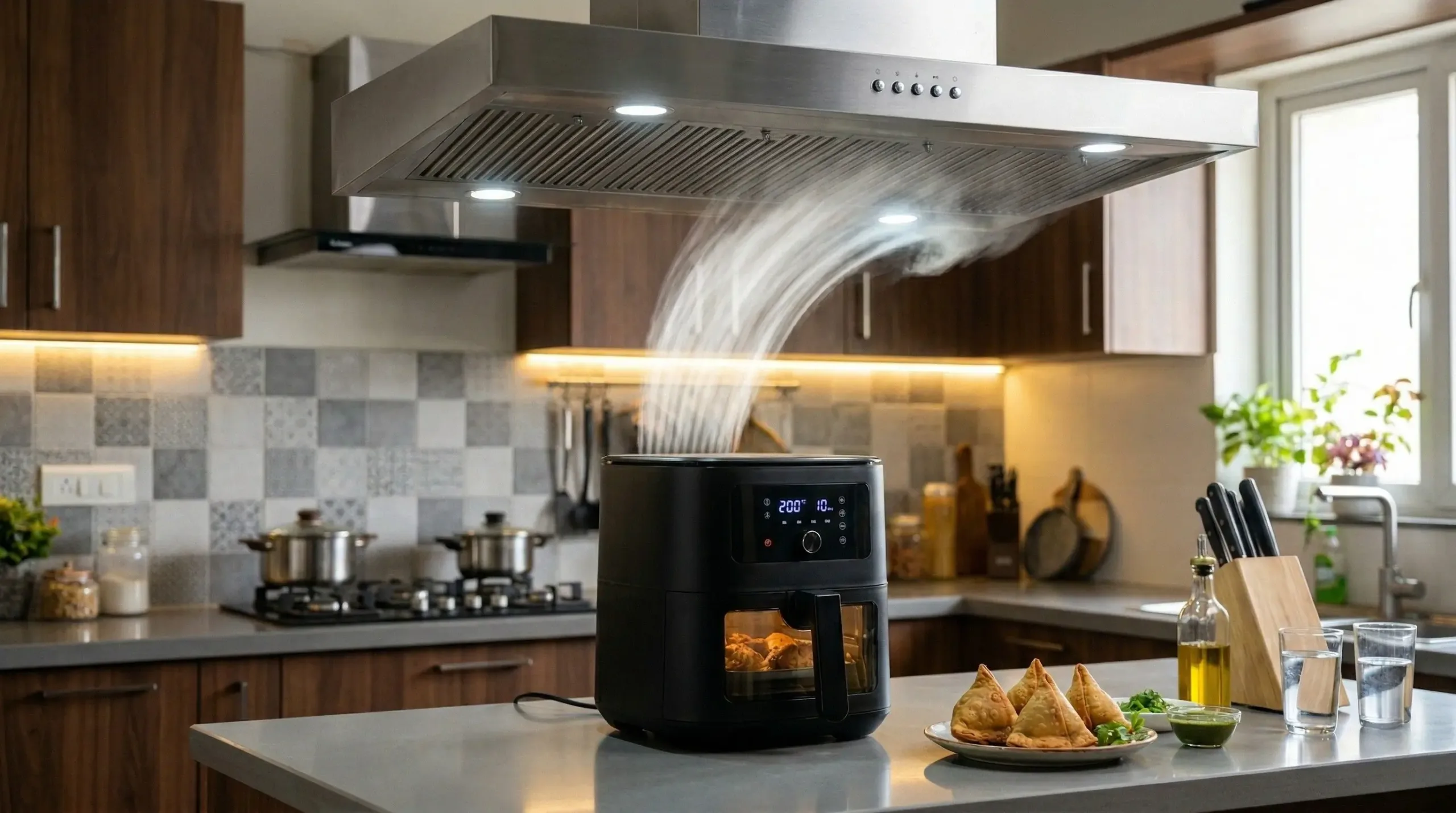
TL;DR: Air fryers, while producing a fraction of the particulate matter (PM2.5) of traditional deep frying, still emit volatile organic compounds (VOCs) and intense thermal plumes that degrade indoor air quality. Operating an air fryer in an unventilated kitchen causes humidity spikes, localized cabinet warping, and the accumulation of microscopic grease aerosols in your breathing zone. The National Building Code (NBC) 2016 mandates a dedicated extraction system providing 15 Air Changes Per Hour (ACH). Pairing your air fryer with a ducted, baffle-filter chimney of minimum 600 m³/hr suction capacity is not optional, it is the only engineering-compliant method to maintain a safe thermodynamic and respiratory environment in a modern Indian kitchen.
The air fryer has become the defining kitchen appliance of the decade in India. Marketed aggressively as a smoke-free, guilt-free, nearly oil-free miracle, it sits on millions of countertops across Chennai, Mumbai, and Delhi, quietly doing something no brand brochure mentions: exhausting a high-velocity column of steam, aerosolized trace fats, and volatile organic compounds directly into the kitchen every single time it operates.
That moisture has to go somewhere. Without a chimney intercepting it, it travels in one direction, upward, straight into the underside of your engineered wood overhead cabinets, into the plaster of your walls, and into your respiratory tract. Within two weeks of daily use, the visible signs begin: condensation beads on laminate, a faint greasy film on cabinet surfaces, and a persistent clammy odour that no amount of natural ventilation resolves.
This article is not a buying guide dressed up in technical language. It is a rigorous engineering baseline, derived from peer-reviewed emission studies, Bureau of Indian Standards (BIS) documentation, and National Building Code (NBC) 2016 ventilation mandates, that gives you the precise suction capacity your kitchen requires by law, the filter technology that actually works with dry-heat aerosols, and the spatial placement rules that determine whether your chimney captures the thermal plume at all. If you use an air fryer regularly, this is the article you need to read before your cabinets tell you the same thing at three times the cost.
Phase 1: The Engineering Reality of Air Fryer Emissions
The most persistent and dangerous myth in the air fryer market is this: no visible smoke equals no harmful output. This is not thermodynamically true.
A comprehensive peer-reviewed study by researchers at the University of Birmingham, utilizing optical aerosol spectrometers and proton-transfer-reaction time-of-flight mass spectrometers, confirmed that air-frying a chicken breast generated a peak PM2.5 concentration of 0.6 µg/m³, vastly lower than the 92.9 µg/m³ produced by pan-frying the identical protein, but definitively, measurably non-zero. VOC emissions peaked at 20 parts per billion (ppb) for air-frying, versus 260 ppb for pan-frying. These VOCs include acrolein, formaldehyde, and lipid-peroxidation aldehydes, compounds classified by the WHO Indoor Air Quality Guidelines as respiratory and cardiovascular hazards with prolonged, repeated exposure.
The thermal output picture is equally important. A standard 1500W air fryer operating at 200°C generates two distinct heat loads: sensible heat (dry, high-temperature air that raises ambient kitchen temperature) and latent heat (steam stripped from food surfaces during the Maillard reaction, the chemical browning process that gives your samosas their crust). In a sealed or under-ventilated kitchen, this steam condenses on the nearest cool surface, which is almost always the underside of your overhead cabinets. Repeated cycles of wetting and drying initiate veneer delamination, microbial growth, and structural weakening of engineered wood panels.
If you have noticed your appliance emitting visible steam clouds or an acrid smell during high-temperature cycles, that is this mechanism in action. The cumulative safety implications for daily users are well-documented, and emerging research specifically addresses the long-term correlation between cooking aerosol exposure and cancer risk in poorly ventilated domestic spaces. When you compare the full emissions profile against a traditional deep kadai, the air fryer wins on every metric, but winning the comparison does not mean the exhaust is safe to ignore.
It is also worth addressing the Teflon and PTFE question directly in the context of ventilation. When non-stick coating begins to peel from your basket and the raw metal beneath is subjected to 200°C heat cycles, the chemical byproducts entering your exhaust stream shift dramatically. For a full understanding of what PTFE and BPA actually release at high temperatures, and why ventilation becomes even more critical with an ageing appliance, that dedicated analysis is essential reading.
Phase 2: Indian Kitchen Ventilation Standards: The Precise Numbers
Abstract environmental concern is useless without actionable engineering parameters. The Bureau of Indian Standards (BIS) IS 3103 and the National Building Code of India (NBC) 2016 Part 8 (Building Services) provide the statutory baseline. For active domestic cooking zones utilizing high-heat appliances, the mandated standard is 15 Air Changes Per Hour (ACH), meaning the entire volume of kitchen air must be completely replaced with fresh, uncontaminated outdoor air 15 times every single hour.
The required chimney suction capacity flows directly from this single formula:
Required Suction (m³/hr) = Kitchen Volume (m³) × 15 ACH
Applying this to standard Indian architectural footprints:
| Kitchen Size | Dimensions | Volume (m³) | Required Suction |
|---|---|---|---|
| Small | 60 sq ft, 8-ft ceiling | 44.8 m³ | 672 m³/hr minimum |
| Medium | 100 sq ft, 9-ft ceiling | 83.7 m³ | 1,255.5 m³/hr minimum |
| Large | 140 sq ft, 9-ft ceiling | 117 m³ | 1,755 m³/hr minimum |
These numbers immediately expose the catastrophic inadequacy of the standard exhaust fan solution. A 12-inch axial wall fan moves approximately 150–200 m³/hr of air. Even in the smallest 60 sq ft kitchen, this covers just 22–30% of the statutory requirement, leaving over 70% of generated pollutants, moisture, and heat trapped within the building envelope.
For corner-installed air fryers, aerodynamic turbulence at the wall junction disrupts the smooth vertical rise of the thermal plume. The recommended engineering buffer is +20% additional suction capacity to compensate for the dead zone created by intersecting walls.
Phase 3: Chimney Technology: Filter, Duct, and Motor Engineering
Not all chimneys are built for the same exhaust profile. The dry-heat aerosol produced by an air fryer is fundamentally different from the heavy, wet grease generated by a gas-flame kadai, and the filtration technology must match.
Baffle vs. Mesh Filters
Mesh filters consist of overlapping layers of fine aluminum wire and trap particles through mechanical interception. They are highly effective against large, liquid fat droplets from open-flame frying. Against air fryer aerosols, they fail rapidly. The fine, dry particulate matter produced by high-temperature convection cooking bypasses the outer mesh layers, cools on contact with the inner structure, and polymerizes into an impermeable blockage deep within the filter body. This chokes airflow, builds static pressure against the motor, and accelerates bearing failure. Mesh filters in air-fryer-intensive kitchens can fail within 3–4 months.
Baffle filters, constructed from interlocking curved stainless steel panels, operate on centrifugal separation. The high-velocity exhaust is forced through multiple sharp directional changes. The heavier grease and aerosol particles, unable to follow the curves due to their inertia, are thrown onto the steel surfaces and deposited there. The air continues upward, clean. Because the grease sits on the surface of the steel rather than inside a mesh matrix, the airflow path remains unobstructed even as the filter collects significant residue. For any kitchen where an air fryer operates daily, baffle filters are the only correct engineering choice.
Ducted vs. Ductless (Recirculating) Systems
Ductless chimneys recirculate filtered air back into the kitchen using activated charcoal matrices to scrub odours. They are useless for air fryer environments. The intense, high-volume moisture exhausted during a 20-minute cook cycle rapidly saturates the porous charcoal structure. Within 6–8 months of daily use, the carbon is fully saturated. Steam, VOCs, and thermal load pass straight through the housing and recirculate back into your kitchen at reduced temperature but full chemical concentration.
Ducted systems, using rigid 6-inch diameter PVC or smooth aluminum duct to physically expel the contaminated air mass outside the building, are the only architecturally sound solution. They handle continuous moisture and thermal loads without filtration degradation over their service life.
Motor Technology and Acoustic Rating
Standard induction motors in budget chimneys generate significant acoustic resonance when high-velocity air strikes stainless steel baffles. At peak extraction speeds necessary for managing concurrent air fryer and gas hob operation, induction motors can exceed 65 dB, acoustically overwhelming in open-plan homes. Brushless DC (BLDC) motors maintain noise ratings strictly below 58 dB at full volumetric extraction, operating with far less mechanical friction and significantly lower power consumption. For households running an air fryer daily, the BLDC motor is the recommended technology. If you’ve noticed unusual mechanical sounds from your appliance itself, the guide to air fryer noise diagnosis is relevant context for understanding what normal operational sound profiles look like.
Phase 4: Spatial Placement Engineering and Electrical Safety
Positioning Rules
The chimney canopy must be positioned within 600 mm horizontal clearance of the air fryer’s rear exhaust vent. If the appliance is positioned further down the counter, its thermal plume rises outside the suction capture radius and disperses freely into the ambient air.
Vertically, the optimal chimney height above the countertop is strictly 650–750 mm. Above 750 mm, the thermal plume expands laterally and loses vertical momentum before reaching the capture zone, rendering the motor’s suction power irrelevant. Below 650 mm creates a physical obstruction and, over an active gas hob, constitutes a fire hazard.
Electrical Load and Grid Safety
A high-capacity chimney motor draws 150–250W. A family-sized air fryer pulls 1,500–1,800W. Running both simultaneously creates a sustained electrical load approaching 2,000W on a single circuit, a load that will repeatedly trip a standard 6A socket assembly and ultimately melt the plug casing.
A dedicated 16A circuit is mandatory for the air fryer. Do not use an extension cord. The documented user complaint that “the cable is too short to reach the wall outlet” leading to the use of inadequate extension cords is precisely the failure mode that causes PCB burnout and fire risk. Touch screen and digital interface failures are frequently caused by the voltage brownouts that occur when high-draw motors engage on undersized circuits. The sensitive capacitive sensors are the first component to fail under sustained electrical stress. In regions with known voltage fluctuation, a dedicated voltage stabilizer for the air fryer circuit is strongly recommended to protect the PCB. The Pigeon air fryer not turning on failure pattern is a textbook example of sustained low-voltage PCB damage presenting as a complete appliance failure.
Phase 5: Chimney Selection Matrix for Indian Kitchens
The following decision matrix maps statutory suction requirements to specific filtration technology and current Indian market price tiers:
| Kitchen Size | Recommended Suction | Filter Type | Duct Type | Budget Range (INR) | Example Models |
|---|---|---|---|---|---|
| Small (60 sq ft) | 400–600 m³/hr | Baffle | Ducted preferred | ₹4,000–₹8,000 | Faber Hood Pluto PB BF BK 60 |
| Medium (100 sq ft) | 700–900 m³/hr | Baffle | Ducted | ₹8,000–₹15,000 | Elica WDFL 606 HAC LTW MS |
| Large (140 sq ft) | 1,000–1,500 m³/hr | Baffle Auto-clean | Ducted | ₹15,000–₹30,000 | Faber Hood Everest SC TC LTW |
ROI Reality Check: The cost of not having proper ventilation, annualized for a typical Chennai kitchen, is significant. Cabinet laminate panel replacement due to steam delamination runs ₹300–600 per sq ft (Livspace/NoBroker 2026 data); with 8–10 sq ft of affected overhead cabinet surface, that is ₹2,400–₹6,000 every 18–24 months. Professional mold remediation for coastal Tamil Nadu kitchens ranges from ₹5,000–₹12,000 per treatment. A budget ducted baffle chimney at ₹8,000 all-in pays for itself in 5–7 months by eliminating these recurring costs.
For households where budget is the primary constraint, a detailed breakdown of current air fryer price tiers in India helps calibrate the total kitchen infrastructure investment. If you are purchasing your first air fryer and sizing the chimney simultaneously, the complete air fryer buying guide for Indian kitchens covers the appliance-side specifications that directly affect your ventilation sizing calculation. For smaller households, the best air fryer options for small Indian families maps neatly to the budget chimney tier. The lower wattage of compact models reduces the thermal plume intensity, keeping the small kitchen suction requirement manageable.
Phase 6: Hard Specs: Top Air Fryers and Their Thermal Profiles
Understanding the thermodynamic intensity of your specific appliance determines the precision of your chimney sizing. Power density, Watts per Litre of internal chamber volume, is the critical metric, not raw wattage alone.
| Model | Watts | Usable Floor Area | Power Density (W/L) | Ventilation Risk Factor |
|---|---|---|---|---|
| Philips Essential HD9200 (4.1L) | 1,400W | ~400 cm² | 341 W/L | Exposed starfish coil; grease polymerization risk |
| Prestige PAF 6.0 (2.0L) | 1,200W | ~256 cm² | 600 W/L | Extremely concentrated thermal plume; precision placement critical |
| Ninja AF161 Max XL (5.2L) | 1,750W | ~355 cm² | 336.5 W/L | Extreme wattage; dedicated 16A mandatory |
| Agaro Regency (12L) | 1,800W | ~650 cm² | 150 W/L | Wide, sustained steam column; requires broad canopy coverage |
The Prestige PAF 6.0’s extraordinary 600 W/L power density generates the sharpest, most concentrated thermal plume of any mainstream model. Placing it within 600 mm of your chimney capture zone is not optional; it is the defining factor in whether your ventilation system functions at all. The Agaro Regency’s oven-style format produces a wide, sustained moisture column that rolls off the sides of narrow canopy hoods. A chimney with a canopy width of at least 60 cm is essential.
For a comprehensive comparison of the top five air fryers currently dominating the Indian market, including their real-world performance profiles beyond the spec sheet, that guide provides the appliance context that complements this ventilation engineering analysis.
Phase 7: 10 Ventilation Myths Busted with Engineering Data
Myth 1: “Air fryers don’t need ventilation because they don’t produce smoke.”
Reality: Mass spectrometer measurements confirm continuous PM2.5 and VOC expulsion from air fryers. These submicron particles remain suspended in the breathing zone for hours without mechanical extraction.
Myth 2: “An exhaust fan is sufficient.”
Reality: A standard 12-inch axial exhaust fan moves 150–200 m³/hr. The NBC 2016 minimum for a small kitchen is 672 m³/hr. An exhaust fan covers approximately 22% of the legal requirement.
Myth 3: “Ductless/recirculating chimneys are fine.”
Reality: Air fryer steam saturates activated charcoal matrices within 6–8 months, after which the filter recirculates contaminated air directly back into the kitchen.
Myth 4: “Higher suction always means better performance.”
Reality: Oversizing a chimney in a tightly sealed small kitchen creates dangerous negative pressure, pulling exhaust gases backward down water heater flues (backdrafting) and generating intolerable acoustic turbulence.
Myth 5: “You only need the chimney on when using the gas stove.”
Reality: The air fryer’s thermal plume exhausts above 100°C carrying concentrated moisture. Without active chimney extraction during every cook cycle, structural condensation damage to overhead cabinets begins within days.
Myth 6: “Ceramic baskets are universally better than Teflon.”
Reality: While ceramic avoids high-temperature PTFE decomposition issues covered in depth in the full PTFE/BPA/Teflon truth analysis, ceramic’s microscopic porosity causes rapid permanent turmeric staining under Indian cooking conditions, and its non-stick properties degrade faster than modern Teflon formulations.
Myth 7: “Higher wattage is always better.”
Reality: Appliances above 1,500W on a 6A socket will melt the plug casing and trip the MCB repeatedly. High wattage demands a dedicated 16A circuit. Without it, sustained thermal load causes catastrophic electrical failure. The documented cancer risk concerns around air fryer use are amplified when electrical faults lead to overheating of non-stick coatings.
Myth 8: “Air frying is 100% oil-free.”
Reality: To achieve the Maillard reaction responsible for a crispy exterior rather than a dehydrated husk, a minimal lipid layer via oil spray is required. This trace oil is precisely what creates the aerosolized fat particles in the exhaust stream, and exactly why ventilation is non-negotiable.
Myth 9: “Digital touch interfaces are always superior to analog dials.”
Reality: In coastal environments like Chennai or Mumbai, saline moisture infiltrates capacitive touch panel micro-gaps, causing PCB corrosion and erratic sensor behavior. If your air fryer touch screen is already malfunctioning, ambient humidity without chimney extraction is likely accelerating the corrosion. Analog dials offer significantly superior long-term durability in high-humidity environments.
Myth 10: “Preheating isn’t necessary for modern air fryers.”
Reality: The Maillard reaction, the chemical process that creates a fried texture, requires food to enter an already high-heat environment (140°C+) to instantly sear the exterior. Cold food in a cold chamber steams in its own moisture as temperature rises gradually, resulting in a soggy texture. Why preheating is necessary explains the science; the complete preheating guide and optimal preheat temperatures guide cover execution. If you’re consistently getting soggy air fryer fries or snacks, inadequate preheating is almost certainly the cause, and the thermal plume from a fully preheated appliance is significantly more intense, making chimney extraction even more critical during that initial 3–5 minute window.
Engineer’s Take: A Coastal Kitchen Stress Test
By Prathap, B.Tech Agricultural Engineer | Chennai Kitchen Environment
I subjected my personal kitchen environment to a controlled operational stress test to validate these thermodynamic principles under real-world Tamil Nadu coastal conditions. Operating a 1,500W air fryer daily for two weeks, without any active chimney extraction, produced quantifiable environmental degradation within the first 72 hours.
The most alarming observation was the accumulation of condensation on the underside of my engineered wood overhead cabinets. By Day 14, the localized humidity spikes had initiated the preliminary stages of veneer warping, a structural failure that, had it progressed unchecked, would have required panel replacement at significant cost.
Applying the BIS IS 3103 formula to my 100 sq ft kitchen with a 9-foot ceiling, internal volume of 83.7 m³, the statutory 15 ACH requirement demands a minimum extraction rate of 1,255.5 m³/hr. My standard wall exhaust fan, rated at 180 m³/hr, was covering approximately 14% of the legal requirement. Passive diffusion did the rest, which is to say, nothing useful at all.
My specific engineering recommendation for South Indian coastal kitchens, where ambient humidity is already critically elevated, is to install a chimney delivering +1 to 2 ACH above the BIS minimum. For a medium 100 sq ft Chennai kitchen, this means targeting 1,400–1,500 m³/hr rather than the 1,255 m³/hr statutory floor. This aggressively over-engineered buffer is the only reliable method to guarantee complete latent moisture evacuation in a high-humidity ambient environment, preventing mold proliferation on painted surfaces, within cabinet hinges, and on the grout lines of wall tiles.
For practical daily use, operating your air fryer correctly from the start, including correct basket loading, correct temperature selection, and the burn-in cycle required for new appliances, reduces the intensity of the chemical exhaust profile over the long term. For coastal basket care specifically: run the fryer empty for 3 minutes at 200°C immediately after washing to evaporate all microscopic moisture, then apply a light oil coat as a hydrophobic barrier. This prevents the rust that micro-peeling Teflon coating exposes to salt-laden coastal humidity, a failure mode documented in detail in the non-stick coating peeling guide.
If you are cooking Indian snacks specifically, papad, pakora, samosas, the moisture content of these foods during the first 5 minutes of a cook cycle is at its highest, creating the most intense steam plume of the entire session. The guide to roasting papad in an air fryer illustrates why even seemingly low-moisture foods generate significant steam load in a high-temperature convection environment.
How to Select the Right Chimney: An 8-Step Engineering Protocol
This step-by-step protocol guarantees optimal capture efficiency and long-term appliance safety for Indian kitchen environments.
Step 1: Calculate Kitchen Volume Measure the exact length, width, and height of your kitchen in metres. Multiply the three dimensions. The result is your volumetric baseline in m³.
Step 2: Determine the Required ACH Consult the National Building Code (NBC) 2016 Part 8 baseline. For active domestic cooking zones using high-heat appliances, the mandated standard is 15 Air Changes Per Hour.
Step 3: Calculate Minimum Suction Capacity Multiply your kitchen volume (m³) by 15. The result is the absolute minimum extraction rate in m³/hr your chimney must deliver to comply with statutory requirements.
Step 4: Evaluate Layout Constraints and Apply Buffers If the air fryer sits in a corner, add 20% to your calculated minimum suction capacity. If you are in a coastal or high-humidity region (Tamil Nadu, Kerala, coastal Maharashtra), add a further 10–15% buffer above the BIS floor.
Step 5: Select Filtration Technology Eliminate all mesh-filter chimneys from consideration. Narrow your search strictly to heavy-duty stainless steel baffle filters. Baffle systems use centrifugal force to separate the dry-heat aerosols from air fryer convection ovens without the clogging and motor failure that destroys mesh systems.
Step 6: Commit to a Ducted Installation Select only ducted chimneys using rigid 6-inch PVC or smooth aluminum duct. Reject all ductless/recirculating models. Flexible, corrugated ducting creates air friction that can reduce effective suction by 15–25%. Use only rigid pipe runs with 45-degree bends rather than 90-degree elbows.
Step 7: Assess Electrical Load and Grid Stability Confirm the kitchen electrical grid has a dedicated, heavy-gauge 16A circuit for the air fryer. If voltage fluctuations are frequent in your area, install a dedicated voltage stabilizer rated for 2,000W to protect both appliances.
Step 8: Verify Acoustic Rating Cross-reference manufacturer specifications to confirm the chimney motor operates below 58 dB at maximum speed. BLDC motors are recommended for open-plan homes. Install the canopy at 650–750 mm above the countertop, no higher, no lower.
Frequently Asked Questions
Is a chimney strictly necessary for an air fryer? Yes. While air fryers produce significantly less visible smoke than traditional deep frying, they forcefully expel intense thermal plumes, heavy latent steam, and microscopic Volatile Organic Compounds (VOCs). Without mechanical extraction, these accumulate in the breathing zone and cause localized cabinet warping, grease film buildup, and sustained indoor air quality degradation.
Can I use a standard mesh filter chimney with an air fryer? No. Mesh filters trap particles through mechanical interception. The microscopic, dry-heat aerosols produced by air fryers bypass the outer filter layers, cool on contact with the inner structure, and solidify into an impermeable blockage. This progressively chokes airflow and burns out the induction motor within months.
What suction capacity do I need for a 100 sq ft kitchen? A 100 sq ft kitchen with a 9-foot ceiling has an internal volume of approximately 83.7 m³. Multiplying by the NBC-mandated 15 ACH gives a minimum of 1,255.5 m³/hr. Accounting for ducting friction loss and corner placement buffers, a unit rated at 800–1,000 m³/hr at the motor is the practical minimum for this footprint.
Why does my new air fryer smell of burning plastic on first use? New air fryers have industrial surfactant coatings applied to their internal heating coils to prevent oxidation during storage and shipping. When first heated to 200°C, these coatings polymerize and burn off, releasing concentrated VOCs. A “burn-in” cycle, running the empty fryer at full temperature for 15–20 minutes under an actively running chimney before any food is cooked, is required to safely clear these compounds.
Does an air fryer use significantly more electricity than a chimney? Yes. A high-end chimney motor draws 150–250W. An air fryer’s nichrome heating element draws 1,200–1,800W continuously during operation, making it 6–10 times more electrically intensive than the extraction system.
Should I use a 6A or 16A socket for my air fryer? A dedicated 16A socket is mandatory for any air fryer above 1,200W. Operating a 1,500–1,800W appliance through a standard 6A assembly causes sustained thermal overload, eventual melting of the plug casing, and PCB damage.
How do I prevent my air fryer basket from rusting in coastal areas? After every wash, run the empty fryer for 3 minutes at 200°C to fully evaporate trapped moisture. Apply a light coat of cooking oil to the basket to create a hydrophobic barrier against salt-laden humid air. Inspect the coating condition regularly, any peeling must be addressed promptly.
Do ductless chimneys work at all with air fryers? No. Ductless chimneys are physically incapable of expelling latent heat or steam. They only filter the air and return it to the kitchen. The intense moisture load from an air fryer saturates the activated charcoal matrix within months, after which the unit returns hot, humid, contaminated air to the kitchen with no extraction benefit whatsoever.
Conclusion: The Engineering Case Is Closed
The evidence, from emission spectrometers, BIS standards, NBC volumetric mandates, and two-week real-world stress tests, reaches a single, unambiguous conclusion: an air fryer operating without a properly sized ducted baffle chimney is not a health-neutral appliance. It is a continuous, low-level air quality and structural degradation risk that compounds with every cook cycle.
The engineering framework is straightforward. Understand your appliance’s core technology first. Know its full advantages and disadvantages including the ventilation overhead it creates. Select a chimney using the NBC 15 ACH formula for your specific kitchen volume, add appropriate buffers for your layout and climate, and commit to a ducted baffle system with a BLDC motor rated below 58 dB.
For households just beginning this journey, the comprehensive air fryer buying guide for Indian kitchens should be read in parallel with this ventilation guide. The two documents together constitute the complete infrastructure specification for a safe, compliant Indian kitchen. Once your setup is correct, learning to use the appliance properly, including correct preheat duration and the right preheat temperature for each food type, maximizes cooking results while minimizing the thermal plume your chimney must manage.
If you encounter operational issues, error codes, basket problems, unusual sounds, address them promptly, because a malfunctioning appliance operating outside its design parameters generates an unpredictable exhaust chemistry that no chimney specification is designed to manage. And if you are still evaluating whether the appliance is the right choice for your household, the complete safety guide for Indian air fryer users provides the full picture before you commit.
The chimney is not an accessory. It is the engineering prerequisite that makes an air fryer a safe kitchen appliance.
Author: Prathap | B.Tech Agricultural Engineer | ourkitchen.in References: Ruijie Tang et al. (2024), “Impact of Cooking Methods on Indoor Air Quality,” University of Birmingham; WHO Indoor Air Quality Guidelines; Bureau of Indian Standards IS 3103 / National Building Code of India 2016 Part 8.

Prathap is the founder of ourkitchen.in and a B.Tech graduate in Agricultural Engineering from Tamil Nadu. His engineering background in thermodynamics, heat transfer, and food processing science gives him a fundamentally different approach to kitchen appliance reviews compared to typical lifestyle bloggers.
Rather than relying on manufacturer claims, Prathap measures actual power draw against rated wattage, evaluates basket airflow geometry, and stress-tests non-stick coatings over 90-plus cook cycles before recommending any product. He cross-checks every safety claim against BIS and FSSAI standards, and all pricing against live Amazon India and Flipkart listings.
He has written over 61 deep-dive articles on air fryers for the Indian market, personally testing models from Philips, Pigeon, Agaro, Kenstar, Havells, and Bajaj. His reviews are built around Indian realities: 220V power grids, high-humidity coastal kitchens, Indian cooking temperatures, and the price-performance expectations of Indian households.
Based in Chennai, Tamil Nadu.