
TL;DR Quick Answer for Air Fryer Pros and Cons
Air fryers cut oil use by up to 90% and reduce acrylamide formation by 55–90% compared to deep frying, making them genuinely healthier for Indian households. They are excellent for dry snacks samosas, tikkas, cutlets, papad and pay for themselves in oil savings within 12–18 months.
The real disadvantages are specific to Indian conditions: PTFE basket coatings peel within 18–24 months under Indian scrubbing habits, the PCB burns out during voltage spikes without a stabiliser, and the appliance cannot cook wet-batter foods like bajji or bonda. Best for families of 2–5 who eat dry snacks regularly. Not suitable for joint families of 6+ or households whose diet is primarily wet gravies.
Table of Contents
Introduction
Is an air fryer a kitchen revolution or just an expensive paperweight? To decide, you must weigh the real Advantages and Disadvantages of Air Fryer.
The Verdict: It is a nutrient-retention powerhouse, cutting oil by 90% and preventing toxic acrylamides. But here is the catch: It isn’t built for rough Indian usage. The Teflon basket peels easily with abrasive scrubbing, and the “uncleanable” coil traps grease. If you are brand new to this technology, start with our foundational guide on What is an Air Fryer? 7 Amazing Benefits to understand the basics before diving into these pros and cons.

| Feature | The Advantages (Pros) | The Disadvantages (Cons) |
| Health Impact | Cuts oil usage by 90%, reducing calorie density. | Risk of Teflon peeling if scrubbed with abrasive wool. |
| Nutrient Retention | Preserves Vitamin C & Anti-oxidants better than boiling. | “Toxic Ceiling”: Grease buildup on the upper coil is hard to clean. |
| Cooking Quality | Restores crunch to leftovers (Samosas/Pizza) without sogginess. | Dryness: Can dry out lean meats or wet batters if overcooked. |
| Efficiency | Energy Efficient: Cooks 50% faster than an OTG. | Voltage Sensitivity: PCB can burn out during Indian voltage fluctuations. |
Top 5 Underrated Advantages of an Air Fryer
Marketing ads only scream about “90% less oil,” but that is just the surface. If calorie-cutting was the only perk, you could just boil your food.
The real value is biochemical. From locking in delicate vitamins to preventing toxic acrylamides, here are the 5 engineering underrated advantages of an air fryer that truly justify the price tag.
1. Nutrient Retention: Why It Keeps More Vitamins Than Boiling
Most people buy an air fryer just to cut down on oil. But the real, hidden advantage is that it stops your cooking method from “stealing” your nutrition.
Here is how it preserves the health of your vegetables better than your pressure cooker or kadhai:
- The “Water Thief” Effect: Have you noticed that when you boil Broccoli or Palak (Spinach), the water turns green? That isn’t dirt that is Vitamin C leaving the vegetable and dissolving into the water, which you eventually throw down the sink.
- The Air Fryer Fix: Since an air fryer uses hot wind instead of boiling water, there is nowhere for the vitamins to escape. They stay trapped inside the veggie, retaining up to 80% of Vitamin C (compared to just 55% when boiling).
- The “Antioxidant Boost” Vegetables like Broccoli carry a powerful enzyme (Myrosinase) that fights inflammation.
- The Problem: Boiling kills this enzyme instantly because the heat is too harsh and wet.
- The Fix: Air frying is a “Dry Heat” process. At 160°C, it cooks the vegetable without destroying its internal structure. In fact, studies show this specific heat actually wakes up the antioxidants, making the vegetable healthier cooked than raw.
- The “Taxi” for Vitamins Here is a Pro Tip: Don’t aim for “Zero Oil.”
- The Logic: Vitamins A, D, E, and K are “Fat-Soluble.” This means they need fat to move from your stomach into your blood. Think of oil as the Taxi for these vitamins.
- The Fix: By using just one teaspoon of oil in the air fryer, you provide the “vehicle” these vitamins need. This increases nutrient absorption by 300% compared to eating the vegetable completely dry or raw
For a full guide to which cooking methods preserve the most nutrients, see our complete guide on what an air fryer is and its 7 proven benefits
2. Blood Sugar Management
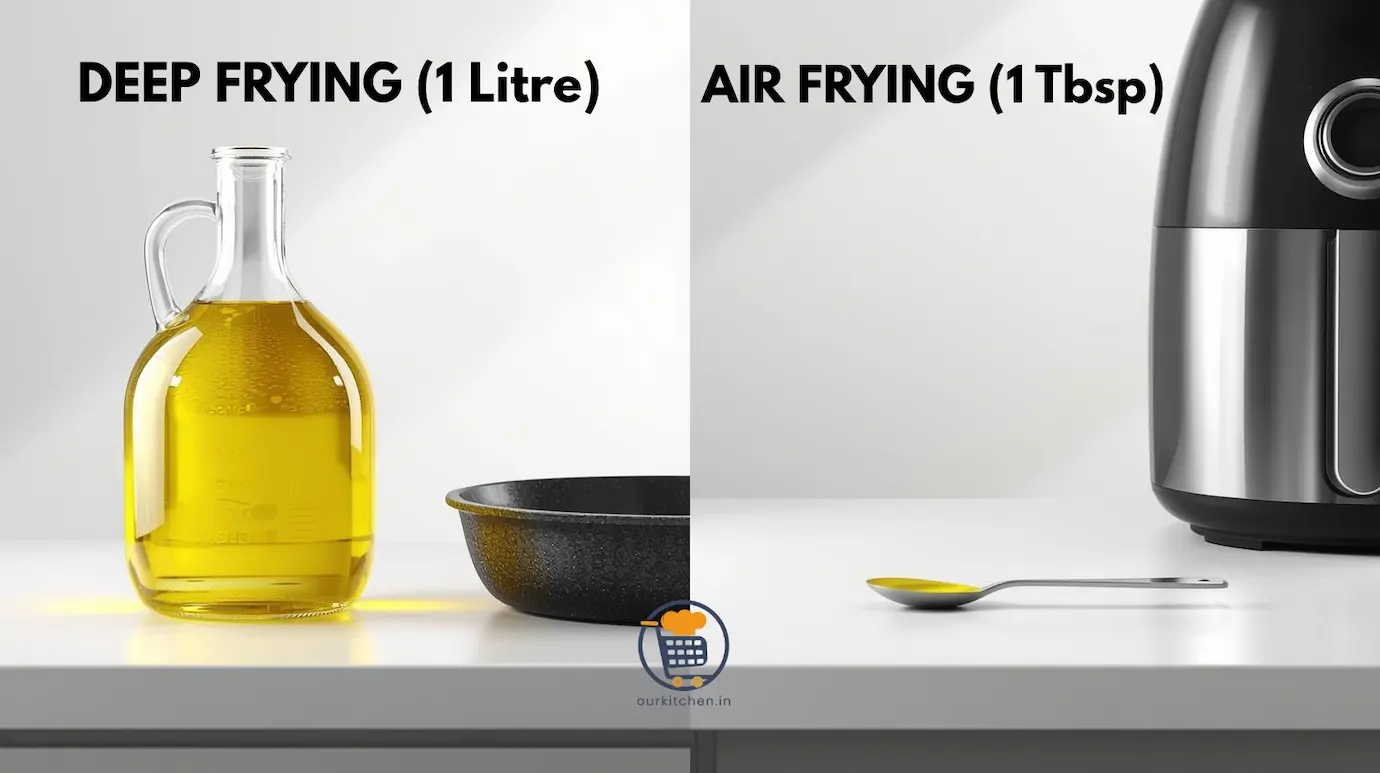
The “Calorie Density Shift”: Visual proof of how replacing 1 Litre of oil with just 1 Tbsp drastically reduces fat intake.This is one of the most vital advantages of using an air fryer. In contrast, a deep fryer works by submerging food in hot oil for an excessive amount of time. This causes rapid oxidation, producing reactive intermediates called α-dicarbonyl compounds (αDCs). These react with the protein and sugar content in your food to form Advanced Glycation End-products (AGEs).
For diabetic patients, AGEs are very harmful. They trigger systemic oxidative stress and inflammation, which is directly responsible for how your cells interact with insulin, often worsening insulin resistance levels. Air fryers use a minimal volume of oil, preventing the formation of AGEs. This keeps these thermal toxins out of your food while protecting the body’s natural insulin signals.
Acrylamide is a chemical responsible for cancer formation. It forms when cooking starchy foods such as potatoes at excess heat (above 140°C) for a longer period, which is common in deep frying. An air fryer reduces Acrylamide formation by 55% to 90%.
Air fryers are crucial for maintaining metabolic health and lowering the toxin load on the liver and kidneys. This helps your body focus its metabolic energy on managing glucose rather than processing toxic contaminants.
⚠️ Critical Health Note: The “Charring” Risk While air fryers reduce acrylamide by 90% compared to deep frying, they do not eliminate it entirely. If you overcook starchy foods (like potatoes) until they turn dark brown or black, acrylamides will still form.
The “Moisture Mediation” Effect: For diabetic patients, air fryers act as a moisture mediation tool. In Indian homes, we often struggle to make low-carb vegetables like Bhindi (Okra) or Gobi (Cauliflower) without deep frying to get that crunch.
The air fryer’s short cooking time with high heat makes the Bhindi and Gobi crunchy without the grease. This helps you consume a larger amount of high-fiber, low-carb vegetables, naturally reducing the Glycemic Load of your total meal by replacing high-carb staples like Roti, Dal, or Rice.
The Calorie Density Shift: Traditional Indian recipes often tend to absorb 8% to 25% of the total oil used in deep frying, causing a spike in calorie density in every bite. A deep-fried snack might contain 12g of fat, while air-fried food carries only about 2 to 3 grams.
For a diabetic patient, maintaining a balanced weight is critical for managing long-term blood sugar levels. By reducing the total fat percentage by 70% to 90%, the air fryer becomes the preferred choice for metabolic control. Using just 1 tablespoon of oil instead of 1 cup prevents chronic fat accumulation, a key driver of Type 2 Diabetes and heart disease.
3. Low EMF Radiation: The Safer Way to Reheat Leftovers
If you’re using a microwave in your home, the fear of EMF radiation is often the first thing that comes to mind. This is because a microwave relies on a Magnetron to generate a high-frequency electromagnetic field (around 2.45 GHz). This creates a Dielectric Heating process, causing the water molecules in the food to vibrate and create heat through molecular friction.
On the other hand, an air fryer works on simple thermal energy from a metallic coil and a powerful fan, instead of electromagnetic induction. This allows the air fryer to cook food without emitting radiation waves, making it a fundamentally different technology from the microwave oven.
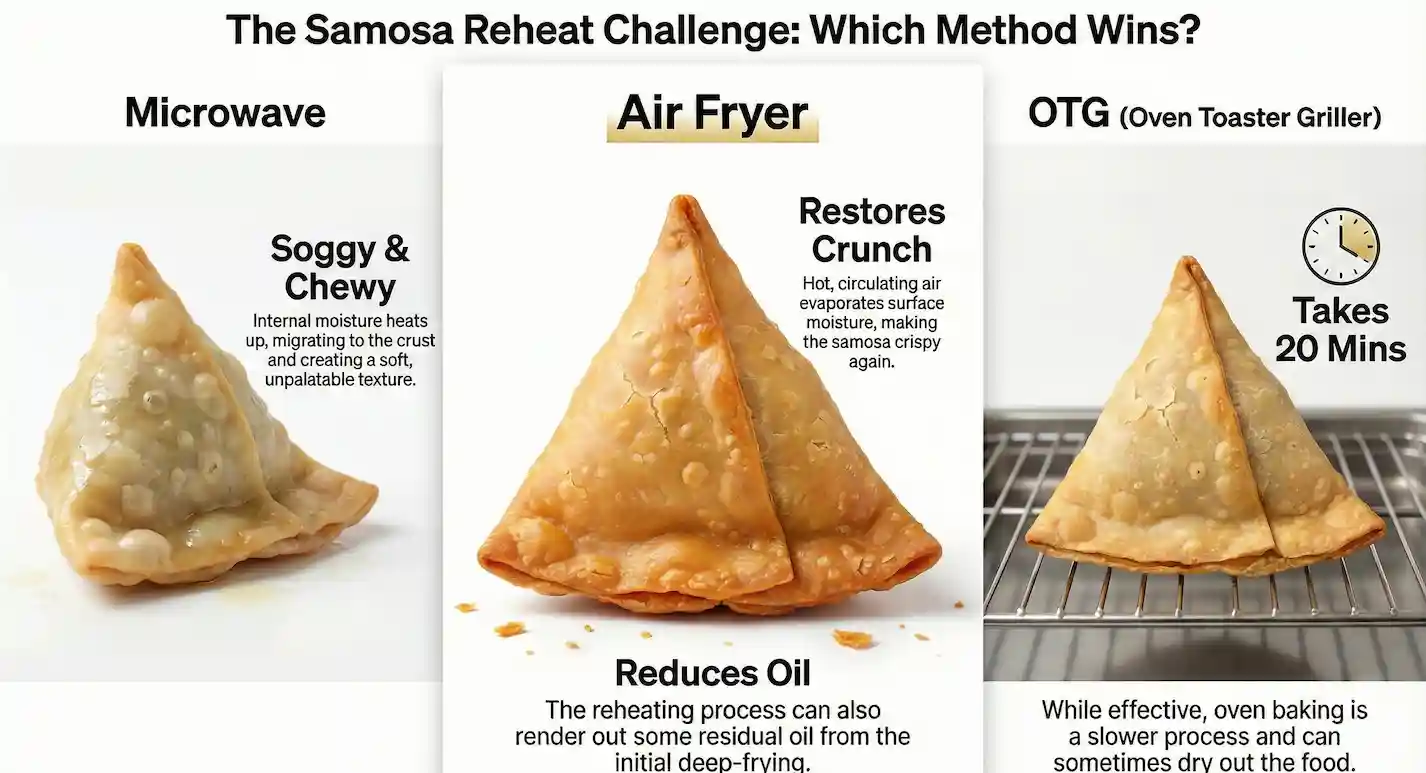
The “Soggy vs. Crunchy” Factor: When you reheat pizza, samosas, pakoras, or any other snack, you prefer crunchiness, not sogginess. In microwave ovens, due to dielectric heating, the water in the food migrates to the crust, making the food soggy and rubbery.
In an air fryer, the high-powered hot air circulation causes the moisture to evaporate immediately. This restores the crunch and even helps render out the excess oil content, often making the food less oily than when it was first cooked.
Container Safety: One of the critical safety advantages of an air fryer is its design. Microwaves often require plastic containers. Even “microwave-safe” plastic, if damaged or scratched, can allow PFAS (forever chemicals) to migrate into your food particles, causing health concerns.
An air fryer is specially designed with a perforated metal basket that avoids the need for external containers, making it a safer choice for daily reheating.
4. It Keeps Your Kitchen Cool in Summer
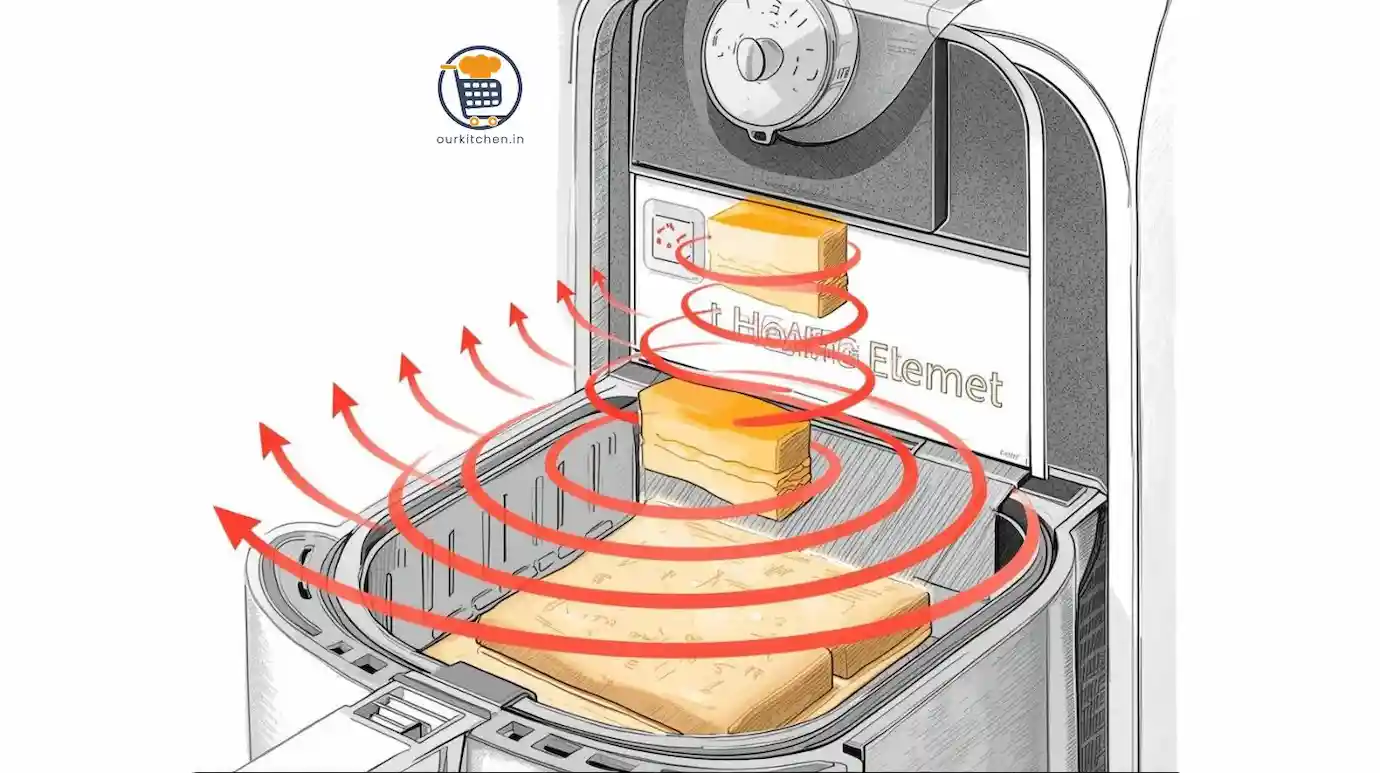
The difference between a gas stove and an air fryer comes down to the Open System vs. Closed Loop design. The traditional gas stove operates on an open flame to transfer heat via conduction and radiation to a cooktop, where 40% to 50% of the thermal energy is wasted into the surrounding air.
However, an air fryer works in a Closed Insulated Cooking System. The thermal energy is trapped inside the perforated basket and circulated by a high-powered fan, resulting in near-zero energy wastage while reaching temperatures of 160°C to 200°C internally.
In addition to that, cooking on a gas stove or deep fryer is similar to babysitting. You have to stay close to the heat source to flip and monitor the frying process. In a summer afternoon, when the temperature is typically 40°C, this makes cooking physically exhausting.
On the other hand, in an air fryer, just pressing a button is enough. You don’t need to stay close to monitor it, and you don’t feel like you are standing in a hot tub, the room remains at a normal temperature. Furthermore, the outer body of the air fryer is usually cool-to-the-touch, ensuring safety alongside high energy efficiency.
5. The ‘LPG Flip’: Is It Really Cheaper Than a Gas Cylinder?
As we mentioned in the previous advantage, an air fryer works on a closed loop, whereas a gas stove or deep fryer works on an open system. This causes about 40% to 50% energy wastage in traditional cooking. In comparison, an air fryer has an energy efficiency rate of 85% to 90%, which helps in making the running cost much more economical.
In the Indian cooking process, oil plays a vital role. It is often called “Liquid Gold” because it solidly accounts for ⅓ of the monthly grocery expense. To cook crispy Indian snacks such as Samosas and Pakoras in a deep fryer, it requires a minimum of 250ml to 500ml of oil to submerge the recipe completely.
On the other hand, an air fryer recipe only requires 2 tablespoons of oil. This means that within 12 to 18 months of usage, the money you save on oil alone will basically pay for the machine (ROI).
For the full electricity cost calculation with Indian state-wise tariffs, see our air fryer electricity consumption guide for India
The Pre-heating Factor: Heating a large volume of oil in a heavy Kadhai takes a minimum of 15 minutes to preheat to reach the perfect cooking temperature. But an air fryer takes only 3 to 5 minutes to reach its maximum temperature.
In conclusion: By evaluating all these factors, the verdict is clear. While the air fryer requires a heavy initial cost, the zero wastage of energy and massive oil savings make it cheaper to run in the long term compared to relying solely on an LPG cylinder.
The Bottom Line: An air fryer costs roughly ₹3–₹4 per hour to run. Deep frying the same meal costs ₹40+ in oil and gas. The electricity cost is negligible compared to the massive oil savings.
Is Air Frying Healthy or Unhealthy? The Direct Answer
| Healthy vs unhealthy: Air frying is significantly healthier than deep frying. It reduces absorbed fat by 70–90% per meal, cuts acrylamide formation by 55–90%, and eliminates the trans fats created when oil overheats in a kadhai. It is not a health risk under normal use. |
The direct answer: air frying is healthier than deep frying by every meaningful metric. It is not unhealthy. The concern is not the method itself, it is two specific misuses that create risk.
What Makes Air Frying Healthy
When you deep fry in a kadhai, the food absorbs 8–25% of the surrounding oil. That absorbed oil repeatedly heated, oxidised, and reused is the real health problem. It raises LDL cholesterol, forms Advanced Glycation End-products (AGEs) that worsen insulin resistance, and creates trans fats that increase cardiovascular risk.
An air fryer eliminates all of this. The food is cooked in circulating hot air, not submerged in oil. Oil absorption drops to near zero. AGE formation drops sharply. And acrylamide, the probable carcinogen formed when starchy food is cooked at high heat for too long is reduced by 55–90% compared to deep frying, according to peer-reviewed research (NCBI, 2024).
For the 77 million diabetics in India and the millions more managing cholesterol and heart disease, this is not a minor difference. Switching from daily kadhai frying to daily air frying meaningfully reduces the toxic load on the liver and the inflammatory burden on the cardiovascular system.
The Two Health Risks That Are Real (and Preventable)
There are two genuine health risks from air fryers, but both are caused by misuse, not by the appliance itself.
First: a scratched or peeling PTFE basket. Most air fryer baskets are coated with PTFE (Teflon), which belongs to the PFAS family of chemicals. PFAS are linked at high chronic exposure levels to hormonal disruption and certain cancers. Under normal use, PTFE is food-safe below 260°C and air fryers operate at 160–200°C. The risk only emerges when the coating is scratched, which happens fast in Indian kitchens that use abrasive Scotch-Brite scrubbers. A scratched basket can contaminate food with coating flakes. The fix is simple: soft sponge only, and consider a silicone basket liner (₹300–₹500).
Second: charring starchy food. Acrylamide forms when starchy foods (potatoes, bread, maize) are cooked to a dark brown or black colour at high heat. An air fryer reduces acrylamide dramatically compared to deep frying, but if you consistently overcook your food until it chars, acrylamide will still form. The rule: cook to golden, not dark brown.
Fix both of these and air frying is one of the safest daily cooking methods available safer than a kadhai, safer than a microwave for reheating, and significantly safer than repeated deep frying in the same oil.
Can I Eat Air Fryer Food Every Day?
| Daily use safety: Yes. Daily air fryer use is safe provided the basket coating is intact and you avoid charring food. Air-fried food is healthier than deep-fried food by every nutritional metric. The appliance itself is not a health hazard under normal use. |
Yes, with two conditions. First, your basket coating must be intact. If it is peeling or heavily scratched, replace the basket or add a silicone liner before continuing daily use. Second, do not cook starchy food to a dark charred colour consistently.
Beyond those two conditions, there is no reason to limit daily air fryer use. The WHO, ICMR, and FSSAI have not issued any advisory against air fryers as a cooking method. The base food matters too daily air-fried samosas are still samosas, but the cooking method itself is safe and considerably healthier than the deep-fried alternative.
If you want to go deeper on the safety science, our full analysis of whether air fryers are safe for Indian homes covers every concern in detail, including the FSSAI and BIS standards angle.
Critical Disadvantages of Air Fryer: Brands Don’t Tell You
So far, an air fryer sounds like a kitchen superhero. However, a complete analysis of the advantages and disadvantages of an air fryer isn’t honest without discussing the structural flaws brands hide. From the nightmare of ‘Teflon Fatigue’ to the struggle of cleaning the hidden heating coil, here is the uncensored truth about an air fryer you need to know before buying.
1. The “PCB Burnout” (India-Specific Flaw)
The PCB (Printed Circuit Board) acts as the “brain” of a digital air fryer, controlling the precise temperature and timer. This PCB relies on a sensitive microprocessor specifically designed for stable voltage, unlike rugged analog devices which can tolerate some fluctuations.
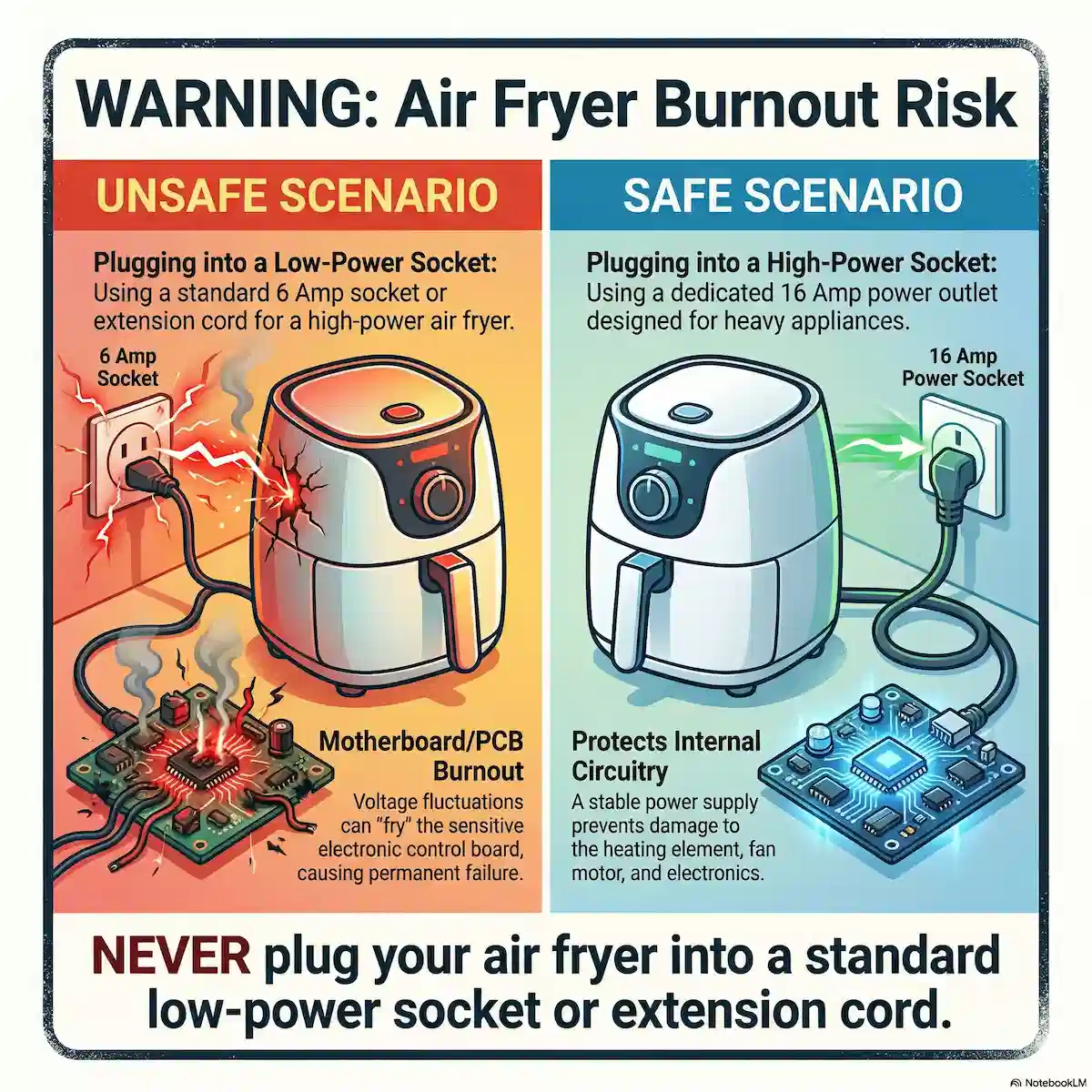
In India, especially during summer, voltage oscillations are common due to the high load from Air Conditioners. A sudden high voltage spike can literally “fry” the microscopic paths on the circuit board. Conversely, low voltage forces the internal power supply to work harder to maintain operation, causing the internal parts to overheat.
In contrast, Manual Air Fryers use mechanical knobs for time and temperature control. These are hard electromechanical components that can withstand voltage fluctuations much better than their digital counterparts.
The Repair Nightmare: When a digital air fryer faces PCB burnout, the repair is rarely cheap. It often requires the replacement of the entire proprietary motherboard, the cost of which can be more than half the price of the new air fryer. Unlike induction cooktops or gas stoves, where “first copy” or generic spare parts are available at local shops, air fryer parts are specific to the brand and model, making local mechanics struggle to fix them.
The Hidden Cost: Because the replacement cost is so high, a burnt-out air fryer often becomes instant E-waste. Furthermore, even if the display is off, if the plug is in the socket, the PCB often remains electrically engaged to the power source. A sudden surge can kill the machine even when you aren’t cooking.
To protect your gadget from this PCB burnout, a dedicated voltage stabilizer is essential, similar to what you use for a refrigerator. Unfortunately, most users lack education on this and consider a stabilizer a “waste of money,” until their appliance fails.
If your air fryer has already stopped working, see our diagnostic guide on why your Pigeon air fryer is not turning on and our full list of air fryer error codes for all Indian brands.
2. The “Toxic Ceiling” Effect (The Uncleanable Zone)
We tend to clean our air fryer after every use to remove grease and oil stains from the perforated basket. However, we often ignore the upper portion where the heating element and fan are located, as cleaning there is extremely difficult, this area is commonly known as the “Uncleanable Zone”.
When we cook fatty and marinated foods (common in India), the intense heat renders the fat content, creating an aerosolized grease mist. The high-speed fan is placed above the heating element to force the heat directly towards the basket. This creates a reciprocal aerodynamic effect, a powerful updraft that creates a suction force, dragging the sticky grease mist into the metallic chamber behind the “safety guard.” Unlike a Kadhai or Tawa where the grease settles on the bottom, in an air fryer, it settles on top.
Once this greasy mist settles and forms a coat, we continue to use our air fryer at temperatures from 160°C to 200°C. This environment triggers Polymerization, causing the fat and oil to oxidize and transform from a liquid state into a hard, resinous layer. Over a period of time, this becomes a sticky yellow-brown varnish that bonds to the metal chamber. Simple dishwashing liquid or warm water is chemically insufficient to clean this polymerized layer.
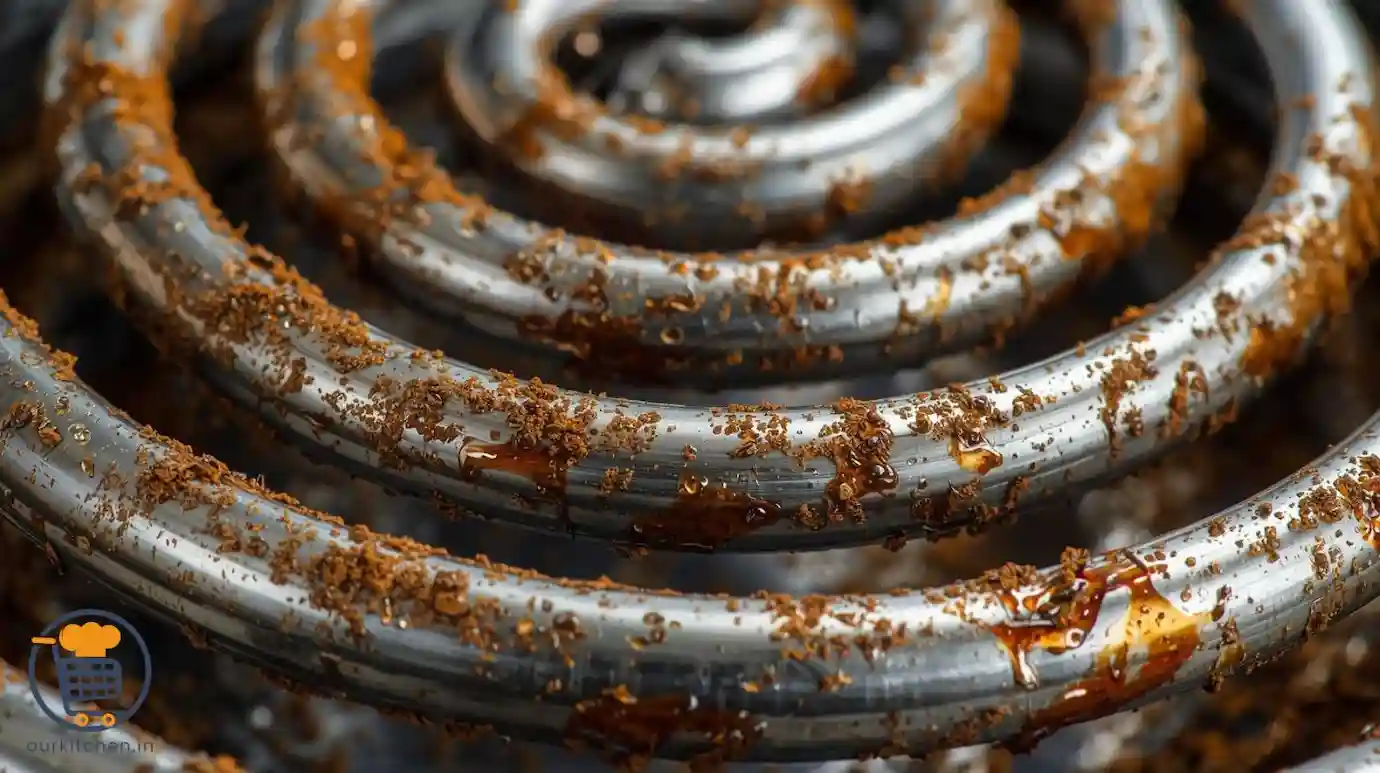
The air fryer is designed in a way that makes it nearly impossible to remove this layer, creating a permanent hygiene hazard. To remove the varnish, you would have to scrub the internal part located behind the heating element. However, protective mesh guards are fixed there because that zone is an electrical risk where the fan motor and sensitive electronics are placed. Touching it with bare hands or forcing a brush into the upper portion may cause a permanent defect in the appliance.
Over time, this buildup begins to degrade, leading to the emission of acrid smoke and burnt odors during operation. In older air fryers that are maintained with the least care, this polymerized layer can even drip back onto the food while cooking, introducing toxic compounds into your fresh meal.
Grease buildup is also the main reason why air fryers start smoking, here is the full cause and fix guide.
3. The ‘Flying Food’ Hazard: Risks with Lightweight Ingredients
As we discussed in the previous disadvantage, an air fryer creates a strong updraft (upward pull) before it starts sending high-powered air downwards. The food placed in the air fryer must have a gravitational force (weight) higher than the aerodynamic lift and drag force generated by the fan to resist getting sucked into the upper layer of the appliance.
Lightweight ingredients like cheese slices and small food particles possess a high surface-area-to-mass ratio. When high-speed heat hits a cheese slice, the aerodynamic lift overcomes the gravitational force, making the food an airborne projectile.
The sucked food particle moves towards the intake zone of the fan, where the heating element is located. The temperature of the heating coil ranges from 160°C to 200°C. If a sucked food particle makes physical contact with the heating element, it undergoes immediate thermal degradation, as the food is often dry or fatty enough to cause ignition.
Since an air fryer is a high-oxygen environment, it is easy to produce fire. While it usually only sparks a small flame that disappears after a few seconds, it produces acrid smoke that circulates easily and lasts for a few minutes.
Food particles such as Papads, Curry Leaves, Dhaniya (Coriander), Cheese, and sliced Breads are common “flying foods” in an air fryer. Therefore, it is always advised not to place lightweight ingredients loosely in the basket. Consider using a silicone basket with a strainer jaali (mesh) or a steel lid to physically cage the lightweight food particles.
The same updraft principle explains why roasting papad in an air fryer needs a specific technique it won’t work if you just drop it loose in the basket.
4. The “Plastic Seasoning” Phenomenon (Why Your First Batch Tastes Toxic)
The “new car smell” might feel luxurious in a sedan, but when it wafts from your kitchen counter, it is an appetite killer. Most first-time users panic when their new air fryer starts emitting a strong odor of burning plastic and hot metal.
This isn’t a defect; it is a chemical reality caused by two specific manufacturing shortcuts:
- The Coil Coating: To prevent the metal heating element from rusting while it sits in humid shipping containers crossing the ocean, factories coat it in a layer of industrial surfactant.
- The Plastic “Cure”: The heat-resistant plastic shell contains stabilizing agents and binders. When heated for the first time, these materials “settle” and release trapped gases.
The “Plug-and-Play” Mistake: In India, we love to unbox and cook immediately. But if you throw food in during this first run, you are making a mistake. The high-speed fan acts as a chemical circulation system. Since the fryer is a closed loop, the fan forces these releasing VOCs (Volatile Organic Compounds) directly into your food.
The Result: Because fats and proteins are excellent absorbers of odors, your first batch of French Fries will effectively act as a sponge for these fumes, tasting distinctly bitter or metallic. The machine isn’t broken, it just needs a “Burn-Off Cycle” (which we detail in the Precautions section below) to clear its throat before it cooks your dinner.
We have a dedicated deep-dive on the plastic smell in new air fryers, causes and how to eliminate it
5. The “Teflon Life-Cycle” Trap (Planned Obsolescence)
The non-stick coating of an air fryer plays a vital role in both the lifespan of the appliance and the quality of cooking. Most air fryer baskets are coated with PTFE (Teflon), which contains PFAS (often called “forever chemicals”). From a materials engineering perspective, this coating is chemically vulnerable to “Thermal Cycling” , the constant expansion and contraction when heated to 200°C and cooled down, which weakens its bond to the metal over time.
The Indian Context: In India, the degradation timeline is drastically accelerated due to our cleaning habits. Unlike Western methods that rely on sprays or gentle dishwashers, Indian households frequently use abrasive scrubbers (like green Scotch-Brite) or steel wool to remove stubborn turmeric stains and sticky masala. This mechanical abrasion destroys the weakened PTFE layer, causing it to peel or flake within just 18 to 24 months.
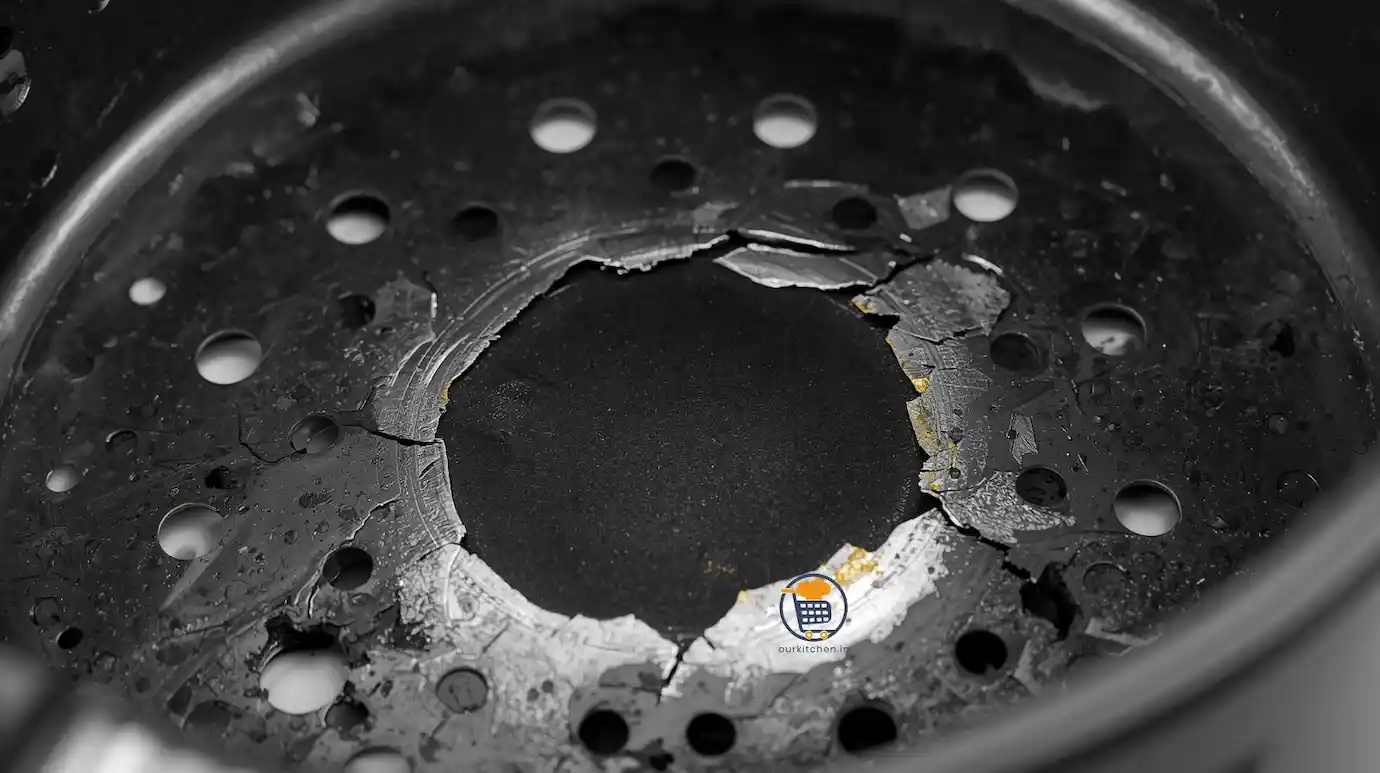
of the PTFE (Teflon) non-stick coating. The large hole in the center reveals
exposed metal underneath, with visible oxidation (gray/brown discoloration)
and coating flakes around the damaged area. This damage typically occurs
within 18-24 months in Indian households due to aggressive scrubbing with
abrasive tools like steel wool or Scotch-Brite pads combined with repeated
thermal cycling at 160-200°C.
The “Weakest Link” Trap: This leads to the “Planned Obsolescence” trap. Manufacturers engineer the motor to last for years, but the basket is designed as the “weakest link.” In the Indian market, finding a specific replacement basket is a critical pain point; if available, it often costs 50% to 60% of the price of a completely new machine.
Consequently, once the coating breaches, you risk ingesting micro-flakes of toxic chemicals with your food. This turns a health-promoting appliance into a hazardous one, often forcing users to discard a perfectly functional motor simply because the basket has failed.
If your basket is already peeling, read our full analysis on whether a peeling air fryer non-stick coating is safe to use and our guide on whether your air fryer is toxic, the PTFE and BPA truth.
6. The “Vacuum Cleaner” Noise Factor
Unlike a microwave which hums quietly in the corner, or an OTG which operates in near silence, an Air Fryer makes its presence felt loudly. If you are expecting a silent cooking partner, you are in for a surprise.
The Decibel Reality: A standard air fryer operates at approximately 65 dB. To put that in perspective, that isn’t a gentle hum; it is roughly the volume of a running vacuum cleaner or a loud dining table conversation. It is a dominant auditory presence that you cannot ignore.
The Engineering Logic: This noise isn’t a defect; it is an aerodynamic necessity. To simulate the crisping effect of deep-frying without oil, the appliance relies on Rapid Air Technology. A high-speed industrial fan must force a massive volume of air through a constricted, pressurized chamber to strip moisture from the food. High velocity equals high noise.
The “Open Kitchen” Headache: In modern Indian apartments where Open Kitchens are the norm, this constant drone becomes intrusive. The mechanical whir is often loud enough to drown out the TV volume in the living room or force you to step onto the balcony just to take a phone call.
If the noise has become grinding or rattling rather than the normal hum, see our guide on why your air fryer is making a loud noise, causes and fixes.
Comparison: Air Fryer vs. OTG vs. Microwave
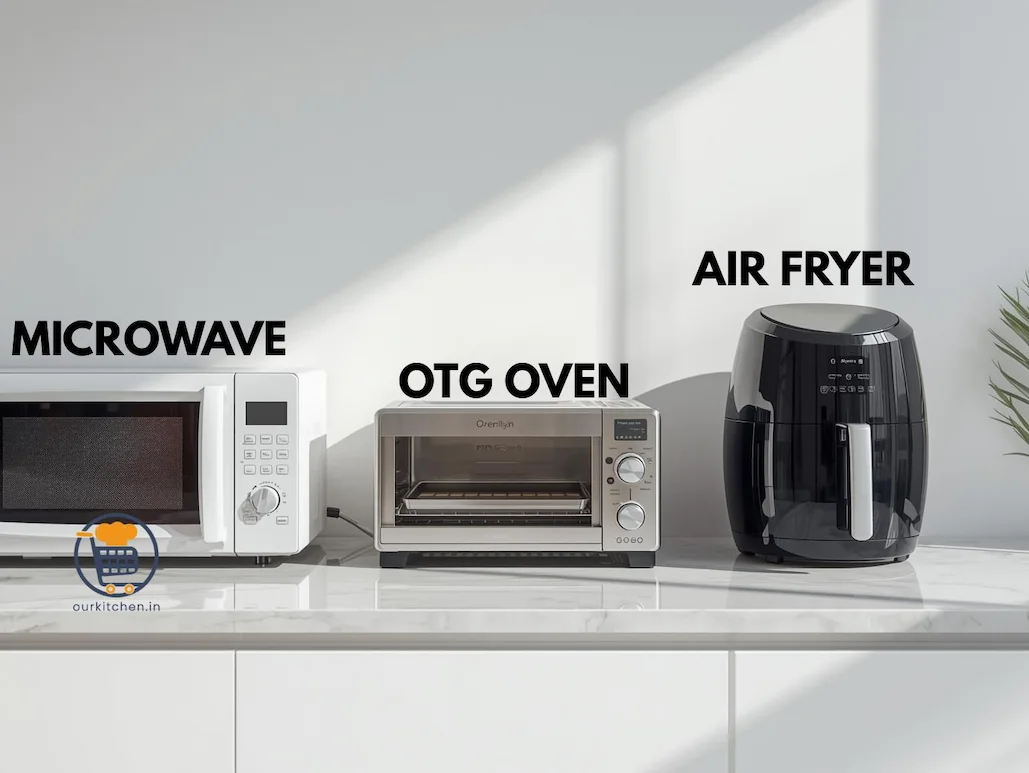
Walk into an electronics store, and they all look like ‘boxes that heat food.’ But to truly understand the advantages and disadvantages of an air fryer versus an OTG or Microwave, you need to look at the physics.
The difference isn’t just the price, it is the heating mechanism. While a microwave vibrates water molecules and an OTG mimics a coal tandoor, an air fryer acts like a high-speed wind tunnel. Here is the definitive breakdown to help you choose the right tool for your Indian kitchen.
| Feature | Air Fryer (The Specialist) | Microwave (The Reheater) | OTG (The Baker) |
| Heating Physics | High-Velocity Rapid Air Technology (High-Velocity Fan) creates a “tornado” of hot air. | Dielectric Heating: Electromagnetic waves vibrate water molecules inside the food. | Radiant Conduction: Stationary heating rods radiate heat (like a tandoor). |
| Cooking Speed | Fastest: Preheats in 3 mins. Cooks 50% faster than an OTG. | Ultra-Fast: Instant heating (seconds/minutes). | Slow: Needs 15-20 mins preheat + long cooking time. |
| Crispy Factor | High: Restores the “fried” crunch without drying out the core. | Zero: Makes food soggy, chewy, or rubbery. | Medium: Can crisp, but often dries out the food (makes it hard). |
| The “Samosa Test” | Result: Crunchy shell, hot filling. It tastes freshly fried. | Result: Soggy crust, rubbery edges. Unappetizing. | Result: Dry, hard crust. Filling takes too long to heat. |
| Best Used For | Healthy snacks (Tikki, Pakora), roasting veggies, reheating crunch. | Reheating lunch, defrosting, boiling water, and simple cakes. | Professional baking (Cakes, Bread), large batch grilling. |
| Who Should Buy? | Health Seekers: You want crispy snacks with 90% less oil. | Busy Professionals: You just need to warm up food fast. | Bakers: You want to bake perfect cakes and pizzas. |
Air Fryer vs Convection Oven: Which Is Better for Daily Indian Cooking?
| Air fryer vs convection oven: For daily Indian snacks and starters, an air fryer outperforms a convection oven. It preheats in 3 minutes vs 8–12 minutes for a convection oven and produces crispier results due to its smaller, more intense cooking chamber. A convection oven wins for baking and large-batch cooking for 6+ people. |
Your existing table covers OTG and Microwave well. But many Indian buyers are now choosing between a standalone air fryer and a convection microwave oven (like LG, IFB, Samsung models priced ₹10,000–₹18,000). Here is the direct comparison:
| Feature | Air Fryer | Convection Oven (Microwave with Convection) | Winner for Daily Use |
|---|---|---|---|
| Preheat Time | 2–5 minutes | 8–12 minutes | Air Fryer |
| Crispiness for snacks | Excellent – deep-fried texture | Good – slightly softer results | Air Fryer |
| Baking (cakes, bread) | Poor – too small, uneven heat | Excellent | Convection Oven |
| Cooking for 5+ people | Needs 6L+ model; borderline | Good – 28–32L capacity handles large batches | Convection Oven |
| Energy efficiency | Higher (85–90% efficient, fast cook time) | Lower (larger cavity loses heat) | Air Fryer |
| Indian samosa/tikka test | Restores deep-fried crunch perfectly | Crisp but not identical to fried texture | Air Fryer |
| Counter space needed | Compact (35×35cm footprint) | Large (60×45cm typical) | Air Fryer |
| Price range (India) | ₹3,500–₹15,000 | ₹9,000–₹22,000 (convection microwave) | Air Fryer |
| Best suited for | Daily snacks, starters, reheating | Baking, large family meals, multiple dishes | Depends on use case |
Bottom line: if your household primarily uses the appliance for evening snacks, tikkas, and reheating leftovers, the air fryer wins on every metric that matters speed, crispiness, energy, and price. If you bake regularly or cook for more than 5 people, the convection oven’s larger capacity justifies its higher cost. Many households benefit from owning both, since they serve genuinely different purposes.
We have a full dedicated comparison of air fryer vs OTG vs microwave for Indian kitchens if you want the extended breakdown across all three appliance types.
‘If you are choosing between an air fryer and a traditional deep fryer, our air fryer vs deep fryer comparison covers the health, cost, and cooking quality differences in detail.
Who Should Buy an Air Fryer?
Don’t buy an air fryer just for the ‘trend.’ First, ensure it actually adds value to your specific cooking style. If you are confused about which size or model fits your needs, check our Air Fryer Buying Guide for Indian Kitchens. To decide if you really need one, see if you fit into one of these three profiles:
Who Should Buy an Air Fryer? To ensure this appliance doesn’t become an expensive paperweight, map these profiles to your lifestyle:
- The Health-Conscious Foodie
- Profile: You love Samosas and Pakoras but fear the cholesterol and calories.
- Why It Works: It mimics the crunch of fried food while cutting oil by 90%. You can indulge in “cheat meals” without the guilt.
- The Busy Professional
- Profile: You rely on frozen foods (Nuggets, Fries, Sausages) for quick dinners.
- Why It Works:It is a speed demon for processing frozen food. Because of the high-powered hot air circulation in a compact closed environment, it takes only 10 to 15 minutes to cook a batch perfectly. Unlike an oven, you don’t need to guess how long it takes to preheat an air fryer; usually, 3-5 minutes is enough to get that perfect crunch.
- The Small Nuclear Family (3-4 People)
- Profile: You need to cook side dishes like Paneer Tikka or Roasted Potatoes for a small group.
- Why It Works: A standard 4 to 5.5-liter air fryer basket is designed exactly for you. It can comfortably hold 500g to 800g of food, which is the perfect portion size for a small family dinner. If you are looking for models that fit this capacity perfectly, see our curated list of the Top 5 Air Fryers in India.
- First-time buyers unsure which model to pick, our complete air fryer buying guide for Indian kitchens walks you through every specification with Indian market context.
See our curated list of the best air fryers for small families in India.
Who Should NOT Buy an Air Fryer?
For specific Indian use cases, the advantages and disadvantages of an air fryer tilt heavily towards the negative. If you fall into the categories below, it is advised not to buy one, as it will simply become an expensive paperweight on your countertop.
- The “Wet Batter” Lover
- The Profile: You love authentic street-style snacks such as Bajji, Bonda, and Vada, where the batter is liquid and dripping.
- The Reality Check: An air fryer works on high-powered hot air circulation. When you put a wet-battered item inside, the high-speed fan literally blows the batter off the food before it sets. This causes the batter to drip through the basket holes onto the heating element, creating a massive mess and a cleaning nightmare.
- The “Gravy” Cook
- The Profile: As a traditional Indian home cook, your daily menu revolves around main course curries like Sambar, Dal, or Chicken Gravy, rather than dry starters.
- The Reality Check: An air fryer is designed for dry heat cooking, not wet cooking. It cannot boil or stew liquids. If you are looking to replicate the soft textures of a pressure cooker or the slow-cooking of a Handi, this appliance is useless for you.
- The Large Joint Family
- The Profile: You regularly cook for a large group (6 to 8+ people) and hope to serve everyone simultaneously at the dining table.
- The Reality Check: Cooking for a large family in an air fryer is practically impossible. A standard basket is too small. For example, cooking Paneer Tikka for 8 people would require 3 to 4 separate batches. By the time the final batch is ready, the first batch will be cold and soggy. For large families, a standard OTG with multiple racks is a much more practical investment.
Unless you are willing to invest in a Dual-Basket Air Fryer (like the Ninja or Nutricook) that cooks two dishes at once, a standard model will turn you into a full-time kitchen waiter.
Which Air Fryer Capacity Is Right for Your Family Size?
| Capacity for family of five: For a family of 5 in India, the minimum recommended air fryer capacity is 6 litres. A standard 4–5L model has an effective cooking capacity of only 2.5–3L because air frying requires food in a single layer with gaps for airflow. Cooking in multiple batches means the first batch goes cold before the last is ready. |
Capacity is the most misunderstood specification in air fryer marketing. The stated litre volume is not how much food you can cook at once. Air frying requires every piece of food to sit in a single layer with space between pieces, so hot air can circulate around each item. Pile food up and you get steamed, soggy results instead of the crispy texture you bought the machine for.
In practice, a 5L basket cooks approximately 2.5–3L of food effectively. A 4L basket cooks about 2L effectively. Factor this into your buying decision.
| Family Size | Minimum Capacity Needed | Effective Cook Volume | Indian Models to Consider | Price Range |
|---|---|---|---|---|
| 1–2 people | 2–3 litres | 1.2–1.8L per batch | Pigeon 2.5L, iBELL 2.5L, Prestige 2.2L | ₹3,000–₹5,000 |
| 3–4 people | 4–5 litres | 2–3L per batch | Philips HD9252, Agaro Regency 5L, Havells Prolife | ₹5,500–₹10,000 |
| 5 people | 6–7 litres | 3.5–4L per batch | Philips HD9270, Agaro Grand 7L, Kenstar 6.5L | ₹8,000–₹13,000 |
| 6+ people / joint family | Dual basket or 8L+ | Two independent baskets | Ninja DZ-style dual basket, large OTG-style air fryer ovens | ₹12,000–₹22,000 |
The Rule of Thumb for Indian Cooking
In Indian households, we serve everyone at the table simultaneously. We do not serve food in batches. This means for a family of 5, you need a single-batch capacity large enough to plate for 5 people at once which means a 6L minimum, not a 5L model.
The ₹1,500–₹2,000 price difference between a 5L and a 6L model is worth paying to avoid the frustration of the first person eating cold food while you cook the final batch.
For a detailed, tested recommendation across every budget and family size, see our complete guide to the best air fryers in India for 2026. For families of 2–3 specifically, we have a focused review of the best air fryers for small families in India with tested models at each price point.
Which Indian Air Fryer Brand Has the Best Pros and Cons Balance?
| Best Indian air fryer brand: Among Indian market brands, Philips offers the best pros/cons balance superior build quality, BIS-certified components, and the best Rapid Air cooking performance, at a premium price (₹8,000–₹12,000). Agaro offers the best value-for-money balance in the ₹5,000–₹7,000 range. Pigeon is the most affordable entry point but has the shortest basket coating lifespan under Indian cleaning conditions. |
Not all air fryers are equal, and the pros and cons of this appliance vary significantly by brand. Here is an honest assessment of the most common Indian market brands, based on their actual performance, not manufacturer claims.
| Brand | Best Advantage | Biggest Disadvantage | Common User Issues | Verdict |
|---|---|---|---|---|
| Philips (HD9252/HD9270) | Best build quality; Rapid Air Technology genuinely superior; BIS-certified | Most expensive (₹8,000–₹12,000) | Occasional touch panel issues on older models; higher replacement basket cost | Best overall, buy this if daily use |
| Agaro (Regency/Grand) | Best capacity-per-rupee; solid build for mid-range; 5–7L options available | After-sales service inconsistent; no FSSAI coating documentation published | Fan noise slightly higher than Philips; basket coating lasts 18–24 months with proper care | Best value recommended for budget-conscious buyers who need 5L+ |
| Pigeon (Healthifry Digital) | Cheapest digital air fryer in India; widely available nationwide | Basket coating peels fastest (12–18 months); PCB quality concerns at voltage spikes | Basket warping after 6 months of daily use; inconsistent temperature calibration | Entry level only not recommended for daily heavy use |
| Havells (Prolife/Digicook) | Best nationwide service network; strong brand warranty support | Mid-tier cooking performance; bulkier design than competitors | Slightly louder fan; control panel less intuitive than Philips | Best choice for Tier-2/3 cities where service matters more than peak performance |
| Kenstar (Aster/Supreme) | Budget-friendly; adequate for occasional use | Not built for daily heavy cooking; inconsistent basket quality batch-to-batch | Shorter motor lifespan under daily heavy use; limited spare parts availability | Occasional use only 2–3 times per week maximum |
| Bajaj Digital | Pan-India service centres; trusted brand name in Indian households | Older heating technology; bulkiest form factor in class | Heating element takes longer to reach set temperature vs competitors | Good backup choice in cities where Philips/Agaro are unavailable |
We have written detailed individual reviews for the major brands. Before buying, read the full analysis for whichever model you are considering:
- Read our full Philips air fryer review for Indian kitchens
- Read our full Agaro Regency air fryer review
- Read our full Havells air fryer review for India
- Read our full Kenstar air fryer review for India
If budget is your primary constraint, see our curated lists of the best air fryers under ₹3,000 in India and the best air fryers under ₹5,000 in India both updated for 2026 with tested models.
Precautions and Best Practices for Safe & Efficient Air Fryer Use
The good news is that 90% of these issues from peeling Teflon to fire risks are completely preventable with the right habits. Follow these 5 Golden Rules to keep your air fryer safe. For a complete walkthrough on mastering your machine, read our guide on Using an Air Fryer: Easy Steps for Perfect Result.
Voltage Safety (Solving PCB Burnout)
Most air fryers draw 1500W to 1700W of power. This means they require a 16 Amp “Power Plug” (the large socket used for ACs/Geysers). Do not plug them into a standard 6 Amp phone charger socket or extension cord, or you risk melting the switchboard.
- Rule: The “Unplug Protocol”. Never leave a digital air fryer plugged into a socket when not in use. For high-end models, consider using a dedicated 16A socket or a voltage stabilizer (similar to what you use for a refrigerator).
- Why: A digital air fryer’s PCB remains electrically engaged with the power point even if the device is turned off. In India, voltage fluctuation during summer days is common. A sudden surge can fry the motherboard, and replacing it costs almost as much as buying a new machine.
For step-by-step instructions on first use, see our beginner’s guide to using an air fryer with easy steps for perfect results
Hygiene Maintenance (Solving “The Toxic Ceiling”)
- Rule: The Monthly Deep Clean. Once a month, unplug the unit, let it cool completely, turn it upside down, and gently clean the upper portion near the heating element with a soft brush or damp cloth. Do not use harsh chemicals or dripping wet sponges.
- Why: Grease is sucked upward by the fan and coats the heating element over time. If left uncleaned, this grease undergoes Polymerization, turning into a hard, sticky varnish that causes smoke, bad odors, and reduced thermal efficiency.
Fire Safety (Solving “Flying Food”)
- Rule: Cage the Lightweights. If your recipe includes lightweight foods such as cheese slices or papad, they must be mechanically weighted down using a silicone mesh, a steel Jaali, or a steel rack.
- Why: The high-velocity updraft acts like a wind tunnel. It sucks lightweight food into the upper heating chamber, where it sticks to the coil, causing immediate charring, acrid smoke, and potentially a small fire.
Moisture getting into controls during cleaning is also the main cause of air fryer touch screen not working.
Odor Control (Solving ‘Plastic Seasoning’)
- Rule: The “Burn-Off” Cycle. Before cooking your very first meal, run the new machine empty at 200°C for 20 minutes in a well-ventilated area.
- Why: Brand new air fryers imported from factories often retain protective oils and manufacturing residues on the heating coil. Running this cycle eliminates volatile organic compounds (VOCs) and chemical smells, ensuring they are not absorbed by your first batch of food.
Coating Care (Solving ‘Teflon Peeling’)
- Rule: The “Sponge-Only” Policy. Strictly avoid green abrasive scrubbers, steel wool, and metal spoons. Use only soft sponges and silicone or wooden utensils.
- Why: The non-stick PTFE (Teflon) coating is chemically sensitive to mechanical abrasion. A single deep scratch compromises the layer, which leads to rapid peeling and allows coating flakes to migrate into your food.
If your basket has become stuck and you are forcing it, stop and read our guide on how to fix an air fryer basket stuck problem forcing it is how the coating cracks
Disadvantages of Air Fryers in Small Indian Kitchens
| Small kitchen drawbacks: In a small Indian kitchen (50–80 sq ft), an air fryer’s main drawbacks are: a 35×35cm counter footprint that is hard to spare, exhaust heat and grease vapour that settles on nearby surfaces without ventilation, and 65dB noise amplified in an enclosed hard-surfaced space. Minimum 15cm clearance on all sides is required. |
Most Indian urban kitchens particularly in Mumbai, Chennai, Bengaluru, and Delhi are compact. A typical flat kitchen is 50–80 sq ft, with a gas stove, mixer-grinder, water purifier, and often a microwave already competing for counter space. Before buying an air fryer, here is what you need to know about using one in a small kitchen.
Counter Space: The 35×35cm Problem
A standard 4–5L air fryer occupies approximately 35cm × 35cm of counter space and stands 35–40cm tall. It cannot be tucked into a corner like a mixer-grinder, it needs 15cm clearance on all sides for safe operation and proper air circulation. Without this clearance, the appliance overheats and the motor degrades faster.
In a small kitchen, this usually means permanently giving up one-third of your usable counter space. Some buyers solve this by placing the air fryer on a separate small trolley or shelf unit at counter height a practical option if wall space is available.
Exhaust Heat and Grease Vapour
Air fryers exhaust hot, slightly greasy air through a rear vent during operation. In a well-ventilated large kitchen, this dissipates quickly. In a compact enclosed kitchen without a window or chimney directly above, this warm greasy air settles on nearby cabinets, tiles, and appliances. Over weeks of daily use, you will notice a thin greasy film forming on surfaces within 60–80cm of the vent.
The fix: position the air fryer near a window or under a kitchen chimney, and wipe the surrounding surfaces weekly. If you do not have a chimney, our guide on
which kitchen chimney works best with an air fryer in India covers the ventilation options in detail.
Noise Amplification in Enclosed Kitchens
As covered in the disadvantages section, air fryers operate at approximately 65dB. In a large open kitchen, this is background noise. In a small, hard-surfaced kitchen tiles, granite counters, concrete walls sound reflects and amplifies. The same appliance can feel noticeably louder in a compact kitchen than in an open-plan layout.
This is not a reason to avoid buying one, but it is worth knowing if you cook in the early morning, live in a studio apartment, or have a sleeping baby nearby.
The Counter Space Trade-Off Worth Making
One important counterpoint: an air fryer can replace multiple appliances. If you currently have a separate toaster, a countertop grill, and a small convection oven, replacing all three with a single air fryer can actually free up net counter space. Do that maths for your specific kitchen before dismissing it on footprint alone.
If counter space is genuinely a constraint, consider a compact small air fryer designed for Indian kitchens the 2–2.5L models have a significantly smaller footprint and suit 1–2 person households perfectly.
FAQs: Clarifying the Advantages and Disadvantages of Air Fryer
1. Is there a “cancer warning” associated with air fryers?
No, the appliance itself doesn’t cause cancer. The confusion comes from a chemical called Acrylamide, which forms when starchy foods (like potatoes) are burned at extremely high heat. In reality, air fryers reduce Acrylamide formation by 90% compared to deep frying because they remove the need for reheating dangerous oils. To be safe, simply avoid charring your food to a dark black color.
2. Why do some people say air fryers are bad for heart health?
This is a common myth. Critics argue that high-heat cooking oxidizes cholesterol. However, compared to deep-frying, where food soaks up oxidized, thermally abused oil, an air fryer is significantly better for heart health. It reduces total fat intake by 80% and prevents the formation of trans fats, making it a much safer choice for managing cholesterol.
3. Do I really need an air fryer if I already have an OTG (Oven)?
Yes, if you value speed. An OTG is great for baking cakes, but it typically takes 15 minutes just to preheat. Many users ask, is preheating necessary in an air fryer? The short answer is yes, but it is ready in just 3 minutes. If you want crispy snacks on a Tuesday evening, an air fryer will do it in 10 minutes, whereas an OTG will take 30.
4. Will an air fryer significantly increase my electricity bill?
Surprisingly, no. While they have high wattage (1400W), they cook extremely fast. A batch of chicken cooks in just 15 minutes, meaning the unit consumption is minimal. For most Indian households, the electricity cost of using an air fryer daily is actually lower than the cost of the LPG gas required to deep-fry the same snacks.
5. Is an air fryer safe for daily use?
Yes, it is safe and healthy for daily cooking. Unlike microwaves, which use radiation, air fryers use simple thermal convection (heat + wind). The only safety precaution is ensuring you clean the basket regularly to prevent grease buildup and avoid using “flying” ingredients like cheese slices that can touch the heating element.
6. Can I cook traditional Indian snacks like Pakoras and Bajji?
Yes, but with a strict condition. You can make excellent Onion Pakoras because the thick batter wraps tightly around the onion. However, you cannot make dripping wet recipes like Molaga Bajji or Bonda. The liquid batter will simply blow off the food and drip through the mesh, burning the heating coil. The air fryer requires “coated” food, not “dripping” food.
7. Considering the advantages and disadvantages of an air fryer, is it a waste of money for Indian cooking?
It depends on your diet. If your family primarily eats wet gravies like Sambar, Dal, and Rice, an air fryer is a waste of money because it cannot boil liquids. However, if your family loves fried snacks, roasted veggies, or non-veg starters (Chicken Tikka/Fish Fry), it is the best investment you can make, typically paying for itself in saved oil costs within a year.
8. What is the ideal size for an Indian family of 4?
Do not buy anything smaller than 4.5 Liters. Indian cooking involves serving the whole family at once. A small 2L or 3L basket will force you to cook in 4 different batches, meaning the first person eats cold food while the last person waits. A 4.5L+ basket is essential to fit 4 servings of Tandoori Chicken or Paneer Tikka in a single go.
9. Is the non-stick coating dangerous (Teflon)?
It is safe as long as you treat it gently. The PTFE coating is food-safe up to 260°C. However, as discussed in our “Disadvantages” section, it becomes risky if you scrub it with steel wool. Once the coating flakes, it can contaminate food. To ensure safety, always use a soft sponge and consider using a silicone liner to minimize wear and tear.
10. Can I reheat leftovers (Pizza/Samosas) in it?
Yes, it is the best reheating tool available. Unlike a microwave, which makes bread and crusts soggy and rubbery, an air fryer restores the original crunch. Reheating a Samosa or yesterday’s Pizza for 3 minutes at 180°C makes it taste freshly fried.
11. What are the side effects of an air fryer?
The main side effects to be aware of: PFAS exposure from a peeling PTFE basket coating (avoid by using a soft sponge, never abrasive scrubbers); VOC off-gassing from a new air fryer if you cook without running an empty 20-minute burn-off cycle first; acrylamide formation if you consistently char starchy foods to dark brown or black; and PCB damage from Indian voltage fluctuations if used without a stabiliser. All four are preventable. The appliance itself has no side effects under proper use.
12. Can I eat air fryer food every day? Is it safe for daily use?
Yes, daily air fryer use is safe under two conditions: the basket coating is intact (not peeling or heavily scratched) and you avoid consistently charring food. Air-fried food is healthier than deep-fried food on every measurable nutritional metric. WHO, ICMR, and FSSAI have issued no advisory against air fryers as a daily cooking method. The base food matters too, daily air-fried snacks should be balanced with vegetables and whole grains, but the cooking method itself is not a concern.
13. Are air fryers toxic? Is the non-stick coating dangerous?
Under normal use, no. Air fryers are not toxic. The PTFE (Teflon) non-stick coating is food-safe below 260°C, and air fryers operate at 160–200°C. The risk arises only when the coating is scratched, peeled, or the appliance accidentally overheats, all preventable. PFAS (the chemical family PTFE belongs to) is a concern at chronic high exposure; using an intact basket with a soft sponge makes this a negligible daily risk. For extra safety, buy a model with a ceramic-coated or stainless steel basket, which contains no PTFE at all.
14. Is an air fryer better than a convection oven for Indian daily cooking?
For daily snacks and starters (samosas, tikkas, cutlets, papad), yes an air fryer is better. It preheats in 3 minutes vs 8–12 minutes for a convection oven, produces crispier results, and uses less electricity per session. A convection oven wins for baking and cooking for 6+ people simultaneously. If your household mainly uses the appliance for snacks and reheating, the air fryer is the right choice. If you bake regularly or have a large family, the convection oven’s larger capacity justifies the higher cost. See our detailed air fryer vs OTG vs microwave comparison for India for the full breakdown.
Conclusion: Final Verdict on the Advantages and Disadvantages of Air Fryer
The verdict is clear: An air fryer is a Nutrition-Retention Engine. It passes the “Samosa Test” where microwaves fail, giving you the crunch without the carcinogenic risks of deep-frying. But let’s be practical, it is not a rugged Kadhai. If you scrub the Teflon with steel wool or ignore voltage fluctuations, this machine becomes expensive e-waste.
Pro Tip: The “20°C / 20% Rule”Don’t cook blindly. If a packet says 200°C, set your fryer to 180°Cand reduce the time by 20%. Understanding what temperature to preheat air fryer is crucial because 180°C is the “Goldilocks” zone, hot enough to crisp, but safe enough to prevent burning.
our complete air fryer buying guide for Indian kitchens will help you choose the right model for your budget and family size.’
‘For full pricing from ₹2,500 to ₹15,000, see our air fryer price in India 2026 guide.’
‘If you are still concerned about safety, our dedicated guide on are air fryers safe, complete India analysis covers every concern with cited evidence.’
‘For the cancer risk science specifically, read our air fryer cancer risk and acrylamide analysis for Indian kitchens.’
‘And if you need to locate a repair centre, our air fryer service centre directory for India covers all major brands across cities.
About the Author
Prathap is the founder of ourkitchen.in and a B.Tech graduate in Agricultural Engineering, a discipline built on thermodynamics, heat transfer, fluid dynamics, and materials science. These are the exact engineering principles that govern how a kitchen appliance heats, circulates air, and degrades over time.
Rather than relying on manufacturer specifications or sponsored product samples, Prathap evaluates air fryers the way an engineer would: measuring actual power draw against rated wattage, testing basket airflow geometry, simulating Indian cleaning habits to assess coating durability, and cross-checking brand safety claims against BIS and FSSAI standards.
He has personally tested models from Philips, Pigeon, Agaro, Kenstar, Havells, and Bajaj across real Indian cooking conditions voltage fluctuations, humid climates, Indian spices and oils, and Indian family cooking patterns.
His mission with ourkitchen.in is direct: give Indian buyers honest, data-backed guidance on kitchen appliances, adapted for the specific realities of Indian kitchens not recycled Western reviews converted from dollars to rupees.
He has written over 37 articles on air fryers for the Indian market. For this article, his analysis specifically covered PTFE coating durability under Indian cleaning conditions, health risks in the Indian dietary context, and the engineering reasons why certain Indian cuisines work (or don’t work) in an air fryer.

Prathap is the founder of ourkitchen.in and a B.Tech graduate in Agricultural Engineering from Tamil Nadu. His engineering background in thermodynamics, heat transfer, and food processing science gives him a fundamentally different approach to kitchen appliance reviews compared to typical lifestyle bloggers.
Rather than relying on manufacturer claims, Prathap measures actual power draw against rated wattage, evaluates basket airflow geometry, and stress-tests non-stick coatings over 90-plus cook cycles before recommending any product. He cross-checks every safety claim against BIS and FSSAI standards, and all pricing against live Amazon India and Flipkart listings.
He has written over 61 deep-dive articles on air fryers for the Indian market, personally testing models from Philips, Pigeon, Agaro, Kenstar, Havells, and Bajaj. His reviews are built around Indian realities: 220V power grids, high-humidity coastal kitchens, Indian cooking temperatures, and the price-performance expectations of Indian households.
Based in Chennai, Tamil Nadu.